


Synonym name: Hyoscyamine; Daturine; Duboisine
Catalogue No.: BP0749
Cas No.: 101-31-5
Formula: C17H23NO3
Mol Weight: 289.375
Botanical Source: Alkaloid from Atropa, Datura, Duboisia, Hyoscyamus, Anthocercis and Scopolia spp. , Mandragora officinarum and several other genera in the Solanaceae, esp. some strains of Duboisia myoporoides
Purity: 95%~99%
Analysis Method: HPLC-DAD or/and HPLC-ELSD
Identification Method: Mass, NMR
Packing: Brown vial or HDPE plastic bottle
Can be supplied from milligrams to grams.
For Reference Standard and R&D, Not for Human Use Directly.
Inquire for bulk scale.
HPLC of Hyoscyamine
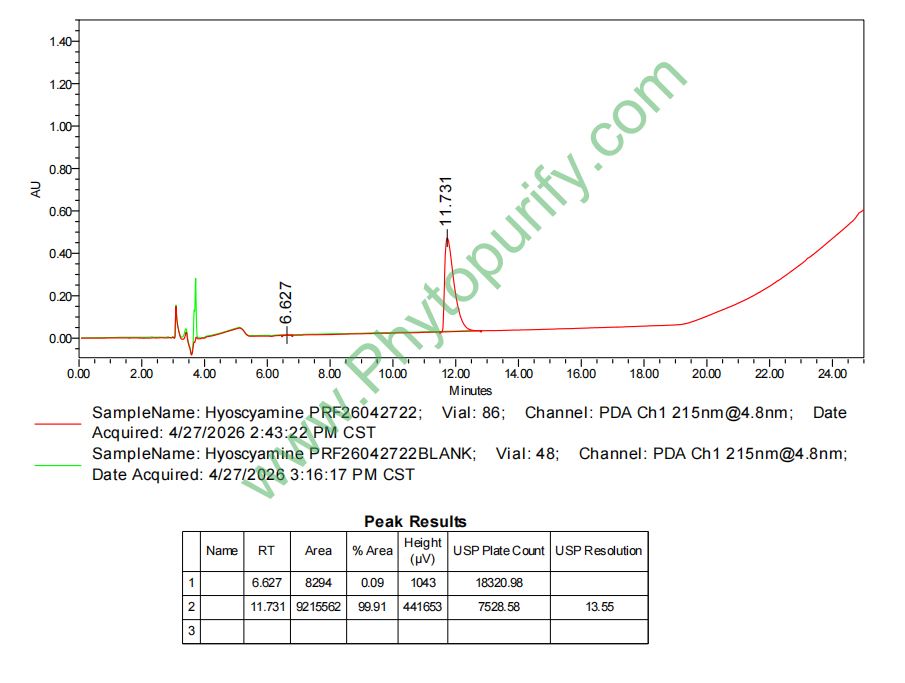
Storage conditions:Short-term storage at 2~8℃, long-term storage at -20 ~ -80℃
Hyoscyamine, as an important natural alkaloid, is widely present in plants of the Solanaceae family, especially in plants of the Hyoscyamus, Atropa, and Datura genera. Its chemical properties and biological activity give it an important position in the field of pharmacology. Scopolamine, with its significant anticholinergic effects and central nervous system regulatory functions, has been widely studied for the treatment of various diseases, especially showing unique advantages in pain relief, anti spasms, and management of gastrointestinal diseases. In recent years, with the development of molecular pharmacology technology, significant progress has been made in the study of the mechanism of action and targets of scopolamine, revealing its complex pharmacological network of multiple targets and pathways.
This article aims to systematically review the chemical structure, plant sources, and extraction methods of hyoscyamine, and provide a detailed evaluation of its pharmacological activity and mechanism of action. Combining the pharmacological parameters and pharmacokinetic characteristics, it explores its clinical application prospects and future research directions, providing comprehensive academic references for researchers in the field of natural product pharmacology.
Scopolamine (CAS number: 101-31-5) is a chiral alkaloid with a molecular formula of C17H23NO3 and a molecular weight of 289.3750. The core of its chemical structure is the hyoscyamine skeleton, which has a (S) - configuration and is often described as the conjugated base form of (S) - atropine. The structural features of this compound include an ester linked benzene ring and a nitrogen-containing heterocyclic ring, endowing it with good lipophilicity and biological activity.
In terms of physical and chemical properties, the LogP value of hyoscyamine is 1.7583, indicating its moderate lipophilicity, which is conducive to passing through cell membranes and the blood-brain barrier (BBB). Its TPSA (topological polar surface area) is 49.77 Å ², further supporting its good membrane permeability. The water solubility is 6.4341, indicating that its solubility in the aqueous phase is moderate and convenient for formulation development. Importantly, scopolamine does not exhibit hERG channel inhibitory activity, indicating a low risk of cardiac toxicity, and the Ames test result is 0.0, showing no significant mutagenicity and high safety.
Scopolamine is mainly found in plants of the Solanaceae family, especially in the leaves, roots, and seeds of plants such as Atropa belladonna, Hyoscyamus niger, and Datura stramonium. The content of hyoscyamine in plants is greatly affected by growth environment, harvesting time, and plant parts.
Traditional extraction methods often use acidic aqueous solution extraction combined with organic solvent extraction. The specific process includes:
Modern extraction techniques have gradually introduced ultrasound assisted extraction, microwave-assisted extraction, and high-performance liquid chromatography (HPLC) separation, significantly improving extraction efficiency and purity, reducing solvent usage, and conforming to the concept of green chemistry.
The pharmacological activity of scopolamine mainly manifests in its potent anticholinergic effect and regulatory ability on the central nervous system. Its main pharmacological effects include:
Scopolamine competitively blocks M-type acetylcholine receptors, inhibiting the excitatory response of the parasympathetic nervous system, leading to smooth muscle relaxation, decreased glandular secretion, and increased heart rate. This effect makes it clinically valuable in the treatment of gastrointestinal spasms, overactive bladder, and certain arrhythmias.
The research on scopolamine in the field of analgesia is increasing, involving multiple molecular targets, including TRPV1, TRPA1, CNR1 (cannabinoid receptor 1), OPRD1 (delta opioid receptor), OPRM1 (μ - opioid receptor), OPRK1 (kappa opioid receptor), and DRD2 (dopamine D2 receptor). By regulating these targets, scopolamine can affect pain transmission and perception, exerting analgesic effects.
Scopolamine has a regulatory effect on prostaglandin synthase PTGS1 (COX-1) and PTGS2 (COX-2), participates in the regulation of inflammatory response, and reduces tissue inflammation and pain.
The effects of scopolamine on the central nervous system involve regulating the serotonin transporter SLC6A4, affecting the reuptake of neurotransmitters, and may have an impact on mood and cognitive function.
In summary, the multi-target pharmacological properties of hyoscyamine demonstrate broad potential for its application in pain relief, anti-inflammatory, and treatment of neurological diseases.
The mechanism of action of scopolamine is complex, involving multiple signaling pathways and multiple receptor targets. The specific mechanism is as follows:
As a classic anticholinergic drug, scopolamine competitively inhibits the M1-M5 subtype of acetylcholine receptors, blocks parasympathetic mediated physiological responses, and alleviates smooth muscle spasms and excessive secretion.
Scopolamine can regulate TRPV1 and TRPA1 channels, two transient receptor potential channels that play a key role in pain and inflammation perception. Scopolamine reduces the transmission of pain signals by inhibiting the activation of these channels.
Scopolamine interacts with three opioid receptors (OPRM1, OPRD1, OPRK1): μ, δ, and κ, enhancing the activity of the endogenous analgesic system and exerting analgesic and anti anxiety effects.
The regulatory effect of scopolamine on CNR1 helps to regulate neuroinflammation and pain transmission, and participates in neuroprotective and analgesic mechanisms.
By regulating PTGS1 and PTGS2, scopolamine affects the synthesis of prostaglandins, reducing inflammation and related pain.
The effect of scopolamine on SLC6A4, regulating serotonin reuptake, may improve neurological function, alleviate anxiety and depression related symptoms.
The regulatory effect of scopolamine on DRD2 receptors may affect motor control and mental state, suggesting its potential application value in neurological and psychiatric disorders.
In summary, scopolamine regulates the nervous system and inflammatory response through multi-target synergistic effects, forming its unique pharmacological effects.
The pharmacological parameters of hyoscyamine show that it has good potential for drug development:
In terms of pharmacokinetics, scopolamine is rapidly absorbed after oral administration and has a high bioavailability. It is mainly metabolized by the liver in the body, and the metabolites are excreted by the kidneys. Moderate half-life, supports multiple administrations to maintain blood drug concentration. The high blood-brain barrier permeability of scopolamine gives it an advantage in the treatment of central nervous system diseases, but its potential central side effects also need to be considered.
Scopolamine, as a traditional anticholinergic drug, has been used for many years in fields such as gastrointestinal spasms, bladder spasms, motion sickness, and Parkinson's disease. With a deeper understanding of its multi-target mechanism of action, scopolamine has shown new clinical application potential in the following areas:
Based on its regulation of multiple targets such as TRPV1 and opioid receptors, scopolamine is expected to become a novel therapeutic drug for chronic pain, neuropathic pain, and inflammatory pain. The combination therapy strategy is also worth further exploration to enhance analgesic effects and reduce side effects.
The regulation of serotonin transporters and dopamine receptors by scopolamine suggests that it may play an adjuvant therapeutic role in diseases such as depression, anxiety, and schizophrenia. In the future, its targeting and safety can be improved through structural modification and formulation optimization.
By regulating COX enzymes and inflammatory mediators, scopolamine has the potential to be used as an adjuvant therapy for inflammatory diseases, especially neuroinflammatory related diseases.
Considering the central role and risk of side effects of scopolamine, developing more targeted and controllable drug delivery systems (such as nanocarriers and sustained-release formulations) will be a future research focus.
Chemical modification of scopolamine molecules to optimize their pharmacological and pharmacokinetic properties, reduce side effects, and improve selectivity is an important direction for promoting their clinical application.
Overall, scopolamine has broad application prospects in the fields of analgesia and treatment of neurological diseases in the future due to its unique pharmacological properties and good drug properties.
As a classic and important natural alkaloid, hyoscyamine occupies an important position in the field of natural product pharmacology. Its complex chemical structure, multi-target pharmacological effects, and good drug properties make it not only effective in traditional anticholinergic therapy, but also demonstrate new application potential in pain relief, neural regulation, and inflammation control. In the future, by combining modern medicinal chemistry, molecular biology, and drug delivery technologies, research on scopolamine and its derivatives will be further deepened, promoting their clinical translation and new drug development, and providing more innovative solutions for the treatment of related diseases. As an important source of drug discovery, natural products have provided valuable experience and theoretical basis for the development of similar natural products through the study of scopolamine.
