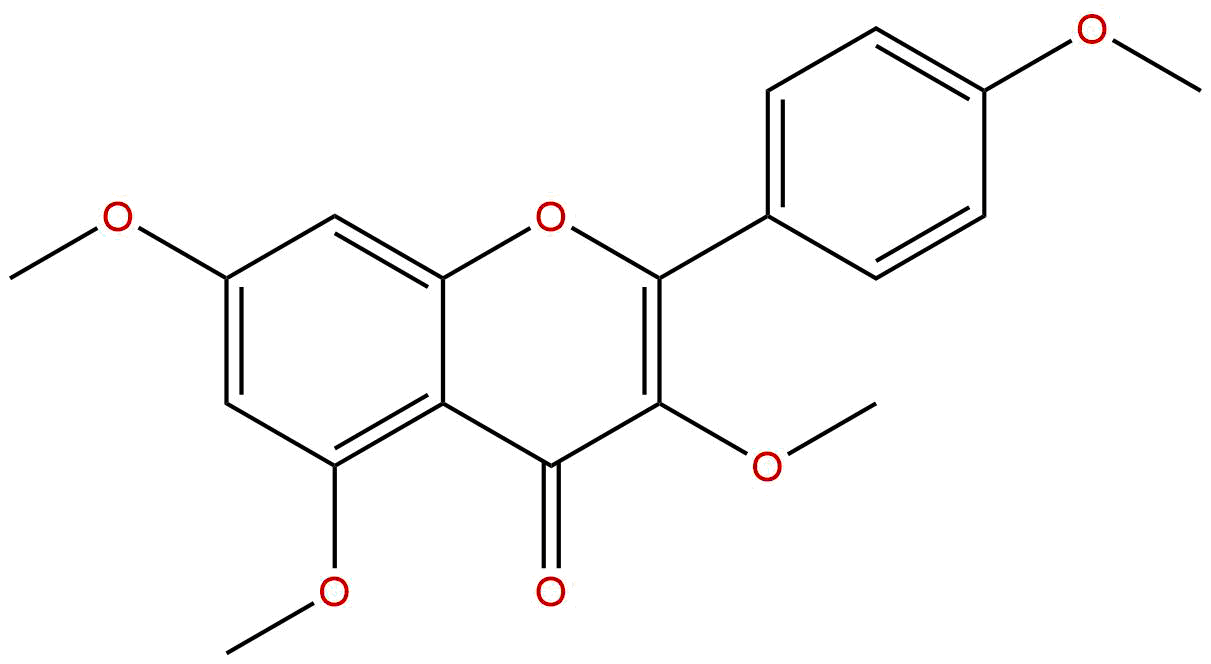


Product name: Tetramethylkaempferol
Synonym name: Tetramethoxyflavone
Catalogue No.: BP4650
Cas No.: 16692-52-7
Formula: C19H18O6
Mol Weight: 342.347
Botanical Source:
Type of Compound: Flavonoids
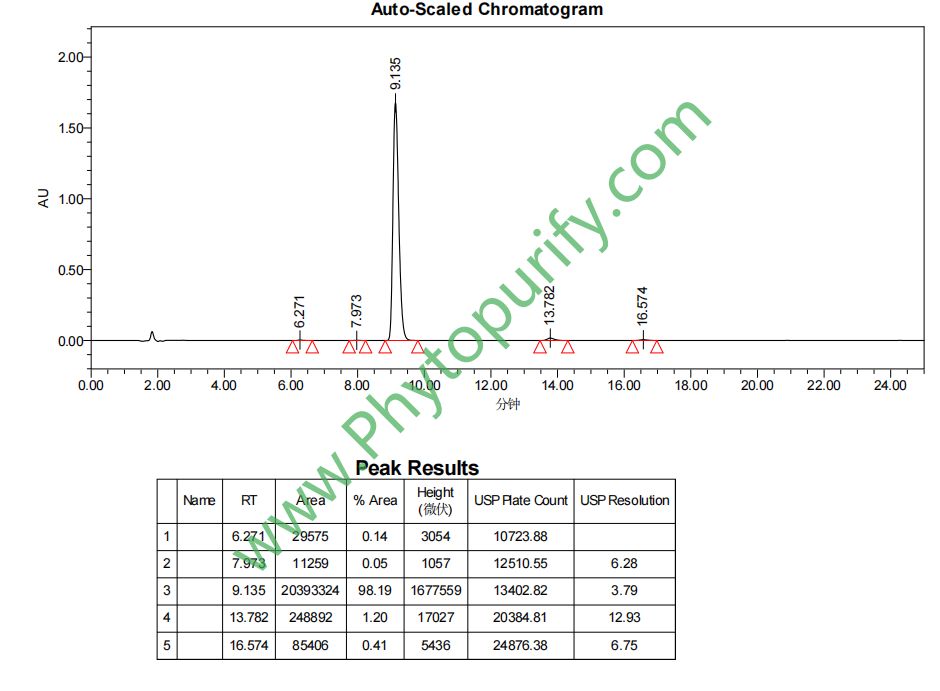
Purity: 95%~99%
Analysis Method: HPLC-DAD or/and HPLC-ELSD
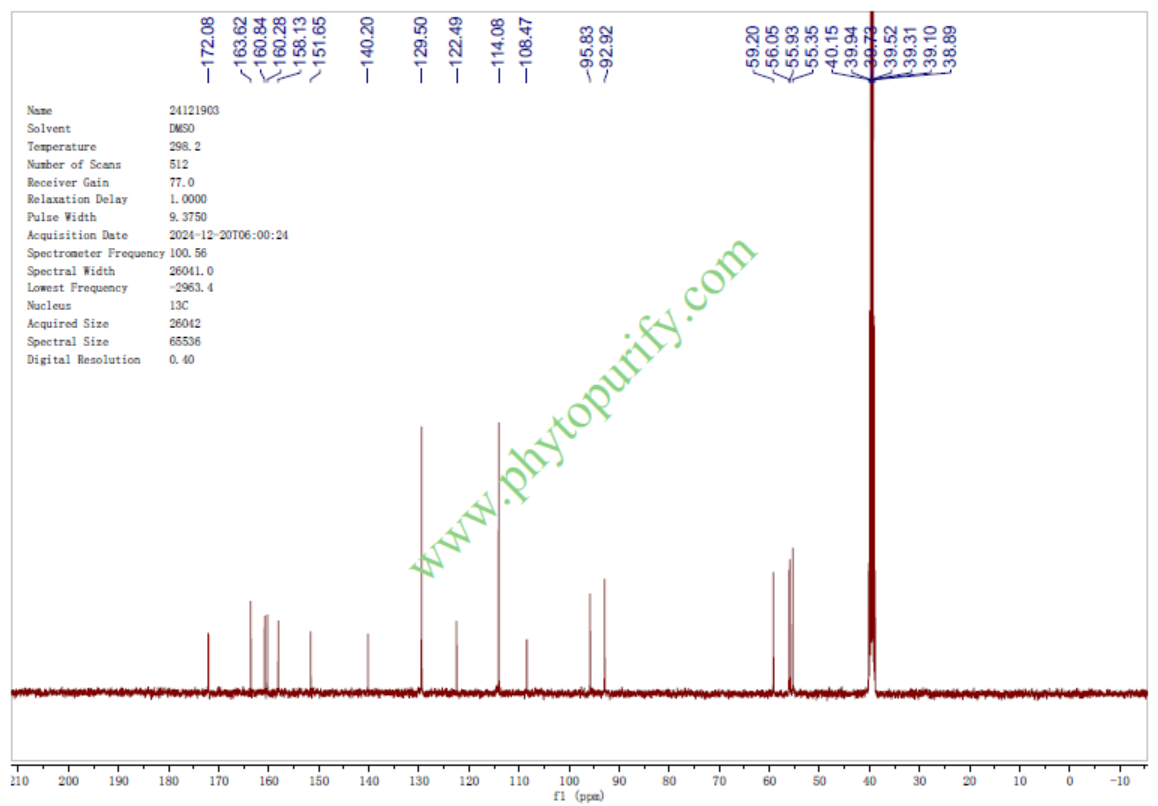
Identification Method: Mass, NMR
Packing: Brown vial or HDPE plastic bottle
Storage: Store in a well closed container, protected from air and light. Put into refrigerate or freeze for long term storage.
Whenever possible, you should prepare and use solutions on the same day. However, if you need to make up stock solutions in advance, we recommend that you store the solution as aliquots in tightly sealed vials at -20℃. Generally, these will be useable for up to two weeks.
The product could be supplied from milligrams to grams
Inquire for bulk scale.
For Reference Standard and R&D, Not for Human Use Directly.
HPLC of Tetramethylkaempferol
NMR of Tetramethylkaempferol
Storage conditions:Short-term storage at 2~8℃, long-term storage at -20 ~ -80℃
Tetramethylkaempferol (CAS number: 16692-52-7), as a natural flavonoid compound, has received widespread attention in recent years due to its unique biological activity. Flavonoids are commonly found in various plants and have diverse pharmacological effects, such as antioxidant, anti-inflammatory, antibacterial, and anti-tumor effects. As a methylated derivative of kaempferol, tetramethylkaempferol exhibits excellent antifungal activity, especially against Candida albicans, showing significant inhibitory effects with an IC50 value of 17.63 µ g/mL. In addition, its potential role in the field of antioxidant has also attracted high attention in the pharmacology community, with related targets covering various key enzymes and transcription factors, such as NFE2L2 (NRF2), SOD1, CAT, etc. This article aims to systematically review the chemical structure, sources, pharmacological activity, mechanism of action, and pharmacological evaluation of tetramethylkaempferol, and explore its potential and development prospects in clinical applications.
Tetramethylkaempferol belongs to the flavonoid class, with a molecular formula of C18H18O7 and a molecular weight of 342.3470. Its structure is based on the kaempferol skeleton, which is modified by four methyl substitutions, significantly affecting its physicochemical properties and biological activity. The LogP value of this compound is 3.0279, indicating that it has moderate lipid solubility, which is beneficial for membrane penetration and in vivo distribution. The polar surface area (TPSA) is 67.13 Å ², indicating that it has certain polar groups that contribute to solubility in the aqueous phase and binding to the target. Low water solubility (0.0048 mg/mL) suggests limited solubility in aqueous phase, which may affect oral bioavailability. It is worth noting that tetramethylkaempferol has a high blood-brain barrier penetration ability, indicating its potential application value in central nervous system diseases. The negative result of hERG channel inhibition experiment indicates a low risk of cardiac toxicity. The Ames mutagenicity test score is 0.9, indicating a low risk of genotoxicity and good safety.
Tetramethyl kaempferol is mainly found in various traditional medicinal plants, especially in plants rich in kaempferol flavonoids. Common sources include certain leguminous plants, Asteraceae plants, and some woody plants. Its content is greatly affected by plant species, growth environment, and harvesting period. The extraction method often uses organic solvent extraction combined with column chromatography separation technology. Common extraction solvents include methanol, ethanol, and ethyl acetate, which can effectively extract flavonoids. The extraction process usually includes crushing plant materials, solvent extraction, concentration, liquid-liquid distribution, and purification by silica gel column chromatography. In recent years, emerging technologies such as ultrasound assisted extraction and microwave-assisted extraction have been applied to improve extraction efficiency and purity. In addition, high-performance liquid chromatography (HPLC) and mass spectrometry (LC-MS) are widely used for qualitative and quantitative analysis of tetramethylkaempferol.
One of the most significant pharmacological activities of tetramethylkaempferol is its inhibitory effect on fungi, especially Candida albicans. In vitro experiments showed that its IC50 for Candida albicans was 17.63 µ g/mL, indicating its strong antifungal activity. This activity makes it a potential candidate molecule for antifungal drug development. Compared with traditional antifungal drugs, tetramethylkaempferol may exert its effects through different mechanisms, which is expected to overcome the resistance problem of existing drugs.
Tetramethylkaempferol exerts protective effects by regulating various antioxidant related targets. Its target proteins include tyrosinase (TYR), matrix metalloproteinases (MMP1, MMP3), nuclear factor E2 related factor 2 (NFE2L2/NRF2), superoxide dismutase (SOD1, SOD2), catalase (CAT), glutathione peroxidase (GPX1), and heme oxygenase 1 (HMOX1). These targets play a key role in cellular oxidative stress response, and tetramethylkaempferol has potential anti-aging and prevention of oxidative related diseases by activating the NRF2 signaling pathway, promoting antioxidant enzyme expression, reducing oxidative damage, and preventing free radical mediated cell damage.
In addition to antifungal and antioxidant effects, preliminary studies have shown that tetramethylkaempferol may have multiple pharmacological activities such as anti-inflammatory, anti-tumor, and neuroprotective effects. Its high blood-brain barrier permeability provides the possibility for drug development in neurological diseases, but related research is still in its infancy and needs further in-depth exploration.
The antifungal mechanism of tetramethylkaempferol has not been fully elucidated, but it is speculated that its inhibitory effect is achieved by interfering with the structure and function of fungal cell membranes, inhibiting fungal cell wall synthesis, or affecting fungal metabolic pathways. Combined with its flavonoid structure, it may regulate the intracellular oxidative state of fungal cells through redox reactions, inducing cell apoptosis.
In terms of antioxidant activity, tetramethylkaempferol activates the NFE2L2/NRF2 signaling pathway, promotes the expression of downstream antioxidant enzymes such as SOD1, CAT, GPX1, and HMOX1, enhances the ability of cells to clear reactive oxygen species (ROS), and reduces cellular damage caused by oxidative stress. In addition, its regulatory effect on MMP1 and MMP3 helps maintain the stability of the extracellular matrix, prevent tissue damage and inflammatory reactions caused by oxidative stress.
Molecular docking and in vitro experiments have shown that tetramethylkaempferol can form stable binding with various target proteins, regulate their activity, and further support its multi-target and multi pathway pharmacological mode of action.
The pharmacological evaluation of tetramethylkaempferol shows that it has good potential for drug development. The LogP value is 3.0279, which meets the requirements of Lipinski rule for lipid solubility and is beneficial for oral absorption. The TPSA is 67.13 Å ², indicating that it has suitable polarity and balances lipid solubility and water solubility. Low water solubility may limit its oral bioavailability, but it can be overcome through formulation improvements such as nanocarriers, liposomes, and other technologies.
Its high blood-brain barrier permeability provides the possibility for the treatment of central nervous system diseases. The negative results of hERG channel inhibition reduced the risk of cardiac toxicity, and the Ames test results showed that its genetic toxicity risk was low and its safety was good.
At present, there is limited pharmacokinetic data on tetramethylkaempferol, and it is preliminarily speculated that it has good distribution characteristics in vivo. However, the metabolic pathways and excretion mechanisms still need to be systematically studied. In the future, in vivo pharmacokinetic studies need to be conducted to clarify its absorption, distribution, metabolism, and excretion (ADME) characteristics, laying the foundation for clinical applications.
As a natural flavonoid compound, tetramethylkaempferol has shown broad clinical application prospects due to its significant antifungal activity and multi-target antioxidant effects. Its inhibitory effect on Candida albicans provides new ideas for the development of antifungal drugs, especially in the context of increasingly severe antifungal resistance, which has important clinical value.
The antioxidant activity makes it potentially valuable in the prevention and treatment of oxidative stress-related diseases such as cardiovascular disease, neurodegenerative diseases, and inflammatory diseases. The high blood-brain barrier permeability provides the possibility for its application in central nervous system diseases, such as Alzheimer's disease, Parkinson's disease, etc.
Future research should focus on in-depth analysis of its mechanism of action, optimization of extraction and synthesis processes, and improvement of purity and yield; Simultaneously conduct systematic pharmacokinetic and toxicological studies to evaluate their safety and efficacy. Combining modern drug delivery systems to enhance their bioavailability and targeting, and promote their clinical translation.
In addition, based on its multi-target action characteristics, tetramethylkaempferol is expected to serve as a multifunctional drug or combination drug ingredient, exerting synergistic therapeutic effects and expanding its clinical indications.
Tetramethylkaempferol, as a natural flavonoid compound with significant antifungal and antioxidant activities, has shown good medicinal properties and broad clinical application prospects due to its unique chemical structure and multi-target mechanism of action. Although the current research on its pharmacological mechanism and pharmacokinetics is not comprehensive, the existing research results have laid a solid foundation for its development as a new type of antifungal drug and antioxidant therapeutic agent. In the future, we should strengthen basic and applied research, optimize formulation technology, promote its transformation into clinical applications, and contribute new drug resources and treatment strategies to the field of natural product pharmacology.
