


Product name: Oridonin
Synonym name: Isodonol; Rubescensin; Rubescensin A
Catalogue No.: BP1041
Cas No.: 28957-04-2
Formula: C20H28O6
Mol Weight: 364.438
Botanical Source: Rabdosia rubescens
Physical Description:
Type of Compound: Diterpenoids
Purity: 95%~99%
Analysis Method: HPLC-DAD or/and HPLC-ELSD
Identification Method: Mass, NMR
Packing: Brown vial or HDPE plastic bottle
Storage: Store in a well closed container, protected from air and light. Put into refrigerate or freeze for long term storage.
Whenever possible, you should prepare and use solutions on the same day. However, if you need to make up stock solutions in advance, we recommend that you store the solution as aliquots in tightly sealed vials at -20℃. Generally, these will be useable for up to two weeks.
The product could be supplied from milligrams to grams
Inquire for bulk scale.
Description:
Oridonin has anticancer activity, might be useful as adjunctive therapy for individuals with lymphoid malignancies, including the lethal disease adult T-cell leukemia.It inhibits tumor growth in glioma by inducing cell cycle arrest and apoptosis, inhibits BxPC-3 cell growth through cell apoptosis.
References:
Sichuan Da Xue Xue Bao Yi Xue Ban. 2014 Nov;45(6):903-7.
Anti-leukemia effect of oridonin on T-cell acute lymphoblastic leukemia[Pubmed: 25571712]
To investigate the antileukemia effect of Oridonin on T-cell acute lymphoblastic leukemia cell line CEM.
METHODS AND RESULTS:
Human T-cell acute lymphoblastic leukemia cell line CEM was cultured in vitro. The 50% inhibition concentration (IC50) of Oridonin against CEM cells was examined using modified MTT assay. The cellular morphologic changes were observed using a light microscope. The percent of apoptosis of CEM cells after drug treatment was evaluated by flow cytometric analysis. The active levels of AKT/mTOR, RAF/MEK/ ERK, STAT5 signaling pathways and the expression levels of Bcl-2 and BAX were examined by Western blot. Oridonin inhibited the growth of CEM cells in time- and dose dependent manner and the ICs0 of Oridonin was (7. 37± 1. 99) μmol/L after 72 h treatment. The cellular membrane of CEM cells treated with Oridonin became unsharp, some of them disintegrated. Oridonin induced apoptosis in CEM cells and the percent of apoptosis rate after 0, 5, 7.5, 10 μmol/L Oridonin treatment for 24 h were (4. 8±2. 11)%, (19.03±12.54)% ,(40.27± 3.31) / and (57. 23 ± 6. 69)% respectively. Oridonin inhibited activation of mTOR, P70S6, 4EBP1, RAF. ERK and STAT5 signaling protein, which were constitutively activated in CEM cells, however, Oridonin had no inhibitory effect on AKT kinase. Oridonin down-regulated the level of anti apoptotic protein Bcl-2 and up-regulated the expression of pro-apoptotic protein Bax.
CONCLUSIONS:
Oridonin exerted antileukemia effect in CEM cells by inhibiting the activation of mTOR/P70/4EBP1, RAF/ERK and STATS signaling pathways, down-regulating the expression of Bel-2 and up-regulating the expression of BAX.
Zhong Yao Cai. 2014 Jul;37(7):1230-3.
Experimental study on anti-pancreatic cancer effect of oridonin.[Pubmed: 25566662]
To investigate the apoptotic effect of Oridonin in human pancreatic cancer cells PANC-1, and to explore the underlying mechanism.
METHODS AND RESULTS:
MTT assay was used to measure the cell viability. Apoptosis was determined by confocal laser scanning microscope after Hoechst 33342 staining and flow cytometry analysis after PI staining. The regulation of JNK and p38 MAPK signaling pathway proteins was examined by Western blot analysis. Treatment with Oridonin for 24 h resulted in a marked decrease in cell viability in a dose-dependent manner. The IC50 value was determined as 49.80 μmol/L for 24 h. After treatment with 50 micromol/L and 80 μmol/L Oridonin for 24 h, typical apoptotic nucleus alterations were observed with confocal laser scanning microscope and apoptotic rates of PANC-1 cells increased by flow cytometry analysis. Treatment with 80 μmol/L Oridonin down-regulated protein expression of JNK, p38 and increased the expression of p-JNK, p-p38. Furthermore, 80 μmol/L Oridonin treatment decreased the expression of down-stream proteins Caspase-9, Caspase-3 and PARP in the apoptotic pathway as well as activated the cleavage of Caspase-9.
CONCLUSIONS:
Oridonin can induce apoptosis of PANC-1 cells through JNK and p38 MAPK pathway proteins.
HPLC of Oridonin
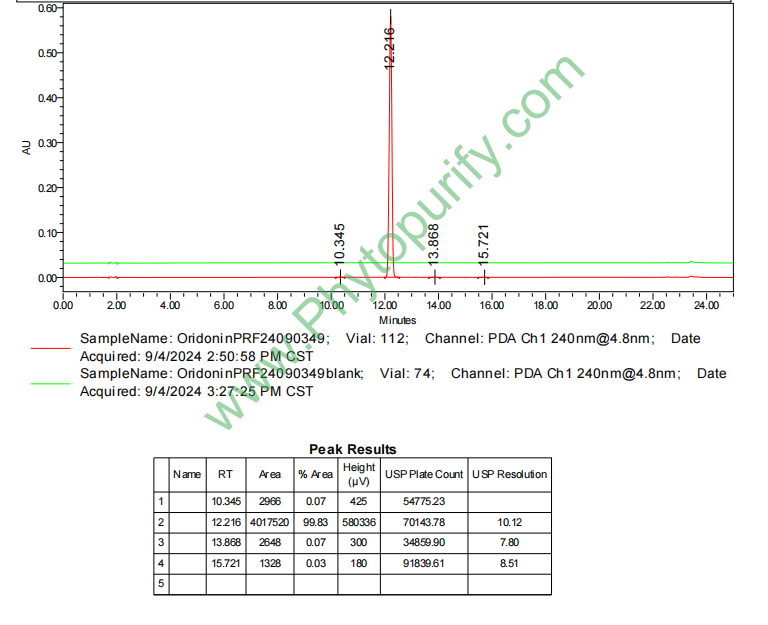
Storage conditions:Short-term storage at 2~8℃, long-term storage at -20 ~ -80℃
107.2200
.9503
.9501
.4276
1.7838
5.8674
High
43.6670
6.8557
No
No
No
No
Yes
No
0.0
Yes
No
Yes
Yes
Natural products, as an important source of drug discovery, play an irreplaceable role in the long history of human fight against diseases. One of the core tasks of modern medicinal chemistry and pharmacology research is to isolate and identify compounds with significant biological activity from traditional herbs, and elucidate their mechanisms of action. Oridonin (CAS number: 28957-04-2), also known as NSC-250682, is a plant from the family Lamiaceae in the genus Camellia(Rabdosia rubescens, also known as Isodon rubescens)Natural diterpenoid compounds isolated from the middle. As a commonly used folk Chinese herbal medicine, winter grass is widely distributed in Henan, Hebei, Shanxi and other places in China, known as "winter grass". It is named after its stems and leaves that freeze ice in winter. It is commonly used in folk medicine to treat diseases such as sore throat, tonsillitis, snake and insect bites. Since the 1970s, Chinese scholars have conducted systematic studies on the chemical composition and pharmacological activity of Ophiopogon japonicus, and found that it is rich in various diterpenoid compounds, among which Ophiopogon japonicus methyl has attracted much attention due to its significant anti-tumor activity.
Ophiopogon belongs to the enantiomeric kaempferol group(ent-Kaurane type diterpenes have a unique molecular structure, containing an alpha, beta unsaturated ketone structural unit and a cyclopentanone structure. Early studies have confirmed that oridonin exhibits broad-spectrum cytotoxicity against various tumor cell lines, and its mechanism of action involves inducing cell apoptosis, inhibiting cell proliferation, anti angiogenesis, and other aspects. With the deepening of research, it has been found that oridonin is an effective AKT protein kinase inhibitor, with IC50 values of 8.4 μ M and 8.9 μ M for AKT1 and AKT2 subtypes, respectively. The AKT signaling pathway is a key pathway that regulates cell survival, proliferation, metabolism, and apoptosis, and is often in an abnormally activated state in various malignant tumors. Therefore, targeting AKT has become an important strategy for the development of anti-tumor drugs. The inhibitory effect of Ophiopogon japonicus on AKT provides a key molecular explanation for its anti-tumor activity. In addition, the study also revealed that oridonin has regulatory effects on multiple targets closely related to tumor occurrence and development, such as MCL1, BCL2, STAT3, MMP2, TOP1, HIF1A, TOP2A, MAPK1, ESR1, CYP19A1, etc., demonstrating its multi-target and multi pathway characteristics.
In addition to its anti-tumor activity, Ophiopogon japonicus also exhibits various pharmacological effects such as antibacterial, anti-inflammatory, antioxidant, and neuroprotective properties, making it a highly promising natural lead compound for development. However, its complex chemical structure, limited natural resources, and potential pharmaceutical challenges also require further clinical translation. This article will provide a systematic review of the research progress of Ophiopogon japonicus from the aspects of chemical structure and physicochemical properties, plant sources and extraction methods, pharmacological activity, mechanism of action and molecular targets, drug evaluation and pharmacokinetics, as well as clinical application prospects. The aim is to provide reference for the in-depth research and development of this important natural product.
The chemical structure of winter grass beetle is the basis for its biological activity. Its chemical name is (1 α, 6 β, 7 α, 14 β) -6,7,14,20-tetrahydroxy-16-chaitane-15-one, with a molecular formula of C ₂₀ H ₂₈ O ₆ and a molecular weight of 364.4380 g/mol. Structurally, Ophiopogon belongs to the enantiomeric kaempferol type tetracyclic diterpenes, with its core skeleton consisting of four rings A, B, C, and D. Among them, ring A is a six membered ring, rings B and C are six membered rings combined, and ring D is a five membered ring. This molecule contains multiple hydroxyl groups (- OH) and one carbonyl group (C=O). Specifically, there is one hydroxyl group at positions C-1, C-6, C-7, and C-14, one carbonyl group at position C-15, and an extra cyclic methylene group (=CH ₂) formed between positions C-16 and C-17. The presence of multiple hydroxyl and carbonyl groups gives oridonin the potential to form hydrogen bonds and interact with biomolecules such as proteins and nucleic acids. Especially the α, β - unsaturated ketone structural unit composed of the carbonyl group at C-15 and the methylene group at C-16 is a classic Michael addition receptor that can covalently bind to the thiol group (- SH) on the cysteine residue of proteins, which is considered one of the key mechanisms for its anti-tumor activity.
In terms of physical and chemical properties, Ophiopogon japonicus is a white or off white crystalline powder, odorless, and bitter in taste. Its LogP value is 0.9503, indicating that it has a certain degree of lipophilicity, but overall its lipophilicity is not strong. Its topological polar surface area (TPSA) is 107.2200 Å ², which is a relatively high value, usually indicating good water solubility of the molecule, but may also affect its transmembrane transport ability. In fact, the water solubility of Ophiopogon japonicus (0.4276 mg/mL) is not ideal and belongs to the category of slight solubility, which to some extent limits its bioavailability. It is worth noting that its blood-brain barrier (BBB) penetration has been evaluated as "high", indicating that the compound may enter the central nervous system, which provides a possibility for its application in brain diseases such as glioma. In addition, the predicted result of hERG inhibition is' no ', indicating a low risk of cardiac toxicity; The Ames test result is 0.0, indicating no significant mutagenicity. These preliminary pharmacological evaluation results provide positive signals for the further development of Ophiopogon japonicus, but issues such as poor water solubility and metabolic stability still need to be addressed through structural modification or formulation optimization.
The main source of donglingcao is donglingcao, a plant in the family Lamiaceae and the genus Theaceae(Rabdosia rubescens (Hemsl.) Hara, Also frequently writing Isodon rubescens). This plant is a perennial herb or sub shrub, mainly distributed in the Yellow River Basin and several provinces south of it in China, such as Henan, Hebei, Shanxi, Shaanxi, Gansu, Hubei, Hunan, Sichuan, Guizhou, etc. Among them, the quality of winter grass produced in Wangwushan area of Jiyuan City, Henan Province is the best, and its content of winter grass beetle is relatively high. The above ground parts (stems and leaves) of winter grass are the main medicinal parts. In folk medicine, they are often dried and brewed into tea for drinking, used to treat pharyngitis, tonsillitis, etc. Modern research has confirmed that the content of arbutin in arbutin varies depending on factors such as place of origin, harvest season, and plant location, generally ranging from 0.1% to 0.5%, and is a relatively low trace component.
The traditional extraction method of winter grass beetle extract is mainly based on solvent extraction. Usually, the dried stems and leaves of winter grass are crushed and subjected to reflux extraction or percolation extraction with ethanol or methanol. After the extraction solution is concentrated under reduced pressure, a paste is obtained. Then, taking advantage of the difference in solubility of Ophiopogon japonicus in different solvents, liquid-liquid extraction method was used for preliminary purification, such as sequential extraction with solvents such as petroleum ether and ethyl acetate. Ophiopogon japonicus was mainly enriched in the ethyl acetate extraction layer. Further separation and purification rely on classical chromatographic techniques such as silica gel column chromatography and recrystallization. Due to the presence of multiple hydroxyl groups and high polarity in the structure of Ophiopogon japonicus, mixed solvent systems such as chloroform methanol and ethyl acetate methanol are commonly used for gradient elution in silica gel column chromatography. By repeated column chromatography and recrystallization, high-purity monomers of oridonin can be obtained. However, traditional methods have disadvantages such as cumbersome steps, high solvent consumption, low yield, and long cycles, which make it difficult to meet the needs of large-scale production and scientific research.
In recent years, in order to improve extraction efficiency and purity, various modern extraction techniques have been applied to the preparation of Ophiopogon japonicus extract. For example, ultrasound assisted extraction (UAE) utilizes the cavitation effect and mechanical vibration of ultrasound to effectively destroy plant cell walls, accelerate solvent penetration and effective ingredient dissolution, thereby significantly shortening extraction time and improving extraction efficiency. Microwave assisted extraction (MAE) utilizes the penetrability and selective heating of microwaves to rapidly evaporate internal water in plants, creating pressure that leads to cell rupture and improves extraction efficiency. In addition, supercritical fluid extraction (SFE) technology, especially the use of carbon dioxide as an extractant, has shown unique advantages in extracting thermosensitive natural products due to its non-toxic, residue free, and low operating temperature. Modern separation techniques such as high-speed counter current chromatography (HSCCC) and preparative high performance liquid chromatography (Prep HPLC) have also been applied for the purification of Ophiopogon japonicus, which can achieve one-step or rapid separation to obtain high-purity target compounds. The application of these new technologies not only improves the extraction efficiency and purity of oridonin, but also provides a material basis for subsequent pharmacological research and drug development.
The pharmacological activity research of Ophiopogon japonicus mainly focuses on its anti-tumor effect, while its antibacterial, anti-inflammatory, antioxidant and other activities have also attracted widespread attention.
Antitumor activity: Oridonin has significant proliferation inhibition and cytotoxicity effects on a variety of human tumor cell lines, including but not limited to liver cancer, lung cancer, breast cancer, stomach cancer, colorectal cancer, prostate cancer, bladder cancer cancer, cervical cancer, leukemia, melanoma, osteosarcoma, etc. Its concentration of action is usually in the micromolar range, and its toxicity to normal cells is relatively low, showing a certain degree of selectivity. In vivo experiments have also confirmed that berberine can inhibit the growth of transplanted tumors in nude mice and prolong the survival of tumor bearing mice. For example, in liver cancer models, berberine can inhibit tumor growth by inducing cell apoptosis and autophagic death; In the breast cancer model, it can inhibit the proliferation of estrogen receptor positive (ER+) and triple negative breast cancer (TNBC) cells; In lung cancer models, it can reverse the resistance of non-small cell lung cancer (NSCLC) to chemotherapy drugs. These research results indicate that Ophiopogon japonicus has broad-spectrum anti-tumor potential.
Antibacterial activity Oridonin has inhibitory effects on various bacteria and fungi. Early research found that it has varying degrees of inhibitory effects on common pathogenic bacteria such as Staphylococcus aureus, Streptococcus pyogenes, Streptococcus pneumoniae, Escherichia coli, and Shigella. Its antibacterial mechanism may be related to the destruction of bacterial cell membrane integrity, inhibition of bacterial nucleic acid or protein synthesis. In recent years, studies have also found that berberine has certain antibacterial activity against methicillin-resistant Staphylococcus aureus (MRSA) and other resistant strains, providing ideas for the development of new antibacterial drugs.
anti-inflammatory activity Oridonin has shown anti-inflammatory effects in various inflammatory models. In the macrophage model stimulated by lipopolysaccharide (LPS), it can significantly inhibit the production of pro-inflammatory factors such as tumor necrosis factor - α (TNF - α), interleukin-6 (IL-6), interleukin-1 β (IL-1 β), and nitric oxide (NO). Its anti-inflammatory mechanism is related to the inhibition of the activation of nuclear factor kappa B (NF - κ B) and mitogen activated protein kinase (MAPK) signaling pathways. In addition, in animal models, berberine has shown protective effects against inflammatory diseases such as acute lung injury, colitis, and arthritis.
Other activities In addition to the main activities mentioned above, Ophiopogon japonicus also exhibits various pharmacological effects such as antioxidant, neuroprotective, anti fibrotic, and antiviral effects. For example, it can eliminate free radicals and alleviate oxidative stress damage; In the Alzheimer's disease model, it can reduce the aggregation and neurotoxicity of β - amyloid protein (A β); In the liver fibrosis model, it can inhibit the activation of hepatic stellate cells and collagen deposition. These diverse pharmacological activities further expand the potential application range of oridonin.
The pharmacological activity of Ophiopogon japonicus, especially its anti-tumor effect, is achieved through a complex mechanism of multiple targets and pathways. One of its core mechanisms is its role as an AKT protein kinase inhibitor. AKT (also known as protein kinase B, PKB) is the core node of the PI3K/AKT/mTOR signaling pathway, playing a crucial role in regulating cell survival, proliferation, metabolism, migration, and angiogenesis. In various cancers, AKT is often overactivated due to genetic mutations or upstream signal abnormalities, leading to tumor cells gaining survival advantages. Oridonin can directly bind to AKT, inhibit its kinase activity, and thus block downstream signal transduction. Specifically, its IC50 values for AKT1 and AKT2 subtypes are 8.4 μ M and 8.9 μ M, respectively. By inhibiting AKT, berberine can downregulate downstream effector molecules such as mTOR, GSK-3 β, FOXO, Bad, etc., thereby inducing cell cycle arrest and apoptosis.
In addition to directly targeting AKT, oridonin also exerts anti-tumor effects through various other mechanisms:
Inducing cell apoptosis Oridonin can induce tumor cell apoptosis through two pathways: endogenous (mitochondrial) and exogenous (death receptor). It can downregulate the expression of anti apoptotic proteins MCL1 and BCL2, while upregulating the expression of pro apoptotic proteins Bax and Bak, leading to a decrease in mitochondrial membrane potential, release of cytochrome c, and activation of Caspase-9 and Caspase-3, initiating the apoptotic cascade reaction. In addition, it can activate the JNK and p38 MAPK signaling pathways, upregulate the expression of death receptors such as Fas and DR5, and enhance apoptosis induced by tumor necrosis factor related apoptosis inducing ligand (TRAIL).
Inhibition of STAT3 signaling pathway Signal transducer and activator of transcription factor 3 (STAT3) is continuously activated in various cancers, promoting tumor cell proliferation, survival, and angiogenesis. Oridonin can inhibit the phosphorylation of STAT3 (Tyr705 site), thereby suppressing its nuclear translocation and transcriptional activity. This leads to downregulation of downstream target genes such as Cyclin D1, Survivor, VEGF, MMP2, etc., thereby inhibiting tumor cell proliferation, inducing apoptosis, and suppressing angiogenesis and metastasis.
Inhibit angiogenesis The growth and metastasis of tumors depend on the formation of new blood vessels. Oridonin can inhibit the expression and stability of hypoxia inducible factor 1 alpha (HIF1A), thereby downregulating the expression of its target gene vascular endothelial growth factor (VEGF). At the same time, it can directly inhibit the proliferation, migration, and lumen formation of endothelial cells. These effects collectively inhibit tumor angiogenesis.
Inhibition of Topoisomerase Activity Topoisomerase I (TOP1) and Topoisomerase II (TOP2A) are essential enzymes for DNA replication and transcription, as well as important targets for anti-tumor drugs. Research has shown that oridonin can inhibit the activity of TOP1 and TOP2A, leading to DNA damage and thus inhibiting tumor cell proliferation.
Regulating other signaling pathways Oridonin can also exert its anti-tumor effects by affecting the MAPK signaling pathway (such as inhibiting ERK1/2 and activating JNK/p38), estrogen receptor signaling pathway (such as downregulating the expression of ESR1 and CYP19A1), Wnt/β - catenin pathway, NF - κ B pathway, etc. In addition, it can induce autophagy in tumor cells, which plays a dual role in tumor development and progression. Autophagy can promote cell survival or lead to cell death, depending on the cell type and microenvironment.
In summary, Oridonin directly inhibits AKT and synergistically regulates multiple key targets and signaling pathways such as STAT3, MAPK, NF - κ B, HIF-1 α, BCL2 family, topoisomerase, etc., forming a complex network regulatory mechanism to achieve inhibition of tumor cell proliferation, apoptosis, angiogenesis, metastasis, and other aspects.
Despite its significant pharmacological activity, the pharmacological development of Ophiopogon japonicus faces many challenges, mainly reflected in its pharmacokinetic properties. According to the provided pharmacological parameters, the molecular weight of Ophiopogon japonicus (364.44 Da) conforms to the "five rules" (<500 Da), and the LogP value (0.95) is also within a reasonable range (-0.4~5.6). However, its TPSA (107.22 Å ²) is relatively high (usually considered to be<140 Å ²), and its water solubility (0.43 mg/mL) is poor, which directly affects its oral absorption and bioavailability.
absorb The poor water solubility of Ophiopogon japonicus leads to its low solubility in aqueous environments, which is the primary factor limiting its oral absorption. Although its LogP value indicates a certain degree of lipophilicity, which facilitates its passage through biofilms, excessive TPSA and intramolecular hydrogen bonds may hinder its passive diffusion. Therefore, the oral bioavailability of oridonin is usually very low. Animal experiments have shown that after oral administration, the peak blood concentration of oridonin is low, the peak time is short, and the absolute bioavailability may be less than 10%. In order to improve its oral absorption, researchers have attempted various strategies, such as preparing phospholipid complexes, liposomes, nanoparticles, cyclodextrin inclusion complexes, etc. These formulations can significantly enhance its water solubility and oral bioavailability.
distribution Ophiopogon methyl is widely distributed in the body. It is worth noting that its blood-brain barrier penetration has been evaluated as "high", indicating that it may enter brain tissue. This characteristic is of great significance for the treatment of brain tumors (such as glioblastoma) or neurological diseases. However, this may also bring potential central nervous system side effects that require further evaluation. The binding rate between it and plasma proteins is not fully understood, but due to the presence of multiple hydroxyl groups in its structure, it may bind to plasma proteins to a certain extent.
Metabolism Ophiopogon japonicus mainly undergoes phase I and phase II metabolism in the body. Phase I metabolism is mainly mediated by the cytochrome P450 enzyme system (CYP450), which may undergo reactions such as hydroxylation and oxidation. Phase II metabolism involves binding with glucuronic acid, sulfuric acid, etc. to form metabolites with higher water solubility, which are easier to excrete from the body. Due to the presence of multiple hydroxyl groups in its structure, glucuronic acid binding may be its main metabolic pathway. Poor metabolic stability is another important reason for its short half-life and fast clearance in the body. Structural modifications, such as introducing fluorine atoms, methylating hydroxyl groups, etc., are commonly used strategies to improve their metabolic stability.
excretion Ophiopogon japonicus and its metabolites are mainly excreted through bile and urine. Due to its poor water solubility, the prototype drug may have a lower excretion in urine, while metabolites are mainly excreted through urine and feces.
safety Preliminary pharmacological evaluation shows that Ophiopogon japonicus has no hERG inhibitory activity (low risk of cardiac toxicity) and negative Ames test (no mutagenicity), which provides a positive signal for its safety. However, its potential hepatotoxicity, nephrotoxicity, and long-term safety still need to be evaluated through systematic toxicological studies. Previous studies have shown that high doses of Ophiopogon japonicus may cause certain damage to the liver and kidneys, but its therapeutic window is relatively wide.
Overall, as a natural lead compound, berberine has clear pharmacological activity and unique mechanism of action, but its poor pharmacokinetic properties are the main bottleneck for its clinical translation. Future research should focus on improving its water solubility, metabolic stability, and bioavailability through structural modifications (such as prodrug design, skeleton modification) or novel drug delivery systems (such as nanomaterials, targeted delivery systems), while maintaining or enhancing its pharmacological activity.
As a natural product with a multi-target mechanism of action, oridonin has shown broad application prospects in the field of anti-tumor and other disease treatments.
Antitumor therapy Given its effective inhibitory effect on various tumor cells and its regulatory ability on key oncogenic signaling pathways such as AKT and STAT3, it is expected to be developed as a novel anti-tumor drug. Its application prospects are mainly reflected in the following aspects:
1. Single use medication: Some tumor types sensitive to oridonin A, such as liver cancer, breast cancer, leukemia, etc., may become effective therapeutic drugs after structural optimization or dosage form improvement.
2. combination therapy The combination of oridonin with existing chemotherapy drugs (such as cisplatin, paclitaxel, doxorubicin, 5-fluorouracil, etc.) or targeted drugs (such as sorafenib, gefitinib, etc.) may produce synergistic effects, overcome tumor resistance, and reduce the toxic side effects of chemotherapy drugs. For example, studies have shown that oridonin can enhance TRAIL induced apoptosis and reverse tumor cell resistance to TRAIL.
3. adjuvant therapy After radiotherapy or surgery, berberine can be used as an adjuvant therapy drug to clear residual tumor cells, prevent tumor recurrence and metastasis.
4. Targeted delivery By utilizing its blood-brain barrier penetrability, the development of a targeted nano delivery system for glioblastoma is expected to improve the therapeutic efficacy of brain tumors.
Treatment for other diseases:
1. Inflammatory diseases The anti-inflammatory activity of Ophiopogon japonicus has the potential to treat chronic inflammatory diseases such as rheumatoid arthritis, inflammatory bowel disease, asthma, etc.
2. infectious diseases Its antibacterial activity against drug-resistant bacteria (such as MRSA) provides ideas for the development of new antibiotics.
3. Neurodegenerative diseases Its antioxidant and neuroprotective effects make it potentially valuable in the treatment of neurodegenerative diseases such as Alzheimer's disease and Parkinson's disease.
Challenges and Future Directions Faced:
Despite its broad prospects, the clinical translation of oridonin still faces many challenges:
1. Pharmacokinetic properties Poor water solubility, unstable metabolism, and low oral bioavailability are the core issues. The future needs to be overcome through prodrug design, structural modification (such as introducing polar groups, blocking metabolic sites), or the development of novel drug delivery systems (such as liposomes, nanoparticles, polymer micelles).
2. Complexity of mechanism of action Its multi-target mechanism of action is both an advantage and a challenge. Further clarification is needed on the key targets and signaling pathways that exert the main pharmacological effects in vivo, as well as the synergistic or antagonistic relationships between different targets.
3. Toxicological research Systematic acute and chronic toxicology studies are needed to clarify the safe dose range, potential toxic target organs (such as liver and kidney), and the safety of long-term use.
4. Resource sustainability The content of winter grass beetle in winter grass is low, and natural resources are limited. Efficient chemical or biological synthesis methods need to be developed to meet potential large-scale production demands in the future.
5. clinical trial At present, there are relatively few clinical trials related to the use of Ophiopogon japonicus, and most of them are preliminary exploratory studies. In the future, it is necessary to conduct rigorously designed clinical trials with sufficient sample sizes to verify their clinical efficacy and safety.
As an enantiomeric kaempferol diterpenoid isolated from the traditional Chinese herb Ophiopogon japonicus, its unique chemical structure and significant biological activity, especially as an AKT inhibitor in the field of anti-tumor, have become a hot topic in natural product pharmacology research. It regulates AKT, STAT3, MAPK, NF - κ B, BCL2 family HIF-1α、 Topoisomerase and other key targets and signaling pathways exert broad-spectrum pharmacological effects such as anti-tumor, antibacterial, anti-inflammatory, etc., demonstrating the characteristics of multi-target and multi pathway action. However, its pharmacokinetic defects such as poor water solubility, unstable metabolism, and low oral bioavailability severely restrict its clinical translation process.
In the future, research on orideomycin should focus on the following aspects: firstly, improving its drug properties through medicinal chemical methods (such as structural modification and prodrug design) and pharmaceutical methods (such as nano formulations); The second is to use modern molecular biology and omics technologies to deeply elucidate its functional network and key targets in vivo; Thirdly, conduct systematic toxicology and pharmacokinetic studies to provide a basis for safe drug use; The fourth is to explore its synergistic effect with existing drugs and develop effective combination therapy plans. We have reason to believe that with the continuous deepening of research and the advancement of technological means, the natural product of Ophiopogon japonicus is expected to overcome its pharmacological bottleneck and ultimately transform into a drug that benefits human health, especially playing an important role in the field of tumor treatment.
