| Catalog No | Package | Original Price | Price | Inventory | Quantity | Operating |
|---|---|---|---|---|---|---|
| BP5100-5mg | 5mg | $850.00 | Sign in |
|


Storage conditions:Short-term storage at 2~8℃, long-term storage at -20 ~ -80℃
Olivil 4 '- O-glucoside (CAS number: 76880-93-8) is a natural lignan glycoside widely present in various plants, especially in the olive genus. As an important member of the lignans family, oleanol-4 '- O-glucoside has attracted widespread attention in the field of natural product pharmacology in recent years due to its unique chemical structure and diverse biological activities. This compound exhibits certain antioxidant activity, especially with potential application value in free radical scavenging. In addition, the pharmacological parameters of oleanol-4 '- O-glucoside demonstrate its good safety and biocompatibility, laying the foundation for further pharmacological research and clinical development.
This article aims to systematically review the chemical structure, physicochemical properties, plant sources, and extraction methods of oleagine-4 '- O-glucoside, explore its pharmacological activity and mechanism of action, evaluate its pharmacological properties and pharmacokinetic characteristics, and prospect its clinical application potential, aiming to provide theoretical support and practical guidance for related research.
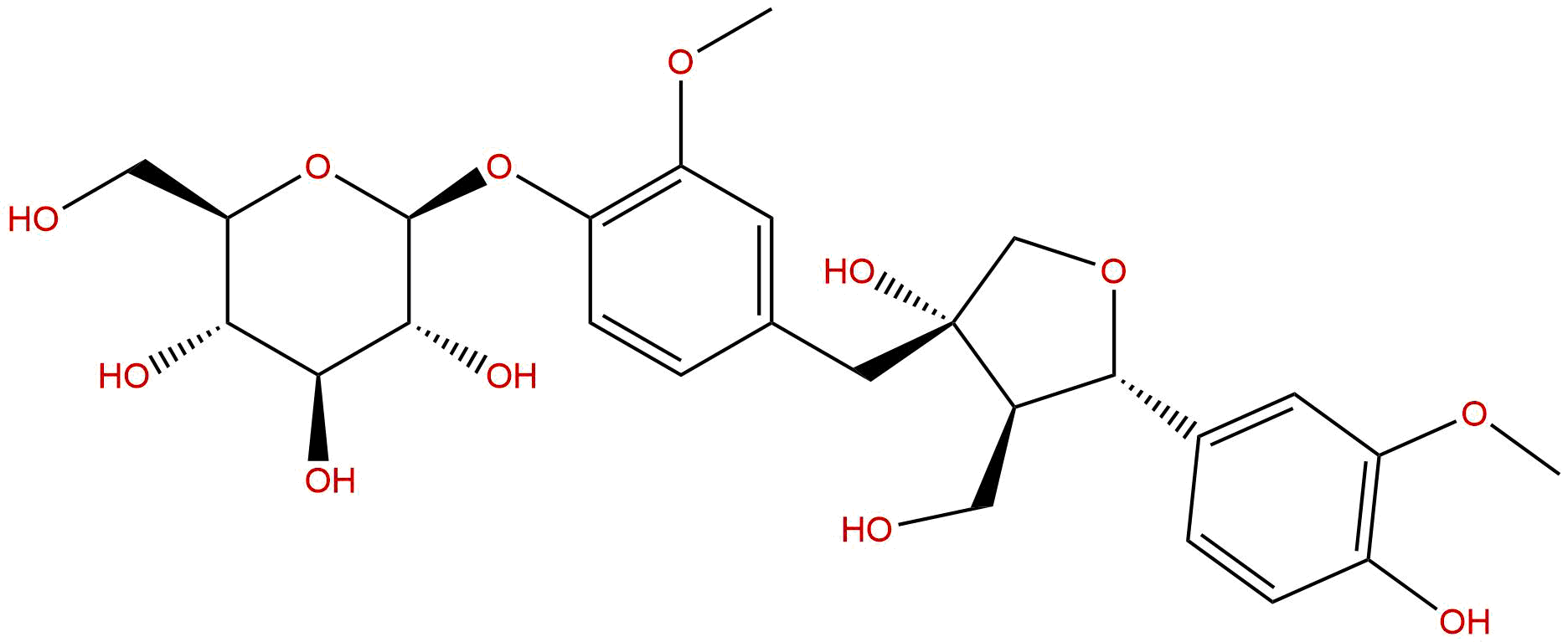
The chemical name of oleagin-4 '- O-glucoside is 4- {[(3S, 4R, 5S) -3-hydroxy-5- (4-hydroxy-3-methoxyphenyl) -4- (hydroxymethyl) tetrahydro-3-furyl] methyl} -2-methoxyphenyl β - D-glucoside, with a molecular formula of C26H34O12 and a molecular weight of 538.5460. Its structure belongs to the class of lignans glycosides, with a core skeleton consisting of tetrahydrofuran ring connecting two phenyl units, one of which is bonded to β - D-glucoside through a 4 '- site.
In terms of physicochemical properties, oleanol-4 '- O-glucoside has low hydrophobicity (LogP=0.0812), indicating strong hydrophilicity, and a total polar surface area (TPSA) of 187.76 Å ², reflecting a large number of polar functional groups such as hydroxyl and methoxy groups, giving it good water solubility (water solubility index of about 2.1762). These properties make the compound have good solubility in aqueous environments, which is beneficial for absorption and distribution in organisms.
In addition, oleanol-4 '- O-glucoside does not have the ability to penetrate the blood-brain barrier, suggesting that its main target of action may be limited to peripheral tissues. In terms of safety, the hERG channel inhibition experiment showed a negative result, indicating a low risk of cardiac toxicity; The Ames mutagenicity test result was 0.0, indicating no significant mutagenicity and meeting the safety requirements for drug development.
Olean-4 '- O-glucoside is mainly found in plants of the Olea genus (Olea europaea) and its related species, especially abundant in olive leaves, fruits, and roots. In addition, some plants with high levels of lignin, such as those in the Fabaceae and Walnut families, have also been reported to contain this compound or its derivatives with similar structures.
The traditional method for extracting oleagin-4 '- O-glucoside often uses polar solvents such as methanol, ethanol, or water alcohol mixed solvents to obtain crude extracts through leaching or reflux extraction. Subsequently, liquid-liquid partitioning, column chromatography (such as silica gel column, reverse phase C18 column), and high-performance liquid chromatography (HPLC) techniques were used for separation and purification. In recent years, the application of emerging technologies such as ultrasound assisted extraction and microwave-assisted extraction has improved extraction efficiency and purity, while reducing extraction time and solvent usage.
In terms of identification, mass spectrometry (MS), nuclear magnetic resonance (NMR), and infrared spectroscopy (IR) were used to confirm the structure of the purified product. Especially two-dimensional NMR techniques (such as COSY, HSQC, HMBC) provide key evidence for analyzing glycosidic bond positions and stereoconfigurations.
The pharmacological activity research of oleagin-4 '- O-glucoside mainly focuses on its antioxidant, anti-inflammatory, and neuroprotective aspects.
As a lignan compound, oleanol-4 '- O-glucoside exhibits certain free radical scavenging ability. The in vitro DPPH radical scavenging experiment showed that its EC50 was about 176 μ M, belonging to the category of weak antioxidants. Although its antioxidant capacity is not as strong as some potent polyphenolic substances, the abundant hydroxyl and methoxy groups in its structure endow it with certain electron donor abilities, which can capture free radicals and alleviate oxidative stress damage to cells.
Partial in vitro cell models and animal experiments have shown that oleanol-4 '- O-glucoside can inhibit the release of inflammatory mediators such as tumor necrosis factor - α (TNF - α), interleukin-6 (IL-6), and nitric oxide (NO). Its anti-inflammatory mechanism may involve the regulation of the NF - κ B signaling pathway, which weakens the cascade amplification effect of inflammatory response and protects tissues from chronic inflammatory damage.
Due to its antioxidant and anti-inflammatory properties, oleanol-4 '- O-glucoside has shown a certain protective effect in neurodegenerative disease models. For example, in an in vitro neural cell model, the compound can alleviate oxidative stress-induced cell apoptosis and promote neural cell survival. Although its blood-brain barrier permeability is low, it is suitable for peripheral nerve protection or as an adjuvant therapy.
Preliminary studies also suggest that oleandrin-4 '- O-glucoside may have the potential for anti-tumor, antibacterial, and immune function regulation, but the relevant data is not yet sufficient and further systematic research is needed for verification.
The mechanism of action of oleagin-4 '- O-glucoside mainly revolves around its antioxidant and anti-inflammatory activities.
This compound provides hydrogen atoms or electrons to directly scavenge free radicals, terminate free radical chain reactions, and reduce oxidative damage. In addition, its hydroxyl group can chelate transition metal ions (such as iron and copper), inhibit hydroxyl radicals generated by Fenton reaction, and indirectly exert antioxidant effects.
Olive lipin-4 '- O-glucoside regulates multiple signaling pathways, particularly the NF - κ B and MAPK pathways. It inhibits the phosphorylation and degradation of I κ B α, preventing NF - κ B transcription factors from entering the nucleus and reducing the expression of pro-inflammatory cytokine genes. At the same time, inhibiting the activation of MAPKs such as p38 and JNK reduces the synthesis and release of inflammatory mediators.
At present, there are no clear reports of high affinity targets, but it is speculated that their targets may include oxidative stress-related enzymes (such as superoxide dismutase (SOD), glutathione peroxidase (GPx)), inflammatory signaling molecules (such as IKK complex, TNF - α receptor), and related transcription factors. In the future, molecular docking and proteomics research are expected to reveal more specific targets and action networks.
The pharmacological parameters of oleanol-4 '- O-glucoside indicate its potential for development.
The molecular weight of 538.5460 is in the moderate range, and the LogP value of 0.0812 indicates strong hydrophilicity, which is conducive to dissolution and absorption; The TPSA value is relatively high at 187.76, which may limit its cell membrane permeability, especially its ability to pass through the blood-brain barrier is weak.
The hERG channel inhibition test was negative, indicating a low risk of cardiac toxicity. The Ames mutagenicity test result is 0, indicating no mutagenicity and good safety.
At present, there is limited in vivo pharmacokinetic data on oleagine-4 '- O-glucoside. Based on its structure and physicochemical properties, it is speculated that oral absorption may be limited by high polarity and glycosidic structure, and its bioavailability may be low. Its metabolic pathway may involve hydrolysis of glycosidic bonds by gut microbiota, release of active lignin core, and subsequent metabolic transformation through liver phase I and phase II. Excretion is mainly through urine and bile.
In the future, in vivo pharmacokinetic studies are needed to clarify its absorption, distribution, metabolism, and excretion (ADME) characteristics, providing a basis for dosage form design and optimization of dosing regimens.
Olive lipin-4 '- O-glucoside has shown potential value in the prevention and treatment of various chronic diseases due to its antioxidant and anti-inflammatory activities.
Chronic inflammation is the common pathological basis of cardiovascular disease, diabetes, arthritis and other diseases. Olive lipin-4 '- O-glucoside has the potential to become a natural anti-inflammatory drug or adjuvant therapy by regulating the inflammatory signaling pathway, reducing the burden of inflammation, and improving tissue function.
Although the blood-brain barrier has limited penetration ability, its inhibitory effect on peripheral neuroinflammation and oxidative stress may provide assistance in the adjuvant treatment of neurodegenerative diseases such as Parkinson's disease and Alzheimer's disease. In the future, its brain targeting ability can be improved through structural modification or nanocarrier technology.
As a natural antioxidant, oleanol-4 '- O-glucoside is suitable for development as a functional health supplement to prevent sub-health states related to oxidative stress and age-related diseases.
Olive lignin-4 '- O-glucoside, as a typical natural lignan glycoside, has shown broad research and application prospects in antioxidant, anti-inflammatory, and neuroprotective fields due to its unique chemical structure and diverse biological activities. Although current research has revealed some of its pharmacological effects and safety advantages, further exploration of its molecular mechanisms, pharmacokinetics, and clinical efficacy is still needed. In the future, combining modern medicinal chemistry and biotechnology methods, oleanol-4 '- O-glucoside is expected to become an important candidate molecule for natural product drug development, providing new strategies and ideas for the prevention and treatment of related diseases.
