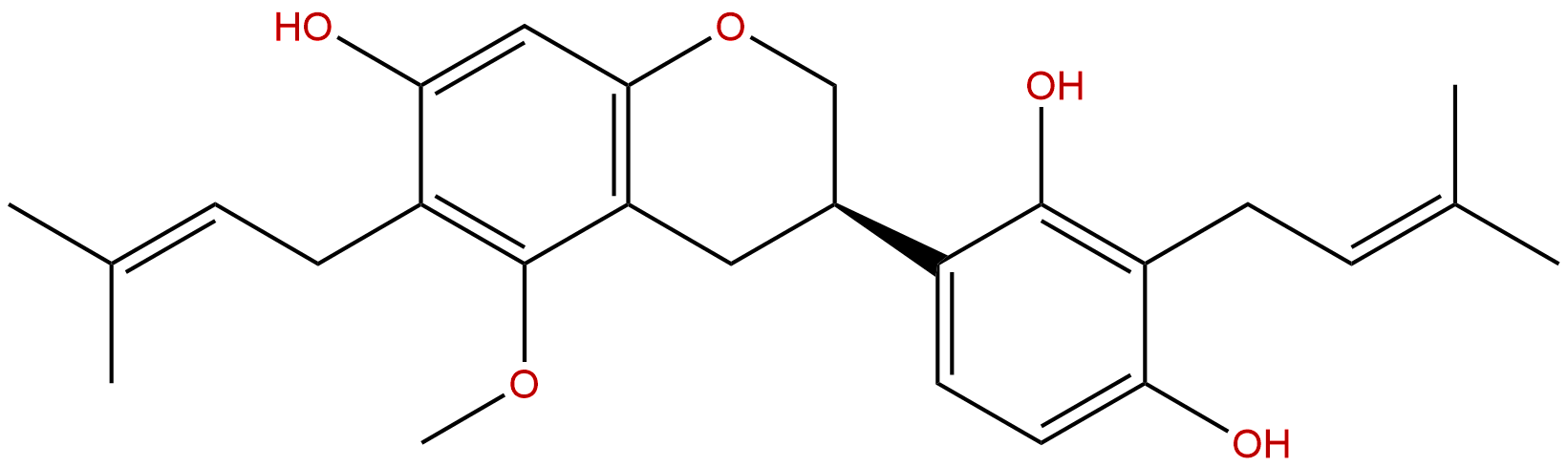


Product name: Licoricidin
Synonym name:
Catalogue No.: SBP03353
Cas No.: 30508-27-1
Formula: C26H32O5
Mol Weight: 424.537
Botanical Source:
Physical Description:
Type of Compound: Flavonoids
Purity: 95%~99%
Analysis Method: HPLC-DAD or/and HPLC-ELSD
Identification Method: Mass, NMR
Packing: Brown vial or HDPE plastic bottle
The product could be supplied from milligrams to grams. Inquire for bulk scale.
We provide solution to improve the water-solubility of compounds, thereby facilitating the variety of activity tests and clinic uses.
For Reference Standard and R&D, Not for Human Use Directly.
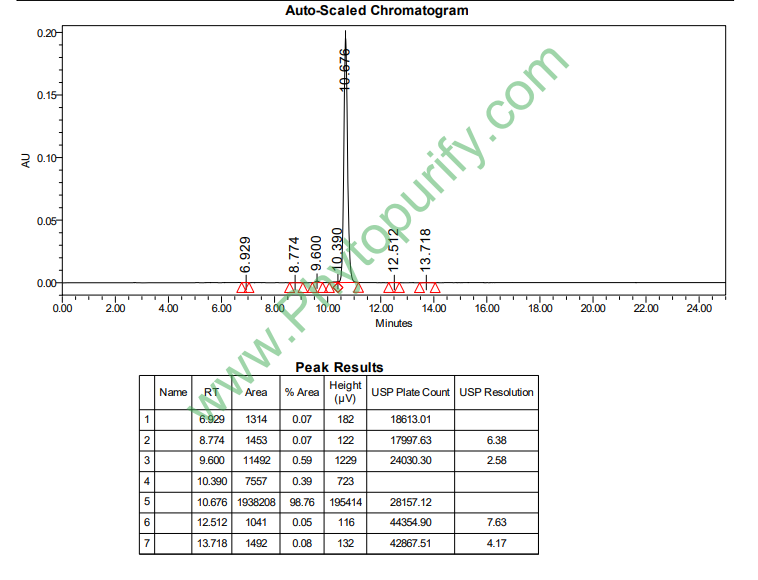
HPLC of Licoricidin
Storage conditions:Short-term storage at 2~8℃, long-term storage at -20 ~ -80℃
Glycyrrhiza uralensis Fisch, as a traditional Chinese medicinal herb, has been widely used in clinical and health fields for a long time due to its diverse pharmacological activities and safety. Licoricidin (LCD) is a natural flavonoid product isolated from licorice, which has significant biological activity and unique potential in anti-tumor, anti-aging and other fields. In recent years, with the deepening of molecular biology and pharmacology research, the mechanism of action of LCD has gradually become clear, showing that it regulates cell cycle, apoptosis, autophagy, and tumor microenvironment through multiple signaling pathways, exerting anti-cancer and anti-aging effects. The purpose of this article is to systematically review the chemical structure, pharmacological activity, mechanism of action, and clinical application potential of glycyrrhizic acid, providing a theoretical basis for subsequent research and drug development.
The molecular formula of Licoricidin is C24H24O7, with a molecular weight of 424.53. Its chemical structure belongs to the flavonoid class compounds, with a typical flavonoid skeleton containing multiple hydroxyl and methoxy substituents. These functional groups endow it with good biological activity and certain water solubility. The structural characteristics of LCD enable it to interact with various biomolecules and regulate cellular signaling pathways. The specific chemical structural formula shows that there are multiple conjugated double bond systems and phenolic hydroxyl groups in LCD molecules, which have strong antioxidant capacity.
In terms of physical and chemical properties, LCD appears as a yellow crystalline solid, soluble in organic solvents such as methanol, ethanol, and dichloromethane, with low water solubility. Its stability is affected by pH and light, and it is suitable for storage under neutral or weakly acidic conditions. Due to its moderate molecular weight, LCD has good cell membrane permeability, providing a foundation for its intracellular functions.
Glycyrrhiza uralensis is mainly extracted from the root of licorice, which is the dried root and rhizome of the legume plant Glycyrrhiza uralensis Fisch. Traditional extraction methods often use alcohol extraction combined with liquid-liquid separation technology. The specific process generally includes:
Crude extraction After crushing the dried licorice roots, reflux extraction is carried out using 70% -95% ethanol or methanol. The extraction time is generally 2-4 hours, and the extraction temperature is controlled at 60-80 ℃.
Concentrated separation After the extraction solution is concentrated under reduced pressure, liquid-liquid extraction (such as ethyl acetate or chloroform) is used to separate the portion rich in isoflavone compounds.
Chromatographic purification Further separation and purification of glycyrrhizic acid by techniques such as silica gel column chromatography and reverse phase high performance liquid chromatography (RP-HPLC). Purity testing is usually carried out using HPLC-UV or mass spectrometry techniques.
In recent years, the application of new technologies such as ultrasound assisted extraction and microwave-assisted extraction has improved the extraction efficiency and purity of LCDs, laying the foundation for large-scale production.
Licorice extract, as a multifunctional natural product, has shown extensive pharmacological activity in various disease models, especially in the fields of anti-tumor and anti-aging, making significant progress.
LCD exhibits significant inhibitory effects on various tumor cells, especially in models of colorectal cancer, osteosarcoma, and lung metastasis, with potential clinical value.
colorectal cancer LCD induces cell cycle arrest and blocks the proliferation of tumor cells. Research has shown that LCD can activate apoptosis related proteins, promote tumor cell apoptosis, induce autophagy, and enhance tumor cell mortality. Its anti-cancer effect is closely related to the regulation of cell cycle proteins, Bcl-2 family proteins, and autophagy related proteins.
osteosarcoma LCD can enhance the cytotoxicity of gemcitabine against osteosarcoma cells by inhibiting the activity of Akt and NF - κ B signaling pathways, demonstrating a synergistic anti-tumor effect. This mechanism provides a new approach for enhancing chemotherapy efficacy in osteosarcoma.
Lung metastasis inhibition LCD inhibits tumor angiogenesis and lymphangiogenesis, changes the tumor microenvironment, and blocks the process of tumor cell metastasis, especially showing significant inhibitory effects in lung metastasis models.
Gancao Xiding has also shown unique advantages in the prevention and treatment of skin photoaging. The production of ROS induced by UVA radiation is one of the main mechanisms of skin photoaging. LCD can eliminate ROS, block UVA induced oxidative stress, reduce the activity of matrix metalloproteinase-1 (MMP-1), decrease collagen degradation, and delay the process of skin aging. Therefore, LCD is considered a potential local anti-aging active ingredient.
In addition to the main activities mentioned above, LCD also exhibits certain anti-inflammatory, antibacterial, and immunomodulatory effects, further expanding its pharmacological application scope.
The multi-target and multi pathway mechanism of action of Gancao Xiding is an important basis for its pharmacological activity.
LCD can induce tumor cells to stagnate in the G0/G1 or G2/M phase, inhibit the expression of cell cycle proteins (such as Cyclin D1, Cyclin E) and their dependent kinases (CDKs), block cell cycle progression, and limit tumor cell proliferation.
LCD activates the endogenous apoptotic pathway, regulates the proportion of Bcl-2 family proteins, promotes mitochondrial membrane potential loss and cytochrome C release, activates the Caspase cascade reaction, and induces cell apoptosis. Meanwhile, LCD induces the expression of autophagy related proteins such as LC3-II, promotes autophagosome formation, enhances cellular autophagy, and synergistically promotes tumor cell death.
Akt signaling pathway LCD inhibits the phosphorylation of Akt kinase, blocks the PI3K/Akt signaling axis, reduces cell survival signals, and enhances sensitivity to chemotherapy drugs.
NF - κ B signaling pathway By inhibiting the nuclear translocation of NF - κ B, LCD reduces the expression of pro-inflammatory cytokines and anti apoptotic genes, thereby inhibiting the proliferation and metastasis ability of tumor cells.
LCD suppresses the expression of vascular endothelial growth factor (VEGF) and lymphangiogenesis factor, inhibits the formation of tumor neovascularization and lymphatic vessels, blocks tumor nutrient supply and metastasis pathways, and improves the local microenvironment of tumors.
The phenolic hydroxyl structure of LCD endows it with the ability to clear reactive oxygen species (ROS), alleviate oxidative stress damage, and protect cells from photoaging and inflammatory damage.
At present, there is relatively limited research on the pharmacological parameters of Gancao Xiding, but existing data indicates that it has certain potential for development.
molecular weight 424.53, moderate, conducive to cell membrane penetration.
Blood-brain barrier permeability There is no clear data yet, and future research needs to supplement it.
Toxicity assessment At present, there are no clear reports on liver toxicity, cardiac toxicity, and hERG channel inhibition. The safety is good, but further systematic evaluation is needed.
In vivo pharmacokinetics Current research has mostly focused on in vitro activity, while in vivo absorption, distribution, metabolism, and excretion (ADME) characteristics are not yet clear. Due to the structural characteristics of LCD, there may be low water solubility and bioavailability, which needs to be optimized through pharmaceutical formulation technology.
Drug interactions LCD may have synergistic or antagonistic effects with multiple targeted drugs or chemotherapy drugs by regulating multiple signaling pathways, and its drug interaction mechanisms need to be further studied in the future.
Gancao Xiding, as a natural flavonoid compound, has multi-target and multi mechanism anti-cancer and anti-aging activities, demonstrating good clinical development prospects.
Development of anti-tumor drugs LCD has shown significant therapeutic effects in various tumor models such as colorectal cancer, osteosarcoma, and lung metastasis, especially in enhancing drug sensitivity in combination chemotherapy, and has the potential to become an adjuvant anti-cancer drug. In the future, it is necessary to conduct systematic preclinical safety evaluations and pharmacokinetic studies to promote clinical trials.
Anti aging and skin care The antioxidant and anti-aging effects of LCD provide new ideas for its application in the fields of cosmetics and skin drugs. Developing local application formulations that utilize their ability to inhibit MMP-1 and clear ROS has the potential to become a novel anti-aging active ingredient.
Multi functional drug design Combining the multi-target characteristics of LCD, design structurally modified derivatives or nanocarrier systems to enhance their bioavailability and targeting, and expand their clinical application scope.
Safety and Toxicology Research We need to strengthen research on the long-term safety and dose-dependent toxicity of LCD medication to ensure its clinical safety.
Gancao Xiding, as an important active ingredient in licorice, has become a hot topic in natural product pharmacology research due to its unique chemical structure and diverse pharmacological activities. Its multiple mechanisms of action in anti-cancer, autophagy regulation, anti-aging, etc. provide a solid foundation for the development of new anti-tumor and anti-aging drugs. Although the research on its pharmacological properties and clinical applications is still in its infancy, with the advancement of modern drug development technology, glycyrrhizin is expected to become an important candidate molecule for future natural drug development. Future research should focus on its in vivo pharmacokinetics, toxicological evaluation, and clinical efficacy verification to promote its transformation into safe and effective clinical drugs.
