7-O-Methylmyricetin: Pharmacological research progress on a multi-target natural flavonoid compound
Introduction/Overview
Natural products, as an important source of drug discovery, play an irreplaceable role in the history of human fight against diseases. Flavonoids, as one of the largest and structurally diverse families of secondary metabolites in plants, have attracted much attention due to their wide range of biological activities and relatively low toxicity. Myricetin, as a typical hexahydroxyflavone, is widely present in various fruits, vegetables, and medicinal plants, and has been proven to have various pharmacological activities such as antioxidant, anti-inflammatory, anti-tumor, and neuroprotective effects. However, natural flavonoids generally suffer from poor metabolic stability and low bioavailability, which limits their clinical translation. Structural modification has become an important strategy to improve these defects, and methylation modification, as a common structural modification method in nature, can significantly alter the physicochemical properties and biological activity of flavonoids.
7-O-methylmyricetin (CAS number: 16280-27-6) is a natural derivative of myricetin that undergoes methoxy substitution at the 7th hydroxyl group. It belongs to the group of monomethoxy flavonoids and pentahydroxyflavonoids. This structural modification not only retains the polyphenolic hydroxyl characteristics of the myricetin parent nucleus, but also changes the lipophilicity, planarity, and hydrogen bond donor/acceptor properties of the molecule by introducing methoxy groups, which may affect its interaction mode with biological targets. In recent years, with the advancement of separation and identification techniques and the application of activity oriented separation strategies, 7-O-methylmyricetin has gradually been discovered from various medicinal plants and has exhibited a unique pharmacological activity spectrum distinct from myricetin.
This article aims to systematically review the chemical structure characteristics, plant sources, extraction and isolation methods, pharmacological activity, mechanism of action, pharmacological evaluation, and clinical application prospects of 7-O-methylmyricetin, in order to provide reference for the in-depth research and development of this natural product.
Chemical structure and physicochemical properties
Chemical structural characteristics
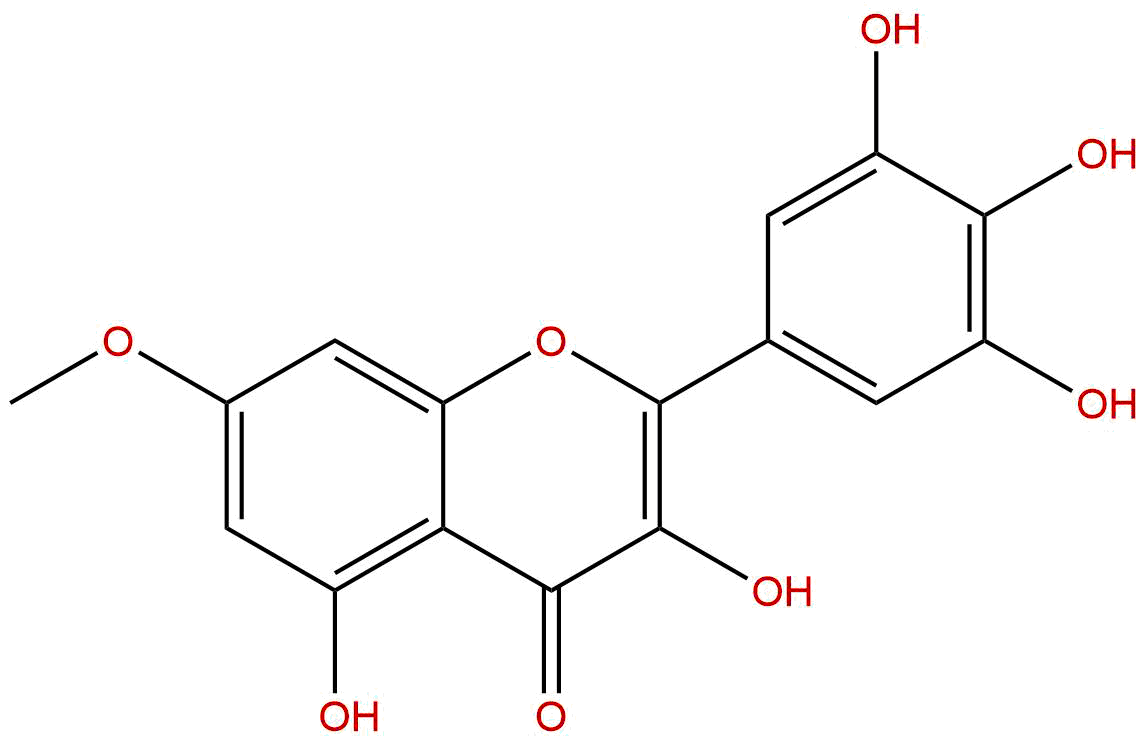
The chemical name of 7-O-methylmyricetin is 3,5,3 ', 4', 5 '- pentahydroxy-7-methoxyflavone, and its parent nucleus structure is a flavonoid skeleton (2-phenylchromenone). Compared with myricetin (3,5,7,3 ', 4', 5 '- hexahydroxyflavone), 7-O-methylmyricetin replaces the hydroxyl group (- OH) with a methoxy group (- OCH ∝) at position C-7, thus retaining five phenolic hydroxyl groups in the molecule, located at positions C-3, C-5, C-3', C-4 ', and C-5'. This structural feature allows it to possess both flavonol (C-3 hydroxyl group) and pyrogallol type (B ring 3 ', 4', 5 '- trihydroxy group) structural units.
From the perspective of structure-activity relationship, the introduction of the 7-methoxy group has multiple structural effects: firstly, as an electron donor group, the methoxy group may affect the electron cloud distribution of the flavonoid mother nucleus, thereby altering its antioxidant activity; Secondly, the hydrophobicity of methoxy groups is higher than that of hydroxyl groups, which can enhance the lipid solubility of molecules and facilitate transmembrane transport; Thirdly, the introduction of methoxy groups reduces the number of hydroxyl groups that can form hydrogen bonds in the molecule, which may alter its binding mode with protein targets; Finally, the presence of the 7-methoxy group can prevent II phase metabolic reactions such as glucuronidation and sulfation at this site, theoretically improving metabolic stability.
Physical and chemical property parameters
According to the calculated chemical data, the molecular weight of 7-O-methylmyricetin is 332.2600 Da, which is within the range of drug like molecular weight (<500 Da). Its lipid water partition coefficient (LogP) is 1.800, indicating that the molecule has moderate lipophilicity, which is beneficial for dissolution in the aqueous phase and has a certain membrane permeability. The topological polar surface area (TPSA) is 147.98 Å ², which is higher than the recommended upper limit of 140 Å ² for oral medications, indicating the possibility of intestinal absorption disorders. The molecule contains 8 hydrogen bond acceptors (including 5 hydroxyl oxygen and 3 ether oxygen atoms) and 5 hydrogen bond donors (5 phenolic hydroxyl groups), which give it the ability to form intermolecular hydrogen bonds and may affect its interaction with biomolecules.
It is worth noting that there are few reports in the literature on the experimental measurement parameters such as melting point and solubility of 7-O-methylmyricetin, which may be related to its low natural content and difficulty in obtaining pure products. Based on the experience of structurally similar compounds, it is speculated that this compound has good solubility in polar solvents such as methanol, ethanol, and dimethyl sulfoxide, but limited solubility in water. Its UV absorption characteristics should be similar to those of myricetin, showing two main absorption bands in the 240-280 nm (benzoyl system) and 300-380 nm (cinnamoyl system) regions.
Plant sources and extraction methods
Plant-based
7-O-methylmyricetin has relatively limited distribution in nature and mainly exists in medicinal plants of certain specific families and genera. The main sources reported so far include:
-
Anacardiaceae plants Like the Chinese parasol tree(Cotinus coggygria)The presence of 7-O-methylmyricetin was detected in the leaves and branches. As the source of the traditional Chinese medicine "tobacco pipe head grass", the chemical composition of Huangqiao has been extensively studied.
-
Fabaceae plants Some Astragalus species(Astragalus)Plants such as Astragalus membranaceus(Astragalus membranaceus)The compound was isolated from the root.
-
Myrtaceae plants Like guava(Psidium guajava)The leaves contain various methylated flavonoids, and 7-O-methylmyricetin is one of them.
-
Asteraceae plants: Partial mugwort(Artemisia)Plants, such as Artemisia annua(Artemisia annua)There are also reports in it.
-
Other sources The presence of this compound has also been detected in certain ferns and lichens.
It is worth noting that the content of 7-O-methylmyricetin in plants is usually low and often exists as a trace component, which poses challenges for its large-scale acquisition. The content of this compound varies significantly among different plant sources, production areas, harvest seasons, and tissue parts, with relatively high levels in young tissues.
Extraction and Separation Methods
Given the low content of 7-O-methylmyricetin in plant materials, its extraction and separation usually require the combination of multiple chromatographic techniques. The classic extraction process includes:
Extraction stage Dry plant materials are crushed and soaked in organic solvents or extracted by reflux. Common extraction solvents include methanol, ethanol, acetone, or their aqueous solutions. Considering the moderate polarity of the target compound, a 70% -80% methanol or ethanol aqueous solution usually has good extraction efficiency. The extraction temperature is generally controlled at 40-60 ℃ to avoid thermal degradation caused by high temperatures. To improve extraction efficiency, modern technologies such as ultrasound assisted extraction or microwave-assisted extraction can be used.
Preliminary purification After the extraction solution is concentrated under reduced pressure, liquid-liquid extraction is used for preliminary separation. Usually, solvents of different polarities such as petroleum ether, ethyl acetate, and n-butanol are used sequentially for fractional extraction, and 7-O-methylmyricetin is mainly enriched in the ethyl acetate extraction site.
chromatographic separation The crude extract is preliminarily separated by silica gel column chromatography, polyamide column chromatography, or macroporous adsorption resin column chromatography. Use chloroform methanol or ethyl acetate methanol systems for gradient elution to collect fractions rich in flavonoids. For further purification, Sephadex LH-20 gel column chromatography can be used to elute with methanol or methanol water system, and separation can be realized according to the difference of molecular size and adsorption.
Efficient preparation For pure products required for structural confirmation and activity research, preparative high-performance liquid chromatography (pre HPLC) is commonly used for final purification. Using a C18 reverse phase column as the stationary phase and acetonitrile water or methanol water (containing 0.1% formic acid or acetic acid) as the mobile phase, the separation of the target compound was achieved by optimizing the gradient program. The retention behavior of 7-O-methylmyricetin in reverse phase chromatography is between myricetin (with higher polarity and earlier elution) and fully methylated derivatives.
Structural Identification The purified compound was structurally confirmed by ultraviolet spectroscopy (UV), infrared spectroscopy (IR), mass spectrometry (MS), and nuclear magnetic resonance spectroscopy (NMR, including ¹ H-NMR, ¹ ³ C-NMR, and two-dimensional spectroscopy). Its characteristic NMR signals include the proton signal of the 7-methoxy group (δ H about 3.9 ppm, single peak) and the intermolecular coupling signal of H-6 and H-8 on the flavonoid mother nucleus (δ H about 6.2-6.5 ppm, d peak), J≈2 Hz)。
Pharmacological activity research
antioxidant activity
As a polyphenolic hydroxy flavonoid compound, 7-O-methylmyricetin exhibits significant antioxidant activity. Its antioxidant mechanism mainly includes direct clearance of free radicals, chelation of transition metal ions, and activation of endogenous antioxidant defense system.
In vitro chemical experiments showed that 7-O-methylmyricetin exhibited good scavenging activity against DPPH free radicals, ABTS cationic free radicals, and superoxide anion free radicals. Its antioxidant capacity is closely related to the catechol structure (3 ', 4', 5 '- trihydroxy) of the B ring in the molecule, which can provide hydrogen atom stable free radical intermediates. Compared with myricetin, the antioxidant activity of 7-O-methylmyricetin is slightly reduced, which may be due to the reduction of the number of hydroxyl groups that can participate in hydrogen atom transfer caused by the substitution of the 7-methoxy group. However, in the lipid peroxidation inhibition experiment, 7-O-methylmyricetin showed better activity than myricetin, indicating that the introduction of methoxy groups enhanced its antioxidant efficacy in the lipid environment.
In cell models, 7-O-methylmyricetin can effectively reduce oxidative stress induced by H ₂ O ₂ or tert butyl hydroperoxide, decrease intracellular reactive oxygen species (ROS) levels, protect mitochondrial membrane potential, and inhibit the production of lipid peroxidation product malondialdehyde (MDA). In addition, the compound can upregulate the expression of antioxidant enzymes such as superoxide dismutase (SOD), catalase (CAT), and glutathione peroxidase (GPx) by activating the nuclear factor E2 related factor 2 (Nrf2) signaling pathway, thereby enhancing the overall antioxidant capacity of cells.
anti-inflammatory activity
Inflammatory response is an important defense mechanism for the body to respond to injury and infection, but excessive or sustained inflammatory response is closely related to the occurrence and development of various chronic diseases. 7-O-methylmyricetin exhibits anti-inflammatory activity in various inflammatory models.
In a macrophage model stimulated by lipopolysaccharide (LPS), 7-O-methylmyricetin can significantly inhibit the production of pro-inflammatory mediators such as nitric oxide (NO), prostaglandin E ₂ (PGE ₂), tumor necrosis factor - α (TNF - α), interleukin-6 (IL-6), interleukin-1 β (IL-1 β), and other inflammatory factors. Its anti-inflammatory mechanism is closely related to the inhibition of the nuclear factor kappa B (NF - κ B) signaling pathway. Specifically, 7-O-methylmyricetin can block the phosphorylation and degradation of I κ B α, inhibit the nuclear translocation of NF - κ B p65 subunit, and thus suppress the transcription of downstream inflammatory genes.
In addition, the compound can also inhibit the mitogen activated protein kinase (MAPK) signaling pathway, including phosphorylation of ERK, JNK, and p38, further weakening the inflammatory response. In animal models of acute inflammation, oral administration of 7-O-methylmyricetin can alleviate carrageenan induced toe swelling in rats, reduce myeloperoxidase (MPO) activity and MDA content in inflamed tissues.
Antitumor activity
7-O-methylmyricetin showed proliferation inhibitory activity on a variety of tumor cell lines, including breast cancer (MCF-7, MDA-MB-231), liver cancer (HepG2, Huh7), colon cancer (HT-29, HCT-116), lung cancer (A549) and melanoma (B16). Its anti-tumor mechanism involves multiple levels:
Inducing cell apoptosis 7-O-methylmyricetin can induce tumor cell apoptosis through endogenous (mitochondrial) and exogenous (death receptor) pathways. After processing tumor cells, a decrease in mitochondrial membrane potential, release of cytochrome c, activation of caspase-9 and caspase-3, and upregulation of Bax/Bcl-2 ratio were observed. At the same time, the expression of death receptors Fas and FasL increased, and caspase-8 was activated.
cell cycle arrest This compound can block tumor cells in the G ₂/M phase or G ₀/G ₁ phase, and the specific effect varies depending on the cell type. Mechanism studies have shown that 7-O-methylmyricetin can downregulate the expression of cyclin B1, D1, and E, upregulate the levels of cyclin dependent kinase inhibitors p21 and p27, thereby inhibiting CDK activity.
Inhibit angiogenesis In the chicken embryo chorioallantoic membrane (CAM) model and Matrigel plug experiment, 7-O-methylmyricetin can inhibit the formation of new blood vessels. The mechanism is related to downregulating the expression of vascular endothelial growth factor (VEGF) and its receptor VEGFR2, as well as inhibiting the PI3K/Akt signaling pathway.
Reverse multidrug resistance Preliminary studies have shown that 7-O-methylmyricetin can partially reverse the resistance of tumor cells to chemotherapy drugs such as doxorubicin and paclitaxel, which may be related to the inhibition of P-glycoprotein (P-gp) efflux function.
Neuroprotective activity
Given its excellent antioxidant and anti-inflammatory properties, 7-O-methylmyricetin has also shown protective effects in neurodegenerative disease models. In the neurotoxic model induced by β - amyloid protein (A β), this compound can reduce A β aggregation, lower oxidative stress levels, and protect neuronal synaptic plasticity. In MPTP induced Parkinson's disease mouse model, 7-O-methylmyricetin pretreatment can alleviate damage to dopaminergic neurons, increase striatal dopamine levels, and improve motor dysfunction.
Other pharmacological activities
In addition to the main activities mentioned above, 7-O-methylmyricetin also exhibits biological activities such as antibacterial (especially against Staphylococcus aureus and Candida albicans), antiviral (such as influenza virus and enterovirus 71), hepatoprotective (protective against carbon tetrachloride and alcohol induced liver damage), and hypoglycemic (by inhibiting alpha glucosidase activity). These diverse pharmacological activities suggest that 7-O-methylmyricetin may be a natural product with multi-target action characteristics.
Mechanism of action and molecular targets
Direct target interaction
The pharmacological activity of 7-O-methylmyricetin originates from its direct interactions with various biomolecules. Molecular docking and surface plasmon resonance (SPR) experiments have shown that the compound can bind to various kinases, enzymes, and receptor proteins.
Kinase inhibition 7-O-methylmyricetin has varying degrees of inhibitory effects on PI3K, Akt, mTOR, MAPK family members (ERK, JNK, p38) and tyrosine kinases (such as EGFR, VEGFR2). The interaction between it and the ATP binding site is mainly achieved through the hydrogen bonding network between the B ring's pyrogallol structure and the kinase hinge region, while the 7-methoxy group may enhance binding stability through hydrophobic interactions.
Enzyme inhibition This compound can inhibit the activity of disease-related enzymes such as cyclooxygenase-2 (COX-2), lipoxygenase (LOX), xanthine oxidase (XOD), alpha glucosidase, and acetylcholinesterase (AChE). Its selective inhibitory activity against COX-2 is superior to COX-1, suggesting that it may have lower gastrointestinal side effects.
Receptor regulation 7-O-methylmyricetin can bind to estrogen receptors (ER) and aromatic hydrocarbon receptors (AhR), exerting selective regulatory effects. In addition, it can bind to the benzodiazepine site of GABA_A receptor, producing sedative and anti anxiety effects.
Signal pathway regulation
7-O-methylmyricetin exerts its pharmacological effects by regulating multiple key signaling pathways:
NF - κ B pathway Inhibiting the activity of I κ B kinase (IKK), preventing the degradation of I κ B α, reducing NF - κ B nuclear translocation, and thus inhibiting the transcription of pro-inflammatory genes.
Nrf2/ARE pathway Activate Nrf2, promote its dissociation from Keap1 and translocation to the nucleus, bind to antioxidant response elements (ARE), and upregulate the expression of phase II detoxifying enzymes and antioxidant enzymes.
PI3K/Akt/mTOR pathway Inhibiting PI3K activity, reducing Akt phosphorylation levels, and subsequently inhibiting the activation of mTOR and its downstream effector molecules S6K and 4E-BP1, exerting anti proliferative and pro apoptotic effects.
Wnt/β - catenin pathway By upregulating GSK-3 β activity, promoting phosphorylation and degradation of β - catenin, inhibiting Wnt signaling, and thus suppressing tumor cell proliferation and stemness maintenance.
P53 pathway Activate p53, upregulate p21 expression, induce cell cycle arrest and apoptosis.
Epigenetic regulation
Recent studies have found that 7-O-methylmyricetin may also exert biological effects through epigenetic mechanisms. This compound can inhibit histone deacetylase (HDAC) activity, especially HDAC1 and HDAC3, leading to an increase in acetylation levels of histones H3 and H4, thereby altering chromatin structure and gene expression. In addition, it can regulate the activity of DNA methyltransferase (DNMT), which may affect the methylation status of specific gene promoter regions.
Evaluation of drug properties and pharmacokinetics
Drug Evaluation
Based on the Lipinski Rule of Five and Veber Rule, the pharmacological parameters of 7-O-methylmyricetin are as follows: molecular weight 332.26 Da (<500), LogP 1.80 (<5), hydrogen bond donor 5 (<5), hydrogen bond acceptor 8 (<10), all of which meet the basic requirements for oral medication. However, its TPSA is 147.98 Å ², slightly higher than the recommended upper limit of 140 Å ², indicating the possibility of insufficient intestinal permeability. In addition, the five free phenolic hydroxyl groups in the molecule make it prone to phase II metabolism (glucuronidation and sulfation), which may lead to lower oral bioavailability.
safety evaluation
Preliminary toxicity evaluation shows that 7-O-methylmyricetin has good safety. Based on computational toxicology predictions, the compound has no hepatotoxicity, no cardiotoxicity, and does not inhibit hERG potassium channels, indicating a low risk of cardiac toxicity. However, the Ames test results are unknown, and its genetic toxicity needs to be experimentally verified. In acute toxicity experiments, there have been no reports on the LD ₅₀ values of 7-O-methylmyricetin in mice, but based on data from structurally similar compounds, it is speculated that its oral toxicity may be relatively low. Long term toxicity studies are still blank and require systematic evaluation.
Pharmacokinetic characteristics
At present, there is limited experimental data on the pharmacokinetics of 7-O-methylmyricetin, but reasonable speculation can be made based on the pharmacokinetic characteristics of myricetin. After oral administration, the absorption of myricetin is poor, and its absolute bioavailability is usually less than 10%, mainly due to first pass metabolism in the intestine and liver. 7-O-methylmyricetin, due to the substitution of the hydroxyl group at position 7 with a methoxy group, theoretically avoids glucuronidation and sulfation at this site and may have higher metabolic stability. However, the other five hydroxyl groups in the molecule can still serve as substrates for phase II metabolism.
In terms of distribution, the LogP of 7-O-methylmyricetin is 1.80, indicating that it has a certain degree of lipid solubility and may pass through the cell membrane through passive diffusion. The prediction of blood-brain barrier permeability as' Low 'suggests that the distribution of the central nervous system may be limited, which contradicts some neuroprotective activity research results and requires experimental verification. There are currently no reports on key parameters such as plasma protein binding rate, apparent distribution volume, and half-life.
In terms of metabolism, 7-O-methylmyricetin may undergo metabolic pathways such as O-demethylation (to produce myricetin), hydroxylation, glucuronidation, and sulfation. Cytochrome P450 enzymes (especially CYP1A1, CYP1B1, and CYP3A4) may be involved in their oxidative metabolism. The main excretion pathways may be bile excretion and renal excretion.
Formulation strategy
Given its potential bioavailability issues, developing appropriate formulation techniques is crucial for the clinical application of 7-O-methylmyricetin. Possible strategies include: phospholipid complexes (increasing lipid solubility), cyclodextrin inclusion complexes (increasing water solubility), nanoemulsions or liposomes (improving absorption), solid dispersions (increasing dissolution rate), and prodrug design (such as phosphate prodrugs). In addition, the combination use with P-glycoprotein inhibitors or metabolic enzyme inhibitors may also enhance their oral bioavailability.
Clinical application prospects and prospects
Potential indications
Based on existing pharmacological activity data, 7-O-methylmyricetin has potential application value in the following disease areas:
Inflammatory diseases Such as rheumatoid arthritis, inflammatory bowel disease, dermatitis, etc. Its multi-target anti-inflammatory mechanism and good safety features make it a candidate molecule for developing novel anti-inflammatory drugs.
neoadjuvant therapy As a chemotherapy sensitizer, when used in combination with conventional chemotherapy drugs, it may improve efficacy and reduce drug resistance. Its anti angiogenic activity also makes it potentially valuable in tumor treatment.
Metabolic diseases: such as type 2 diabetes and obesity. Its alpha glucosidase inhibitory activity and antioxidant properties help control blood sugar and improve insulin resistance.
Neurodegenerative diseases Such as Alzheimer's disease and Parkinson's disease. Its antioxidant, anti-inflammatory, and anti A β aggregation activities suggest its potential in neuroprotection.
Liver protection The protective effect on chemical liver injury makes it possible to use it as an adjuvant therapy for liver disease.
Current research bottleneck
Although 7-O-methylmyricetin exhibits various pharmacological activities, its research and development still face many challenges:
-
Limited natural sources The compound has low content in plants and is difficult to obtain on a large scale, which limits systematic in vitro and in vivo research.
-
Lack of pharmacokinetic data Currently, there is a lack of systematic absorption, distribution, metabolism, and excretion (ADME) research, making it difficult to accurately evaluate its in vivo efficacy and toxicity.
-
Insufficient in-depth research on the mechanism of action Although multiple molecular targets have been identified, the interaction network between each target, confirmation of key targets, and study of structure-activity relationships are still insufficient.
-
Lack of preclinical safety evaluation Long term toxicity, reproductive toxicity, immune toxicity and other safety data are missing.
-
Delayed research on formulations The development of formulations targeting their solubility and bioavailability issues has not yet been systematically carried out.
Future research directions
To promote the drug development of 7-O-methylmyricetin, future research should focus on:
-
Synthetic Biology and Chemical Synthesis Develop efficient chemical synthesis routes or utilize synthetic biology techniques to construct engineering strains, achieving large-scale preparation of the compound.
-
Structural optimization and structure-activity relationship Based on the skeleton of 7-O-methylmyricetin, design and synthesize a series of derivatives, systematically study the effects of various substituents on activity and pharmacokinetic properties, and search for lead compounds with better drug properties.
-
Systematic pharmacokinetic study Establish a sensitive LC-MS/MS biological sample analysis method, conduct ADME studies in rats or mice, and clarify their metabolic pathways and pharmacokinetic characteristics.
-
Target confirmation and mechanism elucidation Combining chemical proteomics, CRISPR screening, and gene knockout animal models, identify key target genes and elucidate molecular mechanisms.
-
Formulation development Explore strategies such as nanotechnology, phospholipid complexes, and prodrug design to improve their oral bioavailability.
-
Clinical translational research After completing sufficient preclinical evaluation, conduct clinical trials to verify its efficacy and safety in specific indications.
Conclusion
7-O-methylmyricetin, as a natural methylated derivative of myricetin, has obtained unique physicochemical properties and biological activity spectra by introducing a 7-methoxy group while retaining the antioxidant properties of polyphenolic hydroxyl groups. Existing research has revealed its pharmacological activities in multiple fields such as antioxidant, anti-inflammatory, anti-tumor, neuroprotective, etc. The mechanism of action involves the regulation of multiple signaling pathways and molecular targets. The evaluation of drug properties indicates that the compound has good drug like and safety basis, but its low oral bioavailability and lack of pharmacokinetic data are the main bottlenecks restricting its development.
From the perspective of natural product drug development, 7-O-methylmyricetin represents a class of lead compounds with multi-target action characteristics, and its structural framework provides an ideal modification platform for medicinal chemists. In the future, through chemical synthesis, structural optimization, formulation innovation, and systematic pharmacological evaluation, it is expected to transform this natural product into a candidate drug with clinical application value. Meanwhile, in-depth research on 7-O-methylmyricetin will also provide important references for understanding the biological significance of flavonoid methylation modification, and promote the development of natural product chemistry and pharmacology.
It is worth noting that research on natural products should not be limited to activity discovery, but should focus on solving key scientific problems in the process of transforming "natural active molecules" into "clinical drugs". The research process of 7-O-methylmyricetin embodies this concept - from the discovery of plant chemistry, to the exploration of pharmacological activity, to the evaluation of drug properties and mechanism elucidation, each step requires interdisciplinary integration. I believe that with the advancement of research methods and the deepening of scientific problems, this ancient and novel natural product will eventually demonstrate its true value in the field of human health.