


Product name: Homoharringtonine
Synonym name: Omacetaxine mepesuccinate
Catalogue No.: BP0732
Cas No.: 26833-87-4
Formula: C29H39NO9
Mol Weight: 545.629
Botanical Source: Cephalotaxus fortunei Hook. f.
Physical Description:
Type of Compound: Alkaloids
Purity: 95%~99%
Analysis Method: HPLC-DAD or/and HPLC-ELSD
Identification Method: Mass, NMR
Packing: Brown vial or HDPE plastic bottle
Storage: Store in a well closed container, protected from air and light. Put into refrigerate or freeze for long term storage.
Whenever possible, you should prepare and use solutions on the same day. However, if you need to make up stock solutions in advance, we recommend that you store the solution as aliquots in tightly sealed vials at -20℃. Generally, these will be useable for up to two weeks.
The product could be supplied from milligrams to grams
Inquire for bulk scale.
Chengdu Biopurify Phytochemicals Ltd. is a leading company in the research, development, manufacture and marketing of High Quality Phytochemicals and Extracts(especially Active Ingredients from Traditional Chinese Medicine,TCM), Natural Active Pharmaceutical Ingredients worldwide.
The main services:
A. Supply active ingredients and reference standards of TCM, from mgs to kgs scale
B. Custom extraction and purification, target Herb Active Ingredients
C. Custom synthesis and semi-synthesis for Natural Active Ingredients
D. CR(contract research), CM(contract manufacture) and PD(process development) services from lab scale, pilot scale to commercial scale(GMP is also available)
E. TCM compounds library for drug screen,more than 3000 compounds available, many of them are rare and unique.
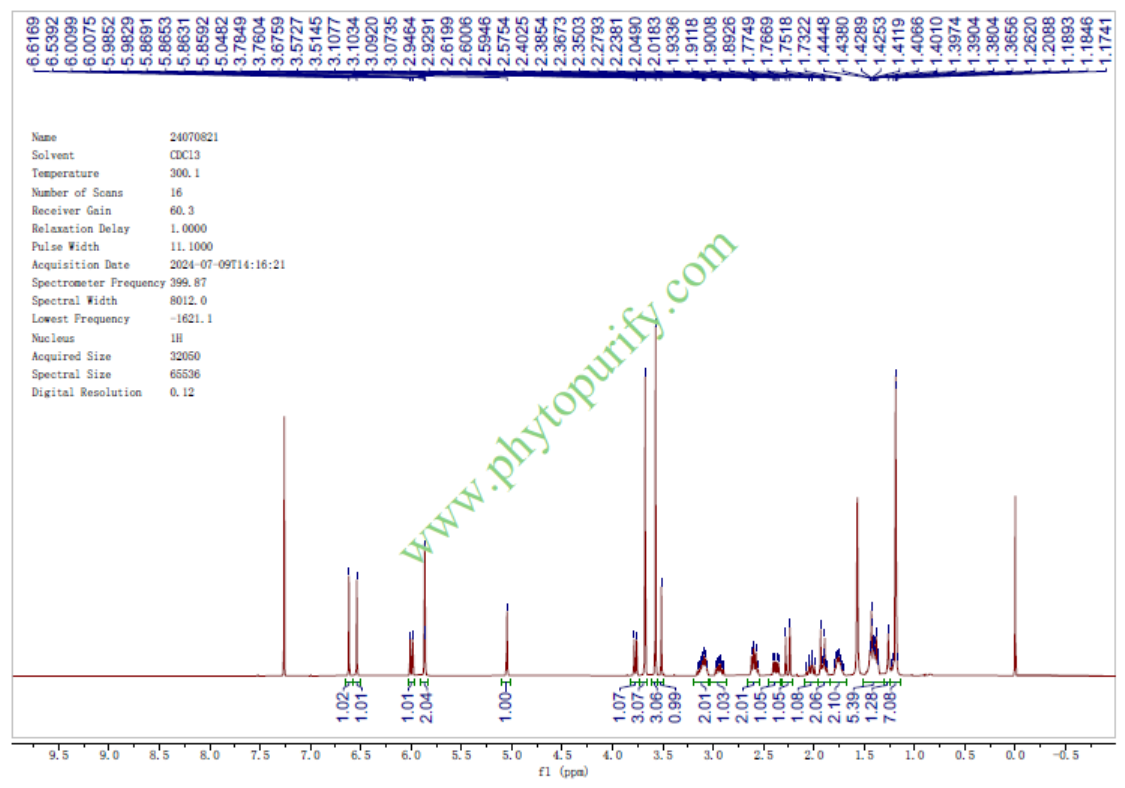
HNMR of Homoharringtonine
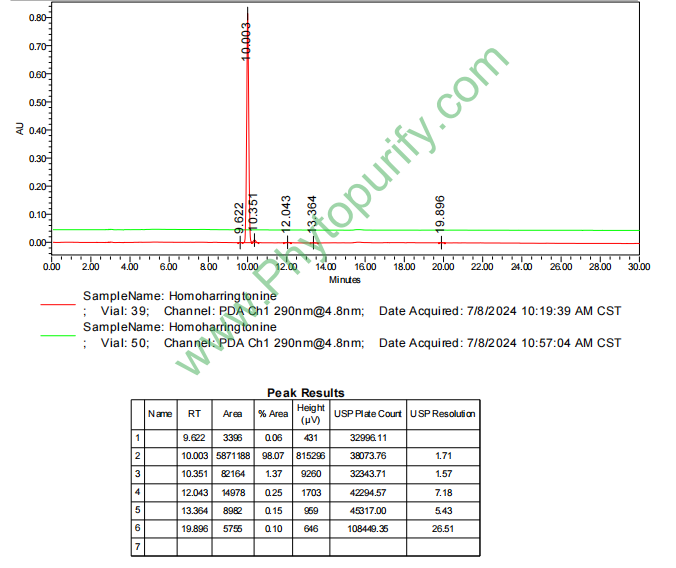
HPLC of Homoharringtonine
Storage conditions:Short-term storage at 2~8℃, long-term storage at -20 ~ -80℃
Homoharingtonine (HHT) is a natural product with significant anti-tumor activity, originally isolated from plants of the genus Cryptomeria. As a cytotoxic alkaloid, HHT exerts its anti-cancer effect by inhibiting the protein translation elongation stage, particularly demonstrating unique therapeutic effects in the field of leukemia treatment. In recent years, with the deepening of molecular biology and pharmacology research, the mechanism of action, molecular targets, and pharmacological characteristics of homoquercetin have been systematically elucidated, providing a solid scientific basis for its clinical application. This article aims to comprehensively review the chemical structure, plant origin, pharmacological activity, mechanism of action, pharmacological properties, and clinical application prospects of homoquercetin, with the hope of providing reference for the fields of natural product pharmacology and anti-tumor drug development.
The molecular formula of homoquercetin is C29H39NO9, with a molecular weight of 545.6290 and a CAS number of 26833-87-4. Its chemical structure belongs to the alkaloid class, with a complex terpenoid skeleton and multiple hydroxyl and ester functional groups. The structure contains multiple chiral centers, giving it a high degree of stereoselectivity. The LogP value of HHT is 2.2768, indicating that it has moderate lipid solubility, which is beneficial for membrane penetration. The polar surface area (TPSA) is 123.9900, indicating that the molecule has a certain polarity that affects its water solubility and bioavailability. The water solubility is relatively low, about 0.2827 mg/mL, indicating the need to optimize solubility in pharmaceutical formulations to improve bioavailability. The compound has low blood-brain barrier permeability, reducing the risk of central nervous system toxicity. The negative result of hERG channel inhibition experiment indicates a low risk of cardiac toxicity. The Ames mutagenicity test showed a value of 0.0, indicating a low risk of genotoxicity and meeting safety requirements.
The main source of sophocarpine is from plants of the Cephalotaxus genus, especially Cephalotaxus harringtonia, which has a higher content. This genus of plants is distributed in East Asia and has traditionally been used in traditional Chinese medicine. The extraction of HHT usually adopts organic solvent extraction combined with multi-step chromatographic separation technology. The classic extraction process includes:
In recent years, with the promotion of green chemistry concepts, supercritical fluid extraction and microwave-assisted extraction technologies have also been attempted to be applied to the extraction of HHT, improving extraction efficiency and environmental friendliness.
As an anti-tumor drug, homoquercetin has shown significant efficacy, especially in the treatment of leukemia. Its pharmacological activity is mainly reflected in the following aspects:
Anti leukemia activity
HHT exhibits cytotoxicity towards various leukemia cell lines, including acute myeloid leukemia (AML) and chronic myeloid leukemia (CML). Clinical studies have shown that HHT can induce apoptosis in leukemia cells, inhibit cell proliferation, and improve patient survival rates.
Inducing cell apoptosis
HHT promotes cell apoptosis by regulating multiple signaling pathways within cells. Its mechanism of action involves downregulation of anti apoptotic proteins MCL1 and BCL2, activating the mitochondrial dependent apoptotic pathway.
Inhibit tumor stem cells
Research shows that HHT can target leukemia stem cells, reduce their self-renewal ability, and lower the risk of recurrence.
Anti multidrug resistance
HHT has activity against multidrug-resistant leukemia cells, which can overcome the resistance of traditional chemotherapy drugs and improve treatment efficacy.
Other types of tumors
Although it is mainly used in leukemia, the anti-tumor activity of HHT in solid tumors such as lung cancer, breast cancer and so on has gradually been reported, showing a broad application potential.
The anti-tumor effect of homoquercetin is mainly achieved by inhibiting the translation elongation stage of protein synthesis. The specific mechanism includes:
Suppress translation delay
HHT binds to ribosomes, blocking the process of peptide chain elongation, leading to hindered synthesis of new proteins, cellular dysfunction, and ultimately inducing cell death.
Regulating key molecular targets
SIRT1 Regulating the deacetylase SIRT1, participating in cellular stress response and metabolic regulation.
Multi target synergistic effect
HHT synergistically regulates the survival, proliferation, and apoptosis of tumor cells through multiple targets and pathways, overcoming the resistance problem of single target drugs and improving treatment efficacy.
High altitude sophocarpine has good medicinal properties:
In terms of pharmacokinetics, HHT has low oral bioavailability and is mainly administered through subcutaneous injection or intravenous infusion. Widely distributed in the body, metabolism is mainly through the liver enzyme system, with a moderate half-life, making it easy to adjust clinical dosage. The clearance rate and toxicity of metabolites are both within a controllable range.
As an anti leukemia drug, homoquercetin has been approved by multiple countries for the treatment of patients with chronic myeloid leukemia (CML) who are resistant or intolerant to tyrosine kinase inhibitors (TKIs). Clinical data shows that HHT combined with other chemotherapy drugs can significantly improve response rates and survival.
The key areas for future clinical applications include:
In addition, the design and synthesis of derivatives based on HHT structure are also actively promoted, aiming to enhance activity, reduce toxicity, improve pharmacokinetic performance, and promote the development of new generation anti-tumor drugs.
As a natural anti-tumor drug, homosophocarpine has made significant progress in the field of leukemia treatment due to its unique mechanism of action and multi-target regulatory ability. Its good medicinal properties and safety have laid the foundation for clinical application. In the future, with the advancement of molecular targeting technology and drug design, HHT and its derivatives are expected to play a greater role in anti-tumor therapy. In depth research on its mechanism of action, optimization of drug formulations, and combination therapy strategies will promote the wider clinical application of homosophocarpine and bring new hope to cancer patients.
