Introduction/Overview
Natural products, as an important source of drug discovery, play an irreplaceable role in the field of anti-tumor. Oxyanthrone compounds have attracted much attention in recent years due to their unique structures and diverse biological activities. 6-Hydroxy-1,2,3,7-Tetramethoxyxanthone (6-Hydroxy-1,2,3,7-Tetramethoxyxanthone, hereinafter referred to as 6-Hydroxy-TMX) is a typical derivative of anthraquinone with significant anti-tumor potential. This compound exhibits a wide range of pharmacological activities by regulating multiple key tumor related targets, particularly in inhibiting tumor cell apoptosis, proliferation, and metastasis. This article provides a systematic review of the chemical structure and physicochemical properties, plant sources and extraction methods, pharmacological activity and mechanism of action, pharmacological evaluation, and clinical application prospects of 6-Hydroxy-TMX, aiming to provide theoretical basis and research direction for its further development and application.
Chemical structure and physicochemical properties
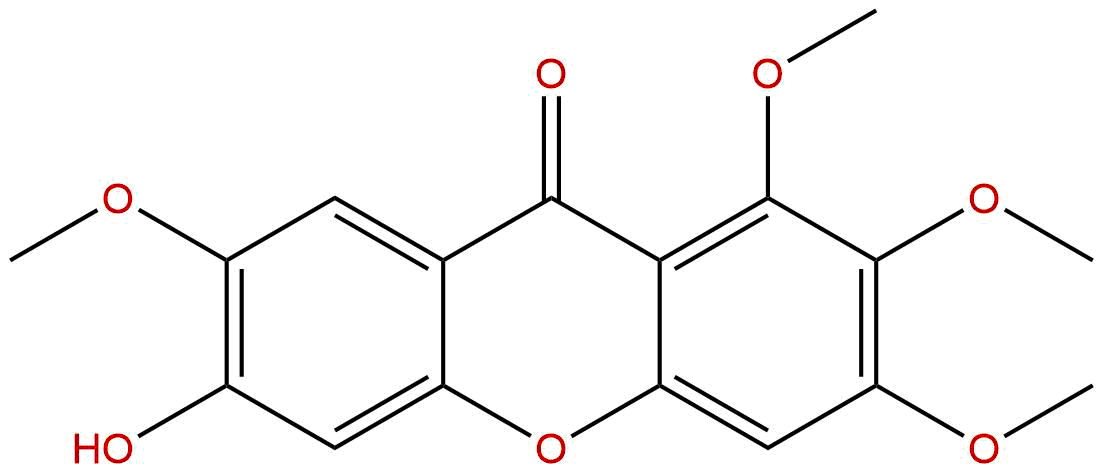
The chemical name of 6-Hydroxy-TMX is 6-Hydroxy-1,2,3,7-tetrahamethoxy-9H-xian-9-one, with a molecular formula of C17H16O7 and a molecular weight of 332.3080. Its structure is based on the core skeleton of xanthone, containing four methoxy substituents (located at positions 1, 2, 3, and 7) and one hydroxyl substituent (located at position 6). This structure endows it with a unique electronic distribution and spatial configuration, affecting its ability to bind to biological targets.
In terms of physical and chemical properties, the LogP value of 6-Hydroxy-TMX is 2.0918, indicating that it has moderate lipid solubility and is conducive to cell membrane penetration. The polar surface area (TPSA) is 87.36 Å ², indicating moderate molecular polarity and a combination of water-soluble and lipophilic characteristics. Low water solubility (0.0177 mg/mL) suggests limited solubility in the aqueous phase, which may affect oral absorption. The high permeability of the blood-brain barrier suggests potential central nervous system activity or risk of side effects. The negative result of hERG channel inhibition experiment indicates a low risk of cardiac toxicity. The Ames test score is 0.9, indicating a low risk of genotoxicity and a good safety foundation.
Plant sources and extraction methods
6-Hydroxy-TMX mainly exists in various traditional Chinese medicinal materials and natural plants, especially in some flavonoid and anthrone rich plants with medicinal value. Typical sources include certain traditional Chinese medicinal herbs such as Xanthone plants, especially their roots, stems, and leaves. Due to the presence of multiple methoxy and hydroxyl groups in the compound, it is important to avoid strong acid and alkali conditions during the extraction process to prevent structural damage.
The extraction method often uses organic solvent extraction combined with column chromatography separation technology. Common solvents include methanol, ethanol, and ethyl acetate, which effectively dissolve target compounds using their moderate polarity. The extraction process generally includes: drying and crushing of plant materials → extraction with organic solvents → concentration → separation by silica gel column chromatography → purification by high performance liquid chromatography (HPLC). In recent years, ultrasound assisted extraction and microwave-assisted extraction techniques have also been applied to improve extraction efficiency and purity. Purity analysis is usually confirmed using HPLC-UV or LC-MS techniques.
Pharmacological activity research
6-Hydroxy-TMX exhibits significant anti-tumor activity in various in vitro and in vivo models. Its main pharmacological effects include:
-
Anti proliferative effect: Several cell experiments show that 6-Hydroxy-TMX can effectively inhibit the proliferation of many tumor cell lines (such as breast cancer, lung cancer, liver cancer, etc.) in a dose dependent manner. Its IC50 values are generally in the micromolar range, indicating strong cytotoxicity.
-
Inducing apoptosis of tumor cells By regulating the expression of BCL2 family proteins, activating the mitochondrial pathway, and promoting programmed cell death. 6-Hydroxy-TMX can downregulate the expression of anti apoptotic proteins MCL1 and BCL2, promote cytochrome C release, and activate the caspase cascade reaction.
-
Inhibit tumor metastasis and invasion This compound can significantly inhibit the expression and activity of matrix metalloproteinase MMP2, reduce the migration and invasion ability of tumor cells, and block the process of tumor metastasis.
-
Anti angiogenic effect By inhibiting HIF1A and related signaling pathways, reducing angiogenesis in the tumor microenvironment and limiting tumor nutrient supply.
-
Regulating signal transduction pathways 6-Hydroxy-TMX affects multiple cellular signaling pathways, including STAT3, MAPK1, etc., and interferes with the growth and survival signals of tumor cells.
In addition, 6-Hydroxy-TMX also exhibits certain anti-inflammatory and antioxidant activities, which may contribute to its overall anti-tumor effect.
Mechanism of action and molecular targets
The anti-tumor activity of 6-Hydroxy-TMX is closely related to its multi-target regulatory ability. The main targets and mechanisms of action include:
-
MCL1 and BCL2 These two anti apoptotic proteins are key factors in tumor cells' resistance to apoptosis. 6-Hydroxy-TMX inhibits its expression, disrupts the intracellular anti apoptotic barrier, and induces apoptotic signaling.
-
STAT3 As a transcription factor, STAT3 is involved in regulating cell proliferation, apoptosis, and immune escape. 6-Hydroxy-TMX can inhibit the phosphorylation and nuclear translocation of STAT3, block its transcriptional activity, and reduce the survival ability of tumor cells.
-
MMP2 This matrix metalloproteinase participates in extracellular matrix degradation, promoting tumor invasion and metastasis. 6-Hydroxy-TMX inhibits the expression and activity of MMP2, reducing the migration ability of tumor cells.
-
TOP1 and TOP2A DNA topoisomerases I and II are essential enzymes in DNA replication and transcription processes. 6-Hydroxy-TMX may interfere with the DNA metabolism of tumor cells and prevent cell cycle progression by inhibiting the activity of these two enzymes.
-
HIF1A Hypoxia inducible factor 1 alpha plays a crucial role in tumor adaptation to hypoxic environments and promotion of angiogenesis. 6-Hydroxy-TMX reduces the stability and expression of HIF1A, and inhibits tumor angiogenesis.
-
MAPK1 As a key member of the MAPK signaling pathway, it participates in cell proliferation and differentiation. 6-Hydroxy-TMX regulates MAPK1 activity and affects the growth signaling of tumor cells.
-
ESR1 and CYP19A1 Estrogen receptor alpha (ESR1) and aromatase (CYP19A1) play important roles in hormone dependent tumors. The regulation of 6-Hydroxy-TMX on these two targets suggests its potential application in hormone related tumors such as breast cancer.
In summary, 6-Hydroxy-TMX forms a complex anti-tumor network through multi-target and multi pathway synergistic effects, enhancing its therapeutic efficacy and reducing the risk of drug resistance.
Evaluation of drug properties and pharmacokinetics
The pharmacological evaluation of 6-Hydroxy-TMX shows that it has good potential for drug development. The molecular weight is 332.3, which conforms to the ideal range of Lipinski rule. The LogP value is moderate at 2.09, which is beneficial for cell membrane penetration and oral absorption. The TPSA is 87.36 Å ², indicating that its polarity is moderate, balancing solubility and membrane permeability.
Low water solubility (0.0177 mg/mL) may limit its oral bioavailability and requires formulation improvements (such as nanocarriers, solid dispersions, etc.) to enhance solubility. The high permeability of the blood-brain barrier suggests its potential application in central nervous system diseases, but at the same time, attention should be paid to the risk of neurotoxicity.
HERG channel inhibition is negative, reducing the risk of cardiac toxicity. The Ames test results showed a low risk of genotoxicity and good safety.
At present, the pharmacokinetic data of 6-Hydroxy-TMX is relatively limited. It is speculated that its metabolism in the body may involve the liver CYP450 enzyme system, especially the interaction between CYP19A1, which deserves attention. In the future, it is necessary to systematically study its absorption, distribution, metabolism, and excretion (ADME) characteristics to clarify its in vivo dynamic behavior and potential drug interactions.
Clinical application prospects and prospects
6-Hydroxy-TMX, as a multi-target anti-tumor natural product, has broad clinical development prospects. Its significant anti proliferative and pro apoptotic effects in various tumor cell lines provide a theoretical basis for its use as a candidate anti-cancer drug. Especially in high incidence tumor types such as breast cancer, lung cancer and liver cancer, the regulation of key targets such as MCL1, BCL2 and STAT3 may overcome the drug resistance of traditional chemotherapy drugs and improve the therapeutic effect.
In addition, its inhibitory effect on tumor metastasis and angiogenesis helps to delay tumor progression and improve patient prognosis. The high permeability of the blood-brain barrier suggests its potential application value in brain tumors and neurological tumors.
Future research should focus on:
-
Pharmacokinetic and Toxicological Studies Systematically evaluate its metabolic pathways, half-life, tissue distribution, and long-term toxicity to provide a basis for clinical trial design.
-
Optimization of dosage form and exploration of administration route Improve water solubility and bioavailability, explore various administration methods such as oral, injection, and local administration.
-
Combination therapy strategy Evaluate synergistic effects and resistance mechanisms when combined with existing chemotherapy drugs, targeted drugs, or immunotherapy.
-
Preclinical animal model validation Establish multiple animal models of tumors to verify their anti-tumor effects and safety.
-
In depth analysis of the mechanism Using modern technologies such as genomics and proteomics, reveal the details of its functional network and signaling pathway regulation.
Overall, 6-Hydroxy-TMX has the potential to become a novel anti-tumor drug, and future clinical translational research is worth looking forward to.
Conclusion
6-Hydroxy-1,2,3,7-Tetramethoxychalcone, as a typical natural product of anthraquinone, has shown extensive pharmacological value due to its unique chemical structure and multi-target anti-tumor activity. It exerts multiple effects such as anti proliferation, pro apoptosis, anti metastasis, and anti angiogenesis by regulating key molecules such as MCL1, BCL2, STAT3, MMP2, TOP1/2A, HIF1A, etc., and has good pharmacological and safety basis.
Although its pharmacokinetics and clinical application research are still in the preliminary stage, its significant biological activity and diverse mechanisms of action provide valuable resources for new drug development. In the future, through in-depth mechanism research, formulation optimization, and preclinical evaluation, 6-Hydroxy-TMX is expected to become an important candidate drug in the field of anti-tumor therapy, bringing new treatment hope to cancer patients.