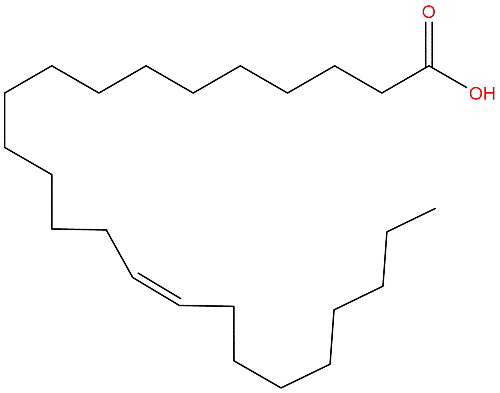


Product name: Nervonic Acid
Synonym name: cis-15-Tetracosenoic Acid; Selacholeic Acid
Catalogue No.: BP3727
Cas No.: 506-37-6
Formula: C24H46O2
Mol Weight: 366.63
Botanical Source: Seeds of Acer truncatum Bunge
Physical Description: White Cryst.
Type of Compound: Aliphatic acid
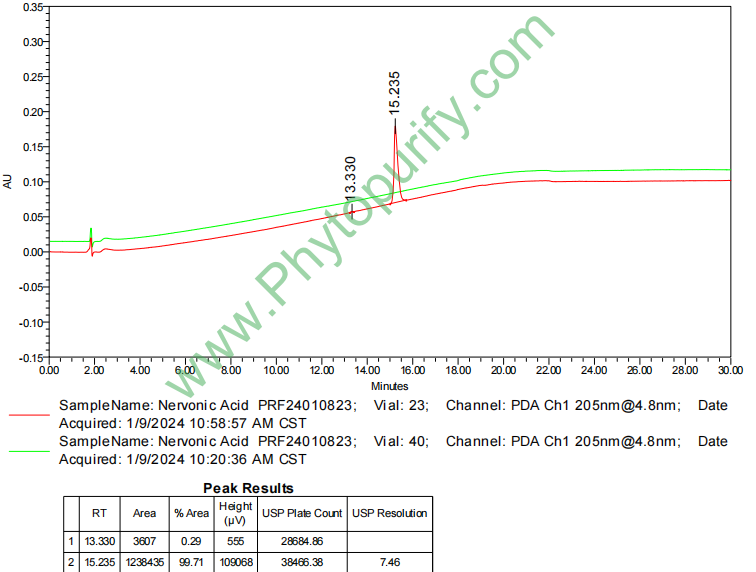
Purity: 75%,85%, 95% by GC
Analysis Method: GC or HPLC-ELSD
Identification Method: Mass, NMR
Packing: Brown vial or HDPE plastic bottle
The product could be supplied from milligrams to grams, up to kilograms.
Inquire for bulk scale.
HPLC of Nervonic Acid
Storage conditions:Short-term storage at 2~8℃, long-term storage at -20 ~ -80℃
37.3000
9.9069
7.6990
.0003
4.1929
2.6431
High
96.4227
2.0840
No
Yes
No
No
No
No
0.0
No
No
Yes
No
Nervonic acid, also known as (15Z) - tetradecenoic acid, is a naturally occurring ultra long chain monounsaturated fatty acid. Since its discovery in the early 20th century, neuroacids have received continuous attention due to their unique distribution and potential biological functions in the nervous system. As an important component of the brain's nerve cell membrane and myelin sheath, neuroacids play a crucial role in maintaining the structural and functional integrity of the nervous system. In recent years, with the aging of the population and the rise of the incidence rate of neurodegenerative diseases, the search for effective neuroprotective agents has become a hot area of drug research and development. Neuroacids, due to their excellent blood-brain barrier penetration ability and multi-target neuroprotective mechanism, have gradually transformed from ordinary fatty acids into natural product candidate compounds with development prospects.
Neuroacids are widely distributed in nature, especially abundant in plant seed oils and certain marine organisms. Traditionally, neuroacids have been considered to be mainly involved in the biosynthesis and repair of myelin sheaths, but recent studies have revealed their important roles in regulating multiple pathological processes such as cell apoptosis, oxidative stress, neuroinflammation, and protein aggregation. These findings provide a scientific basis for the application of neuroacids in neurological diseases such as Alzheimer's disease, multiple sclerosis, and stroke. This article will provide a systematic review of the research progress of neuroacids from the aspects of chemical structure, natural sources, pharmacological activity, mechanism of action, drug evaluation, and clinical application prospects.
The chemical name of nervonic acid is (15Z) - tetradecenoic acid, with a molecular formula of C24H46O2 and a molecular weight of 366.63 g/mol. Its structural feature is a straight chain fatty acid containing 24 carbon atoms, with a cis double bond between C15 and C16. This structure makes the neural acid belong to the ω -9 series of monounsaturated fatty acids, with its double bond position 15 carbon atoms away from the carboxyl end and 9 carbon atoms away from the methyl end. The IUPAC name for neural acid is (15Z) - tetracos-15-enoic acid, with CAS registration number 506-37-6.
The cis double bond configuration of neuroacids results in a bending of approximately 30 ° at the double bond, which is crucial for their function in biological membranes. Compared with saturated fatty acids, the bent structure of nerve acids can increase the fluidity and flexibility of cell membranes, which is of great significance for the normal function of nerve cell membranes and myelin sheaths. Neuronal acid, as a conjugated acid of (15Z) - tetradecenoic acid, mainly exists in anionic form under physiological pH conditions, with a pKa value of approximately 4.8 for its carboxyl group.
Neuroacids are long-chain fatty acids with typical physicochemical properties of fatty acids. Its LogP value is 9.9069, indicating that the compound has extremely high lipid solubility, which allows it to easily cross lipid rich cell membranes and the blood-brain barrier. The water solubility of nervonic acid is extremely low, only 0.0003 mg/mL, which is consistent with its long carbon chain and hydrophobic structure. At room temperature, neuroacids appear as white or pale yellow waxy solids with a melting point of approximately 42-44 ° C. Their total polar surface area (TPSA) is 37.30 Å ², mainly contributed by carboxyl groups, which is much lower than the upper limit of 140 Å ² typically required for oral medications, indicating good membrane permeability.
Neuroacids have good chemical stability, but the presence of cis double bonds makes them more sensitive to oxidation and photolysis. Under long-term exposure to air or high temperature conditions, neuroacids may undergo auto oxidation reactions, producing peroxides and aldehyde degradation products. Therefore, neuroacids usually need to be stored at low temperatures, away from light, and under inert gas protection. In addition, neuroacids are soluble in organic solvents such as ethanol, chloroform, and ether, but insoluble in water. This property has important guiding significance for their extraction, purification, and formulation development.
Neuroacids are widely distributed in nature, but the sources of high content are relatively limited. Traditionally, neuroacids are mainly obtained from marine organisms such as shark brain tissue and certain deep-sea fish. However, due to resource conservation and sustainability considerations, plant-based neuroacids are increasingly being valued.
In higher plants, neuroacids are mainly present in seed oils of certain specific families and genera. Among them, the most representative plant sources include:
Garlic fruit (Malaya oleifera)A rare plant unique to China, its kernel oil contains up to 40-50% of nerve acids, making it the plant source with the highest known nerve acid content. Garlic fruit is mainly distributed in Yunnan, Guangxi and other places, but due to the scarcity of wild resources, it has been listed as a national second-class protected plant.
Acer truncatum The content of nerve acids in its kernel oil is about 5-6%. Although the content is not as high as that of garlic fruit, Acer truncatum, as an ornamental and greening tree species, has a large resource and good development potential.
Falling Bell (Cardiospermum halicacabum)The content of nerve acids in seed oil is about 10-15%, making it a promising source of herbaceous plants for development.
Other sources Including mustard seed oil, rapeseed oil, flaxseed oil, etc., but the content of nerve acids is usually low (<2%).
The extraction of nervonic acid is usually carried out by solvent extraction, which utilizes its lipophilicity to extract oil from plant seeds. Common extraction solvents include non-polar solvents such as n-hexane, petroleum ether, and ether. To improve extraction efficiency, Soxhlet extraction or supercritical CO2 extraction techniques can be used. Supercritical CO2 extraction has the advantages of low operating temperature, no solvent residue, and good selectivity, making it particularly suitable for the extraction of thermosensitive fatty acids.
The separation and purification of nervonic acid from crude oil usually requires the following steps:
Saponification and acidification Saponify the oil with alkaline solution to release fatty acids in the form of salts, and then acidify to obtain a mixture of free fatty acids.
Low temperature crystallization method By utilizing the characteristic of reduced solubility of neuraminic acid at low temperatures, neuraminic acid is preferentially crystallized and precipitated by controlling the temperature. This method is easy to operate, but its purity is limited.
Legitimate urea package By utilizing the characteristic of urea forming inclusion complexes with straight chain fatty acids and controlling the ratio of urea to fatty acids and crystallization temperature, neural acids can be selectively separated. This method has a good separation effect on monounsaturated fatty acids.
Chromatographic separation method High purity neuroacids can be obtained through methods such as silica gel column chromatography and reverse phase high performance liquid chromatography (RP-HPLC). Among them, silver ion chromatography utilizes the coordination effect between silver ions and double bonds, and has excellent separation selectivity for monounsaturated fatty acids.
In recent years, enzymatic enrichment technology has also received attention. The selective esterification or hydrolysis of fatty acids by lipase can achieve efficient enrichment of neuroacids. In addition, the combination of molecular distillation technology and urea encapsulation method has achieved the production of neural acid with a purity of over 90% on an industrial scale.
The most widely studied pharmacological activity of neuroacids is their neuroprotective effect. Numerous in vitro and in vivo studies have confirmed that neuroacids can protect nerve cells from various damaging factors. In vitro experiments have shown that neural acid pretreatment can significantly reduce neuronal apoptosis induced by glutamate, hydrogen peroxide, or β - amyloid protein (A β), and improve cell survival rate. In animal models, administration of neuroacids can alleviate cerebral ischemia-reperfusion injury, reduce infarct volume, and improve neurological function scores.
The neuroprotective effect of neuroacids is closely related to their regulation of cell apoptosis signaling pathways. Research has shown that neuroacids can upregulate the expression of anti apoptotic protein BCL2, while inhibiting the activation of pro apoptotic protein BAX, thereby maintaining mitochondrial membrane potential stability, reducing the release of cytochrome c, and activating CASP9. In addition, neuroacids can enhance the adaptability of cells to oxidative stress and energy metabolism disorders by activating the SIRT1 signaling pathway.
As an important component of myelin sheath, neuroacids play a crucial role in the biosynthesis and repair process of myelin sheath. Myelin sheath is a multi-layered lipid structure wrapped around nerve axons, which is crucial for the rapid transmission of nerve impulses. Damage and loss of myelin sheaths are the main causes of neurological dysfunction in demyelinating diseases such as multiple sclerosis.
Research has found that neuroacids can promote the differentiation and maturation of oligodendrocyte precursor cells, and increase the expression of myelin basic protein (MBP). In an experimental autoimmune encephalomyelitis (EAE) model, neuroacid therapy can reduce demyelination, promote myelin regeneration, and improve motor function. These effects may be related to the substrate of myelin lipid synthesis by neuroacids, as well as their function in regulating cell membrane fluidity and signal transduction.
Neuroacids exhibit significant anti-inflammatory and antioxidant activities. In a small glial cell model activated by lipopolysaccharide (LPS), neuroacid treatment can inhibit the production of pro-inflammatory factors such as TNF - α, IL-1 β, and IL-6, while increasing the release of anti-inflammatory factor IL-10. Its anti-inflammatory mechanism involves inhibiting the activation of the NF - κ B signaling pathway and reducing the transcription of inflammation related genes.
In terms of antioxidant properties, neuroacids can increase intracellular glutathione (GSH) levels, enhance the activity of superoxide dismutase (SOD) and catalase (CAT), and reduce the levels of reactive oxygen species (ROS) and malondialdehyde (MDA). The activation of the NFE2L2 (Nrf2) signaling pathway by neuroacids is one of the important mechanisms of their antioxidant effects, by promoting Nrf2 nuclear translocation and enhancing the expression of downstream antioxidant enzyme genes.
Multiple studies have reported the improvement effect of neuroacids on cognitive function. In aging animal models, long-term supplementation of neuroacids can improve spatial learning and memory abilities, and increase the expression of synaptic plasticity related proteins in the hippocampus. In a transgenic mouse model of Alzheimer's disease, neuroacid therapy can reduce A β deposition, decrease tau protein hyperphosphorylation levels, and improve cognitive impairment.
Clinical studies have also preliminarily confirmed the cognitive improvement effect of neuroacids. A randomized double-blind controlled trial targeting elderly individuals with mild cognitive impairment showed that continuous supplementation of nerve acids for 6 months can significantly improve memory and executive function, as well as enhance daily living abilities. These findings suggest that neuroacids may become a potential nutritional supplement for improving cognitive function and delaying cognitive decline.
The neuroprotective effect of neuroacids is closely related to their precise regulation of the apoptotic signaling pathway. BCL2 family proteins are the core molecules that regulate the mitochondrial apoptosis pathway. Research has shown that neuroacids can upregulate the expression of BCL2 while inhibiting the activation of BAX and BID, thereby maintaining the permeability of the mitochondrial outer membrane and preventing the release of cytochrome c into the cytoplasm. This effect directly inhibits the activation of CASP9, thereby blocking the downstream cascade of CASP3 activation and ultimately inhibiting the execution of cell apoptosis.
In addition, neuroacids can also affect cell survival by regulating the MAPK signaling pathway. Research has shown that neuroacids can activate the MAPK1 (ERK2) signaling pathway, promoting the expression of genes related to cell proliferation and survival. Meanwhile, neuroacids can inhibit the overactivation of JNK and p38 MAPK, alleviating stress-induced cell damage. This bidirectional regulation of the MAPK signaling pathway enables neuronal acids to maintain cellular homeostasis under different pathological conditions.
In the pathological mechanism of Alzheimer's disease, the generation and aggregation of A β, excessive phosphorylation of tau protein, and oxidative stress are three core processes. Neuroacids exhibit regulatory effects on these pathological processes.
APP and BACE1 Neuroacids can regulate the metabolic process of amyloid precursor protein (APP), reduce the expression and activity of BACE1 (β - secretase), and thus decrease the production of A β. Research has found that neural acid treatment can increase the non amyloid pathway metabolism of APP and promote the release of sAPP α, which may be related to its regulation of the composition and function of cell membrane lipid rafts.
MAPT (tau protein)Neuroacids can inhibit the activity of GSK3B and reduce the excessive phosphorylation of tau protein at Ser396, Ser404 and other sites. GSK3B is a key kinase involved in tau protein phosphorylation, and its activity is regulated by multiple signaling pathways. Neuroacids activate the PI3K/Akt signaling pathway, promoting phosphorylation (inhibitory phosphorylation) of the Ser9 site of GSK3B, thereby inhibiting its kinase activity.
NFE2L2(Nrf2)Neuroacids are effective activators of the Nrf2 signaling pathway. By promoting the dissociation of Nrf2 and Keap1, increasing the nuclear translocation of Nrf2, neuroacids can upregulate the expression of a series of antioxidant enzymes and phase II detoxifying enzymes, including HO-1, NQO1, GCL, etc. This mechanism is an important basis for the antioxidant and cell protective effects of neuroacids.
Recent studies have revealed new roles of neuroacids in epigenetic regulation and energy metabolism. SIRT1 is an NAD+- dependent deacetylase involved in regulating cellular aging, metabolism, and stress response. Neuroacids can upregulate the expression and activity of SIRT1, and regulate the function of downstream target proteins such as p53, FOXO, PGC-1 α through deacetylation. The activation of SIRT1 not only enhances the antioxidant defense ability of cells, but also improves mitochondrial function and promotes the homeostasis of energy metabolism.
In addition, neuroacids can also affect the signal transduction of membrane related receptors by regulating the lipid composition of cell membranes. As an ultra long chain fatty acid, neuroacids can embed into the lipid bilayer of cell membranes, altering membrane fluidity and the microenvironment of lipid rafts. This physical and chemical interaction may affect the aggregation and activation of various membrane receptors, including neurotrophic factor receptors, G protein coupled receptors, and indirectly regulate downstream signaling pathways.
Based on Lipinski's Five Rules and Veber's Rules, the pharmacological evaluation of neuroacids showed that the compound has unique pharmacological characteristics. The molecular weight of neuroacid is 366.63 Da, which meets the requirement of<500 Da; The LogP value is 9.9069, much higher than the upper limit of 5, indicating extremely high lipid solubility; The TPSA is 37.30 Å ², which is lower than 140 Å ²; the number of hydrogen bond donors is 1 (carboxyl group), and the number of hydrogen bond acceptors is 2 (two oxygen atoms in the carboxyl group), both of which meet the regulatory requirements.
The inhibition test result of neuroacids on hERG potassium channels was negative, indicating a low risk of cardiac toxicity. The Ames test result is 0.0, indicating that the compound has no significant mutagenicity. These safety data provide favorable conditions for the further development of neuroacids.
However, the extremely low water solubility (0.0003 mg/mL) and high lipid solubility of neuroacids are the main challenges for their pharmacological development. This property may lead to low oral bioavailability and difficulties in formulation development. In addition, the metabolic stability of neural acids in the body also needs further evaluation, as long-chain fatty acids are prone to undergo metabolic pathways such as beta oxidation.
The pharmacokinetic studies of neuroacids are relatively limited, but some key characteristics have been revealed in previous studies. Due to its extremely high lipid solubility, neuroacids can effectively penetrate the blood-brain barrier, which is of great significance for the development of drugs targeting the central nervous system. Research has shown that after oral administration of nerve acid, its concentration in brain tissue can reach an effective therapeutic level.
In terms of absorption, neuroacids, as long-chain fatty acids, are mainly absorbed through the chylomicron pathway in the small intestine. Its absorption efficiency is influenced by other fat components in the diet, and co intake with triglycerides can improve its bioavailability. In the body, neuroacids mainly bind and transport with albumin or lipoprotein, and are distributed to organs such as the liver, brain, and adipose tissue.
The metabolism of neuroacids mainly occurs through the β - oxidation pathway in mitochondria and peroxisomes, gradually shortening the carbon chain length and ultimately converting into acetyl CoA to enter the tricarboxylic acid cycle. In addition, neuroacids can also participate in the synthesis of sphingolipids and phospholipids, integrating into the cell membrane structure. Its metabolites include shorter chain fatty acids and ketone bodies.
The elimination of neuroacids is mainly through metabolic pathways, with small amounts excreted in their original form or metabolite form through bile. Its half-life is influenced by various factors, including dosage, administration route, and individual differences. At present, there is a lack of complete data on the systemic pharmacokinetic parameters of neuroacids, such as Cmax, Tmax, AUC, etc., and further research is needed.
Various formulation strategies are being explored to address the issues of poor water solubility and low bioavailability of neuroacids. Liposome based delivery systems such as liposomes, nanoemulsions, and self microemulsifying drug delivery systems can significantly improve the solubility and oral absorption of neuroacids. For example, encapsulating neural acids in liposomes or solid lipid nanoparticles can improve their stability and bioavailability.
In addition, structural modification of neuroacids is also an important direction for improving their pharmacological properties. By esterifying carboxyl groups or forming salts, the hydrophilic lipophilic balance can be adjusted to improve water solubility. The prodrug strategy is also considered, such as coupling neural acids with amino acids or sugars, and utilizing specific transporters to mediate active transport to improve absorption efficiency.
Neuroacids have broad application prospects in the treatment of neurodegenerative diseases such as Alzheimer's disease, Parkinson's disease, and multiple sclerosis. Its multi-target mechanism of action, including inhibition of A β production, reduction of tau phosphorylation, antioxidant, anti-inflammatory, and promotion of myelin repair, enables it to simultaneously intervene in multiple pathological pathways of diseases, which may have better therapeutic effects than single target drugs.
Currently, nerve acids have been marketed as dietary supplements in some countries to improve memory and cognitive function. However, developing it as a drug for treating neurodegenerative diseases still faces many challenges, including the need for larger scale clinical trials to validate its efficacy and safety, determine the optimal dosage and treatment plan, and develop formulations suitable for long-term use.
The neuroprotective effect of neuroacids makes them potentially valuable in the treatment of acute stroke and traumatic brain injury. Animal experiments have shown that administration of neuroacids can still exert a protective effect after cerebral ischemia, reducing infarct volume and improving neurological function. Its mechanism of action includes inhibiting excitotoxicity, reducing oxidative stress, inhibiting apoptosis, and promoting nerve regeneration.
In terms of clinical translation, as a natural product, neuroacids have high safety and may be suitable for adjuvant therapy or rehabilitation treatment of stroke. But further research is needed on its administration time window, dose-response relationship, and synergistic effects with other treatment methods.
The application of neuroacids in mental disorders such as schizophrenia, depression, and autism spectrum disorder has also received attention. Research has found that patients with these diseases often have lower levels of nerve acids than the normal population, and supplementing with nerve acids may help improve symptoms. During the developmental process, the regulatory effect of neuroacids on myelin formation and synaptic plasticity may have therapeutic value for children with neurodevelopmental disorders.
Despite the multifaceted pharmacological activities and good safety of neuroacids, their development still faces some challenges. Firstly, the issues of water solubility and bioavailability of neuroacids need to be addressed through formulation techniques or structural modifications. Secondly, further research is needed to elucidate its mechanism of action, particularly its pharmacokinetic characteristics in the human body and the safety of long-term use. In addition, the sustainability of the source of nerve acids is also a matter that needs to be considered, especially for the protection of rare plant resources such as garlic fruits.
Future research directions include: developing efficient and sustainable methods for producing neural acids (such as microbial fermentation and enzymatic synthesis); Design a new delivery system to improve its bioavailability; Conduct large-scale, multicenter clinical trials to validate its clinical efficacy; Explore the synergistic effects of neuroacids with other drugs or nutrients; And utilizing omics techniques to further investigate its mechanism of action and biomarkers.
Neuroacids, as a naturally occurring ultra long chain monounsaturated fatty acid, have shown significant research value and application potential in the field of neuroprotection due to their unique chemical structure and multifaceted pharmacological activities. From a chemical structure perspective, the cis double bond configuration and long carbon chain of neuroacids endow them with special membrane regulatory functions; From the perspective of pharmacological activity, neuroacids exert neuroprotective, myelin repair, anti-inflammatory, antioxidant, and cognitive improvement effects by regulating multiple molecular targets such as BCL2, APP/ACE1, MAPT, NFE2L2, SIRT1, MAPK1, CASP9, GSK3B, etc; From the perspective of drug properties, neuroacids have good blood-brain barrier penetration ability and safety, but the problems of poor water solubility and low bioavailability need to be solved through formulation technology.
With the aging of the population and the rise of the incidence rate of nervous system diseases, it is urgent to develop safe and effective neuroprotective agents. As a natural product, neuroacids have the advantages of multi-target, high safety, and oral administration, and have broad application prospects in the prevention and treatment of diseases such as Alzheimer's disease, multiple sclerosis, and stroke. In the future, with a deeper understanding of the mechanism of action of nerve acids, advances in formulation technology, and the accumulation of clinical evidence, this ancient fatty acid is expected to transform from a dietary supplement into a true neuroprotective drug, bringing new treatment options for patients with neurological disorders.
