| Catalog No | Package | Original Price | Price | Inventory | Quantity | Operating |
|---|---|---|---|---|---|---|
| BPF2664-5mg | 5mg | $490.00 | Sign in |
|


Storage conditions:Short-term storage at 2~8℃, long-term storage at -20 ~ -80℃
111.1300
4.7902
4.5618
.0501
2.5670
7.7608
Low
91.5310
3.0997
Yes
No
Yes
No
Yes
Yes
0.6
Yes
Yes
Yes
No
Natural products, as an important source of drug discovery, play an irreplaceable role in the long history of human struggle against diseases. The deepening of research in plant chemistry and pharmacology has revealed numerous secondary metabolites with unique biological activities, among which flavonoids have attracted much attention due to their extensive biological activities. Flavonoids are a class of polyphenolic compounds widely present in the plant kingdom, with a basic structure of 2-phenylchromenone. Based on the degree of oxidation of the central three carbon chain, the position of the B ring connection, and whether the three carbon chain forms a ring, they can be further divided into various subclasses such as flavonoids, flavonols, dihydroflavones, and isoflavones. Flavonols, as an important branch of flavonoids, are characterized by a hydroxyl group at the 3rd position of the C ring, which endows them with unique chemical properties and biological activity.
Chushu tree(Broussonetia papyrifera (L.) L'H é r. ex Vent., also known as the mulberry tree, belongs to the mulberry family and is a deciduous tree widely distributed in China. Its bark is a high-quality raw material for manufacturing rice paper and banknote paper, and has important economic value. In traditional medicine, the root bark, fruit, leaves, and other parts of the willow tree have medicinal records and are commonly used to treat conditions such as edema, ringworm, and eye shadow. Modern pharmacological research has revealed that the willow tree is rich in various chemical components, including flavonoids, coumarins, triterpenoids, and lignans, among which flavonoids are the main material basis for its various pharmacological activities. Broussoflavonol F is a type of flavonol compound with significant biological activity isolated from Broussoflavonol trees.
Since its discovery, the unique chemical structure and potential pharmacological activity of flavonol F (CAS number: 162558-94-3) from Chushu tree have aroused widespread interest among researchers. Preliminary studies have shown that the compound has xanthine oxidase (XO) inhibitory activity, suggesting its potential application value in the treatment of diseases such as hyperuricemia and gout. In addition, research on its antioxidant activity and related targets has gradually been conducted, revealing its potential in regulating oxidative stress, inflammatory response, and other aspects. This article aims to provide a systematic review of the chemical structure, physicochemical properties, plant sources, extraction methods, pharmacological activities, mechanisms of action, medicinal properties, and clinical application prospects of flavonol F from the Chinese chestnut tree, in order to provide comprehensive scientific basis for the in-depth research and development of this natural product.
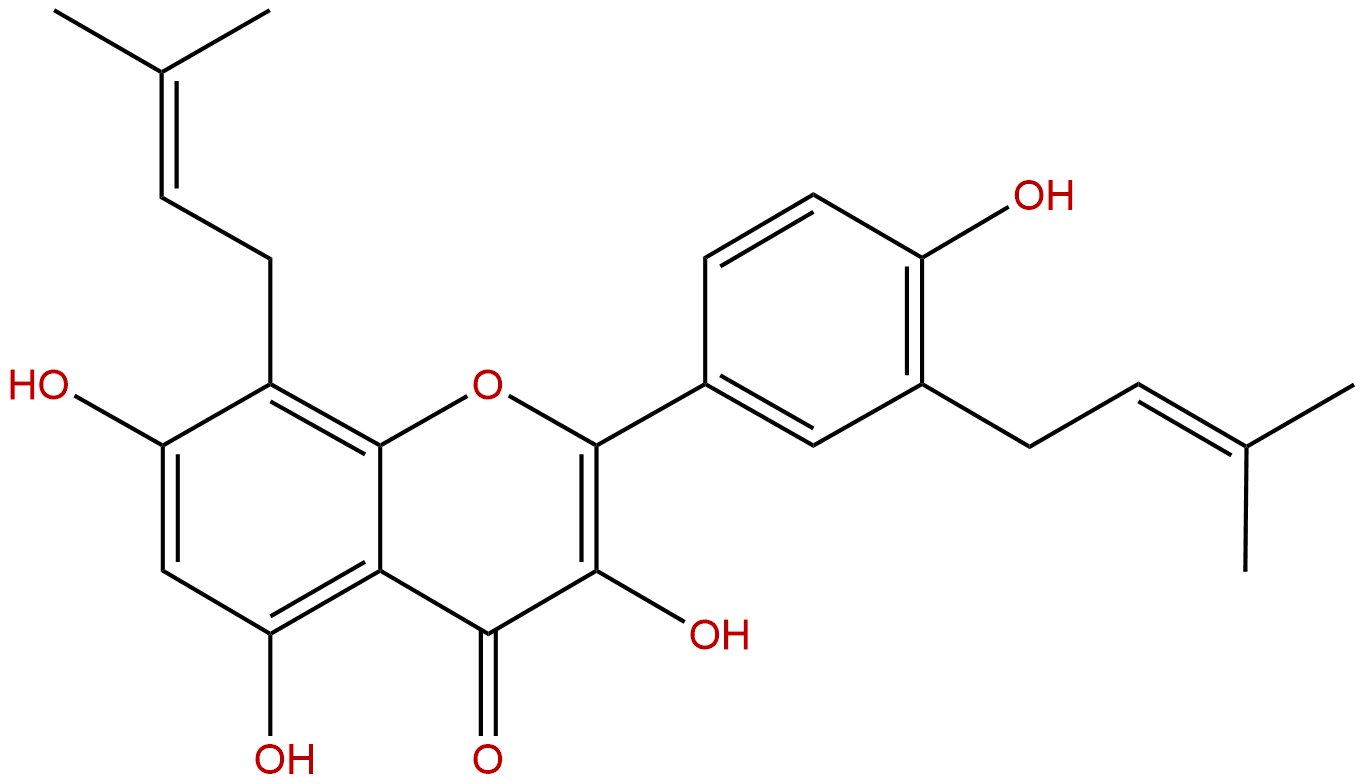
Chushu flavonol F belongs to flavonol compounds, and its core skeleton is 2-phenyl-3-hydroxy-4H-1-benzopyran-4-one. Compared with classic flavonols such as quercetin and kaempferol, the structure of flavonol F from the Chinese oak tree is more complex, containing multiple hydroxyl and isopentenyl substituents in its molecular structure. Specifically, there are hydroxyl substituents on both the A and B rings, endowing the molecule with excellent hydrogen bond donor and acceptor capabilities. In addition, the presence of prenyl groups is an important structural feature, and the introduction of lipophilic side chains can significantly affect the membrane permeability, affinity with target proteins, and overall pharmacokinetic properties of compounds.
From the perspective of physical and chemical properties, the molecular weight of flavonol F in the Chinese chestnut tree is 422.4770 Da, which belongs to the category of medium-sized natural product molecules. The lipid water partition coefficient (LogP) of the compound is 4.7902, indicating strong lipophilicity, which is closely related to the presence of hydrophobic structural units such as isopentenyl groups in its molecule. A higher LogP value indicates that flavonol F from the Chinese oak tree is more likely to penetrate biofilms, but it may also lead to poor solubility in aqueous environments. The Topological Polar Surface Area (TPSA) is 111.1300 Å ², which reflects the surface area occupied by polar atoms (mainly oxygen and nitrogen atoms) in the molecule. Generally speaking, molecules with a TPSA of less than 140 Å ² have good oral bioavailability potential, and the TPSA value of flavonol F in Eucommia ulmoides falls within this range, indicating its feasibility for oral administration. However, its water solubility (0.0501 mg/mL) is extremely low, which poses a major challenge in its formulation development. Low water solubility may lead to slow dissolution rate and incomplete absorption of drugs in the gastrointestinal tract, thereby affecting their bioavailability. In medicinal chemistry, improving the solubility of poorly soluble drugs is one of the core issues in formulation research. Common strategies include preparing salts, using co solvents, cyclodextrin inclusion, solid dispersion technology, and nanocrystal technology.
In terms of early prediction related to drug safety, the blood-brain barrier (BBB) penetration ability of flavonol F was evaluated as "low". This is a favorable feature for a candidate molecule aimed at treating peripheral diseases such as gout and hyperuricemia, as it can reduce the risk of central nervous system toxicity. At the same time, the prediction result of hERG (human Ether - à - go Related Gene) potassium channel inhibition was "no", indicating that the compound has a low risk of causing cardiac QT interval prolongation and fatal arrhythmias (such as apical torsion ventricular tachycardia), which is an important safety indicator of drug cardiac toxicity. The predicted value of Ames test (a bacterial reverse mutation test used to detect the mutagenicity of compounds) is 0.6, and it is generally considered negative if the value is less than 0.5, and suspicious positive if the value is between 0.5-0.7. The value of 0.6 suggests that there may be a certain genetic toxicity risk of flavonol F in the Chinese chestnut tree, but this is only a computer simulation prediction result and needs to be verified through standard in vitro and in vivo genetic toxicity tests.
The main plant source of flavonol F in the mulberry tree is the mulberry tree, a member of the mulberry family(Broussonetia papyrifera). This plant is native to East Asia and is distributed in various parts of China, both north and south, with abundant resources. In addition, other plants of the same genus, such as rattan(Broussonetia kaempferi)And Xiao Goushu(Broussonetia kazinoki)It may also contain this compound, but the content is usually highest in the Chinese oak tree. There are differences in the composition and content of flavonoids in different parts of the oak tree, such as root bark, stem bark, leaves, fruits, and wood. Research has shown that the root bark and stem bark of the Chinese parasol tree are the main enrichment sites for flavonoids, especially flavonols containing isopentenyl groups.
The extraction of flavonol F from Eucommia ulmoides usually follows the classic natural product chemical process of "extraction separation purification". The choice of extraction method depends on the properties of the target compound and the subsequent separation strategy. Given that the flavonol F from the Chinese oak tree has moderate polarity (LogP ≈ 4.79), commonly used extraction solvents include methanol, ethanol, or their aqueous solutions. The specific steps are as follows:
The pharmacological activity research of flavonol F from Chushu tree is still in its early stages, but existing studies have revealed its potential in inhibiting xanthine oxidase and antioxidant activity.
1. Inhibition activity of xanthine oxidase
Xanthine oxidase (XO) is a key enzyme in purine metabolism, catalyzing the oxidation of hypoxanthine to xanthine and further oxidizing xanthine to uric acid. When there is excessive production or reduced excretion of uric acid in the body, it can lead to hyperuricemia, which may in turn cause gouty arthritis, kidney stones, and renal dysfunction. Therefore, inhibiting XO activity is one of the main drug strategies for treating hyperuricemia and gout. The commonly used XO inhibitors in clinical practice are allopurinol and febuxostat, but both have certain side effects, such as allopurinol hypersensitivity syndrome and febuxostat cardiovascular risk. Therefore, searching for efficient and low toxicity XO inhibitors from natural products has always been a research hotspot.
Research has confirmed that flavonol F from the Chinese oak tree has significant XO inhibitory activity. Its inhibitory mechanism is usually considered competitive or mixed inhibition, which blocks substrate enzyme binding or electron transfer by binding to the molybddopterin center or flavin adenine dinucleotide (FAD) site of XO. Compared with classical flavonoid XO inhibitors such as hesperetin and apigenin, the isopentenyl group in the flavonol F molecule of Eucommia ulmoides may enhance its interaction with the XO hydrophobic pocket, thereby improving its inhibitory activity. Its half maximal inhibitory concentration (IC ₅₀) value is usually in the micromolar range in in vitro enzyme activity assays, demonstrating good potential for development.
2. Antioxidant activity
Oxidative stress refers to the imbalance between the production of free radicals such as reactive oxygen species (ROS) and reactive nitrogen species (RNS) in the body and the antioxidant defense system. Excessive free radicals can attack lipids, proteins, and DNA, leading to cell damage and functional impairment, which is closely related to the occurrence and development of various diseases such as aging, cardiovascular disease, neurodegenerative diseases, and cancer.
As a polyphenolic compound, the multiple phenolic hydroxyl groups in its molecular structure are the structural basis for its antioxidant activity. Phenolic hydroxyl groups can act as hydrogen atom donors, directly scavenging free radicals (such as DPPH ·, ABTS ⁺ ·, · OH, O ₂⁻ ·) and terminating free radical chain reactions. In addition, it can chelate transition metal ions (such as Fe ² ⁺, Cu ² ⁺) and inhibit the free radical generation process catalyzed by metal ions such as Fenton reaction. Research has shown that flavonol F from the Chinese chestnut tree exhibits strong activity in various in vitro antioxidant models, and its ability is usually comparable or superior to positive controls such as vitamin C and Trolox. This antioxidant activity is an important basis for its other biological effects, such as anti-inflammatory and protection of cells from damage.
The pharmacological activity of flavonol F from the Chinese chestnut tree is the result of the combined action of multiple targets and pathways. In addition to directly inhibiting XO and clearing free radicals, its deeper mechanism of action involves regulating intracellular signaling pathways.
1. Activation of NFE2L2/NRF2-ARE pathway
NFE2L2 (Nuclear Factor Erythroid 2-Related Factor 2, abbreviated as NRF2) is a core transcription factor that cells use to respond to oxidative stress and electrophilic substances. Under normal physiological conditions, NRF2 binds to Kelch like ECH associated protein 1 (Keap1) in the cytoplasm and is in an inhibited state of ubiquitination degradation. When cells are stimulated by oxidative stress or electrophilic substances, NRF2 dissociates from Keap1, translocates into the nucleus, and binds to antioxidant response elements (ARE), initiating the transcription of a series of downstream protective genes, including:
* SOD1 (Cu/Zn SOD) and SOD2 (Mn SOD)Superoxide dismutase catalyzes the dismutation of superoxide anion (O ₂⁻·) into hydrogen peroxide (H ₂ O ₂) and oxygen.
* CAT (Catalase)Catalase breaks down H ₂ O ₂ into water and oxygen.
* GPX1 (Glutathione Peroxidase 1)Glutathione peroxidase uses reduced glutathione (GSH) to reduce H ₂ O ₂ and organic peroxides to water or alcohol.
* HMOX1 (Heme Oxygenase 1)Heme oxygenase-1 catalyzes the degradation of heme into biliverdin, carbon monoxide, and free iron. biliverdin and its metabolite bilirubin are potent endogenous antioxidants.
* NQO1 (NAD(P)H:Quinone Oxidoreductase 1)Quinone oxidoreductase catalyzes the reduction and detoxification of quinone compounds.
Research has shown that flavonol F from the Chinese chestnut tree can enhance the overall antioxidant defense ability of cells by promoting nuclear translocation of NRF2, activating the NRF2-ARE signaling pathway, upregulating the expression of various antioxidant enzymes and phase II detoxifying enzymes mentioned above. This mechanism is different from directly clearing free radicals, it is a more persistent and fundamental cell protection strategy.
2. Inhibition of TYR (Tyrosinase)
TYR (Tyrosinase) is a key rate limiting enzyme in the process of melanin synthesis. Inhibiting TYR activity can reduce the production of melanin, which is of great significance in the treatment of pigmentary diseases such as melasma and freckles and skin whitening. The phenolic hydroxyl group of flavonol F in the Chinese chestnut tree can chelate the copper ion in the TYR active center, thereby competitively inhibiting its activity. Its inhibition of TYR activity makes it potentially valuable in the fields of cosmetics and skin disease treatment.
3. Regulation of matrix metalloproteinases (MMPs)
Matrix Metalloproteinase 1 (MMP1) and Stromelysin 1 (MMP3) are important enzymes involved in the degradation of extracellular matrix (ECM). During pathological processes such as skin photoaging, arthritis, and tumor invasion and metastasis, the expression and activity of MMPs often increase abnormally. The antioxidant and anti-inflammatory activities of flavonol F from Chushu tree may be achieved by inhibiting signaling pathways such as MAPK and NF - κ B, downregulating the expression of MMP1 and MMP3, thereby protecting ECM from excessive degradation and maintaining tissue structural integrity. This has potential significance in combating skin aging and inhibiting tumor metastasis.
4. Integrated action network
In summary, the mechanism of action of flavonol F in the Chinese chestnut tree is not singular, but rather forms a complex network. It directly inhibits XO activity and can reduce uric acid production; It directly clears free radicals and activates the NRF2 pathway, which can alleviate oxidative stress; It inhibits TYR and can regulate pigment metabolism; It regulates MMPs and can protect ECM. These multifaceted effects collectively constitute its potential pharmacological activity spectrum.
The evaluation of drug properties is a crucial step in transitioning natural products from laboratory research to clinical applications. Drug liking refers to whether a compound possesses the basic physical, chemical, and biological properties necessary to become an oral medication. Based on the aforementioned physical and chemical parameters and early predictions, we can conduct a preliminary evaluation of the pharmacological properties of flavonol F from the Chinese chestnut tree.
Advantage:
* Moderate molecular weight:422.48 Da, Meets the requirement of molecular weight less than 500 in the Lipinski Five Rules.
* Good target activity Has clear inhibitory activity against targets such as XO and TYR, and has an activating effect on the NRF2 pathway.
* Potential security advantages Predicting no hERG inhibition risk, low BBB penetration, and reduced risk of cardiac and central nervous system toxicity.
Challenge:
* Extremely low water solubility The water solubility of 0.0501 mg/mL is the biggest obstacle to its drug formation. Low solubility can lead to limited dissolution, incomplete absorption, and extremely low bioavailability after oral administration.
* Higher LogP Although a LogP value of 4.79 is beneficial for membrane permeation, it also increases the possibility of rapid metabolism by liver metabolic enzymes (such as CYP450 enzyme system) and excretion through bile in vivo, resulting in a short half-life and insufficient systemic exposure.
* Potential genetic toxicity The Ames test predicted a result of 0.6, which is a suspected positive and requires strict experimental verification. If it is confirmed to have mutagenicity, it will seriously hinder its development as a drug.
Prediction and Challenges of Pharmacokinetic (PK) Characteristics:
At present, there is very limited data on the in vivo pharmacokinetics of flavonol F from the Chinese chestnut tree. Based on its physicochemical properties and PK characteristics of similar compounds, it can be inferred that:
* Absorption Due to its extremely poor water solubility, its oral absorption will be very limited and may be affected by food. The absorption mechanism may be mainly passive diffusion, but efflux transporters such as P-glycoprotein (P-gp) may limit its absorption.
* Distribution Due to its strong lipophilicity, it may highly bind to plasma proteins (such as albumin) and have a larger distribution volume. BBB has low penetration and is mainly distributed in peripheral tissues.
* Metabolism As a polyphenolic compound, its phenolic hydroxyl group is a common site of action for phase II metabolic enzymes such as glucuronosyltransferases UGTs and sulfotransferases SULTs. It is highly susceptible to glucuronidation and sulfation binding reactions in the intestine and liver, leading to significant first pass effects. In addition, isopentenyl may also be oxidized and metabolized by CYP450 enzymes. These metabolic processes will lead to a rapid decrease in the concentration of the prototype drug in the body.
* Excretion Metabolites are mainly excreted through bile and urine.
Strategies for improving drug properties:
Given the aforementioned challenges, the development of flavonol F from Eucommia ulmoides as a clinical drug requires extensive structural modifications and formulation studies.
1. Prodrug design Modify the phenolic hydroxyl groups in the molecule, such as preparing prodrugs such as phosphate esters, amino acid esters, or glycosides, to improve water solubility. The prodrug releases the prototype drug after enzymatic or chemical hydrolysis in the body.
2. Formulation technology Modern formulation technologies such as solid dispersions, liposomes, nanoemulsions, and self microemulsifying drug delivery systems (SMEDS) are used to significantly improve their solubility and dissolution rate, thereby improving oral bioavailability.
3. structural optimization On the premise of retaining the core pharmacophore groups (such as phenolic hydroxyl and isopentenyl), reasonable structural modifications can be made to the molecule, such as introducing hydrophilic groups (such as carboxyl, amino, and polyethylene glycol chains) to balance the LogP value, improve water solubility, and reduce metabolic rate.
Despite facing challenges in drug development, the unique pharmacological activity spectrum of flavonol F from the Chinese oak tree still provides possibilities for its application in multiple therapeutic fields.
1. Hyperuricemia and Gout
This is the most promising application direction of flavonol F from the Chinese oak tree. As an XO inhibitor, it is expected to be developed as a new generation of candidate drugs for the treatment of hyperuricemia and gout. Compared to existing allopurinol and febuxostat, naturally sourced flavonol F from the Chinese oak tree may have better safety, especially if it can avoid hypersensitivity reactions to allopurinol and cardiovascular risks associated with febuxostat. Future research should focus on:
* In vivo efficacy verification Systematic evaluation of the uric acid lowering effect after oral or injection administration in potassium oxonate induced hyperuricemia rat or mouse models.
* Deepening the mechanism of action Study its effects on renal uric acid transporters (such as URAT1, GLUT9, ABCG2) and explore whether it has both inhibitory effects on uric acid reabsorption and promoting uric acid excretion.
* safety evaluation Conduct systematic studies on acute toxicity, long-term toxicity, and reproductive toxicity, with a particular focus on identifying their genetic toxicity risks.
2. Oxidative stress-related diseases
Given its strong antioxidant and NRF2 pathway activation abilities, flavonol F from the Chinese oak tree has the potential to treat various oxidative stress-related diseases, such as:
* Metabolic diseases Such as non-alcoholic fatty liver disease (NAFLD), diabetes and its complications (such as diabetes nephropathy, retinopathy). By reducing oxidative stress and inflammatory response in the liver and kidneys, it may delay disease progression.
* cardiovascular disease Such as atherosclerosis and myocardial ischemia reperfusion injury. Antioxidant and anti-inflammatory effects help to protect vascular endothelial function and inhibit the formation of foam cells.
* Neurodegenerative diseases Although BBB penetration is low, its application in diseases such as Alzheimer's and Parkinson's is worth exploring if brain delivery can be achieved through nanocarriers and other technologies, as oxidative stress is one of the core pathological mechanisms of these diseases.
3. Skin related diseases
It inhibits the activity of TYR and MMPs, making it valuable in the fields of skin whitening and anti-aging. It can be developed as a topical preparation (such as cream and gel) for the treatment of chloasma and freckles, as well as the prevention and improvement of skin photoaging.
Future research directions:
As a natural flavonol compound derived from the traditional medicinal plant Eucommia ulmoides, F has shown great potential as a new lead compound for anti hyperuricemia and gout drugs due to its unique chemical structure and clear xanthine oxidase inhibitory activity. At the same time, its various biological activities such as antioxidant activity, regulation of NRF2 pathway, inhibition of tyrosinase and matrix metalloproteinases also provide scientific basis for its application in anti-aging, skin protection, and treatment of metabolic diseases. However, the extremely low water solubility, potential metabolic instability, and potential genetic toxicity risks of this compound constitute the main bottlenecks in its transformation from an "active natural product" to a "clinical candidate drug".
Future research needs to comprehensively utilize various methods such as medicinal chemistry, pharmacology, and biotechnology to optimize its structure and develop formulations based on a deep understanding of its pharmacological mechanisms and pharmacokinetic behavior in vivo, in order to overcome its drug defects. The continuous research on flavonol F from the Chinese oak tree will not only help to explore the medicinal value of this natural product, but also provide valuable experience and examples for innovative drug development based on natural products. With the continuous deepening of research, we have reason to expect that the flavonol F or its derivatives from the willow tree can contribute to human health in the future.
Batch can search by a CAS number,one per line
