


Synonym name: 5-Hydroxy-1,4-naphthoquinone
Catalogue No.: BP0812
Cas No.: 481-39-0
Formula: C10H6O3
Mol Weight: 174.155
Botanical Source: Occurs in Juglans spp.; leaves and nuts of pecan (Carya illinoensis), leaves of Pterocarya fraxinifolia, Lomatia spp. and Platycarya strobilacea. Also prod. by Penicillium diversum var. aureum and a mutant of Verticillium dahliae
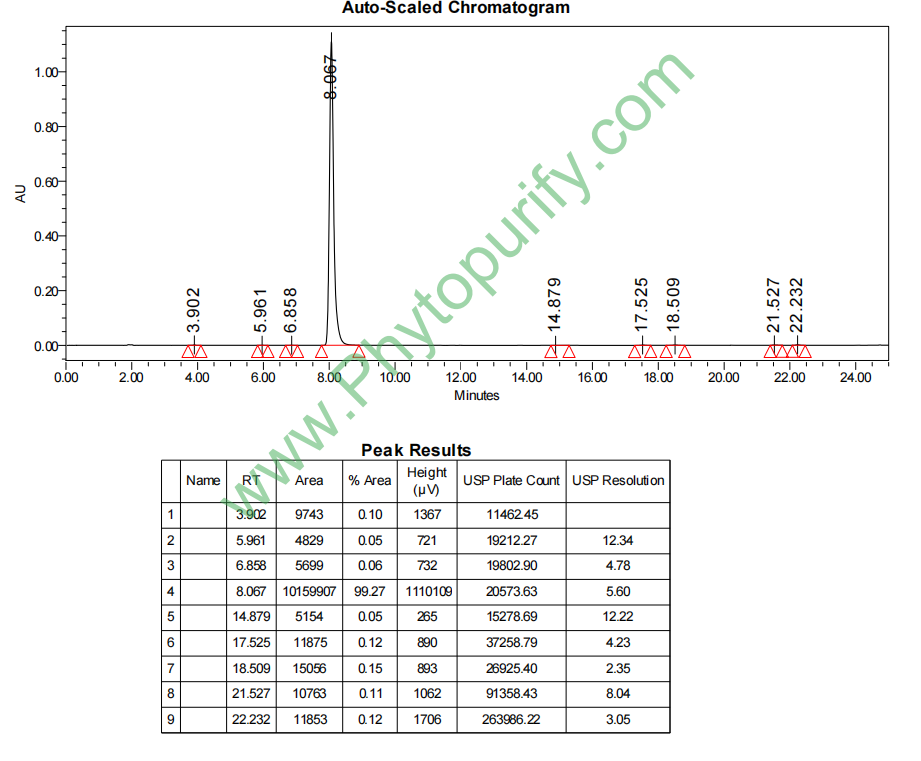
Purity: 95%~99%
Analysis Method: HPLC-DAD or/and HPLC-ELSD
Identification Method: Mass, NMR
Packing: Brown vial or HDPE plastic bottle
Can be supplied from milligrams to grams.
For Reference Standard and R&D, Not for Human Use Directly.
Inquire for bulk scale.
HPLC of Juglone
Storage conditions:Short-term storage at 2~8℃, long-term storage at -20 ~ -80℃
Juglone (5-hydroxy-1,4-naphthoquinone, CAS number: 481-39-0) is a natural naphthoquinone compound mainly found in Juglans regia plants, particularly in the leaves, shells, and roots of walnut trees. As a yellow dye, juglone not only has practical value in the traditional dyeing industry, but also has become a hot topic in natural product pharmacology research due to its significant biological activity. In recent years, with the in-depth exploration of its antibacterial, anti-tumor, and apoptosis regulating effects, juglone has shown great potential for application in tumor treatment, especially in the field of lung cancer.
As one of the malignant tumors with the highest incidence rate and mortality in the world, lung cancer urgently needs to develop new effective and low toxic therapeutic drugs. Walnut quinone exhibits excellent anti lung cancer activity by regulating tumor cell growth and apoptosis through multiple targets and pathways. This article will provide a systematic review of the chemical structure and physicochemical properties, plant sources and extraction methods, pharmacological activity and mechanism of action, drug evaluation and pharmacokinetic characteristics of juglone, with a focus on exploring its molecular targets and clinical application prospects in the treatment of lung cancer. The aim is to provide a theoretical basis and research direction for the drug development of juglone.
The chemical name of walnut quinone is 5-hydroxy-1,4-naphthoquinone, with a molecular formula of C10H6O3 and a molecular weight of 174.1550. The core of its structure is a 1,4-naphthoquinone skeleton, and the introduction of a 5-hydroxy group endows it with unique electronic properties and biological activity. The LogP value of juglone is 1.7708, indicating that it has moderate lipid solubility, which is beneficial for cell membrane penetration. The polar surface area (TPSA) is 54.37 Å ², indicating its good absorption and distribution potential in living organisms. The water solubility index is 0.5483, indicating low water solubility but good solubility in organic solvents.
Walnut quinone has a high blood-brain barrier permeability, suggesting that it may affect central nervous system function or be used in research on neurological related diseases. Importantly, juglone did not exhibit hERG channel inhibitory activity, reducing its risk of cardiac toxicity. The Ames test result is 1.5, indicating low genotoxicity and ideal safety.
Hutao quinone mainly comes from Juglans regia and its related species. The leaves, shells, roots, and bark of walnut trees all contain varying amounts of juglone, with the shell and roots having the highest content. Traditionally, walnut shells have been used to extract natural dyes, while modern research focuses more on the extraction and purification of their pharmacological active ingredients.
The extraction of juglone is usually carried out using organic solvent extraction method. Common solvents include ethanol, methanol, ethyl acetate, and their mixed solvent systems. The extraction process generally includes crushing plant materials, solvent soaking, ultrasound assisted extraction or reflux extraction, followed by purification through liquid-liquid distribution, column chromatography and other methods. High performance liquid chromatography (HPLC) and mass spectrometry (MS) techniques are widely used for qualitative and quantitative analysis of juglone.
In recent years, supercritical CO2 extraction and microwave-assisted extraction techniques have also been introduced into the research of walnut quinone extraction to improve extraction efficiency and purity, reduce solvent usage, and comply with green chemistry principles.
Momoquinone exhibits broad-spectrum antibacterial activity and can inhibit the growth of various Gram positive and Gram negative bacteria. Research has shown that walnut quinone has significant inhibitory effects on common pathogens such as Staphylococcus aureus, Pseudomonas aeruginosa, and Escherichia coli. Its antibacterial mechanism mainly involves cell membrane damage, oxidative stress induction, and energy metabolism interference.
In addition, juglone is also effective against certain drug-resistant strains, demonstrating its potential application value in antimicrobial resistance issues.
The anti-tumor activity of walnut quinone is the focus of its research. Both in vitro cell experiments and in vivo animal models have confirmed that juglone can significantly inhibit the proliferation of various tumor cells and induce cell apoptosis. Especially in lung cancer cell lines, juglone exhibits strong cytotoxicity and anti migratory ability.
Walnut quinone regulates multiple signaling pathways, affects cell cycle progression and the expression of apoptosis related proteins, and inhibits the growth and metastasis of tumor cells. In addition, walnut quinone also has anti angiogenic effects and blocks the nutritional supply to tumors.
Walnut quinone has also been reported to have various biological activities such as antioxidant, anti-inflammatory, and neuroprotective properties. Its anti-inflammatory effect is mainly achieved by inhibiting the release of inflammatory mediators and regulating signaling pathways. The neuroprotective effect is related to its antioxidant capacity and regulation of cell apoptosis.
The mechanism by which juglone induces cell apoptosis is mainly achieved through the mitochondrial pathway. Its function involves multiple molecular targets and signaling pathways, and has been widely studied in the treatment of lung cancer.
Walnut quinone can disrupt mitochondrial membrane potential, promote cytochrome c release, activate caspase cascade reaction, and ultimately lead to cell apoptosis. It regulates the expression of BCL2 family proteins, reduces the level of anti apoptotic protein BCL2, promotes the activity of pro apoptotic proteins, and enhances cell apoptosis signals.
In summary, walnut quinone exerts its anti-tumor and antibacterial effects through multi-target and multi pathway synergistic effects, demonstrating a complex and precise pharmacological mechanism.
The pharmacological parameters of juglone indicate that it has good potential for drug development. Moderate molecular weight and LogP value are beneficial for the in vivo absorption and distribution of drugs. The lower polar surface area and water solubility index suggest potential solubility limitations during oral administration, but can be overcome through formulation optimization.
Walnut quinone has high blood-brain barrier permeability, indicating its potential value in the treatment of central nervous system diseases. HERG channel inhibition is negative and has a lower risk of genotoxicity, providing assurance for its safety.
In terms of pharmacokinetics, existing studies have shown that juglone is rapidly absorbed orally and widely distributed in the body, but further systematic research is needed on its metabolic pathways and half-life. Its main metabolism may involve phenolic hydroxylation and reduction reactions in the liver, and the activity and toxicity assessment of metabolites will also be a focus of future research.
As a natural product, hydroquinone has shown potential as an adjuvant therapy for lung cancer and other malignant tumors due to its multi-target anti-tumor activity and good drug properties. By combining modern drug design with nanocarrier technology, it is expected to overcome the limitations of water solubility and bioavailability, and achieve clinical translation.
Future research should focus on:
In addition, the antibacterial and anti-inflammatory properties of juglone also provide a possibility for its application in infectious diseases and inflammation related diseases.
As a widely sourced, structurally simple, and biologically active natural naphthoquinone compound, HuTao quinone has become an important research object in the field of natural product pharmacology due to its unique antibacterial and anti-tumor effects, especially in the multi-target regulatory mechanism of lung cancer treatment. Its good pharmacological parameters and safety foundation have laid a solid foundation for subsequent drug development. In the future, by combining modern medicinal chemistry and biotechnology methods, juglone is expected to move from the laboratory to clinical practice and become a new model for the development of natural anti-cancer drugs.
