Introduction/Overview
Kaempferol 7-O - α - L-rhamnoside (CAS number: 20196-89-8), as a natural flavonoid glycoside derivative, has received widespread attention in recent years due to its multi-target and multi mechanism pharmacological activities. This compound not only exhibits significant antioxidant effects, but also demonstrates potential therapeutic value in various disease models such as heart failure, non-alcoholic fatty liver disease (NAFLD), drug-induced liver injury, and tumor immune escape. Of particular note is the dual function of kaempferol-7-O - α - L-rhamnoside as a PD-1/PD-L1 immune checkpoint inhibitor and a farnesol X receptor (FXR) agonist, which has opened up new directions for its application in tumor immunotherapy and metabolic diseases. In addition, the compound exerts cardioprotective effects by regulating the AMPK α 1 signaling pathway, demonstrating potential in the treatment of heart failure. This article will provide a systematic review of the chemical structure and physicochemical properties, plant sources and extraction methods, pharmacological activity and mechanism of action, pharmacological evaluation and pharmacokinetic characteristics of kaempferol-7-O - α - L-rhamnoside, and explore its clinical application prospects and development trends.
Chemical structure and physicochemical properties
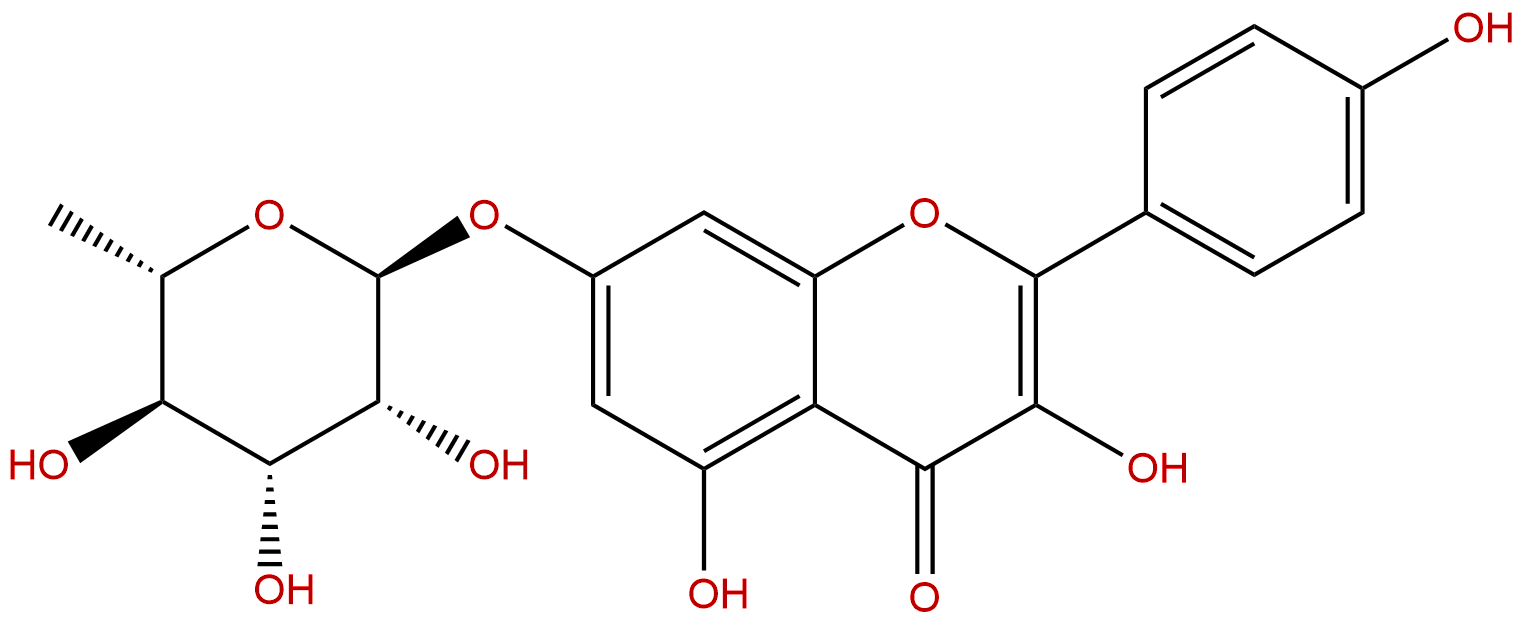
Kaempferol-7-O - α - L-rhamnoside belongs to the flavonoid glycoside class of flavonoids, with a molecular formula of C21H20O11 and a molecular weight of 448.38. The core of its structure is Kaempferol, which is connected to a rhamnose unit via an α - L-rhamnoside bond at the 7th hydroxyl group. This structure endows it with high polarity, exhibiting a large topological polar surface area (TPSA) of 189.98 Å ² and a hydrogen bond acceptor count of up to 10, demonstrating good water solubility and intermolecular hydrogen bond formation ability. The LogP value is approximately 1.0, indicating moderate lipid solubility that facilitates membrane penetration but is not easily accumulated in the lipid environment. The low permeability of the blood-brain barrier suggests its limited distribution in the central nervous system. In vitro toxicological evaluation showed that kaempferol-7-O - α - L-rhamnoside had no significant hepatotoxicity, cardiotoxicity, or hERG channel inhibition, and had high safety. Multiple phenolic hydroxyl groups in its molecular structure endow it with strong antioxidant activity, while the presence of glycosidic bonds may affect its bioavailability and metabolic stability.
Plant sources and extraction methods
Kaempferol-7-O - α - L-rhamnoside is widely present in various Chinese herbal medicines and edible plants, especially in some medicinal plants such as Kaempferia spp., Morus alba, and Ginkgo biloba. Traditional extraction methods often use ethanol or methanol as solvents to obtain crude extracts through reflux extraction or ultrasound assisted extraction, followed by separation and purification using techniques such as silica gel column chromatography and reverse phase high-performance liquid chromatography (RP-HPLC). In recent years, the application of supercritical CO2 extraction and membrane separation technology has improved extraction efficiency and purity. The optimization of extraction process mainly focuses on solvent polarity adjustment, extraction temperature and time control, in order to maximize the activity and stability of compounds. The purified kaempferol-7-O - α - L-rhamnoside was structurally identified by mass spectrometry (MS), nuclear magnetic resonance (NMR), and infrared spectroscopy (IR) to ensure its chemical purity and structural integrity.
Pharmacological activity research
Antioxidant effect
Kaempferol-7-O - α - L-rhamnoside exhibits significant antioxidant activity in various in vitro and in vivo models. It alleviates oxidative stress damage by directly clearing reactive oxygen species (ROS) and promoting the expression of endogenous antioxidant enzymes such as superoxide dismutase (SOD1, SOD2), catalase (CAT), glutathione peroxidase (GPX1), and heme oxygenase 1 (HMOX1). Research has shown that this compound can significantly upregulate the activity of nuclear factor erythroid associated factor 2 (Nrf2, NFE2L2), activate its downstream antioxidant genes, and enhance the cell's antioxidant defense system. In the APAP induced liver cell injury model, kaempferol-7-O - α - L-rhamnoside reversed the decrease in glutathione (GSH) content and the increase in ROS production, significantly reducing cellular oxidative damage, suggesting its protective role in drug-induced liver injury.
Cardioprotective effect
Kaempferol-7-O - α - L-rhamnoside exerts a protective effect in cardiomyocytes by activating the AMPK α 1 (PRKAA1) signaling pathway. H9c2 myocardial cell experiments showed that the compound significantly upregulated the mRNA expression of AMPK α 1, promoting energy metabolism balance and cell survival. As a cellular energy sensor, AMPK activation can regulate lipid metabolism, inhibit inflammatory response, and alleviate myocardial cell apoptosis, thereby improving the pathological state of heart failure. In addition, kaempferol-7-O - α - L-rhamnoside acts as an agonist of the farnesol X receptor (FXR, NR1H4), regulating bile acid metabolism and lipid homeostasis, and helping to alleviate metabolic disorders associated with cardiovascular disease. In summary, this compound has potential therapeutic value in heart failure and related cardiovascular diseases.
Liver protection and metabolic regulation
In the non-alcoholic fatty liver disease (NAFLD) model, kaempferol-7-O - α - L-rhamnoside regulates key lipid metabolism factors such as peroxisome proliferator activated receptor alpha (PPAR alpha) and fat synthesis transcription factor SREBP-1c (SREBF1) by activating FXR and AMPK alpha 1, reducing liver lipid accumulation and inflammatory response. It can also inhibit the expression of pro-inflammatory factors such as tumor necrosis factor alpha (TNF - α) and alleviate liver inflammatory damage. In addition, the compound has a regulatory effect on the CYP450 enzyme system, which may affect drug metabolism and detoxification processes, suggesting its potential application in drug-induced liver injury.
Tumor immune regulatory effect
As an immune checkpoint inhibitor for PD-1 (PDCD1)/PD-L1 (CD274), kaempferol-7-O - α - L-rhamnoside can block immune suppression signals between tumor cells and immune cells, restoring T cell anti-tumor activity. It has shown potential regulatory effects on other immune checkpoints such as CTLA-4, LAG-3, TIGIT in vitro experiments, suggesting its potential as a multi-target immune modulator. This feature provides new ideas for intervening in tumor immune escape mechanisms, especially in combination immunotherapy strategies with broad application prospects.
Mechanism of action and molecular targets
The multi-target mechanism of action of kaempferol-7-O - α - L-rhamnoside mainly involves the following aspects:
-
AMPK α 1 signaling pathway activation By upregulating the expression and activity of AMPK α 1, regulating cellular energy metabolism, promoting lipid oxidation, inhibiting fat synthesis, reducing oxidative stress and inflammatory response, and protecting the function of myocardial cells and liver cells.
-
FXR excitatory effect Activate FXR to regulate bile acid metabolism and lipid homeostasis, improve liver metabolic abnormalities, alleviate liver steatosis and inflammation.
-
Enhanced antioxidant defense system Activate the Nrf2 signaling pathway, promote the expression of antioxidant enzymes, clear ROS, and protect cells from oxidative damage.
-
Immune checkpoint inhibition Blocking the interaction between PD-1/PD-L1, relieving tumor immune escape, and enhancing T cell-mediated anti-tumor immune response.
-
Regulating the expression of inflammatory factors Inhibit pro-inflammatory factors such as TNF - α and alleviate chronic inflammation.
The synergistic effect of these mechanisms enables kaempferol-7-O - α - L-rhamnoside to exhibit multiple therapeutic potentials in cardiovascular disease, liver disease, and tumor immunotherapy.
Evaluation of drug properties and pharmacokinetics
From the perspective of medicinal properties, kaempferol-7-O - α - L-rhamnoside has superior safety and pharmacological characteristics. Its molecular weight is moderate (448.38 Da), with a LogP value of 1.0, indicating that it has a good balance of hydrophilicity and lipophilicity, which is beneficial for in vivo distribution. High TPSA and a higher number of hydrogen bond receptors may limit their oral bioavailability, but at the same time, they facilitate targeted specific binding. Low blood-brain barrier permeability reduces the risk of central nervous system side effects. In vitro toxicology experiments did not show significant hepatotoxicity, cardiotoxicity, or hERG channel inhibition, indicating its high safety. The results of Ames mutagenicity test are not yet clear, and further research is needed to confirm its genotoxicity risk.
In terms of pharmacokinetics, the absorption, distribution, metabolism, and excretion (ADME) characteristics of kaempferol-7-O - α - L-rhamnoside are still in the preliminary research stage. Due to the presence of glycosidic bonds in its structure, it may be hydrolyzed into kaempferol by microorganisms or enzymes in the intestine, affecting its biological activity and half-life. The metabolic pathway may involve the CYP450 enzyme system, and further clarification is needed on its metabolites and metabolic kinetic parameters. In the future, through structural modification and pharmaceutical optimization, it is expected to enhance its oral bioavailability and in vivo stability.
Clinical application prospects and prospects
Based on its multi-target and multi mechanism pharmacological activity, kaempferol-7-O - α - L-rhamnoside has broad clinical application prospects in the fields of heart failure, liver metabolic diseases, and tumor immunotherapy. It provides new molecular targets for the treatment of cardiovascular and metabolic diseases by activating the AMPK and FXR signaling pathways, regulating energy metabolism and lipid homeostasis. As a PD-1/PD-L1 inhibitor, it is expected to be used as a monotherapy or combination immune checkpoint inhibitor in the treatment of immune tumors, overcoming tumor immune escape and improving treatment efficacy.
Future research should focus on the following aspects:
-
Pharmacodynamics and Formulation Development Optimize the administration route and dosage form design to improve bioavailability and targeting.
-
Safety and Toxicological Assessment Systematic evaluation of long-term medication safety, particularly genotoxicity and immune related side effects.
-
Preclinical and clinical trials Conduct animal models and early clinical trials to verify its efficacy and safety.
-
In depth analysis of the mechanism Further elucidate its multi-target mechanism of action and explore potential synergistic therapeutic strategies.
-
Combination therapy research Evaluate synergistic effects and reducing toxicity when used in combination with existing drugs.
In summary, kaempferol-7-O - α - L-rhamnoside, as a multifunctional drug candidate molecule derived from natural products, has good development potential and application prospects.
Conclusion
Kaempferol-7-O - α - L-rhamnoside has become a hot topic in natural product pharmacology research due to its unique chemical structure and diverse biological activities. Its multiple mechanisms of action in antioxidant, cardiac protection, liver metabolism regulation, and tumor immune regulation provide new ideas and strategies for the treatment of related diseases. Although research on its pharmacokinetics and clinical applications is still in its infancy, existing experimental data fully demonstrates its value as a potential drug molecule. In the future, with the deepening of research and advances in technology, kaempferol-7-O - α - L-rhamnoside is expected to become an important drug for the treatment of cardiovascular diseases, metabolic liver diseases, and tumor immunotherapy, making positive contributions to the development of natural product pharmacology.