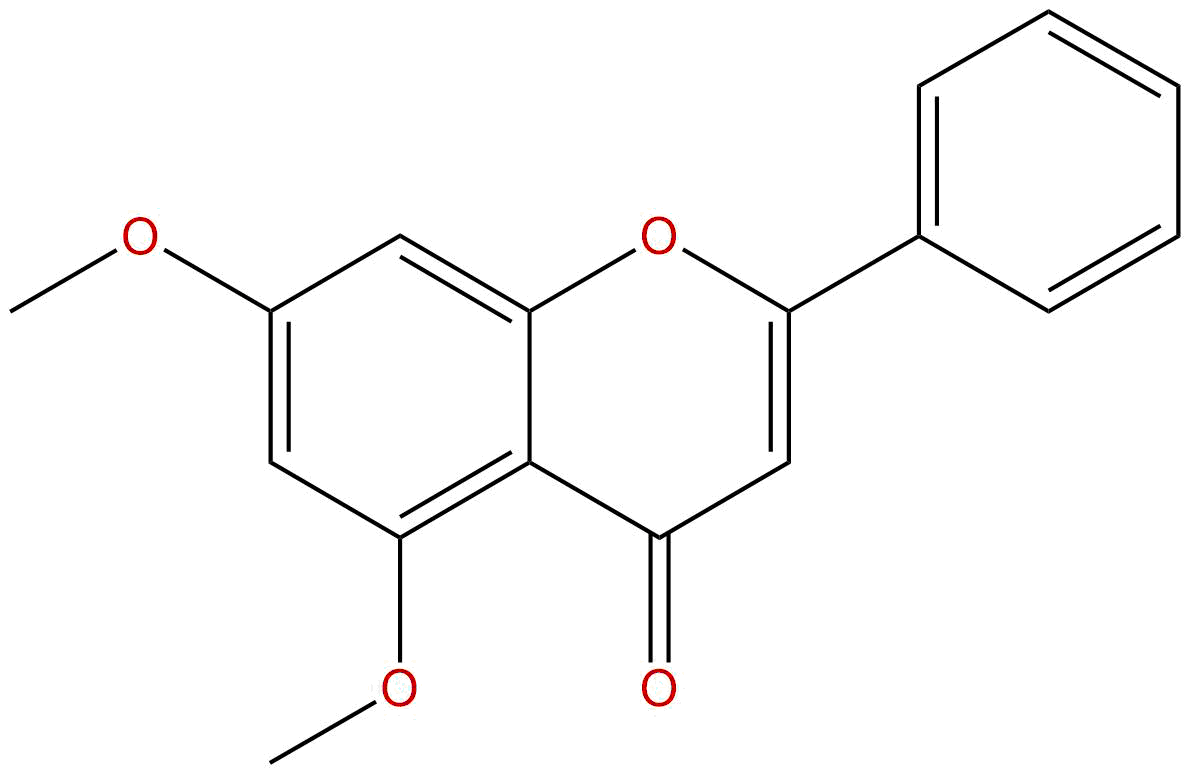


Product name: 5,7-Dimethoxyflavone
Synonym name: Dimethylchrysin
Catalogue No.: BP4263
Cas No.: 21392-57-4
Formula: C17H14O4
Mol Weight: 282.295
Botanical Source:
Type of Compound: Flavonoids
Purity: 95%~99%
Analysis Method: HPLC-DAD or/and HPLC-ELSD
Identification Method: Mass, NMR
Packing: Brown vial or HDPE plastic bottle
Storage: Store in a well closed container, protected from air and light. Put into refrigerate or freeze for long term storage.
Whenever possible, you should prepare and use solutions on the same day. However, if you need to make up stock solutions in advance, we recommend that you store the solution as aliquots in tightly sealed vials at -20℃. Generally, these will be useable for up to two weeks.
The product could be supplied from milligrams to grams
Inquire for bulk scale.
For Reference Standard and R&D, Not for Human Use Directly.
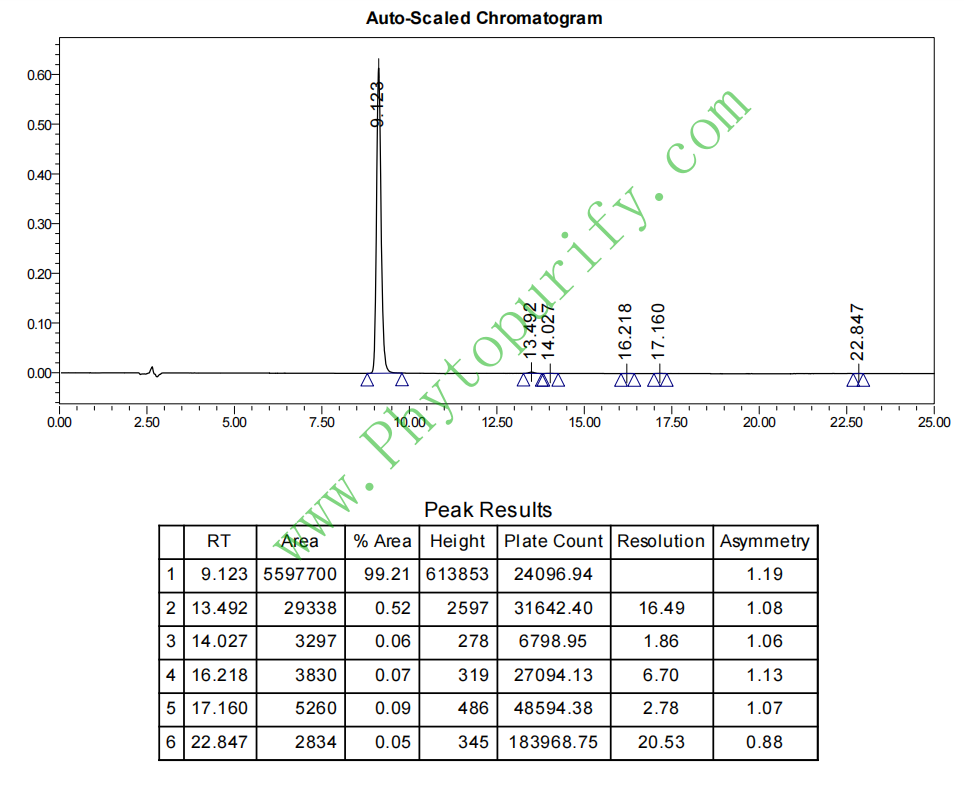
HPLC of 5,7-Dimethoxyflavone
Storage conditions:Short-term storage at 2~8℃, long-term storage at -20 ~ -80℃
48.6700
3.0945
3.0945
.0021
4.3368
26.5709
High
91.7042
1.9634
Yes
No
Yes
No
Yes
No
0.6
No
Yes
Yes
Yes
5,7-Dimethoxyflavone (CAS number: 21392-57-4) is a typical dimethoxyflavonoid compound, which is a methylated derivative of 5,7-dihydroxyflavone and widely present in various plants. As an important flavonoid member in natural products, Baiyin dimethyl ether has attracted widespread attention in the field of pharmacology research in recent years due to its unique chemical structure and diverse biological activities. Especially in the field of tumor treatment, especially in the prevention and treatment of prostate cancer, Baiyin dimethyl ether has shown significant potential, involving the regulation of multiple signaling pathways and key molecular targets.
This review aims to systematically summarize the chemical structure and physicochemical properties, plant sources and extraction methods, pharmacological activity and mechanism of action, pharmacological evaluation and pharmacokinetic characteristics of Baiyin dimethyl ether. The focus is on exploring its molecular targets and mechanism of action in the treatment of prostate cancer, and finally looking forward to its clinical application prospects and future research directions, providing reference and inspiration for researchers in related fields.
The molecular formula of Baiyin dimethyl ether is C17H14O4, with a molecular weight of 282.2950. Its chemical structure is based on the flavonoid skeleton, specifically, the two hydroxyl groups at positions 5,7 are replaced by methyl to form a dimethoxy structure, and its chemical name is 5,7-dimethoxyflavone. The structure contains a typical flavonoid C6-C3-C6 skeleton, with good planarity and conjugated system, which provides the possibility for its binding with various biomolecules.
In terms of physical and chemical properties, the LogP value of Baiyin dimethyl ether is 3.0945, indicating that it has moderate lipid solubility and is conducive to cell membrane penetration. The topological polar surface area (TPSA) is 48.67 Å ², indicating good membrane permeability. The water solubility is relatively low (0.0021 mg/mL), which to some extent limits its oral bioavailability, but the fat solubility is good, which is beneficial for its distribution in the body, especially for its strong ability to cross the blood-brain barrier (high blood-brain barrier permeability). In addition, the hERG channel inhibition experiment results were negative, indicating a low risk of cardiac toxicity. The Ames mutagenicity test score is 0.6, indicating a low risk of genetic toxicity and a good safety basis.
Baiyin dimethyl ether is widely present in various plants, especially in the roots, stems, leaves, and flowers of certain leguminous, labiaceae, and Asteraceae plants. Its natural sources are abundant, and the content varies depending on the plant species, harvesting period, and growth environment. Common plants containing berberine dimethyl ether include Scutellaria spp. and Populus spp.
The extraction method mainly adopts organic solvent extraction combined with chromatographic separation technology. The general steps include:
In recent years, green extraction technologies such as supercritical CO2 extraction and microwave-assisted extraction have also been applied to the extraction of lignin dimethyl ether, improving extraction efficiency and purity, reducing the use of organic solvents, and complying with the concept of green chemistry.
Baiyangsu dimethyl ether, as a natural flavonoid compound, exhibits various pharmacological activities, including anti-tumor, antioxidant, anti-inflammatory, neuroprotective, and endocrine regulation.
Prostate cancer is a key area of research in the field of poplar extract dimethyl ether. In vitro cell experiments have shown that berberine dimethyl ether can significantly inhibit the proliferation of prostate cancer cell lines (such as LNCaP, PC-3, DU145), induce cell cycle arrest and apoptosis. Its anti-tumor effect is closely related to regulating multiple signaling pathways, including inhibiting the activity of STAT3 signaling pathway, regulating the expression of BCL2 family proteins, and promoting the endogenous apoptosis pathway mediated by CASP9. In addition, berberine dimethyl ether can reverse the multidrug resistance of tumor cells and enhance the sensitivity of chemotherapy drugs.
Baiyin dimethyl ether has significant antioxidant activity, which can scavenge free radicals and alleviate oxidative stress damage. It activates the NFE2L2 (Nrf2) signaling pathway, induces the expression of antioxidant enzymes, and enhances the antioxidant defense ability of cells. In the inflammatory model, berberine dimethyl ether inhibits the secretion of pro-inflammatory factors such as TNF - α and IL-6, reduces inflammatory response, and demonstrates good anti-inflammatory potential.
Due to its excellent blood-brain barrier penetration, Baiyin dimethyl ether has also shown potential in the field of neuroprotection. Related studies have shown that this compound can alleviate oxidative damage and inflammatory response of nerve cells, promote nerve cell survival, and may have a protective effect on neurodegenerative diseases such as Alzheimer's disease and Parkinson's disease.
Baiyin dimethyl ether also exhibits the ability to regulate endocrine function, which may affect the development of hormone dependent diseases by modulating the activity of estrogen receptor (ESR2) and androgen receptor (AR). In addition, its regulatory effect on drug metabolizing enzyme CYP19A1 suggests its potential application value in hormone metabolism and the treatment of related diseases.
The pharmacological effects of Baiyin dimethyl ether are mainly achieved by regulating various key molecular targets, especially in the treatment of prostate cancer. The following is the main mechanism of action and target analysis:
In summary, Baiyangsu dimethyl ether exerts its anti-tumor and other pharmacological activities through multi-target and multi pathway synergistic effects, demonstrating its multifunctionality as a natural product and potential clinical application value.
Drug formation is a crucial step in the conversion of natural products into clinical drugs. The pharmacological parameters of Baiyangsu dimethyl ether indicate that it has certain potential for drug development.
At present, there are relatively few systematic pharmacokinetic studies on Baiyuansu dimethyl ether. However, based on its physicochemical properties and studies similar to flavonoids, it can be inferred that it:
Future research should focus on conducting systematic pharmacokinetic and toxicological evaluations to lay the foundation for clinical applications.
Baiyangsu dimethyl ether has good clinical translation prospects due to its multi-target and multi mechanism pharmacological activity, especially its potential in the treatment of prostate cancer. Its advantages include:
However, clinical applications still face several challenges:
Suggestions for future research directions include:
Baiyangsu dimethyl ether, as a natural dimethoxyflavonoid with unique structure and rich biological activity, has shown extensive pharmacological potential, especially in the prevention and treatment of tumor diseases such as prostate cancer, demonstrating significant multi-target regulatory ability. Its good pharmacological parameters and safety provide strong support for clinical translation. In the future, through in-depth pharmacological mechanism research, pharmacokinetic evaluation, and formulation technology optimization, Baiyangsu dimethyl ether is expected to become an important candidate molecule for natural product drug development, promoting the application of natural flavonoid drugs in the treatment of tumors and related diseases.
