| Catalog No | Package | Original Price | Price | Inventory | Quantity | Operating |
|---|---|---|---|---|---|---|
| BP4192-5mg | 5mg | $350.00 | Sign in |
|


Storage conditions:Short-term storage at 2~8℃, long-term storage at -20 ~ -80℃
105.8200
2.5008
2.4821
.0159
3.4292
18.7791
Low
86.7726
2.5874
Yes
No
Yes
No
Yes
No
0.6
Yes
No
No
No
With the continuous rise of natural products in the field of drug development, flavonoids have become a research hotspot due to their diverse biological activities and good safety. 8-Hydroxy-3,5,6,7,3 ', 4' - Hexamethoxyflavone (8-HMH), as a unique multi methoxyflavone, has attracted widespread attention in recent years due to its significant antioxidant activity and potential multi-target regulatory effects. This compound not only exhibits excellent free radical scavenging ability in vitro, but also regulates various key enzymes and transcription factors related to oxidative stress, demonstrating good pharmacological potential.
This article will provide a systematic review of the chemical structure and physicochemical properties, plant sources, and extraction methods of 8-HMH, with a focus on its pharmacological activity and mechanism of action. The pharmacokinetic characteristics of 8-HMH will be analyzed based on its pharmacological parameters, and its potential and development direction in clinical applications will be discussed. The aim is to provide theoretical basis and reference for the in-depth research and drug development of this natural product.
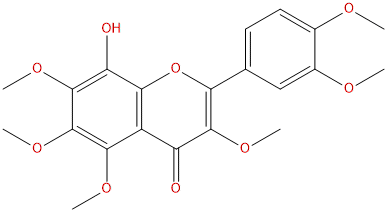
8-HMH belongs to flavonoids, with a molecular formula of C23H26O9 and a molecular weight of 418.3980. Its structural characteristics are that the flavonoid skeleton is replaced by methoxy groups at positions 3, 5, 6, 7, 3 ', and 4', and there is a hydroxyl group at position 8. This multi methoxy modification endows it with good lipid solubility (LogP=2.5008) and a certain polarity (TPSA=105.82 Å ²), giving it good cell membrane permeability.
In terms of physical and chemical properties, 8-HMH has low water solubility (0.0159 mg/mL), which is closely related to its multi methoxy structure, limiting its solubility in aqueous media. Its blood-brain barrier permeability is low, indicating that the compound is difficult to directly act on the central nervous system. The negative result of hERG channel inhibition experiment indicates a low risk of cardiac toxicity. The Ames test result is 0.6, indicating that the compound has no significant mutagenicity and good safety.
Overall, the structural characteristics of 8-HMH endow it with excellent lipid solubility and stability, providing a molecular basis for its biological activity in vivo. However, its low water solubility and blood-brain barrier permeability limit certain application areas, which need to be overcome through drug formulation optimization.
8-HMH is mainly present in various traditional Chinese medicinal materials and plants, especially in the leaves and rhizomes of certain Rutaceae and Lamiaceae plants, where its content is relatively high. According to literature reports, this compound has been detected in flavonoid rich plants such as Scutellaria baicalensis, Mentha spp., and some citrus peels.
The extraction method often uses organic solvent extraction combined with column chromatography separation. Common extraction solvents include methanol, ethanol, and their aqueous solutions, which can effectively dissolve and enrich the compound due to their high lipid solubility. The extraction process generally includes:
In recent years, green and efficient technologies such as supercritical CO2 extraction and microwave-assisted extraction have gradually been applied to the extraction of flavonoids, improving extraction efficiency and reducing the use of organic solvents.
The antioxidant activity of 8-HMH is one of its most significant biological activities. In vitro experiments have shown that the compound can effectively scavenge various free radicals, including DPPH free radicals, hydroxyl free radicals, and superoxide anions, demonstrating strong free radical scavenging ability. Its antioxidant activity is superior to some monomethoxy flavonoids, demonstrating the enhanced effect of multi methoxy modification on activity.
Cell level studies have shown that 8-HMH can significantly increase the activity of intracellular antioxidant enzymes such as superoxide dismutase (SOD1, SOD2), catalase (CAT), and glutathione peroxidase (GPX1), thereby reducing oxidative stress damage. In addition, 8-HMH can induce the expression of heme oxygenase 1 (HMOX1), further enhancing the antioxidant defense ability of cells.
Although there is currently limited research on the anti-inflammatory and anti-tumor effects of 8-HMH, preliminary data suggests that it exerts certain anti-inflammatory effects by regulating the activity of matrix metalloproteinases (MMP1, MMP3), inhibiting the release of inflammatory mediators. In tumor models, 8-HMH can inhibit tumor cell proliferation and migration by regulating oxidative stress-related signaling pathways, indicating its potential anti-tumor application value.
Given the antioxidant properties of 8-HMH, its application in the field of neuroprotection has also received attention. Although its blood-brain barrier permeability is low, it is still expected to play a certain neuroprotective role by regulating the oxidative stress state of the peripheral nervous system. Related in vitro neural cell model studies have shown that 8-HMH can alleviate oxidative stress-induced cell apoptosis and promote neuronal survival.
The mechanism of action of 8-HMH mainly revolves around its regulation of oxidative stress-related signaling pathways and key targets. Its targets include:
In addition, 8-HMH may also regulate intracellular red oxygen balance, affect cellular signal transduction and gene expression, exert multi-target synergistic effects, and demonstrate its complex pharmacological network.
According to existing data, the pharmacological properties of 8-HMH exhibit certain advantages and challenges:
In terms of pharmacokinetics, although there are few systematic studies, it is speculated that its high lipid solubility is beneficial for intestinal absorption. However, low water solubility and high polarity may lead to significant first pass effects and limited bioavailability. The metabolic pathway may involve demethylation and hydroxylation of methoxy groups in the liver, producing active or inactive metabolites. In the future, it is necessary to clarify its absorption, distribution, metabolism, and excretion (ADME) characteristics through in vivo pharmacokinetic studies.
8-HMH, with its significant antioxidant activity and multi-target regulatory ability, has shown broad application prospects in various diseases related to oxidative stress
Future research needs to focus on breaking through its low water solubility and blood-brain barrier permeability limitations, optimizing the administration route and formulation form, and conducting systematic in vivo pharmacological and safety evaluations to lay the foundation for clinical translation.
8-Hydroxy-3,5,6,7,3 ', 4' - Hexamethoxyflavone, as a structurally unique multi methoxyflavone, has shown significant value in the field of natural product pharmacology due to its remarkable antioxidant activity and multi-target regulatory ability. Its good safety and pharmacological parameters provide favorable conditions for further drug development. However, its low water solubility and blood-brain barrier permeability limit its partial application, which needs to be overcome through modern pharmaceutical formulation technology and structural optimization.
In the future, combining in-depth analysis of molecular mechanisms and preclinical efficacy and safety evaluation, 8-HMH is expected to become a potential drug in multiple fields such as antioxidant, anti-inflammatory, and anti-tumor, promoting the application and development of natural flavonoids in modern medicine.
