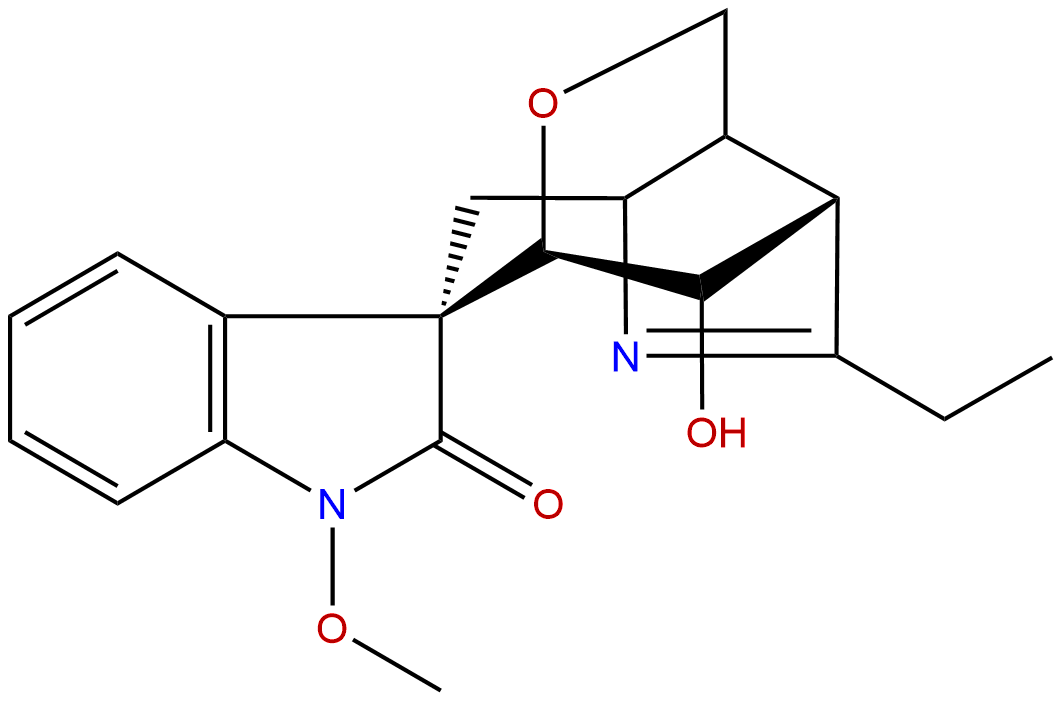
Hu Man Teng alkaloid C: a complex indole alkaloid derived from Gelsemium elegans and its analgesic potential analysis
1. Overview
Humantenidine, CAS number 114027-39-3, is a structurally complex and biologically active monoterpene indole alkaloid. Its molecular formula is C19H22N2O4, with a molecular weight of 342.3950 g/mol. This compound is mainly isolated from plants of the genus Gelsemium, especially Gelsemium elegans This is an important medicinal plant that is both used in traditional medicine and renowned for its high toxicity. As one of the many alkaloids contained in Gelsemium elegans, Humin vine alkaloid C represents a unique member of the natural product chemistry treasure trove. Its complex bridge ring structure and multiple chiral centers not only attract the interest of synthetic chemists, but also because of its unique properties Pharmacological activity spectrum——Especially the interaction between multiple key targets related to pain perception has become a research focus in the field of drug discovery. Existing research has preliminarily revealed its potential in pain relief, but its strong toxicity (such as hepatotoxicity warning) also highlights the challenges it faces as a drug lead compound. This article will provide a systematic and professional interpretation of this natural product from the aspects of its chemical nature, plant origin, pharmacological mechanism, medicinal evaluation, and research prospects.
2. Chemical structure and physicochemical properties
The chemical structure of Houttuynia cordata alkaloids belongs to highly modified monoterpene indole alkaloids. The SMILES string (CCC1=NC2C [C @ @] 3 (C (=O) N (OC) c4ccccc43) [C @ H] 3OCC2 [C @ H] 1C3O) clearly reveals its core skeleton: an indole or indole oxide system fused with a complex multi ring bridged ring system. The structure contains multiple chiral centers (marked by the @ symbol), which means that it has a specific stereoconfiguration, which is crucial for its biological activity and target recognition. The functional groups such as methoxy (- OCH3) and hydroxyl (- OH) in the molecule affect its polarity and intermolecular interactions.
Analyze its physicochemical properties based on the provided pharmacological parameters:
* Molecular weight (MW):342.4 g/mol, Meets the typical range of small molecule drugs (usually<500 Da).
* Lipid water partition coefficient (LogP/LogD)The LogP is about 1.65 and LogD is about 1.65, indicating that the compound has moderate lipophilicity, which is beneficial for penetrating cell membranes, but does not cause metabolic and distribution problems due to high lipid solubility.
* Topological Polarity Surface Area (TPSA)71.36 Å ², which is relatively moderate and reflects the polarity brought by nitrogen and oxygen atoms in the molecule. Usually, TPSA<140 Å ² is beneficial for oral absorption.
* Water solubility:0.6142 mg/mL, Belonging to the category of slight solubility, which is consistent with its moderate LogP and TPSA, it suggests that solubilization strategies may need to be considered in formulation development.
* Caco-2 permeability: 10.29 × 10 ⁻⁶ cm/s, this value is relatively high, indicating that it has Good intestinal absorption potential。
* Blood-brain barrier permeability (BBB)Predicted as' high '. This is related to LogP's moderate molecular weight, small molecular weight, and certain rigidity in structure, suggesting that matrine or its analogues may act on central nervous system targets.
Lipinski Rule of Five Evaluation The molecular weight of Hu Man Teng alkaloid C is less than 500, LogP<5, The number of hydrogen bond donors (inferred from the structure, possibly 1-2 OH/NH) is less than 5, and the number of hydrogen bond acceptors (N+O=6) is less than 10. Therefore, it basically conforms to the Lipinski rule and has a good chemical spatial basis for becoming an orally active drug.
3. Plant sources and traditional applications
The plant source of Humangteng alkaloid C is very clear, that is Gelsemium elegans Also known as the herb for cutting off intestines or tea herbs, it belongs to the Gelsemiaceae family. This plant is widely distributed in eastern and southern Asia, particularly common in southern China.
Gelsemium has a long but extremely cautious history of application in traditional Chinese medicine and folk medicine. Its nature is pungent, bitter, warm, and has Big Poison Traditionally, extremely small doses have been used topically for rheumatic pain, traumatic injuries, neuropathic pain, etc., to achieve the effects of dispelling wind, attacking toxins, reducing swelling, and relieving pain. There are also records of its use in treating skin diseases such as scabies and eczema. However, due to its extremely narrow treatment window, ingestion or slightly larger dosage can cause serious poisoning, manifested as dizziness, blurred vision, dilated pupils, respiratory paralysis, and even death. Therefore, it has always been classified as a highly toxic drug, and oral administration is extremely rare. It is basically not used in modern clinical practice.
Modern plant chemistry research has isolated and identified dozens of alkaloids from Gelsemium, including berberine, such as Koumine and Gelsemine. These alkaloids are considered the main material basis for the pharmacological activity and toxicity of Gelsemium elegans. The discovery of Hu Man Teng alkaloid C provides a new clue for understanding the analgesic tradition of "using poison to attack poison" in Gelsemium elegans at the molecular level, while also warning that its strong toxicity (such as the elevated serum ALT/AST/GGT/ALK levels suggested in the data, indicating potential liver damage risk) must be taken seriously.
4. Pharmacological activity and mechanism of action
The most notable pharmacological activity of Houttuynia cordata alkaloids is concentrated in analgesia field The database information shows that it interacts with five key neural signals and pain regulation targets: TRPV1, CNR1, OPRD1, OPRM1, and OPRK1. This reveals a possible multi-target mechanism of action.
1. Acting on transient receptor potential vanillic acid subtype 1 (TRPV1):
TRPV1 is a non selective cation channel widely distributed on sensory neurons, which can be activated by capsaicin, heat (>43 ° C), acid (pH<6), etc., mediating inflammatory pain and thermal pain. Hu Man Teng alkaloid C acts on TRPV1 and may serve as a potential Antagonists or modulators Inhibit excessive activation of channels, thereby reducing pain signaling mediated by TRPV1. This is one of the important mechanisms by which it may exert peripheral analgesic effects.
2. Acting on cannabinoid receptor 1 (CNR1, also known as CB1 receptor):
CNR1 is mainly distributed in the central nervous system and also exists in the peripheral nervous system. The endocannabinoid system is an important pain descending inhibitory system. Hemp vine alkaloid as a CB1 receptor Excitants or allosteric modulators It can simulate the effect of endogenous cannabinoids, inhibit neurotransmitter release, and produce analgesic, anti anxiety and other effects. This may be the pathway through which it exerts central analgesic effects.
3. Acting on the opioid receptor system (OPRM1/μ, OPRD1/δ, OPRK1/κ):
This is a classic endogenous analgesic system. Hu Man Teng alkaloid C can simultaneously act on three subtypes of opioid receptors, namely μ, δ, and κ, suggesting that it may be one of them Multi subtype opioid receptor modulators This multi-target characteristic may bring unique analgesic effects and may also help avoid the side effects of single receptor activation (such as respiratory depression and addiction related to μ receptors, sedation and irritability related to κ receptors). However, the interaction with opioid receptors also inevitably triggers its effects Potential dependence and abuse tendency The concern is a core issue that must be addressed in subsequent safety evaluations.
Integration of mechanism of action and association with analgesia:
The analgesic effect of Houttuynia cordata alkaloids is likely not achieved through a single pathway, but through Multi target synergistic effect:
* Peripheral level By antagonizing TRPV1, reduce the transmission of nociceptive stimuli to the central nervous system.
* Spinal cord and upper layer of spinal cord By activating CB1 receptors, the endogenous pain suppression pathway is enhanced; Simultaneously regulating the opioid receptor system, directly inhibiting the transmission of pain signals in the spinal cord and regulating the perception of pain in the brain.
This strategy of simultaneously intervening in multiple aspects of pain signal transduction, including peripheral input, spinal cord integration, and central regulation, may result in better efficacy than single target drugs for complex pain (such as neuropathic pain and inflammatory pain). However, multi-target also means a more complex spectrum of side effects, with liver toxicity warnings (Ser_LT/AST and other indicators positive) and risks of chromosomal aberrations (chromosomal-aberration: present), which are major obstacles in its analgesic application.
5. Evaluation of drug properties
Based on the provided detailed pharmacological parameters, we can conduct a systematic evaluation of the potential of huperzine C as a drug lead compound:
Advantage aspects:
1. Good drug like properties As mentioned earlier, its molecular weight LogP、 The number of hydrogen bond donors and acceptors conforms to Lipinski's five rules, and the TPSA value is also in a favorable range, indicating that it has good Oral absorption potential The high permeability data of Caco-2 further supports this point.
2. Excellent central nervous system (CNS) permeability BBB permeability is predicted to be "high", which is crucial for its action on central targets (CNR1, OPRM1/D1/K1) to achieve potent analgesia. Many promising analgesic compounds have failed due to their inability to penetrate the blood-brain barrier.
3. Moderate protein binding rate The plasma protein binding rate (PPB) is about 72.47%, which is at a moderate level. This means that there is a sufficient proportion of free drugs that can be distributed to tissues and exert pharmacological effects, without causing rapid clearance due to low binding rates.
4. No clear hERG channel inhibition HERG inhibition is a common cause of severe cardiac toxicity, such as prolonged QT interval and torsade cuspidata. The data prompt 'No' reduces the direct risk of causing cardiac toxicity.
5. No sensitization risk Skin sensitization (Skid_Sens) and respiratory sensitization (Resp_Sens) are both "no", and phototoxicity (Photo_tox) is "none", which has a certain basis in terms of safety.
Challenges and Risks:
1. Clear genetic toxicity and organ toxicity risks This is the main 'roadblock'.chromosome aberration Positive results indicate that it may have genetic toxicity, which is a serious safety issue that needs to be avoided in drug development. Meanwhile,Ames test A value of 1.2 (usually>1.1 is considered potentially positive) further suggests a risk of mutagenicity. serum ALT, AST, GGT, ALK Raise the sign to indicate its existence Potential risk of liver injury This is consistent with the highly toxic nature of the Gelsemium plant itself.
2. Generally water-soluble The water solubility of 0.614 mg/mL may affect the development of its formulations, especially injectable forms, which may require the use of excipients or structural modifications to increase solubility.
3. Complex side effects caused by multi-target targeting Although multi-target therapy may bring therapeutic advantages, it also makes the prediction and management of side effects complex, especially when it comes to the opioid receptor system, which must be rigorously evaluated Addiction, respiratory depression, and tolerance Risk.
Comprehensive Assessment Hu Man Teng alkaloid C is a compound with Excellent chemical starting point and clear pharmacological mechanism But Accompanied by serious toxicity risk The lead compound. It does not meet the core requirements for safety in "drug development" (genetic toxicity and significant organ toxicity). Therefore, it Not suitable for direct development as a drug However, its chemical structure is subsequent Pharmaceutical Chemistry Optimization Provided an excellent template. The core of future work should be to preserve its multi-target analgesic activity and good membrane permeability through structural modification,Completely eliminate or significantly reduce its genetic toxicity and hepatotoxicity。
6. Research Status and Application Prospects
Research status:
At present, research on the alkaloid C of Houttuynia cordata is still in progress Early preclinical stage The existing literature mainly focuses on:
1. Phytochemistry Isolation, purification, and structural identification from the plant derived Gelsemium elegans.
2. Preliminary pharmacological screening Confirm its activity against TRPV1, opioid receptors, cannabinoid receptors, etc. through in vitro receptor binding experiments or functional experiments, and preliminarily validate its analgesic effect in animal models.
3. Preliminary Study on Toxicity The existing data clearly indicates its genetic toxicity and hepatotoxicity, which may be the main bottleneck currently limiting its research to deeper levels.
There is still a relative lack of systematic research on its detailed mechanism of action (whether it is excitatory, antagonistic, or allosteric regulation), selectivity of three opioid receptor subtypes, pharmacokinetic characteristics in vivo, and specific molecular mechanisms of toxicity.
Application prospects and future directions:
Although it is difficult to directly develop into a drug, the future value of Humanvine alkaloid C is reflected in the following aspects:
1. As the "star skeleton" of new analgesic drug design Its unique rigid multi ring structure is a valuable chemical template for designing novel multi-target analgesics. Pharmaceutical chemists can systematically analyze it Research on Structure Modification and Structure Activity Relationship (SAR)For example, simplifying the skeleton, introducing or replacing specific functional groups, changing stereochemistry, etc., aimed at "maximizing strengths and avoiding weaknesses" - enhancing analgesic efficacy and receptor subtype selectivity, while stripping toxic groups or fragments.
2. Developing non central acting analgesic derivatives Given its high BBB permeability, it is possible to design derivatives that are difficult to enter the central nervous system (such as increasing polarity or molecular weight) to primarily act on peripheral TRPV1 receptors for the treatment of peripheral inflammatory pain or neuropathic pain, thereby avoiding addiction and respiratory depression risks associated with the central opioid system.
3. As a tool molecule for exploring pain pathways Its multi-target properties make it a promising candidate for studying the relationship between TRPV1, endocannabinoid system, and opioid system Crosstalk (Interactive Dialogue) The unique tool helps deepen our understanding of pain network regulation.
4. Exploring toxicity mechanisms and detoxification strategies In depth research on the specific mechanisms that lead to chromosomal aberrations and liver toxicity, such as whether they involve specific metabolic activation, DNA adduct formation, or mitochondrial damage, not only helps optimize the compound itself, but may also provide new ideas for the clinical treatment of Gelsemium elegans poisoning.
Conclusion:
Humantenidine is a contradictory natural product derived from the traditional toxic plant Gelsemium elegans. It presents us with a complex chemical blueprint shaped by natural evolution that can precisely intervene in mammalian pain perception networks. Its multi-target analgesic mechanism is fascinating, and some highlights in the drug properties also offer hope. However, natural creations are not tailor-made for human medicine, and their accompanying strong toxicity (especially genetic toxicity) has sounded the alarm for their direct application. In the future, it will primarily serve as a high-value asset lead compound Motivate medicinal chemists, pharmacologists, and toxicologists to work together to refine safe and effective "pain relieving drugs" from their dangerous "blades" through rational structural modification. This path is full of challenges, but it is also the core charm and value of modern research on natural products.