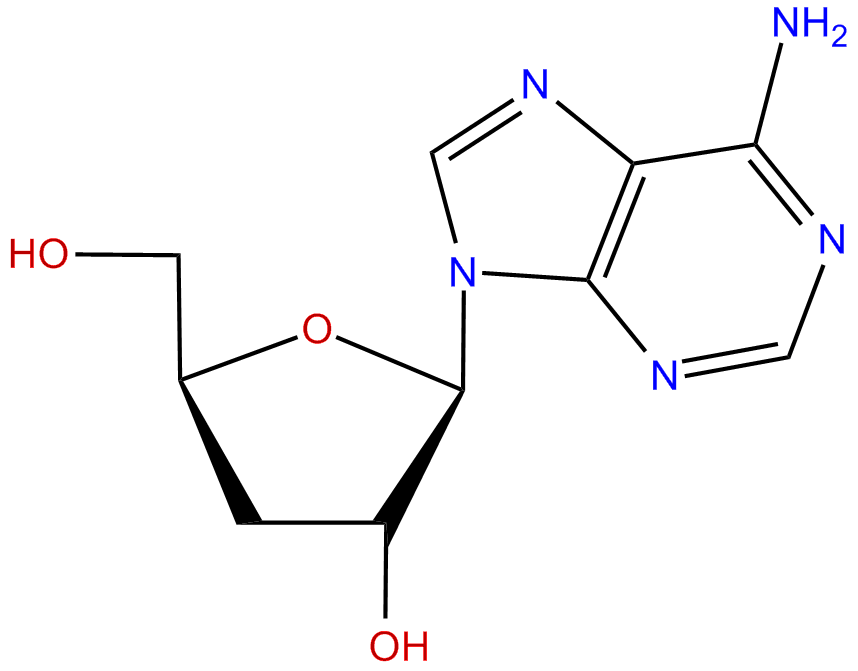


Synonym name: 3'-Deoxyadenosine, 9CI,8CI; 9-Cordyceposidoadenosine; Adenine cordyceposide; Cordycepine
Catalogue No.: BP0392
Cas No.: 73-03-0
Formula: C10H13N5O3
Mol Weight: 251.246
Botanical Source: Cordyceps militaris
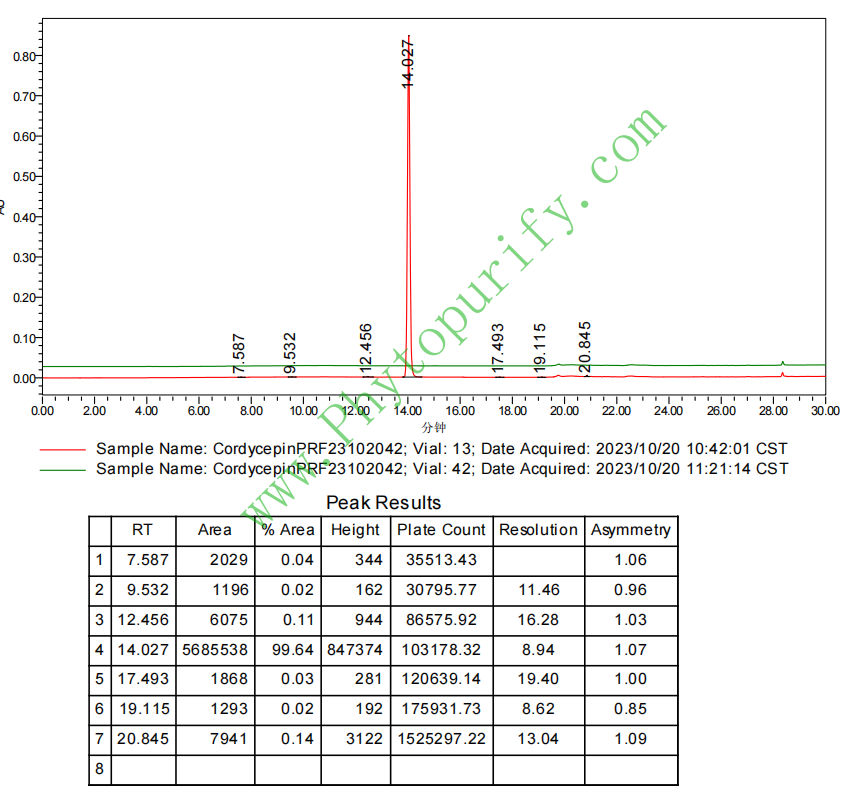
Purity: 95%~99%
Analysis Method: HPLC-DAD or/and HPLC-ELSD
Identification Method: Mass, NMR
Packing: Brown vial or HDPE plastic bottle
Can be supplied from milligrams to grams, up to kilograms.
GMP is available on request.
Inquire for bulk scale.
Profile:
Cordycepin
A purine nucleoside antimetabolite and antibiotic isolated from the fungus Cordyceps militaris with potential antineoplastic activity. Cordycepin is an adenosine analogue, which is readily phosphorylated to its mono-, di-, and triphosphate intracellularly. Triphosphate cordycepin can be incorporated into RNA, and inhibits transcription elongation and RNA synthesis due to the absence of a hydroxyl moiety at the 3' position. Because it can be converted to an inactive metabolite by adenosine deaminase, this agent must be administered with an adenosine deaminase inhibitor in order to be effective. Cordycepin has displayed cytotoxicity against some leukemic cell lines in vitro. Check for active clinical trials using this agent. (NCI Thesaurus).
References:
Storage conditions:Short-term storage at 2~8℃, long-term storage at -20 ~ -80℃
119.3100
-.4711
-.4720
7.5935
.8299
.8420
High
29.7783
3.6323
Yes
Yes
No
No
Yes
No
1.2
Yes
No
Yes
Yes
Cordycepin, chemical name 3 '- deoxyadenosine, CAS number 73-03-0, is a purine nucleoside analogue isolated from traditional medicinal fungi such as Cordyceps Militaris. Since its first discovery in the 1950s, cordycepin has attracted much attention due to its wide range of biological activities and has become a hot molecule in natural product pharmacology research. It not only carries the wisdom of traditional Chinese medicine's "strengthening the body and consolidating the foundation", but also demonstrates great potential for multi-target and multi-channel intervention in diseases in modern molecular pharmacology research. Early research mainly focused on its antibacterial and antiviral activities, while research in the past two decades has profoundly revealed its significant efficacy in anti-inflammatory, immune regulation, anti fibrosis, and anti-tumor fields. Especially in major disease models such as lung cancer and rheumatoid arthritis, cordycepin exhibits the characteristic of exerting therapeutic effects by regulating key signaling pathways and target molecules. This article aims to systematically review the chemical properties, sources, pharmacological activities, molecular mechanisms of action, medicinal properties, and clinical application prospects of cordycepin, in order to provide comprehensive academic references for the in-depth development and transformation research of this natural product.
The molecular formula of cordycepin is C10H13N5O3, with a molecular weight of 251.2460. Its chemical structure can be regarded as an analogue of adenosine, with the core difference being the absence of a hydroxyl group (- OH) on the 3 'carbon atom of the ribose ring, which is replaced by a hydrogen atom, forming a 3' - deoxy structure. This subtle structural difference is the chemical basis that distinguishes it from endogenous adenosine and generates unique biological activity.
In terms of physical and chemical properties, cordycepin is a white to off white crystalline powder. The calculated lipid water partition coefficient (LogP) is approximately -0.4711, indicating that it has a certain degree of hydrophilicity. The topological polar surface area (TPSA) is 119.3100 Å ², reflecting the presence of multiple hydrogen bond acceptors in the molecule, such as purine ring nitrogen atoms and sugar epoxide atoms. Its water solubility data is about 7.5935 mg/mL, which belongs to the solubility range, which is beneficial for its application in water-based formulations. Cordycepin is relatively stable at room temperature, but is sensitive to strong acids, strong bases, and high temperatures. Therefore, attention should be paid to condition control during extraction, purification, and storage. The purine base in its structure gives it a characteristic ultraviolet absorption peak around 260 nm. It is worth noting that its 3 '- deoxy structure allows it to be incorporated into RNA strands, but the elongation of the strand is terminated due to its lack of 3' - hydroxyl, which is one of the core mechanisms affecting nucleic acid metabolism.
Cordycepin is mainly derived from fungi of the Ascomycota and ergot families, with Cordyceps Militaris being the main source. Under artificial cultivation conditions, its cordycepin content is high and stable. In addition, cordycepin has also been detected in Ophiocordyceps sinensis, but the content is usually low and significantly affected by the place of origin and growth stage.
The extraction method of cordycepin has undergone development from traditional to modern. Traditional methods often use hot water or alcohol water (such as methanol, ethanol) solutions for reflux extraction, which is simple to operate but has poor selectivity. There are many co extracts, and the subsequent purification steps are cumbersome. Modern extraction techniques are more efficient and environmentally friendly:
1. Ultrasound assisted extraction Utilizing the cavitation effect of ultrasound to destroy cell walls and accelerate solute release can significantly improve extraction efficiency, shorten time, and reduce solvent consumption.
2. Microwave assisted extraction By selectively heating the internal water of cells with microwave energy, high pressure is generated to cause cell rupture and rapid release of contents, which has the advantages of high efficiency and energy saving.
3. Supercritical fluid extraction Supercritical CO2 is commonly used to selectively extract target components by adjusting temperature and pressure to change its solubility. This method has no solvent residue and mild conditions, especially suitable for thermosensitive substances, but the equipment cost is relatively high.
The crude extract after extraction usually needs to undergo a series of purification steps, including macroporous adsorption resin chromatography (separated based on polarity differences), silica gel column chromatography, preparative high-performance liquid chromatography (HPLC), etc., to obtain high-purity cordycepin monomers. In recent years, advances in fermentation engineering technology have made it possible to produce cordycepin on a large scale through deep liquid fermentation of Cordyceps militaris mycelium, providing sustainable resource guarantees for meeting research and clinical needs.
Cordycepin exhibits diverse and powerful pharmacological activities, and its research has extended from in vitro cell models to in vivo animal experiments.
Anti inflammatory and immune regulatory activity Cordycepin is one of the most extensively studied activities. In the rheumatoid arthritis (RA) model, cordycepin can significantly inhibit the expression of matrix metalloproteinase-1 and MMP-3 (MMP-1, MMP-3) in synovial fibroblasts (RASF) induced by interleukin-1 β (IL-1 β) in a dose-dependent manner. MMPs are key enzymes that degrade the extracellular matrix of articular cartilage cells, and their overexpression is the core link leading to joint damage in RA. The inhibitory effect of cordycepin suggests its therapeutic potential in alleviating RA joint inflammation and bone erosion. In addition, cordycepin can regulate the functions of various immune cells such as macrophages and T lymphocytes, and inhibit excessive inflammatory reactions.
Antitumor activity Cordycepin has inhibitory effects on proliferation and induces apoptosis in various tumor cell lines, with particularly in-depth research on lung cancer. Research has shown that cordycepin can inhibit the growth, invasion, and metastasis of lung cancer cells. Its function is closely related to inducing cell cycle arrest (such as G2/M phase), activating apoptotic signaling pathways, and inhibiting tumor angiogenesis.
Antibacterial and antiviral activity Cordycepin has a killing effect on Mycobacterium tuberculosis, and its mechanism is unique by inhibiting the bacterial adenosine kinase and interfering with its purine metabolism. In addition, cordycepin also exhibits inhibitory activity against certain Gram positive and Gram negative bacteria, as well as multiple viruses such as influenza virus and human immunodeficiency virus HIV, mainly by interfering with the synthesis of viral nucleic acids.
Other activities The study also found that cordycepin has potential activities such as anti fibrosis (such as pulmonary fibrosis, liver fibrosis), neuroprotection, improvement of insulin resistance, and anti fatigue, indicating a wide range of pharmacological effects.
The multiple pharmacological effects of cordycepin stem from its multi-target and multi pathway mechanism of action. The structure of its 3 '- deoxyadenosine allows it to mimic adenosine and participate in and interfere with various biochemical processes within cells.
Core Function Mode:
Key targets and pathways in specific diseases (taking lung cancer as an example):
Based on the provided target information, the mechanism of action of cordycepin against lung cancer involves complex network regulation:
In the RA model, its inhibitory effect on MMP-1/3 expression is closely related to the inhibition of transcription factors such as NF - κ B and AP-1 activation.
The evaluation of drug properties is a crucial step in the conversion of natural products into drugs. Cordycepin exhibits both advantages and disadvantages in this regard.
Physicochemical and Preliminary ADMET Properties Cordycepin has a moderate molecular weight (251 Da) and strong hydrophilicity (LogP -0.47), which is beneficial for dissolution and distribution. Its topological polar surface area (TPSA 119 Å ²) suggests that it may comply with the five drug class rules. Good water solubility, easy to prepare. It is worth noting that it Prediction of blood-brain barrier permeability as' high 'This provides potential advantages for its application in central nervous system related diseases such as neuroinflammation and brain tumors. In terms of security,HERG inhibition is' no 'Reducing the risk of inducing QT interval prolongation and apical torsion type ventricular tachycardia is an important safety advantage.The Ames test value is 1.2(It is generally considered positive if the ratio is greater than 2), indicating a low risk of mutagenicity, but further in vivo genetic toxicity testing is needed to confirm.
Pharmacokinetic Challenge The main challenge faced by cordycepin as a drug is its rapid metabolism and inactivation in the body. After oral administration, cordycepin can be rapidly deaminated by adenosine deaminase (ADA) widely present in the intestine and liver, and converted into 3 '- deoxyinosine with significantly reduced activity, resulting in extremely low oral bioavailability (usually<5%). After intravenous administration, its half-life in plasma is also short, widely distributed but rapidly eliminated.
Formulation strategy To improve the stability and bioavailability of cordycepin, researchers have developed various strategies:
The broad biological activity of cordycepin has shown promising prospects in the treatment of various diseases, but its transformation still needs to overcome many challenges.
Potential clinical application directions:
challenges faced:
Future Prospects:
Future research should focus on: ① utilizing chemical synthesis and biotechnology to optimize the structure of cordycepin and develop more stable and targeted derivatives or prodrugs; ② Deepen the research on the mechanism of action based on systems biology and computational simulation, and clarify its core therapeutic target network; ③ Vigorously promote the research and development of formulations based on new nano drug delivery systems to achieve precise delivery and controlled release; ④ Conduct standardized clinical studies, particularly in evaluating the efficacy and safety of cordycepin in combination therapy strategies. Through interdisciplinary collaboration, cordycepin, an ancient natural molecule, is expected to rejuvenate and contribute new therapeutic solutions to human health.
Cordycepin, as a natural active molecule derived from traditional medicinal fungi, has demonstrated outstanding potential in multiple pharmacological frontiers such as anti-inflammatory, anti-tumor, and antibacterial fields due to its unique 3 '- deoxyadenosine structure. The study of its mechanism of action has progressed from early RNA synthesis inhibition to intervening in the pathological processes of major diseases such as lung cancer and rheumatoid arthritis by regulating key targets such as BCL2, TLR4/STAT3, MMPs, and NFE2L2. Despite the severe challenge of rapid metabolism in the body for its drug development, this bottleneck is gradually being overcome through strategies such as structural modification, ADA inhibitor combination, and advanced drug delivery systems. Currently, the research on cordycepin is in a critical stage of transitioning from laboratory to clinical use. In the future, with more precise analysis of its molecular mechanism, the application of innovative drug delivery technology, and the advancement of rigorous clinical trials, cordycepin is expected to transform from a highly anticipated scientific research molecule into an innovative drug or therapeutic adjuvant with practical clinical application value, continuing the glorious chapter of natural products in modern medicine.
