| Catalog No | Package | Original Price | Price | Inventory | Quantity | Operating |
|---|---|---|---|---|---|---|
| BP5101-5mg | 5mg | $850.00 | Sign in |
|


Storage conditions:Short-term storage at 2~8℃, long-term storage at -20 ~ -80℃
Swainsonine is a natural indole alkaloid that was first isolated from plants such as Swainsona spp. As an effective and reversible inhibitor of alpha mannosidase, coumarin has attracted widespread attention in the field of natural product pharmacology. Its unique molecular structure endows it with multiple biological activities in cell biology and tumor therapy, particularly exhibiting significant effects in inducing cell apoptosis, cell cycle arrest, and anti-tumor effects. In recent years, with the development of molecular targeted therapy and precision medicine, the mechanism of action and related molecular targets of coumarin have been continuously studied, providing theoretical basis and practical guidance for its clinical application.
This article aims to systematically review the chemical structure and physicochemical properties, plant sources and extraction methods, pharmacological activity and mechanism of action, pharmacological evaluation and pharmacokinetic characteristics of coumarin, and explore its potential applications and future development directions in tumor therapy based on current research progress.
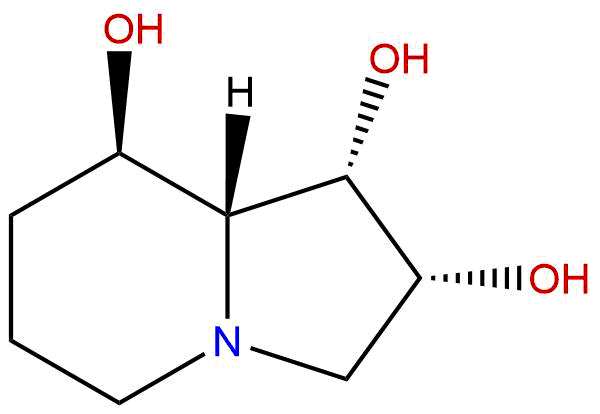
The chemical name of coumarin is 1,2,8,8a-tetrahydro-1-hydroxy-2-methylindolizidine, with a molecular formula of C8H15NO3 and a molecular weight of 173.2120. Its structural feature is an indolizine skeleton containing multiple hydroxyl groups, which endows it with strong hydrophilicity. The LogP value of coumarin is about -1.1149, indicating that it has low lipid solubility and high water solubility (about 224.1652 mg/mL), which is beneficial for its distribution and metabolism in the body.
Its topological polar surface area (TPSA) is 63.93 Å ², indicating that its molecular polarity is moderate and conducive to binding with biomolecules such as enzyme proteins. Ku Ma Dou Su is not easy to penetrate the blood-brain barrier, and the permeability of the blood-brain barrier is low, reducing the risk of central nervous system side effects. In addition, coumarin does not exhibit hERG channel inhibitory activity, reducing the risk of cardiac toxicity. The Ames test result is 0.3, indicating a low risk of genotoxicity and a certain level of safety.
The chemical structure diagram of coumarin is as follows:
(A schematic diagram of the molecular structure of coumarin should be inserted here)
Ku Ma Dou Su was initially isolated from the Australian plant genus Swainsona spp. and subsequently discovered in various plants and fungi. Plants containing Ku Ma Dou Su also include certain flavonoid plants and fungal genera such as Rhizoctonia and Metarhizium. It has a wide range of natural sources and relatively low content, which limits its large-scale application.
The traditional extraction method mainly adopts solvent extraction combined with column chromatography separation technology. The general steps include:
In recent years, the introduction of supercritical fluid extraction and membrane separation technology has improved the extraction efficiency and purity of coumarin, and is more in line with the principles of green chemistry. In addition, the progress of genetic engineering and microbial fermentation technology provides new strategies for the biosynthesis of coumarin, which is expected to achieve industrial production.
As an inhibitor of α - mannosidase, coumarin can interfere with the glycosylation process of glycoproteins, thereby affecting cellular function and signal transduction. Its main pharmacological activities include:
A large number of in vivo and in vitro experiments have shown that swainsonine has a significant inhibitory effect on a variety of tumor cell lines, including breast cancer, lung cancer, liver cancer, stomach cancer, colorectal cancer, etc. Its anti-tumor effect is mainly manifested as:
In addition to anti-tumor effects, coumarin also exhibits potential activities such as antiviral, anti-inflammatory, and neuroprotective effects, but related research is still in the preliminary stage and needs further validation.
The biological effects of coumarin mainly stem from its inhibitory effect on alpha mannosidase, leading to abnormal glycosylation of glycoproteins and subsequently affecting cell signaling and function. The specific mechanism involves multiple molecular targets:
Ku Ma Dou Su regulates the expression of anti apoptotic proteins MCL1 and BCL2, reduces their levels, and promotes cell apoptosis. MCL1 and BCL2 are key regulatory factors in the mitochondrial apoptosis pathway, and their downregulation helps to release cytochrome C and activate the caspase family.
Signal transducer and activator of transcription factor 3 (STAT3) is an important regulatory factor for tumor cell proliferation and immune escape. Ku Ma Dou Su inhibits the phosphorylation and activity of STAT3, blocking its downstream tumorigenic signaling pathway.
Matrix metalloproteinase-2 (MMP2) is involved in the degradation and invasion of tumor cell matrix. Ku Ma Dou Su inhibits the expression of MMP2 and reduces the migration and metastasis ability of tumor cells.
Topoisomerase 1 (TOP1) and topoisomerase 2 α (TOP2A) are key enzymes involved in DNA replication and transcription. Ku Ma Dou Su inhibits the normal replication and repair of tumor cell DNA by affecting the activity of these two enzymes.
Hypoxia inducible factor 1 alpha (HIF1A) regulates the adaptive response of tumor hypoxic microenvironment. Ku Ma Dou Su inhibits the expression of HIF1A, interferes with the metabolic reprogramming and angiogenesis of tumor cells.
Ku Ma Dou Su also affects the MAPK1 signaling pathway, regulating cell proliferation and apoptosis. Its regulation of estrogen receptor 1 (ESR1) and aromatase (CYP19A1) suggests its potential application value in hormone dependent tumors.
In summary, coumarin exerts its anti-tumor and cellular regulatory functions through multi-target and multi pathway synergistic effects.
The pharmacological evaluation of coumarin shows that it has certain potential for drug development:
In terms of pharmacokinetics, coumarin is rapidly absorbed orally and widely distributed in the body, but its metabolic pathways and excretion mechanisms are not yet fully understood. Its half-life is moderate and suitable for daily administration. Current research suggests that coumarin is mainly excreted through the kidneys, with limited contribution to liver metabolism.
However, the bioavailability and in vivo stability of coumarin still need to be optimized. Through drug delivery systems such as nanoparticles and liposomes, it is expected to enhance their pharmacokinetic properties and targeting.
Due to its unique anti-tumor mechanism and good safety, coumarin has become a hot topic in the development of anticancer drugs. Its multi-target mode of action meets the current demand for the treatment of multidrug-resistant tumors and has broad clinical application potential.
Ku Ma Dou Su can be used as a candidate drug for monotherapy, combination chemotherapy, and targeted therapy. It has a good inhibitory effect on breast cancer, lung cancer and other solid tumors, and its efficacy and safety can be verified through clinical trials in the future.
The immunomodulatory effect of coumarin provides a new approach for tumor immunotherapy. Combined immune checkpoint inhibitors may enhance anti-tumor immune responses and improve treatment efficacy.
The low fat solubility and in vivo stability of coumarin limit its clinical application. In the future, it is necessary to improve its pharmacokinetics and targeting through structural modification, dosage form innovation, and optimization of drug delivery systems.
In addition, the safety and toxicological evaluation of coumarin need to be further improved, especially regarding the potential side effects and drug interactions of long-term use.
The development of genetic engineering and synthetic biology technologies is expected to achieve large-scale production of coumarin, reduce costs, and promote its clinical translation.
As a natural indolizine alkaloid, coumarin has shown broad application prospects in the field of anti-tumor due to its effective and reversible α - mannosidase inhibitory activity. Its multi-target and multi pathway mechanism of action provides a new strategy for tumor treatment. Despite still facing challenges in drug formulation and production processes, with advances in medicinal chemistry, molecular biology, and drug delivery technology, coumarin is expected to become an important candidate for the new generation of anti-tumor drugs.
Future research should focus on the structural optimization, in-depth analysis of the mechanism of action, promotion of preclinical and clinical studies, as well as the establishment of efficient and green production processes for coumarin, in order to promote its transition from laboratory to clinical application and benefit patients.
