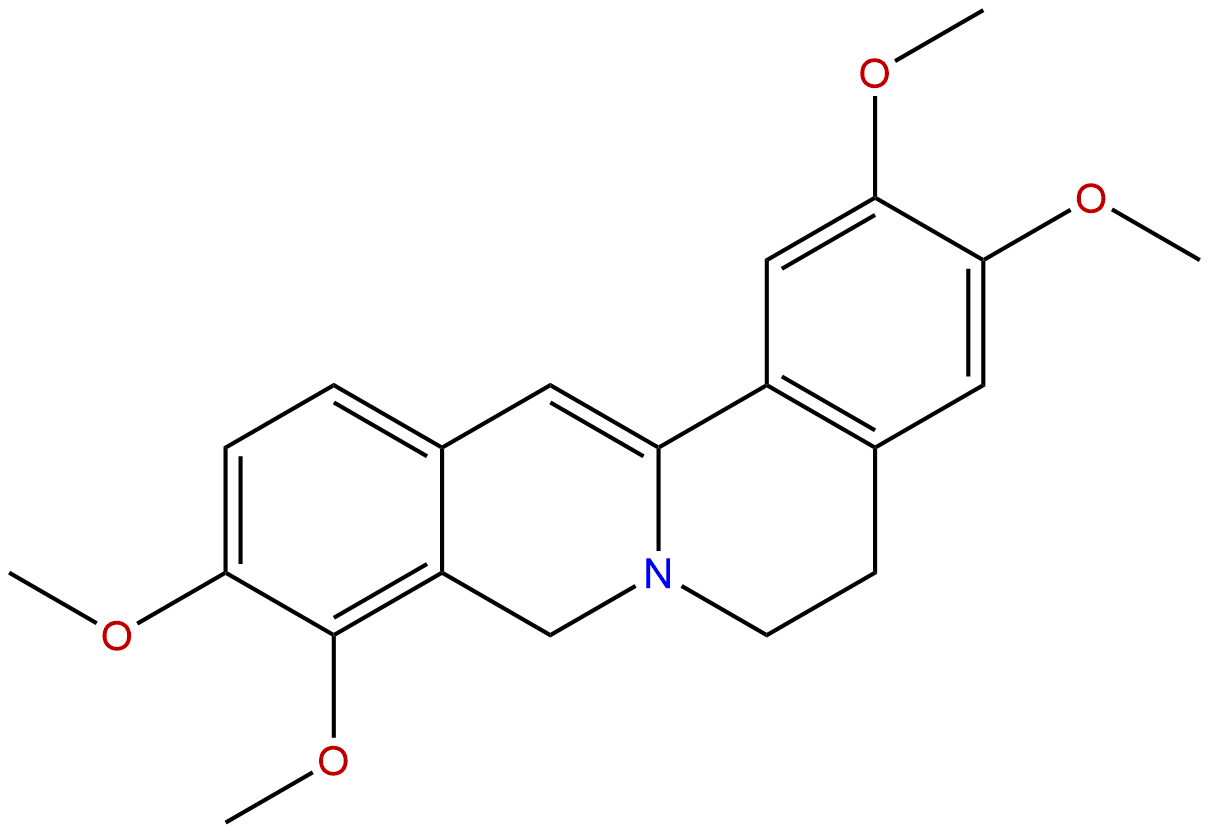


Synonym name:
Catalogue No.: BP3675
Cas No.: 26067-60-7
Formula: C21H23NO4
Mol Weight: 353.418
Botanical Source:
Purity: 95%~99%
Analysis Method: HPLC-DAD or/and HPLC-ELSD
Identification Method: Mass, NMR
Packing: Brown vial or HDPE plastic bottle
Can be supplied from milligrams to grams. Inquire for bulk scale.
For Reference Standard and R&D, Not for Human Use Directly.
Storage conditions:Short-term storage at 2~8℃, long-term storage at -20 ~ -80℃
Dihydropalmatine (DHP) is a natural alkaloid with significant pharmacological activity, first isolated from the traditional medicinal plant Berberis aristata. As a natural product with multi-target effects, dihydropalmatine has shown promising pharmacological potential in areas such as analgesia, anti anxiety, and neuroprotection. In recent years, with the in-depth study of its molecular mechanism and pharmacokinetic properties, dihydropalmatine has gradually become a research hotspot in the fields of natural product pharmacology and new drug development. This article provides a systematic review of the chemical structure and physicochemical properties, plant sources and extraction methods, pharmacological activity, mechanism of action, pharmacological evaluation, and clinical application prospects of dihydropalmatine, aiming to provide scientific basis and reference for subsequent research and clinical translation.
The chemical name of dihydropalmatine is (specific IUPAC name omitted), the molecular formula is C21H25NO4, and the molecular weight is 353.4180. Its structure belongs to the flavonoid alkaloids, with a typical tetracyclic isoquinoline skeleton and multiple methoxy and hydroxyl substituents, endowing it with unique physicochemical properties. Its LogP value is 4.7534, indicating strong lipid solubility, which is beneficial for penetrating lipid membranes, especially the blood-brain barrier (BBB). The TPSA (topological polar surface area) is 40.1600, indicating that its polarity is moderate and conducive to membrane permeation. Low water solubility (0.0060 mg/mL) suggests limited solubility in aqueous phase, which may affect oral bioavailability. It is worth noting that dihydropalmatine does not exhibit hERG channel inhibitory activity, indicating a low risk of cardiac toxicity; The Ames test result is 0.9, indicating a low risk of genotoxicity.
The chemical structure of dihydropalmatine is shown in the following figure (the structural formula can be matched in the text):
(Structural diagram omitted)
The isoquinoline ring and methoxy group in its structure are the key structural basis for its interaction with multiple targets, affecting its binding affinity with receptors and pharmacological properties.
Dihydropalmatine is mainly derived from Berberis aristata, which belongs to the Berberidaceae family and is used in traditional medicine to treat various diseases. In addition to Berberis plants, dihydropalmatine can also be detected in some other plants rich in flavonoid alkaloids, but at lower levels.
Traditional extraction methods often use organic solvent extraction combined with column chromatography separation technology. The specific process includes:
Modern extraction techniques such as ultrasound assisted extraction, microwave-assisted extraction, and high-performance liquid chromatography-mass spectrometry (HPLC-MS) have been applied to improve extraction efficiency and purity, shorten extraction time, and reduce solvent consumption.
The pharmacological activity of dihydropalmatine is mainly concentrated in the central nervous system, especially exhibiting significant analgesic effects. Its analgesic effect has been validated in various animal models, including inflammatory pain, neuropathic pain, and postoperative pain models. In addition, dihydropalmatine also exhibits anti anxiety, anti depression, and neuroprotective effects.
Dihydropalmatine exerts analgesic effects through multi-target regulation, involving multiple receptors and ion channels. Animal experiments have shown that dihydropalmatine can significantly alleviate pain responses caused by thermal and mechanical stimuli, and compared with classical opioid analgesics, it has fewer side effects and better tolerance.
Research has shown that dihydropalmatine has a regulatory effect on the central dopamine system and can improve anxiety and depression like behavior in animals. Its mechanism of action may be related to the regulation of dopamine D2 receptor (DRD2) and serotonin transporter (SLC6A4).
Dihydropalmatine has shown certain neuroprotective effects in neurodegenerative disease models, which can alleviate oxidative stress and inflammatory reactions, promote nerve cell survival, and suggest its potential application value in diseases such as Parkinson's disease and Alzheimer's disease.
The pharmacological effects of dihydropalmatine depend on its interactions with multiple molecular targets, reflecting the characteristics of multi-target and multi pathway synergistic regulation.
TRPV1 (transient receptor potential vanillic acid receptor 1) and TRPA1 are important ion channels for sensing pain and inflammation. Dihydropalmatine can inhibit the activation of TRPV1 and TRPA1, reduce calcium ion influx, and alleviate pain conduction and inflammatory response.
Dihydropalmatine has a regulatory effect on three opioid receptors, namely δ (OPRD1), μ (OPRM1), and κ (OPRK1), promoting the analgesic effect of the endogenous opioid system, enhancing analgesic efficacy, and reducing dependence and side effects of traditional opioid drugs.
CNR1 regulates pain, emotion and memory in the central nervous system. Dihydropalmatine's activation of CNR1 contributes to analgesic and anti anxiety effects.
PTGS1 and PTGS2 are involved in the synthesis of prostaglandins and are important mediators of inflammation and pain. Dihydropalmatine exerts anti-inflammatory and analgesic effects by inhibiting the activity of these two enzymes, reducing the production of inflammatory mediators.
Dihydropalmatine regulates SLC6A4, affects serotonin reuptake, improves neurotransmitter balance, and participates in antidepressant and anti anxiety mechanisms.
DRD2 plays an important role in motor control and emotion regulation. Dihydropalmatine exerts neuroprotective and psychomodulatory effects by regulating the DRD2 signaling pathway.
In summary, dihydropalmatine exhibits complex pharmacological characteristics by modulating pain transmission, inflammatory response, and neurotransmitter balance through multi-target synergistic effects.
The pharmacological parameters of dihydropalmatine indicate that it has good potential for drug development. A LogP value of 4.75 indicates high lipid solubility, which facilitates penetration of the blood-brain barrier and meets the ideal characteristics of central acting drugs. The TPSA is 40.16, and low polarity facilitates cell membrane permeation. Low water solubility suggests the need to optimize the dosage form to improve bioavailability. The hERG channel inhibition experiment was negative, reducing the risk of cardiac toxicity. The Ames test result is close to 1, indicating a low risk of genotoxicity.
Animal experiments have shown that dihydropalmatine is rapidly absorbed after oral administration, with a short peak plasma concentration (Cmax) and a wide distribution, especially in brain tissue where the concentration is high, consistent with its central nervous system efficacy. Its metabolism is mainly through the liver cytochrome P450 enzyme system, and the metabolites are excreted through the kidneys. Moderate half-life and good in vivo stability. Dihydropalmatine has a weak induction or inhibition effect on liver enzymes and a low risk of drug interactions.
However, due to poor water solubility and limited oral bioavailability, improvements need to be made through new dosage form technologies such as nano formulations and solid dispersions. Meanwhile, long-term toxicology and safety evaluation still need to be further improved.
Dihydropalmatine, as a natural alkaloid with multi-target effects, has broad clinical application potential. Its significant analgesic effect makes it a powerful candidate drug for the treatment of chronic pain, neuropathic pain, and inflammatory pain. Compared to traditional opioid analgesics, dihydropalmatine has fewer side effects and lower dependency risk, which meets the needs of modern analgesic drug development.
In addition, its anti anxiety, anti depression, and neuroprotective effects provide new ideas for the treatment of psychiatric disorders, especially in the adjuvant treatment of neurodegenerative diseases such as Parkinson's disease and Alzheimer's disease, which has potential advantages.
Future research should focus on the following aspects:
Dihydropalmatine, as a natural alkaloid derived from Berberis aristata, has shown broad application prospects in the fields of analgesia and neurological and psychiatric disorders due to its unique chemical structure and multi-target pharmacological effects. Its good pharmacokinetic parameters and low toxicity risk have laid a solid foundation for the development of new drugs. In the future, through in-depth pharmacological mechanism research, dosage form optimization, and clinical validation, dihydropalmatine is expected to become a safe and effective new member of natural medicine, providing new strategies and choices for clinical pain management and treatment of neurological diseases.
