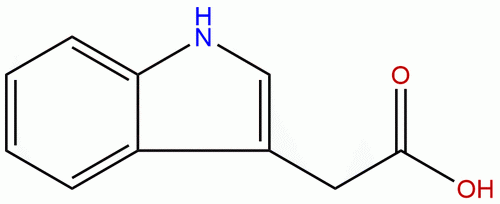


Product name: Indole-3-acetic acid
Synonym name:
Catalogue No.: BP3883
Cas No.: 87-51-4
Formula: C10H9NO2
Mol Weight: 175.187
Botanical Source:
Physical Description:
Type of Compound:
Purity: 95%~99%
Analysis Method: HPLC-DAD or/and HPLC-ELSD
Identification Method: Mass, NMR
Packing: Brown vial or HDPE plastic bottle
The product could be supplied from milligrams to grams
Inquire for bulk scale.
For Reference Standard and R&D, Not for Human Use Directly.
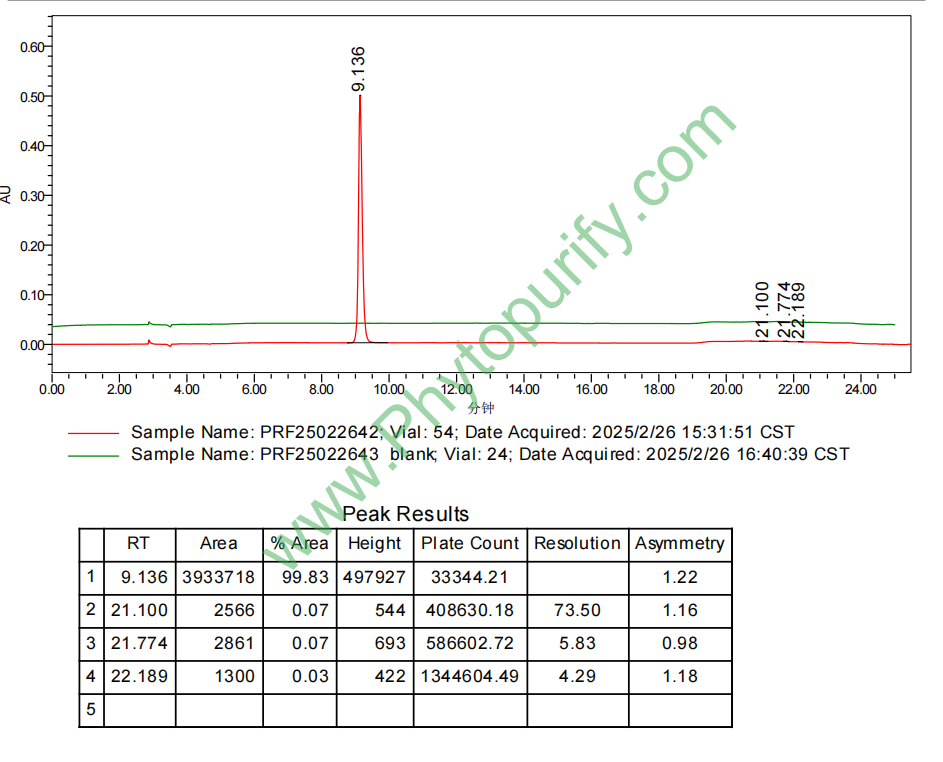
HPLC of Indole-3-acetic acid
Storage conditions:Short-term storage at 2~8℃, long-term storage at -20 ~ -80℃
53.0900
1.6427
-.7924
.7466
2.0318
18.7398
Low
86.4393
1.7294
Yes
Yes
No
No
No
Yes
0.0
Yes
No
Yes
Yes
Natural products, as an important source of drug discovery, play an indispensable role in the long history of human struggle against diseases. In the vast universe of natural products, there is a type of molecule known for its core biological functions despite its simple structure, which is plant hormones. Among them, indole-3-acetic acid (IAA), as the earliest discovered auxin plant hormone, is not only the core regulator of plant growth and development, but also gradually becoming a new focus of pharmacological research due to its potential role in animal and human physiological processes.
3-Indoleacetic acid, with the chemical formula C ₁₀ H ₉ NO ₂, is a naturally occurring monocarboxylic acid. Its history can be traced back to the early 20th century, when Darwin hinted at the existence of some "influencing substance" in his famous experiment on plant phototaxis. Until 1934, Dutch scientist Fritz Went first isolated and identified this active substance from oat germ sheaths, and named it "auxin". Subsequently, IAA was confirmed as the most important natural auxin in plants. In the plant kingdom, IAA is almost involved in the regulation of all life cycles from embryonic development, organ formation to sexual response, aging, and is known as the "master of plant growth".
However, the biological scope of IAA extends far beyond plants. In recent years, with the development of microbiology, metabolomics, and chemical biology, it has been discovered that IAA is also an important member of the endogenous metabolite network in the human body. It is mainly synthesized by the gut microbiota (such as Escherichia coli, lactobacilli, etc.) using tryptophan in the host or diet through deamination, decarboxylation, and other pathways. This discovery elevates IAA from a simple plant hormone to a cross-border signaling molecule that connects plants, microorganisms, and animal hosts. Its role in host microbe interaction, immune regulation, inflammatory response, and even tumor development is gradually being revealed.
This article aims to provide a comprehensive professional review of 3-indoleacetic acid. We will start from its chemical structure and physicochemical properties, systematically sort out its sources and extraction methods in plants, deeply explore its pharmacological activity as a plant hormone and potential mammalian active molecule, and elaborate on its classic and emerging mechanisms of action and molecular targets. At the same time, based on its pharmacological parameters, evaluate its pharmacokinetic characteristics and ultimately look forward to its application prospects in the fields of agriculture, medicine, and biotechnology. By re examining this classic molecule, we hope to provide new perspectives for natural product pharmacology research and stimulate more thinking about the drug conversion of cross-border signaling molecules.
The core structure of 3-indoleacetic acid consists of an indole ring and an acetic acid side chain. The indole ring is formed by the fusion of a benzene ring and a pyrrole ring, and its 3-carbon atom (C-3) is connected to a carboxyl group (- COOH) through a methylene group (- CH ₂ -). This structure endows IAA with unique chemical properties. Its molecular weight is 175.19 g/mol, and its molecular formula is C ₁₀ H ₉ NO ₂. IAA has lively chemical properties, especially sensitive to light, heat, and oxidants, and is prone to degradation in solution.
From the perspective of physicochemical properties, the lipid water partition coefficient (LogP) of IAA is 1.64, indicating that it has a certain lipophilicity and can cross biofilms, but at the same time retains a certain degree of water solubility (water solubility value of 0.75 mg/mL), which allows it to be transported through both extracellular and symplastic transport in plant vascular bundles. Its topological polar surface area (TPSA) is 53.09 Å ², which is lower than the commonly believed passive diffusion threshold (about 140 Å ²), indicating good cell membrane permeability. IAA is a weak acid (pKa of approximately 4.8) that exists mostly in the form of an anion (IAA ⁻) under physiological pH conditions (such as plant cytoplasm pH of approximately 7.2). This ionized state is crucial for its polar transport between cells. In addition, the indole ring of IAA is an electron rich system that allows it to participate in various chemical reactions, such as forming amide bond complexes (IAA amino acid complexes) with amino acids (such as aspartic acid and glutamic acid), which is one of the important ways for IAA homeostasis regulation in plants. The carboxyl group in its structure also makes it easy to form ester bonds with alcohols or combine with sugars to form glycosides.
3-Indoleacetic acid is widely distributed in the plant kingdom, almost present in all higher plants, especially in areas of vigorous growth such as stem meristem, young leaves, germinating seeds, and root tips where its content is highest. In addition, certain microorganisms, especially plant rhizosphere growth promoting bacteria (PGPR) and pathogens, can also synthesize IAA. The synthesis of IAA in plants mainly occurs through two main pathways: tryptophan dependent pathway (including indole-3-acetamide pathway, indole-3-pyruvate pathway, serotonin pathway, and indole-3-acetadoxime pathway) and non tryptophan dependent pathway. Among them, the indole-3-pyruvate pathway is considered the most important synthetic pathway in plants.
The traditional IAA extraction method is mainly based on its chemical properties. The classic extraction process involves homogenizing fresh plant materials (such as corn germ sheaths and pea seedlings) at low temperatures, and extracting them with organic solvents (such as 80% methanol or ether) under dark and low-temperature conditions. After concentration, the extraction solution is preliminarily purified through liquid-liquid distribution (such as extracting the acidic portion with sodium bicarbonate solution). Subsequently, further separation and purification were performed using silica gel column chromatography, thin layer chromatography (TLC), or high-performance liquid chromatography (HPLC). Due to the extremely low content of IAA in plants (usually at ng/g fresh weight level) and its susceptibility to oxidation, antioxidants (such as sodium diethyldithiocarbamate) need to be added during the extraction process, and strict light avoidance is required.
The development of modern analytical techniques has greatly improved the efficiency of IAA extraction and detection. Solid phase extraction (SPE) technology, especially SPE columns using mixed mode reverse phase/weak anion exchange (such as Oasis Wax), can efficiently enrich IAA from complex plant matrices. In terms of detection, gas chromatography-mass spectrometry (GC-MS) and liquid chromatography tandem mass spectrometry (LC-MS/MS) have become the gold standards. These methods not only have high sensitivity (up to pg/mL level), but also can accurately quantify through isotopic internal standards (such as d ₂ - IAA or ¹ ³ C ₆ - IAA), thus overcoming the interference caused by plant matrix effects. In recent years, solid-phase extraction based on molecularly imprinted polymers (MIPs) and microextraction based on nanomaterials have provided new ideas for the highly selective and high-throughput extraction of IAA.
The pharmacological activity research of 3-indoleacetic acid exhibits distinct "cross-border" characteristics, and its activity is reflected in plant, microbial, and animal systems.
1. Plant physiological activity: This is the most classic and extensively studied function of IAA. As the main auxin, IAA can exert strong physiological effects at extremely low concentrations (10 ⁻⁶ to 10 ⁻⁸ M). Its core activities include:Promote cell elongation By activating the proton pump to acidify the cell wall, it relaxes and allows the cell to absorb water and expand;Promote cell division Synergistic regulation of root tip and stem meristem activity with cytokinins;Inducing adventitious root formation This is the basis for its application in agricultural cutting propagation;Regulating directional response Such as phototaxis and gravitropism, which cause organ bending and growth through asymmetric distribution;Maintain the top advantage Inhibit lateral bud germination;Promote fruit development Inducing parthenocarpy. In addition, IAA is also involved in regulating processes such as vascular bundle differentiation, leaf senescence, and abscission.
2. Activity of microorganisms: IAA is a key signaling molecule in the interaction between microorganisms and plants. At the rhizosphere, IAA secreted by bacteria can promote plant root growth, increase root surface area, and enhance plant absorption of water and mineral nutrients. However, high concentrations of IAA may also inhibit plant growth and even act as virulence factors for pathogens. In the human microbiome, IAA produced by intestinal bacteria is considered an important metabolite for maintaining intestinal barrier function and regulating host immunity. Research has shown that IAA can activate the aromatic hydrocarbon receptor (AhR) pathway, promote the secretion of IL-22 by intestinal epithelial cells, enhance defense against pathogens, and maintain intestinal immune homeostasis.
3. Activity of animal and human cells: In recent years, the pharmacological activity of IAA in mammalian systems has attracted widespread attention. Research has found that IAA has significant antioxidant activity It can directly eliminate free radicals and protect cells from oxidative stress damage. In the nervous system, IAA has been proven to have Neuroprotective effect It can alleviate the neurotoxicity induced by β - amyloid protein and may affect mood and behavior by regulating the 5-hydroxytryptamine system. In addition, IAA also exhibits anti-inflammatory activity In various inflammatory models, such as colitis and hepatitis, it can inhibit the production of pro-inflammatory cytokines (such as TNF - α, IL-6). It is worth noting that IAA plays a dual role in tumor biology. On the one hand, as the ligand of AhR, IAA may promote the proliferation and migration of certain types of tumors (such as breast cancer and glioma) by activating this pathway. On the other hand, under specific conditions, IAA can be oxidized by myeloperoxidase (MPO) or horseradish peroxidase (HRP) to generate reactive oxygen species (ROS), thereby inducing tumor cell apoptosis. This provides a theoretical basis for IAA as a prodrug for enzyme catalyzed cancer therapy.
The mechanism of action of 3-indoleacetic acid is complex and diverse, and its classical mechanism has been elucidated in plants, while its mechanism in animal cells is gradually being revealed.
1. Classic mechanisms in plants: The role of IAA in plants is mainly achieved through two core signaling pathways:TIR1/AFB mediated transcriptional regulatory pathway and Non transcriptional regulated rapid response pathway。
- TIR1/AFB pathway: IAA, as a molecular gel, directly binds to its receptor - F-box protein TIR1 (Transport Inhibitor Response 1) and its homologous protein AFB (Auxin Signaling F-Box). TIR1 is a component of the SCF (Skp1-Cullin-F-box) E3 ubiquitin ligase complex. The binding of IAA enhances the interaction between TIR1 and the transcription inhibitory factor Aux/IAA protein, leading to ubiquitination and degradation of Aux/IAA by the 26S proteasome. The degradation of Aux/IAA releases the inhibition of auxin responsive factor (ARF) transcription factors, thereby activating or inhibiting the expression of downstream auxin responsive genes. These genes include numerous genes involved in cell wall remodeling, cell cycle, auxin transport (such as PIN1), and signal transduction (such as AUX1). The targets of BRI1, BAK1, BSK1, BSU1, BZR1, BES1, etc. belong to the brassinosteroid (BR) signaling pathway, and there is extensive cross-talk between the IAA and BR signaling pathways, which jointly regulate plant growth and development.
- Quick response pathway: In addition to gene transcription regulation, IAA can also trigger rapid cellular responses within minutes, such as plasma membrane hyperpolarization, increased cytoplasmic calcium ion concentration, and cell wall acidification. These rapid responses do not rely on the synthesis of new proteins and may involve the binding of IAA to unknown receptors on the cell membrane, as well as activation of plasma membrane H ⁺ - ATPase (such as through phosphorylation).
2. Mechanisms in mammalian cells: The main target of IAA in mammalian cells is Aromatic hydrocarbon receptor (AhR)AhR is a ligand activated transcription factor that plays a critical role in immunity, metabolism, and cell proliferation. IAA, as an endogenous ligand of AhR, can bind and activate AhR, causing it to form heterodimers with ARNT (AhR nuclear translocation protein), enter the nucleus, and bind to exogenous response elements (XRE), thereby regulating the expression of a series of genes, including cytochrome P450 enzymes (such as CYP1A1), immune regulatory factors (such as IL-22), and anti-inflammatory factors. In addition, IAA can also pass through G protein coupled receptor (GPCR) Plays a role, for example, studies have shown that IAA may regulate intestinal immunity through GPR35 receptors. Under oxidative stress conditions, IAA can act as Substrates of peroxidases (such as MPO, HRP)In the presence of hydrogen peroxide, it is oxidized to generate free radical intermediates, which in turn trigger lipid peroxidation and protein oxidation, leading to cell toxicity. This mechanism is the basis for IAA as a prodrug for cancer treatment.
From the perspective of medicinal chemistry, the pharmacological evaluation of 3-indoleacetic acid shows some favorable characteristics, but there are also significant challenges.
Beneficial features: The molecular weight of IAA (175.19 Da) is much lower than the upper limit of the "Five Rules for Drug like Drugs" of 500 Da, which meets the basic requirements of small molecule drugs. Its LogP value (1.64) is moderate, indicating a good balance between lipophilicity and water solubility, which is beneficial for oral absorption and in vivo distribution. The low TPSA value (53.09 Å ²) suggests good cell membrane permeability. In addition, the Ames test result was 0.0, indicating no significant mutagenicity in standard testing and a low risk of genetic toxicity. The hERG inhibition assessment is' no ', indicating a low risk of cardiac toxicity.
Challenges and limitations: The main challenge of IAA's medicinal properties lies in its Metabolic instability and low bioavailability As an endogenous metabolite, IAA is rapidly metabolized in the body. IAA is mainly metabolized in the liver and intestines through the following pathways:Oxidation(such as being oxidized by CYP450 enzymes to indole-3-aldehyde, indole-3-carboxylic acid, etc.);Combination reaction(such as forming conjugates with glycine, glucuronic acid, or sulfuric acid, thereby inactivating and promoting excretion). Its half-life is usually very short, possibly only a few tens of minutes in plasma. In addition, IAA Chemical instability Easy oxidation and photolysis also pose difficulties for the development of formulations. its The blood-brain barrier permeability is evaluated as' low 'This limits its application in the treatment of central nervous system diseases, but it may also reduce central neurotoxicity.
Pharmacokinetic characteristics: Based on existing animal and human studies, IAA is rapidly absorbed after oral administration, but its first pass effect is significant, resulting in low bioavailability. It is widely distributed in the body, but its concentration is highest in the liver and kidneys. The plasma protein binding rate is relatively high (about 80%). IAA is mainly excreted through the kidneys in its original or conjugated form. Its pharmacokinetic behavior is highly dependent on dosage and administration route. For example, after intravenous injection, the plasma concentration time curve usually conforms to a two compartment model, with a short half-life in the distribution phase and a short half-life in the elimination phase. It is worth noting that the pharmacokinetics of IAA are closely related to the status of the gut microbiota, as gut bacteria are an important source of IAA, and the use of antibiotics can significantly reduce IAA levels in the body.
Although the development of 3-indoleacetic acid as a direct therapeutic drug faces many challenges, its unique biological functions and mechanisms of action have opened up broad prospects for its application in multiple fields.
1. In the field of agriculture: This is the most mature application area of IAA. As plant growth regulators, IAA and its analogues (such as NAA and IBA) are widely used to promote rooting of cuttings, prevent flower and fruit drop, induce parthenocarpy (such as seedless tomatoes), and regulate fruit size and maturity. In the future, with a deeper understanding of the IAA signaling pathway, developing more stable and specific IAA analogs or signaling pathway regulators for precise regulation of crop growth and development, improving stress resistance (such as drought and salt tolerance), and yield will be an important direction. In addition, using genetic engineering methods to modify plant IAA metabolism or signaling pathways and cultivate excellent crop varieties also has great potential.
2. In the field of medicine: The application exploration of IAA in the pharmaceutical field mainly focuses on the following aspects:
- Treatment of intestinal diseases: Given that IAA regulates intestinal immunity and barrier function through the AhR pathway, it may serve as a candidate molecule for the treatment of inflammatory bowel disease (IBD, such as Crohn's disease and ulcerative colitis) and irritable bowel syndrome (IBS). Developing oral sustained-release formulations or prodrugs of IAA to enhance its local concentration and stability in the intestine is a feasible strategy.
- Cancer treatment: The characteristics of IAA as a substrate for peroxidase make it a promising candidate Enzyme prodrug therapy Candidates for gene directed enzyme prodrug therapy, such as GDEPT. Targeted delivery of genes encoding HRP or MPO to tumor cells, followed by administration of IAA, can generate high concentrations of reactive oxygen species locally in the tumor, selectively killing cancer cells. This method is expected to overcome the systemic toxicity of traditional chemotherapy.
- Neuroprotection and Mental Disorders: Although IAA is difficult to pass through the blood-brain barrier, its metabolites produced in the gut may indirectly affect the central nervous system through the gut brain axis. Regulating the gut microbiota to increase the production of IAA, or developing IAA analogs that can penetrate the blood-brain barrier, may provide new therapeutic approaches for diseases such as Alzheimer's, Parkinson's, and depression.
- Metabolic disorders: IAA is closely related to host metabolism, and studies have shown that it may be involved in regulating insulin sensitivity, lipid metabolism, and energy balance. In the future, regulators of IAA or its receptors (such as AhR) may become new targets for the treatment of metabolic syndrome such as type 2 diabetes and non-alcoholic fatty liver disease (NAFLD).
3. Biotechnology field: IAA can serve as a substrate for biosensors, such as auxin biosensors based on TIR1 receptors, for real-time monitoring of IAA dynamic changes within plant bodies or microbial communities. In addition, the chemical structure of IAA can serve as a lead compound to improve its metabolic stability, enhance activity, or alter target selectivity through medicinal chemical modifications such as introducing fluorine atoms, methylation, cyclization, etc., thus developing a series of novel synthetic auxin analogs or AhR regulators.
3-Indoleacetic acid, a seemingly simple indole like small molecule, vividly interprets the natural product philosophy of "small molecule, big action" with its extraordinary biological functions spanning across plants, microorganisms, and animals. From the master of plant growth, to the guardian of intestinal health, and to potential anti-cancer prodrugs, the research process of IAA itself is a wonderful chapter of the intersection of chemical biology and pharmacology.
Currently, our understanding of IAA goes far beyond its classical category as a plant hormone. Its emerging role in host microbe interactions, immune regulation, and metabolic regulation provides a new perspective for us to understand the complexity and integrity of life processes. However, from basic research to clinical applications, IAA still faces many challenges: its unstable chemical properties, rapid in vivo metabolism, and dual effects under different physiological and pathological conditions (such as promoting and inhibiting cancer) require us to be more cautious and in-depth in future research.
Future research should focus on: 1) in-depth analysis of IAA's other high affinity receptors in mammalian cells, except for AhR; 2) Developing highly selective and stable IAA analogues using chemical biology methods; 3) Systematically investigate the systemic pharmacological effects of IAA in complex physiological networks such as the gut liver brain axis; 4) Explore IAA based combination therapy strategies to enhance efficacy and reduce side effects. We have reason to believe that with the development of multi omics technologies, chemical biology, and systems pharmacology, this ancient molecule will shine with new vitality in precision agriculture, innovative drug development, and synthetic biology, ultimately benefiting human health and sustainable development.
