Introduction/Overview
Natural products, as an important source of drug discovery, have played a pivotal role in the long history of human resistance to diseases. The marine environment, due to its unique physical and chemical conditions and biodiversity, has nurtured novel and diverse secondary metabolites, becoming a treasure trove for new drug development. Naphthoquinone compounds are a class of quinone derivatives widely present in nature, with a core structure of 1,4-naphthoquinone nucleus. Due to their significant biological activities such as antibacterial, anti-inflammatory, anti-tumor, and anticoagulant properties, they have long been closely studied by medicinal chemists and pharmacologists. Shikonin, juglone, and lapachol are all well-known members of this family, among which lapachol and its derivatives have shown great potential in the field of anti-tumor research.
Deoxyllapachol, as a naturally occurring naphthoquinone compound, has a chemical structure closely related to lapachol and can be regarded as a derivative of lapachol where the 2-position hydroxyl group is replaced by a hydrogen atom. This compound was initially isolated and identified from the unique brown algae Landsburgia quercifolia in New Zealand, and was confirmed as its main cytotoxic component. This discovery not only expands the natural sources of naphthoquinone compounds (from terrestrial plants to marine algae), but also reveals the potential value of deoxyriboquinone as a lead compound in the development of anti-tumor and antifungal drugs. Subsequent studies have further confirmed that deoxybenzoquinone exhibits inhibitory activity against various tumor cell lines and can exert its pharmacological effects by regulating multiple key signaling pathways and molecular targets.
This article aims to provide a systematic review of the current research status of deoxyriboquinones. The article will first introduce its chemical structure and physicochemical properties, followed by tracing its plant origin and extraction and separation methods, focusing on its pharmacological activities such as anti-tumor and antifungal effects. The article will further explore its mechanism of action and the molecular target network involved, and evaluate its pharmacokinetic characteristics and development potential based on its pharmacological parameters. Finally, this article will look forward to the prospects and challenges faced by the clinical application of deoxybenzoquinone and its derivatives, in order to provide comprehensive references for the in-depth research and development of this natural product.
Chemical structure and physicochemical properties
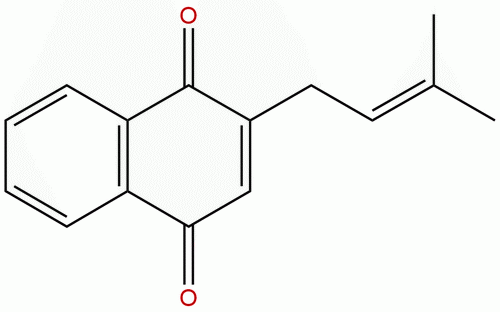
The chemical name of Deoxyllapachol is 2- (3-methyl-2-butenyl) -1,4-naphthoquinone, and its core skeleton consists of a 1,4-naphthoquinone nucleus and an isopentenyl side chain. Specifically, a 3-methyl-2-butenyl (i.e. isopentenyl) side chain is attached to the 2nd position of the naphthoquinone nucleus. Its molecular formula is C ₁₅ H ₁₄ O ₂, and its molecular weight is 226.2750 g/mol. Compared with naphthoquinone (2-hydroxy-3- (3-methyl-2-butenyl) -1,4-naphthoquinone), deoxynaphthoquinone lacks a hydroxyl group at position 2, which significantly affects its physicochemical properties, chemical reactivity, and biological activity. The CAS number of this compound is 3568-90-9.
In terms of physical and chemical properties, deoxybenzoquinone exhibits typical lipid soluble small molecule characteristics. Its oil-water partition coefficient LogP is 3.1061, indicating that it has strong lipophilicity and is easy to penetrate biological membranes, which is consistent with its ability to efficiently penetrate the blood-brain barrier (BBB). A high LogP value also suggests that it may be mainly distributed in adipose tissue or have a high binding rate with plasma proteins in the body. Its topological polar surface area (TPSA) is 34.1400 Å ², far below the upper limit of 140 Å ² typically required for oral medications, which further supports its good membrane permeability. However, its water solubility is extremely poor, with an experimentally determined water solubility value of only 0.0245 mg/mL. This characteristic is one of the main obstacles limiting its oral bioavailability and in vivo delivery, and may require specific formulation techniques (such as liposomes, nanoparticles, cyclodextrin inclusion complexes, etc.) to improve its solubility and dissolution rate.
From a chemical reactivity perspective, the 1,4-naphthoquinone nucleus is a typical Michael receptor, and the C-2 and C-3 sites on its quinone ring are prone to Michael addition reactions with nucleophilic reagents in the organism, such as glutathione GSH and thiol groups of protein cysteine residues. This covalent modification is considered the key chemical basis for its various biological activities. The presence of isopentenyl side chains increases the hydrophobicity of the molecule and may affect its binding mode with target proteins. In addition, the double bond on the side chain also provides a site for further chemical modification, which provides the possibility for structural optimization and structure-activity relationship research based on deoxyriboquinone.
Plant sources and extraction methods
Deoxylaboquinone was initially isolated from the brown algae Landsburgia quercifolia in New Zealand. Landsburgia quercifolia is a large brown algae belonging to the order Fucales, mainly distributed on intertidal and subtidal rocks around the South Island and Stewart Island of New Zealand. This algae is relatively primitive in evolution, and its unique living environment (such as strong light, high salt, temperature changes, wave impact, etc.) has prompted it to produce structurally diverse secondary metabolites to adapt to environmental stress. Deoxylabanone, as its main cytotoxic component, has a relatively high content in this algae and is the main natural source for isolating and obtaining this compound.
In addition to Landsburgia quercifolia, deoxynivalenol is not unique to this algae. Subsequent research has found that in some plants of the Bignoniaceae family, such as Tabebuia avelliandeae (also known as Red Rapa), the heartwood also contains deoxyraboquinone and its homologs. The heartwood of Lapamu is the raw material of the traditional medicine "Pau d'arco", commonly used to treat infections, inflammation, and cancer. Therefore, deoxybenzoquinone is also distributed in terrestrial plants, but its content is usually lower than that of benzoquinone. In addition, some microorganisms (such as Streptomyces) have also been reported to produce deoxybenzoquinone, which provides a potential pathway for its production through microbial fermentation.
The classic method for extracting deoxyriboquinone from Landsburgia quercifolia is as follows:
1. Sample collection and pretreatment Collect fresh or dry Landsburgia quercifolia algae, wash, dry, and crush into coarse powder.
2. Solvent extraction Extract using organic solvents with moderate polarity, such as dichloromethane, chloroform, ethyl acetate, or methanol dichloromethane mixed solvents. Usually, cold soaking or Soxhlet extraction methods are used, and the extraction is carried out several times at room temperature or by heating and refluxing, and the extraction solutions are combined.
3. Concentration and preliminary separation Concentrate the extract under reduced pressure to obtain the total extract. The total extract can be suspended in water and subjected to liquid-liquid extraction using solvents such as petroleum ether, ethyl acetate, and n-butanol for preliminary polarity segmentation. Deoxylaboquinone is mainly enriched in the extraction sites of petroleum ether or ethyl acetate due to its lipophilicity.
4. chromatographic separation Systematic chromatographic separation and purification of active sites. Common methods include:
* Silica gel column chromatography Use a normal phase silica gel column and perform gradient elution with mixed solvents such as petroleum ether ethyl acetate or petroleum ether acetone.
* Sephadex LH-20 gel column chromatography Use solvent systems such as chloroform methanol or methanol water for elution, and separate based on molecular size and polarity differences.
* Preparation type high performance liquid chromatography (Prep HPLC)For components that are difficult to separate, a reverse phase C18 column can be used with methanol water or acetonitrile water as the mobile phase for preparation grade separation to obtain high-purity deoxybenzoquinone monomer.
5. Structural Identification The structure of the isolated compound was confirmed by spectroscopic techniques such as nuclear magnetic resonance spectroscopy (NMR), mass spectrometry (MS), infrared spectroscopy (IR), and ultraviolet spectroscopy (UV).
Pharmacological activity research
Since its discovery, research on the pharmacological activity of deoxyriboquinone has mainly focused on its anti-tumor and antifungal properties, and has shown significant potential.
1. Antitumor activity
Deoxylaboquinone has been confirmed as the main cytotoxic component of Landsburgia quercifolia, exhibiting broad-spectrum proliferation inhibitory activity against various tumor cell lines. Studies have shown that deoxelabaquinone can effectively inhibit the growth of many solid tumors and hemangioma cells, such as human leukemia cells (such as HL-60, K562), liver cancer cells (HepG2), breast cancer cells (MCF-7), lung cancer cells (A549), colon cancer cells (HCT-116) and prostate cancer cells (PC-3). Its mechanism of action involves inducing cell apoptosis, blocking the cell cycle, inhibiting tumor cell migration and invasion, and other aspects.
- Inducing cell apoptosis Deoxylabanone can induce tumor cell apoptosis through two pathways: endogenous (mitochondrial) and exogenous (death receptor). It can upregulate the expression of pro apoptotic proteins Bax and Bad, downregulate the expression of anti apoptotic proteins Bcl-2 and Mcl-1, lead to a decrease in mitochondrial membrane potential, release cytochrome c, and activate the cascade reaction of Caspase-9 and Caspase-3, ultimately leading to cell apoptosis. Meanwhile, it may also induce apoptosis by activating death receptors (such as Fas) and their downstream Caspase-8 pathway.
- Block cell cycle Deoxylaboquinone can block the tumor cell cycle in the G0/G1 or G2/M phase, and the specific phase of block may vary depending on the cell type. The mechanism may be related to downregulating the expression of Cyclin D1, Cyclin B1 and Cyclin dependent kinases (CDK4, CDK2), as well as upregulating the expression of Cyclin dependent kinase inhibitors (p21, p27).
- Inhibit migration and invasion Deoxylabazone can significantly inhibit the migration and invasion of highly metastatic tumor cells (such as breast cancer MDA-MB-231 cells). The mechanism may be related to the inhibition of the activity and expression of matrix metalloproteinases (MMP-2, MMP-9), thereby reducing the degradation of extracellular matrix.
2. Antifungal activity
In addition to significant anti-tumor activity, deoxynivalenol also exhibits broad-spectrum antifungal activity. Research has shown that it has inhibitory effects on various pathogenic fungi, including Candida albicans, Cryptococcus neoformans, Aspergillus fumigatus, and Trichophyton mentagrophytes. Its antifungal mechanism may be related to the destruction of fungal cell membrane integrity, interference with mitochondrial function, induction of reactive oxygen species (ROS) production, and inhibition of fungal cell wall synthesis. This activity makes it a potential candidate drug for treating invasive fungal infections, especially for the increasingly severe problem of drug-resistant fungi.
3. Other activities
Preliminary studies also suggest that deoxyriboflavin may have anti-inflammatory and anti angiogenic activities. For example, it may reduce the production of inflammatory factors by inhibiting the STAT3 signaling pathway. Its regulatory effect on HIF-1 α also suggests that it may affect the process of angiogenesis in the tumor microenvironment. However, research in these areas is not yet in-depth and requires further verification.
Mechanism of action and molecular targets
The pharmacological activity of deoxynivalenol is not derived from a single target, but is achieved through the synergistic action of multiple targets and pathways. Its core mechanism of action is closely related to the redox activity of its 1,4-naphthoquinone parent nucleus and Michael receptor characteristics. According to existing research, its main molecular targets and signaling pathways include:
-
Regulating apoptosis related proteins (Bcl-2 family)Deoxylaboquinone can directly or indirectly downregulate the expression of anti apoptotic proteins MCL1 and BCL2, while upregulating the expression of pro apoptotic proteins such as Bax and Bak, breaking the balance of Bcl-2 family proteins on the outer membrane of mitochondria, promoting mitochondrial outer membrane permeabilization (MOMP), releasing apoptotic factors such as cytochrome c, and initiating the Caspase cascade reaction. This is one of the core mechanisms by which it induces apoptosis in tumor cells.
-
Inhibition of STAT3 signaling pathway Signal transducer and activator of transcription factor 3 (STAT3) is continuously activated in various tumors, promoting cell proliferation, survival, angiogenesis, and immune escape. Deoxylaboquinone can inhibit the phosphorylation (Tyr705 site) and nuclear translocation of STAT3, thereby suppressing its transcriptional activity and downregulating the expression of downstream target genes (such as Cyclin D1, Bcl xL, VEGF, MMP-2), exerting anti-tumor effects.
-
Inhibition of Topoisomerase Activity Topoisomerase I (TOP1) and Topoisomerase II (TOP2A) are key enzymes in DNA replication and transcription processes. Many anticancer drugs, such as camptothecin and etoposide, cause DNA damage by inhibiting topoisomerase. Deoxylaboquinone has been reported to inhibit the activity of TOP1 and TOP2A, possibly by embedding into DNA or forming stable complexes with enzymes to prevent DNA strand reconnection, thereby inducing DNA damage and cell death.
-
Inhibition of Matrix Metalloproteinase (MMP)MMP2 is a key enzyme that degrades type IV collagen (the main component of the basement membrane) and plays an important role in tumor invasion and metastasis. Deoxylabanone can inhibit the activity and expression of MMP2, thereby weakening the migration and invasion ability of tumor cells.
-
Regulating hypoxia inducible factor (HIF-1 α)HIF-1 α is a key transcription factor for tumor cells to adapt to the hypoxic microenvironment, regulating the expression of genes related to angiogenesis, glycolysis, and metastasis. Deoxylaboquinone may inhibit tumor angiogenesis by suppressing the protein accumulation or transcriptional activity of HIF-1 α.
-
Affects the MAPK signaling pathway The mitogen activated protein kinase (MAPK) pathway (including ERK, JNK, p38) plays an important role in cell proliferation, differentiation, and apoptosis. Deoxylaboquinone may induce tumor cell apoptosis by activating JNK and p38, while inhibiting phosphorylation of ERK1/2 (encoded by MAPK1).
-
Regulating estrogen related targets For hormone dependent breast cancer, deoxelabaquinone may interfere with estrogen signal by down regulating the expression of estrogen receptor α (ESR1) or inhibiting the activity of aromatase (CYP19A1), thus inhibiting the growth of breast cancer cells.
-
Oxidative stress and ROS production Naphthoquinone compounds can undergo redox cycles in the body, producing a large amount of reactive oxygen species (ROS). Deoxylabanone induced ROS accumulation can lead to mitochondrial damage, DNA oxidative damage, and lipid peroxidation, thereby activating the apoptotic signaling pathway. This is a common mechanism by which it exerts cytotoxicity.
In summary, deoxyriboflavin forms a complex regulatory network by acting on multiple targets such as MCL1, BCL2, STAT3, MMP2, TOP1, HIF1A, TOP2A, MAPK1, ESR1, CYP19A1, etc., synergistically exerting its anti-tumor activity. This multi-target mode of action is its advantage, but it also increases the complexity of studying its precise mechanism of action.
Evaluation of drug properties and pharmacokinetics
A systematic evaluation of the drug properties is necessary for the development of the natural product deoxyraphane as a clinical drug. Based on its physicochemical properties and preliminary pharmacokinetic characteristics, the potential and challenges of its development can be analyzed.
Analysis of drug properties parameters:
* molecular weight:226.3 Da, Far below the upper limit of the Lipinski Five Rules of 500 Da, it conforms to the characteristics of small molecule drugs.
* LogP 3.11, located at the upper limit of the ideal range (0-3), has strong lipophilicity, which is beneficial for membrane permeability, but may also lead to poor water solubility and fast metabolic clearance.
* TPSA 34.1 Å ², very small, indicating good intestinal absorption and blood-brain barrier penetration ability.
* Water solubility:0.0245 mg/mL, Extremely poor. This is the biggest obstacle to its medicinal properties. Low water solubility not only affects oral absorption, but also poses significant challenges to the development of injectable formulations.
* blood-brain barrier High penetrability. This provides the possibility for treating brain tumors such as glioblastoma, but it may also increase the risk of central nervous system toxicity.
* HERG inhibition: No. This is a positive signal indicating a lower risk of causing QT interval prolongation and arrhythmia in the heart.
* Ames test: 0.9. This value is close to 1, indicating potential genetic toxicity (mutagenicity). This may be related to the ability of 1,4-naphthoquinone structure to generate ROS and covalently bind with DNA. Genetic toxicity is a risk that requires high vigilance and rigorous evaluation in drug development.
Pharmacokinetic characteristics (speculation and preliminary study):
* absorb Due to its high LogP and low water solubility, the oral absorption of deoxyraphane quinone may be poor and unstable, and its bioavailability may be low. The food effect may also be significant. Injecting medication may be a more effective route of administration.
* distribution Due to its high lipophilicity, deoxybenzoquinone is widely distributed in the body and may accumulate in large amounts in adipose tissue, liver, and brain. Its high plasma protein binding rate can also be expected.
* Metabolism Naphthoquinone compounds mainly undergo phase I metabolism (such as reduction and oxidation) and phase II metabolism (such as binding with glutathione GSH and glucuronidation). Its isopentenyl side chain may also be subjected to oxidative metabolism. The liver is its main metabolic organ. The activity and toxicity of metabolites need to be further studied.
* excretion Metabolites are mainly excreted through bile and urine. The excretion of prototype drugs may be less.
Challenges and Strategies in Drug Development:
1. Poor water solubility Formulation techniques such as preparing prodrugs (such as phosphate esters, amino acid esters), liposomes, nanoparticles, solid dispersions, or cyclodextrin inclusion complexes are required to significantly improve their apparent solubility and dissolution rate.
2. Potential genetic toxicity A more comprehensive genetic toxicity assessment (such as in vivo micronucleus test, comet assay) is needed. If genetic toxicity is confirmed, structural modifications are needed to reduce or eliminate the risk, such as introducing appropriate substituents on the naphthoquinone nucleus to reduce its Michael reaction activity or ROS generation ability.
3. Metabolic stability Isopentenyl side chains may be easily oxidized and metabolized, resulting in a short half-life. Metabolic sites can be blocked and metabolic stability can be improved by structural modifications to the side chains, such as introducing fluorine atoms, methylation, cyclization, etc.
4. therapeutic window It is necessary to systematically evaluate its in vivo toxicity, especially its toxicity to normal cells (such as hepatotoxicity, nephrotoxicity, neurotoxicity), to determine whether its therapeutic window is wide enough.
Clinical application prospects and prospects
Deoxylaboquinone, as a natural naphthoquinone compound with simple structure and significant activity, has shown promising prospects in the development of anti-tumor and antifungal drugs, but also faces severe challenges.
Clinical application prospects:
1. Antitumor therapy In view of its multi-target mechanism of action, especially the regulation of STAT3, Bcl-2 family, topoisomerase and HIF-1 α, deoxelabaquinone or its optimized derivatives are expected to be used to treat a variety of tumors resistant to traditional chemotherapy drugs, such as triple negative breast cancer, liver cancer, leukemia and glioma. Its high blood-brain barrier penetration gives it a unique advantage in treating primary and metastatic brain tumors.
2. Antifungal therapy In the face of increasingly severe invasive fungal infections and drug resistance issues, the broad-spectrum antifungal activity of deoxynivalenol makes it a promising lead compound. Its mechanism of action may be different from existing azole and polyene antifungal drugs, and it is expected to overcome cross resistance.
3. combination therapy The combination of deoxynivalenol and existing chemotherapy drugs (such as cisplatin, paclitaxel, and doxorubicin) or targeted drugs (such as STAT3 inhibitors and Bcl-2 inhibitors) may produce synergistic effects, reduce monotherapy dose and toxicity, and improve therapeutic efficacy.
Future research directions:
1. In depth structure-activity relationship (SAR) research Systematically modify the naphthoquinone parent nucleus and isopentenyl side chain of deoxyraboquinone, synthesize a series of derivatives, investigate the effects of different substituents on activity, selectivity, and toxicity, and search for candidate compounds with higher activity, lower toxicity, and better pharmacokinetic properties. For example, introducing polar groups on the side chains to improve water solubility, or introducing electron donating/electron withdrawing groups on the mother nucleus to regulate the redox potential.
2. Clear mechanism of action research Using chemical biology methods (such as activity-based proteomic analysis (ABPP)) to identify the direct target proteins of deoxyriboflavin, elucidate its precise molecular mechanism, and provide a basis for subsequent rational drug design.
3. In vivo pharmacological and toxicological evaluation of the system Establish multiple in vivo tumor models (such as xenograft tumor model, in situ tumor model, metastatic tumor model) and fungal infection model, comprehensively evaluate their in vivo efficacy, pharmacokinetic characteristics, and safety (including acute toxicity, long-term toxicity, reproductive toxicity, genetic toxicity, etc.).
4. Development of innovative drug delivery systems Develop efficient drug delivery systems, such as targeted liposomes, polymer micelles, mesoporous silica nanoparticles, etc., to address the issues of poor water solubility and potential toxicity, in order to achieve targeted delivery and controlled release of drugs, improve efficacy, and reduce systemic toxicity.
5. Research on Total Synthesis and Biological Synthesis of Derivatives Develop efficient and green synthetic routes to meet the demand for compounds in subsequent research and development. Meanwhile, exploring its biosynthetic pathway provides the possibility for large-scale production through synthetic biology methods.
Conclusion
Deoxylaboquinone, a natural naphthoquinone compound derived from marine brown algae, has become a shining star in the field of natural product drug research due to its unique chemical structure and significant anti-tumor and antifungal activities. It exerts multi pathway and multi-level pharmacological effects by regulating multiple key molecular targets such as MCL1, BCL2, STAT3, TOP1, etc., demonstrating great potential as a lead compound for new drug development. However, its extremely poor water solubility, potential genetic toxicity, and potential metabolic stability issues constitute the main obstacles on its path to becoming a drug.
The focus of future research should be on in-depth structure-activity relationship studies, utilizing rational structural modifications and innovative formulation techniques to leverage strengths and avoid weaknesses, while preserving its core pharmacological activity, significantly improving its physicochemical properties and pharmacokinetic characteristics, and reducing toxicity risks. Meanwhile, in-depth elucidation of its mechanism of action will provide a theoretical basis for designing more precise and efficient targeted drugs. Despite the numerous challenges, deoxyriboquinones and their derivatives still show promising application prospects in the fields of anti-tumor and antifungal therapy, especially in the treatment of drug-resistant tumors and invasive fungal infections. We have reason to believe that through interdisciplinary collaboration, this natural product from the ocean will eventually have the potential to be transformed into clinically available new drugs, contributing to the cause of human health.