


Synonym name: 2',5-Digalloylhamamelofuranose
Catalogue No.: BP0695
Cas No.: 469-32-9
Formula: C20H20O14
Mol Weight: 484.366
Botanical Source: Tannin from witch hazel Hamamelis virginiana. Also in Quercus rubra and Castanea sativa (sweet chestnut)
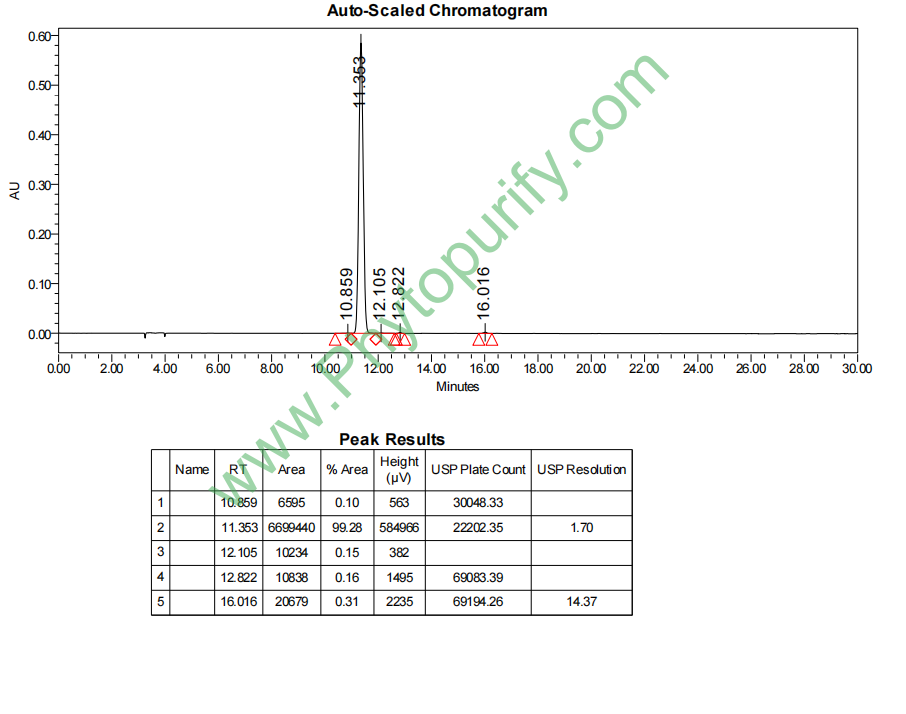
Purity: 95%~99%
Analysis Method: HPLC-DAD or/and HPLC-ELSD
Identification Method: Mass, NMR
Packing: Brown vial or HDPE plastic bottle
Can be supplied from milligrams to grams.
For Reference Standard and R&D, Not for Human Use Directly.
Inquire for bulk scale.
HPLC of Hamamelitannin
Storage conditions:Short-term storage at 2~8℃, long-term storage at -20 ~ -80℃
243.9000
-.0961
-.8592
1.6511
.5656
.1120
Low
74.7499
4.1829
Yes
No
No
No
Yes
Yes
0.0
Yes
No
Yes
Yes
Hamamelitanin (CAS number: 469-32-9) is a polyphenolic compound extracted from the bark of Hamamelis virginiana, a plant belonging to the Hamamelis genus. As a natural product, witch hazel tannin has received widespread attention in recent years due to its unique biological activity, particularly in quorum sensing (QS) inhibition and anti biofilm formation. The QS system is an important signaling mechanism for bacterial regulation of collective behavior, directly affecting bacterial pathogenicity, drug resistance, and biofilm formation. Witch hazel tannins enhance the sensitivity of Staphylococcus aureus to antibiotics by intervening in the formation of biofilms, demonstrating potential anti infective value.
In addition, witch hazel tannins have shown significant pharmacological activity in the field of skin anti-aging, involving multiple key targets such as tyrosinase (TYR), small molecule transcription factor (MITF), matrix metalloproteinase 3 (MMP3), type I collagen (COL1A1), and elastin (ELN). Its multi-target regulatory ability provides new ideas for natural products in skin care and anti-aging drug development.
This article will provide a systematic review of the chemical structure and physicochemical properties, plant sources and extraction methods, pharmacological activity and mechanism of action, pharmacological evaluation and pharmacokinetic characteristics of witch hazel tannin, and explore its clinical application prospects in depth. The aim is to provide a theoretical basis and research direction for the pharmacological research and drug development of this natural product.
Hamamelis tannin is a polyphenolic compound with a molecular formula of C21H20O13 and a molecular weight of 484.3660. Its structural features include multiple phenolic hydroxyl groups and ester bonds, endowing it with rich hydrogen bonding ability and strong antioxidant activity. The topological polar surface area (TPSA) of witch hazel tannin is as high as 243.9 Å ², reflecting its strong polarity and water solubility. The water solubility value is 1.6511, indicating its good solubility in aqueous phase.
The LogP value is -0.0961, indicating that the compound has strong hydrophilicity and weak hydrophobicity, which has a significant impact on its absorption and distribution in vivo. A low LogP value typically indicates poor cell membrane penetration ability, but is beneficial for stability in water-soluble environments. The low blood-brain barrier permeability of witch hazel tannin suggests its limited distribution in the central nervous system, reducing the risk of central nervous system toxicity.
In terms of safety, witch hazel tannins do not exhibit hERG channel inhibitory effects, reducing the risk of cardiac toxicity; The Ames test result is 0.0, indicating that it does not have genotoxicity and has high safety. These physicochemical and safety parameters have laid a solid foundation for it as a drug candidate molecule.
The tannins in witch hazel mainly come from the native North American plant Hamamelis virginiana, commonly known as witch hazel or witch hazel tree. The bark, leaves, and roots of this plant are rich in tannins, with the highest content found in the bark. Traditionally, the bark of witch hazel has been used to treat skin inflammation, stop bleeding, and astringent effects. Modern research has confirmed that its active ingredient is mainly witch hazel tannin.
The extraction method usually adopts solvent extraction technology, and commonly used solvents include ethanol, water, methanol, and their mixed solutions. The specific steps generally include:
In recent years, modern technologies such as ultrasound assisted extraction and microwave-assisted extraction have been introduced, which have improved extraction efficiency and purity, and are more environmentally friendly and energy-saving. The optimization of extraction conditions is crucial for maintaining yield and active ingredients.
As a quorum sensing inhibitor, witch hazel tannin plays a particularly prominent role in inhibiting bacterial biofilm formation. Staphylococcus aureus is a common drug-resistant pathogen in clinical practice, with a complex biofilm structure that protects bacteria from antibiotic invasion. Research has shown that witch hazel tannins disrupt the stability and integrity of biofilms by interfering with bacterial peptidoglycan biosynthesis and extracellular DNA (eDNA) release, significantly enhancing the bactericidal effect of antibiotics on bacteria within biofilms.
In addition, witch hazel tannin can downregulate the expression of QS related genes, inhibit the regulation of bacterial collective behavior, thereby reducing the production of virulence factors and the development of drug resistance in bacteria. This mechanism of action provides a new auxiliary strategy for antibiotic combination therapy, especially in dealing with drug-resistant bacterial infections, which is of great significance.
The research on the application of witch hazel tannin in anti-aging of the skin is gradually increasing. Its main targets include:
Through multi-target synergistic regulation, witch hazel tannins exhibit comprehensive effects of antioxidant, anti-inflammatory, and promoting skin regeneration, with the potential to be developed as anti-aging and beauty products for the skin.
In addition to the main activities mentioned above, witch hazel tannins also exhibit certain anti-inflammatory, antioxidant, and immunomodulatory effects. Its polyphenol structure enables it to eliminate free radicals, alleviate oxidative stress, and protect cells from damage. In the inflammatory model, witch hazel tannin can inhibit the release of pro-inflammatory cytokines and alleviate tissue inflammatory response. These effects provide theoretical support for its application in skin diseases, infectious diseases and chronic inflammation related diseases.
The mechanism of action of witch hazel tannin mainly revolves around its regulation of bacterial QS system and skin cell signaling pathways.
The QS system regulates group behavior through signaling molecules secreted by bacteria, such as AHLs and peptides. Witch hazel tannins disrupt QS signaling by interfering with the synthesis, release, or receptor binding of signaling molecules, resulting in bacteria being unable to coordinate the expression of virulence genes and biofilm formation related genes. The specific mechanism includes:
These mechanisms work together to significantly enhance the killing effect of antibiotics on biofilm bacteria.
In skin cells, witch hazel tannins exert their effects by regulating multiple signaling pathways:
The regulation of these molecular targets collectively delays the process of skin aging, enhances the structural integrity and functional status of the skin.
The pharmacological evaluation of witch hazel tannin shows that it has good safety and certain potential for drug development.
At present, there is relatively little systematic pharmacokinetic research on the tannins of witch hazel. It is speculated that its hydrophilicity and large polar surface area may lead to limited oral bioavailability, and drug carriers or modifications are needed to improve in vivo stability and absorption rate. Its low blood-brain barrier permeability suggests that it mainly functions in peripheral tissues and is suitable for local skin administration or anti infective treatment.
The metabolic pathway may involve polyphenol metabolism in the liver enzyme system, producing multiple metabolites, and further research is needed on its metabolic stability and pharmacological effects of active metabolites.
As a multifunctional natural product, witch hazel tannin has broad clinical application prospects.
In response to infections caused by drug-resistant bacteria, especially Staphylococcus aureus, witch hazel tannin improves antibiotic efficacy through quorum sensing inhibition and biofilm disruption, and has the potential to become an adjuvant drug for antibiotics. In the future, it can be developed as a local anti infective agent for the treatment of trauma, burns, and skin infections, reducing the occurrence and spread of drug-resistant bacteria.
The multi-target regulatory effect of witch hazel tannin on skin anti-aging provides a theoretical basis for its development as anti-aging skincare products and treatment of pigmentation diseases. Combining its antioxidant and anti-inflammatory properties, witch hazel tannins can be used to improve skin texture, reduce wrinkles and pigmentation, and enhance skin health.
Despite its good safety and various biological activities, the medicinal properties of witch hazel tannins still face challenges such as low absorption rate and insufficient in vivo stability. Future research can focus on:
As a polyphenolic natural product derived from Hamamelis virginiana, witch hazel tannin exhibits broad medicinal value and development potential due to its unique quorum sensing inhibitory effect and multi-target skin anti-aging activity. Its good safety and physicochemical properties lay the foundation for subsequent drug design and clinical application. In the future, combining modern drug carrier technology and molecular modification strategies, witch hazel tannin is expected to become an important natural drug resource in the fields of anti infection and skin anti-aging. The in-depth study of pharmacological mechanisms and pharmacokinetics will drive its clinical translation and promote the development and innovation of natural product pharmacology.
