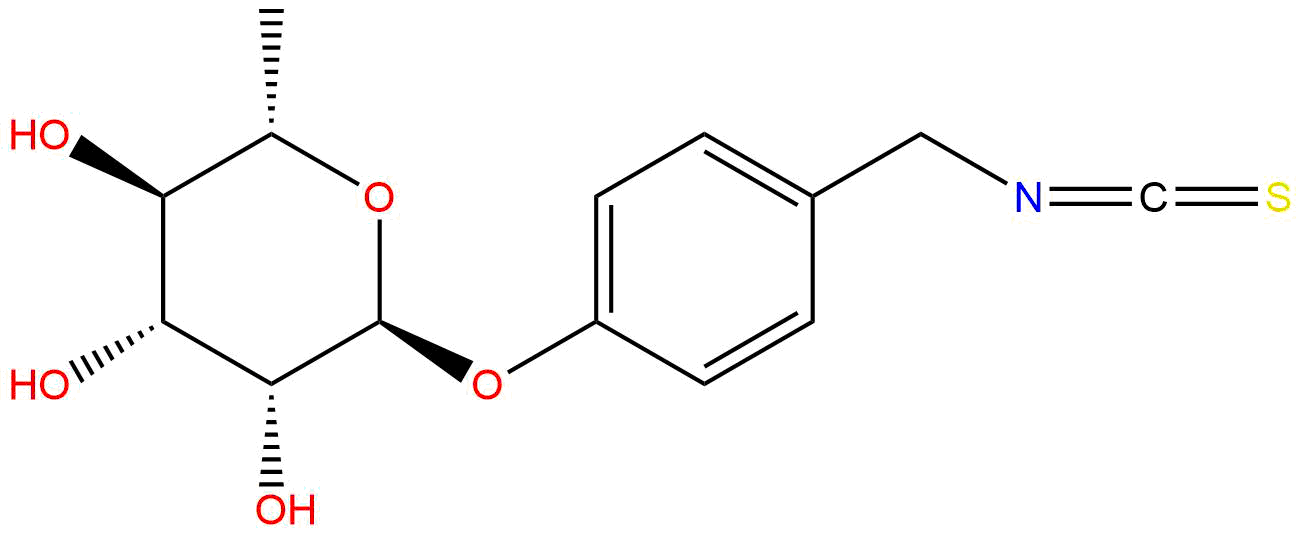


Product name: Moringin
Synonym name: 4-(α-L-Rhamnosyloxy)benzyl isothiocyanate
Catalogue No.: BP4495
Cas No.: 73255-40-0
Formula: C14H17NO5S
Mol Weight: 311.352
Botanical Source: Moringa Seeds
Type of Compound:
Purity: 95%~99%
Analysis Method: HPLC-DAD or/and HPLC-ELSD
Identification Method: Mass, NMR
Packing: Brown vial or HDPE plastic bottle
Storage: Store in a well closed container, protected from air and light. Put into refrigerate or freeze for long term storage.
Whenever possible, you should prepare and use solutions on the same day. However, if you need to make up stock solutions in advance, we recommend that you store the solution as aliquots in tightly sealed vials at -20℃. Generally, these will be useable for up to two weeks.
The product could be supplied from milligrams to grams
Inquire for bulk scale.
References:
Moringin and Its Structural Analogues as Slow H2S Donors: Their Mechanisms and Bioactivity
J. Agric. Food Chem. 2020, 68, 27
Abstract
Moringin (rhamnobenzyl isothiocyanate) is a major bioactive compound in moringa seeds, which have been used as a healthy food. However, its bioactivity mechanisms are not well understood. We investigated moringin and its structurally similar analogues, including benzyl isothiocyanate and 4-hydroxylbenzyl isothiocyanate, for their hydrogen sulfide (H2S)-releasing activity triggered by cysteine. These isothiocyanates rapidly formed cysteine adducts, which underwent intramolecular cyclization followed by slowly releasing (a) organic amine and raphanusamic acid and (b) H2S and 2-carbylamino-4,5-dihydrothiazole-4-carboxylic acids. The product distributions are highly dependent on para-substituents on the phenyl group. Moringin has higher cytotoxicity to cancer cells and is a more potent anti-inflammatory agent than benzyl and hydroxybenzyl analogues, while benzyl isothiocyanate is a better antibacterial agent. Taken together, their bioactivity may not be directly related to their H2S donation activity. However, other metabolites alone do not have cytotoxicity and anti-inflammatory activity. These findings indicated that their activity may be the combination effects of different metabolites via competitive pathways as well the para-substituent groups of benzyl ITCs.
Moringin, A Stable Isothiocyanate from Moringa oleifera, Activates the Somatosensory and Pain Receptor TRPA1 Channel In Vitro
Molecules February 2020 25(4):976
Abstract
Moringa oleifera Lam. is a tropical plant widely used in traditional medicines and as a food supplement. It is characterized by the presence of glucosinolates and isothiocyanates; the stable isothiocyanate 4-[(α-l-rhamnosyloxy)benzyl]isothiocyanate (moringin) has been widely studied for its bioactivity as hypoglycemic, antimicrobial, anticancer and in particular for its involvement in nociception and neurogenic pain. Moringa extracts and pure moringin were submitted to in vitro assays with the somatosensory TRPA1 ion channel, proving that moringin is a potent and effective agonist of this receptor involved in nociceptive function and pain states. Moringin do not activate or activates very weakly the vanilloids somatosensory channels TRPV1,2,3 and 4, and the melastatin cooling receptor TRPM8. The comparison of moringin’s activity with other known agonists of natural origin is also discussed.
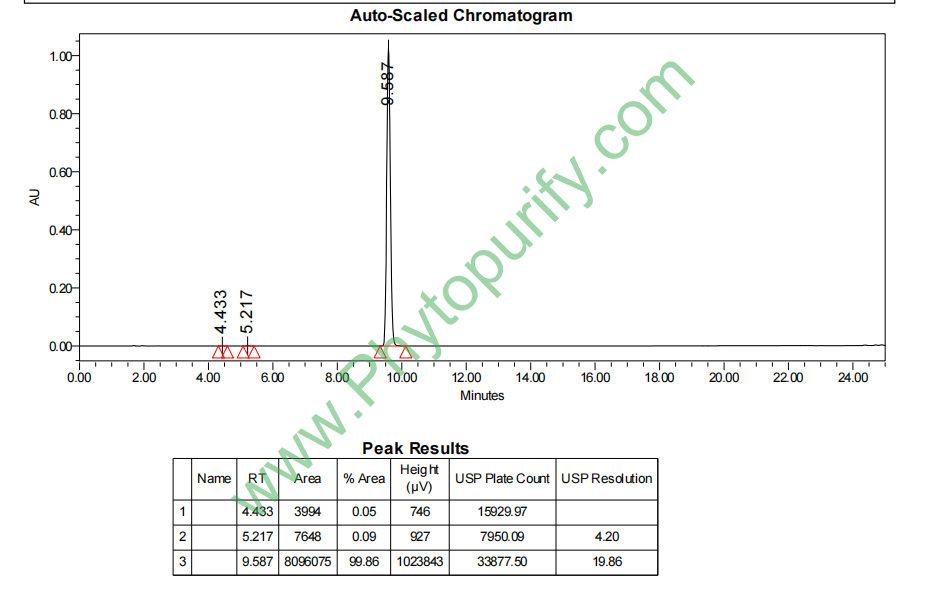
HPLC of Moringin
Storage conditions:Short-term storage at 2~8℃, long-term storage at -20 ~ -80℃
91.5100
.7276
.7267
1.2799
.9268
.2824
Low
50.5314
3.8675
Yes
No
Yes
No
Yes
No
0.0
Yes
Yes
Yes
Yes
Natural products have always been an important treasure trove for innovative drug discovery, among which isothiocyanate compounds have attracted much attention due to their wide range of biological activities. Moringin (Moringin, CAS number: 73255-40-0) is a recently developed compound from Moringa oleifera(Moringa oleifera A key aliphatic isothiocyanate active ingredient isolated and identified from Lam. seeds. Its unique chemical structure endows it with diverse pharmacological potential, making it quickly one of the hot molecules in pharmacological research. Early research revealed significant antibacterial and anti-inflammatory properties of Moringin, and as research deepens, its activities in lowering blood sugar, anti-cancer, and neuroprotection have been gradually discovered, demonstrating enormous potential as a multi-target therapeutic drug. Of particular importance, Moringin has been identified as a highly efficient and selective natural agonist of transient receptor potential anchor protein subtype 1 (TRPA1) ion channels. This property not only provides a molecular basis for its analgesic and anti-inflammatory effects, but also closely links it to various sensory neural pathways and pathophysiological processes. This article aims to systematically review the chemical properties, plant sources, pharmacological activities, mechanisms of action, and medicinal properties of Moringin, in order to provide comprehensive scientific references for the deep development and clinical application of this natural product.
The chemical name of Moringin is 4- [(α - L-rhamnoxy) benzyl] isothiocyanate, which is a glycosidic form of isothiocyanate. Its molecular formula is C14H17NO6S and its molecular weight is 311.3590. Its core structure consists of a benzyl isothiocyanate (- N=C=S) functional group and an α - L-rhamnose group connected by a glycosidic bond. This glycosidic structure is its main storage form in plants, and its activity is relatively weak. However, it is hydrolyzed by endogenous myrosinase or gut microbiota β - glucosidase, releasing highly active deglycosylation ligands -4- (α - L-rhamnoxy) benzyl isothiocyanate glycosides, thereby exerting biological effects.
From the perspective of physicochemical parameters related to drug properties, Moringin exhibits good drug like properties. The calculated lipid water partition coefficient (LogP) is 0.7276, indicating that it has moderate lipophilicity and is conducive to transmembrane transport. The topological polar surface area (TPSA) is 91.51 Å ², which meets the membrane permeability requirements of most oral drugs. The predicted value of its water solubility is 1.2799 mg/mL, which belongs to the range of slightly soluble to soluble, providing a basis for its formulation development. The molecular weight is moderate and conforms to Lipinski's "five rules", indicating that it has good oral absorption potential. These physicochemical properties together form the preliminary physical and chemical basis for Moringin's subsequent drug development.
Moringin mainly comes from Moringa(Moringa oleifera Lam.), This is a multifunctional tree species widely distributed in tropical and subtropical regions, known as the "miracle tree". Its seeds are the most abundant source of Moringin and its precursor, glucosinolates. The glucosinolates in Moringa seeds are stable and biologically inactive. When the seeds are broken, chewed, or processed, the cell structure is disrupted, and endogenous myrosinase comes into contact with the substrate, rapidly catalyzing the hydrolysis of glucosinolates to produce unstable intermediates, which are then rearranged to form biologically active isothiocyanates, known as Moringin.
At present, there are two main strategies for obtaining Moringin from Moringa seeds:
1. Enzymatic conversion extraction method This is the most commonly used method that maximizes the acquisition of active Moringin. After crushing the dried Moringa seeds, homogenize them in a suitable aqueous buffer system and perform in-situ enzymatic hydrolysis using the black mustard enzyme contained in the seeds themselves. Optimize conversion efficiency by controlling temperature (usually between room temperature and 37 ℃), pH (near neutral), and reaction time (usually 30-120 minutes). After the reaction is complete, organic solvents such as ethyl acetate and dichloromethane are used for liquid-liquid extraction, concentrated, and purified by column chromatography (such as silica gel column or preparative high-performance liquid chromatography) to obtain high-purity Moringin.
2. Chemical synthesis and semi synthesis methods To meet the needs of large-scale pharmaceutical research, chemists have also developed routes for the total synthesis or semi synthesis of Moringin starting from its aglycone. These methods typically involve glycosylation reactions and the introduction of isothiocyanates, which can provide a stable and sufficient supply of compounds, but the steps are relatively complex.
The optimization of extraction process, especially the precise control of enzymatic hydrolysis conditions, is crucial for ensuring the yield and biological activity of Moringin. Meanwhile, research also focuses on improving its stability and bioavailability through techniques such as nanoencapsulation and liposomes.
A large number of preclinical studies have confirmed that Moringin has broad and significant pharmacological activities, covering multiple fields such as metabolism, infection, inflammation, tumors, and the nervous system.
Hypoglycemic and anti diabetes activity Moringin has shown excellent hypoglycemic effect in various animal models of diabetes. Its function is not limited to reducing fasting and postprandial blood glucose levels, but can also improve glucose tolerance and alleviate insulin resistance. Research has shown that it can protect pancreatic beta cell function, promote liver glycogen synthesis, and inhibit the activity of key enzymes involved in gluconeogenesis. These comprehensive effects make it of great value in the prevention and treatment of diabetes and its complications.
Antibacterial and antifungal activity Moringin has inhibitory effects on various Gram positive bacteria, Gram negative bacteria, and fungi. Its antibacterial mechanism may involve covalent binding between isothiocyanate groups and enzymes containing sulfur groups in microbial cells (such as dehydrogenases and thioredoxin reductases), disrupting their protein structure and function, interfering with energy metabolism, and leading to microbial growth inhibition or death. Its activity against certain drug-resistant strains has also aroused the interest of researchers.
Anti inflammatory and analgesic activity As a highly selective agonist of TRPA1 channel, Moringin can activate TRPA1 on sensory neurons at low concentrations, triggering transient calcium influx and release of neuropeptides (such as calcitonin gene-related peptide and substance P), which may be involved in its initial pain or itch inducing effects. However, under sustained or high concentrations, Moringin can induce desensitization of the TRPA1 channel or trigger a reverse anti injury signaling pathway by activating the channel, resulting in long-lasting analgesic and anti-inflammatory effects. Animal experiments have shown that it can effectively alleviate pain and edema caused by various chemicals and inflammatory models.
anticancer activity Moringin can inhibit the proliferation and promote apoptosis of many cancer cell lines (such as colon cancer, breast cancer and liver cancer cells). Its anti-cancer mechanism is multifaceted, including inducing cell cycle arrest (such as G2/M phase), activating mitochondrial apoptosis pathway, increasing reactive oxygen species (ROS) levels, inhibiting survival signaling pathways such as nuclear factor kappa B (NF - κ B). It is worth noting that its toxicity to normal cells is relatively low, showing a certain degree of selectivity.
Neuroprotective activity Moringin has shown protective effects in cellular and animal models of neurodegenerative diseases such as Parkinson's disease and Alzheimer's disease. It can alleviate neuroinflammation, inhibit excessive activation of microglia, reduce the toxicity induced by β - amyloid protein, and enhance the antioxidant defense ability of cells (such as upregulating the Nrf2 pathway). These effects are closely related to their anti-inflammatory and antioxidant properties.
The multiple pharmacological activities of Moringin stem from its regulatory effects on multiple key molecular targets, forming a complex network.
Core target: TRPA1 ion channel The most significant feature of Moringin is its high selectivity as an agonist of TRPA1, with a half effective concentration (EC50) as low as 3.14 μ M. TRPA1 is a non selective cation channel mainly expressed in sensory neurons, and is a key sensor for the body to sense environmental stimuli (such as cold and irritant compounds) and inflammatory mediators. Moringin activates TRPA1 channel by covalently modifying specific cysteine residues at the N-terminus of the channel. This activation not only mediates its sensory neural regulation, but also indirectly affects downstream inflammation, pain, and metabolic pathways by regulating processes such as neuropeptide release and neurogenic inflammation.
Anti diabetes related target network The hypoglycemic effect of Moringin involves a multi-target synergistic system.
Anti inflammatory and antioxidant pathways In addition to regulating neurogenic inflammation through TRPA1, Moringin can also inhibit nuclear translocation of NF - κ B and reduce the production of pro-inflammatory cytokines such as TNF - α and IL-6. At the same time, it can activate the nuclear factor E2 related factor 2 (Nrf2) pathway, promote the expression of downstream antioxidant enzymes such as heme oxygenase-1 (HO-1) and quinone oxidoreductase 1 (NQO1), and enhance the oxidative stress resistance of cells.
Anti cancer related mechanisms Its anti-cancer effect is related to inducing ROS generation, causing DNA damage, activating p53 dependent and independent apoptotic pathways, inhibiting anti apoptotic proteins (such as Bcl-2), and blocking survival promoting signals such as PI3K/AKT/mTOR.
Based on calculations and preliminary experimental data, Moringin shows promising potential for drug development, but there are still some challenges.
Analysis of drug properties parameters:
* Absorption and distribution Moderate LogP and molecular weight indicate that it may have good intestinal permeability and oral bioavailability. However, its blood brain barrier (BBB) permeability is predicted to be "low", which limits its direct effect on the central nervous system, but may also reduce the risk of central side effects, which is acceptable for indications mainly acting on the peripheral system (such as diabetes, peripheral neuralgia).
* Metabolism and Safety Preliminary computer predictions indicate that Moringin has no significant inhibitory potential on hERG potassium channels (hERG inhibition: no), which reduces its risk of inducing QT interval prolongation and apical torsion type ventricular tachycardia, and is a positive signal for cardiovascular safety. The predicted result of Ames test is 0.0, indicating that it may not have direct genetic toxicity, but experimental verification is needed.
* Stability The chemical properties of isothiocyanate groups are active and easily react with sulfur-containing molecules (such as glutathione). They may also degrade in the gastrointestinal environment, which may result in a short half-life and unstable bioavailability.
Current status of pharmacokinetic research:
At present, pharmacokinetic studies on the Moringin system are still relatively limited. It is known that its glycoside form (precursor) is hydrolyzed by intestinal microbiota β - glucosidase after oral administration, releasing active aglycones that are absorbed. Active aglycones may undergo extensive metabolism in the body, including binding with glutathione to form thiourea amino acid complexes, which are then further metabolized into N-acetylcysteine complexes (mercaptoacetate) and excreted through urine. This rapid binding and excretion may be the main reason for its limited exposure in the body. Future research needs to clarify its absolute bioavailability, plasma protein binding rate, major metabolic organs (liver, intestine), and metabolic enzyme systems (such as cytochrome P450 enzymes, glutathione S-transferase), and explore ways to improve its pharmacokinetic properties through prodrug design, formulation techniques (such as nanoemulsions, liposomes, cyclodextrin inclusion complexes), or the combined use of myrosinase inhibitors.
The multi-target and multi-functional characteristics of Moringin have depicted broad prospects for its application in various disease fields.
However, the following challenges still need to be overcome for clinical application:
* Pharmacokinetic optimization Improving its oral bioavailability and in vivo stability is the primary task.
* Deep analysis of the mechanism of action Clarify the balance conditions between TRPA1 activation and desensitization in different disease models, as well as the primary secondary relationship and cross dialogue with other targets.
* Security system evaluation A comprehensive preclinical toxicology study is required, including acute toxicity, chronic toxicity, reproductive toxicity, etc., and its human safety is ultimately verified through clinical trials.
* Standardization and Quality Control Establish standardized testing methods for Moringin content and activity from Moringa raw materials to final products to ensure product consistency and effectiveness.
Moringin, as a natural isothiocyanate derived from Moringa, has become a star molecule in natural product pharmacology research due to its unique chemical structure, highly selective TRPA1 agonist activity, and extensive hypoglycemic, antibacterial, anti-inflammatory, anticancer, and neuroprotective effects. The study of its mechanism of action reveals a complex regulatory network involving ion channels, metabolic sensors, kinases, and transcription factors. Although there are still challenges in terms of drug properties, especially pharmacokinetic characteristics, its good preliminary drug like parameters and safety predictions have laid an optimistic foundation for its subsequent development. In the future, through interdisciplinary collaboration, combined with modern medicinal chemistry, pharmacy, and systems biology methods, to deeply optimize its properties and elucidate its multidimensional action network, Moringin is highly likely to successfully transform from a traditional plant component into innovative drugs or lead compounds for the prevention and treatment of various major diseases such as metabolic diseases, pain, inflammation, and even tumors, fully demonstrating the immortal value of natural products in modern pharmaceutical research and development.
