Introduction/Overview
Tetrahydroplastonine (CAS number: 6474-90-4) is an important natural indole alkaloid that was first isolated from plants such as Aristonia solani. As a type of natural product with diverse biological activities, indole alkaloids have shown extensive pharmacological potential in neurological diseases, tumors, and inflammation. Tetrahydroperoxide has received high attention in neuropharmacology research in recent years due to its selective α 2-adrenergic receptor antagonistic activity and neuroprotective effects. It affects autophagy lysosome function by regulating the Akt/mTOR signaling pathway, significantly reducing primary cortical neuron damage induced by ischemia-reperfusion (OGD/R), providing new ideas for the treatment of neurodegenerative diseases and cerebrovascular diseases.
This article will provide a systematic review of the chemical structure and physicochemical properties, plant sources, and extraction methods of tetrahydroduckfoot alkaloids. It will provide a detailed evaluation of their pharmacological activities and mechanisms of action, and explore their clinical application prospects and future development directions based on drug parameters and pharmacokinetic characteristics. The aim is to provide theoretical basis and reference for the in-depth research and drug development of this compound.
Chemical structure and physicochemical properties
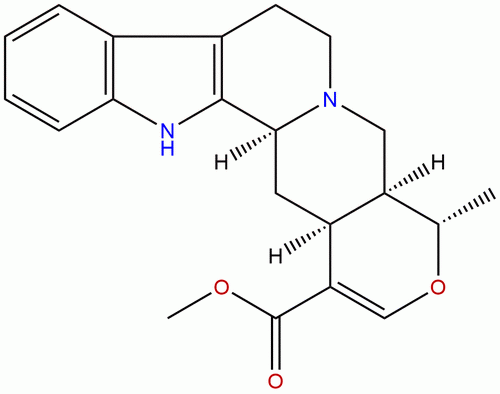
Tetrahydroduckfoot alkaloid belongs to indole alkaloids, with a molecular formula of C22H26N2O3 and a molecular weight of 352.4340. The core of its structure is a typical indole skeleton, which has the characteristics of a tetrahydrogenated duckfoot alkaloid skeleton. The structure contains multiple chiral centers, giving it a high degree of stereoselectivity. Molecules contain polar groups such as hydroxyl and methoxy, which form certain hydrogen bond donors and acceptors, facilitating binding with biomolecules.
In terms of physicochemical properties, the LogP value of tetrahydroduckfoot alkaloid is 2.8312, indicating its moderate lipid solubility, which is beneficial for penetrating cell membranes and the blood-brain barrier (BBB). Its topological polar surface area (TPSA) is 54.56 Å ², which is within the ideal range for BBB and supports central nervous system activity. Low water solubility (0.0363 mg/mL) suggests limited solubility in aqueous phase, which may affect oral bioavailability. The positive inhibition of hERG channel suggests a potential risk of cardiac toxicity that needs to be addressed in drug development. The Ames test result is negative, indicating no significant risk of genotoxicity.
In summary, the physicochemical properties of tetrahydroduckfoot alkaloid combine lipid solubility and polar groups, making it suitable for the development of central nervous system drugs. However, the administration method and dosage form need to be optimized to overcome the limitations of water solubility and safety.
Plant sources and extraction methods
Tetrahydroperoxide is mainly derived from plants of the duckwood genus, especially Aristonia synoris, Aristonia macrophylla, and others. Duckweed plants are widely distributed in tropical Asia and Africa, and are commonly used in traditional Chinese medicine and folk medicine to treat respiratory diseases, fever, pain, inflammation, and other symptoms.
The common methods for extracting tetrahydroquercetin from duck feet include:
-
Solvent extraction
Extract from dry plant roots, stems, or leaves using organic solvents such as methanol, ethanol, or ethyl acetate. The extract undergoes concentration, separation, and acid-base treatment to enrich alkaloid components.
-
Acid-base extraction
By adjusting the pH value, alkaloids are dissolved in the aqueous phase in the form of hydrochloride salts, and then the free bases are extracted with organic solvents to achieve the purpose of separation and purification.
-
chromatographic separation
Using techniques such as silica gel column chromatography and reverse phase high performance liquid chromatography (RP-HPLC), further purification of tetrahydropalmatine was carried out to ensure its purity and accurate structural identification.
In recent years, ultrasound assisted extraction and microwave-assisted extraction technologies have also been applied to improve extraction efficiency and yield, while reducing solvent usage, in line with the concept of green chemistry.
Pharmacological activity research
The pharmacological activity of tetrahydroduckfoot alkaloids mainly focuses on nervous system regulation and analgesic effects, involving multiple receptors and signaling pathways.
Neuroprotective effect
A large number of in vitro and in vivo studies have shown that tetrahydroduckfoot alkaloids effectively alleviate primary cortical neuron damage induced by hypoxia ischemia reperfusion (OGD/R) by activating the Akt/mTOR signaling pathway, regulating autophagy lysosome function. This mechanism not only inhibits neuronal apoptosis, but also promotes moderate activation of autophagy, maintains cellular homeostasis, reduces oxidative stress and inflammatory response.
In addition, the protective effect of tetrahydropalmatine on neurons also involves regulating mitochondrial function, reducing intracellular ROS generation, stabilizing cell membrane potential, and preventing cell necrosis and apoptosis.
Analgesic effect
Tetrahydropiperazine exhibits multi-target analgesic activity, including TRPV1, TRPA1, CNR1 (cannabinoid receptor 1), OPRD1 (delta opioid receptor), OPRM1 (μ - opioid receptor), OPRK1 (kappa opioid receptor), PTGS1/2 (cyclooxygenase 1/2), SLC6A4 (serotonin transporter), and DRD2 (dopamine D2 receptor).
By antagonizing α 2-adrenergic receptors, tetrahydroduckfoot alkaloids regulate neurotransmitter release and alleviate pain signal transduction. Its regulatory effects on TRPV1 and TRPA1 inhibit the occurrence of inflammation and neuropathic pain. The effect on opioid receptors may enhance the endogenous analgesic system and reduce dependence on traditional opioid drugs.
Other pharmacological activities
Some studies have also reported that tetrahydropalmatine has anti-inflammatory, antidepressant, and anti anxiety effects, which may be related to its regulation of the neurotransmitter system and the expression of inflammatory factors. However, the relevant mechanisms still need further clarification.
Mechanism of action and molecular targets
The mechanism of action of tetrahydropalmatine is complex, involving multiple signaling pathways and multiple receptor targets.
α 2-adrenergic receptor antagonist
As a selective α 2-adrenergic receptor antagonist, tetrahydropalmatine can release the inhibitory effect of this receptor on neurotransmitter release, promote the release of neurotransmitters such as norepinephrine, enhance central nervous system excitability, and regulate pain and emotional states.
Activation of Akt/mTOR signaling pathway
Tetrahydroperoxide regulates cellular autophagy and lysosome function by activating the Akt (protein kinase B) and mTOR (mammalian target protein of rapamycin) signaling pathways. The Akt/mTOR pathway is a key regulatory node for cell growth, metabolism, and survival, and its activation helps maintain neuronal homeostasis and prevent cell death caused by ischemic injury.
Multi target analgesia mechanism
- TRPV1/TRPA1 Four hydrogen duckfoot alkaloids regulate these ion channels, inhibit inflammation mediated calcium influx, reduce neuronal excitability, and alleviate pain.
- Opioid receptors (OPRD1, OPRM1, OPRK1)By regulating opioid receptor signaling, endogenous analgesic effects are enhanced.
- CNR1 Regulating cannabinoid receptors, participating in neuroprotection and analgesia.
- PTGS1/2 Inhibit cyclooxygenase activity, reduce prostaglandin synthesis, alleviate inflammation and pain.
- SLC6A4 Regulating serotonin reuptake, affecting mood and pain perception.
- DRD2 Regulating dopamine signaling and participating in emotional and cognitive regulation.
Other mechanisms
Tetrahydroperoxide may also exert neuroprotective and analgesic effects through multiple mechanisms such as antioxidant, anti-inflammatory, and mitochondrial function regulation.
Evaluation of drug properties and pharmacokinetics
Analysis of drug properties parameters
- Molecular weight (352.4340)Moderate, in line with Lipinski's "5 rules", beneficial for oral absorption.
- LogP(2.8312)Displaying moderate lipid solubility is beneficial for cell membrane permeability and blood-brain barrier penetration.
- TPSA(54.56 Ų)Below 90 Å ², it supports good central nervous system permeability.
- Water solubility (0.0363 mg/mL)Low, indicating insufficient solubility, may limit oral bioavailability.
- High blood-brain barrier penetration Suitable for the development of drugs for the central nervous system.
- HERG inhibition positive The potential risk of cardiac toxicity should be given special attention in subsequent drug optimization.
- Ames test negative It has good safety and no obvious genotoxicity.
Pharmacokinetic characteristics
At present, there are relatively few systematic pharmacokinetic studies on tetrahydropalmatine. Preliminary data suggests that it is absorbed orally quickly, has good blood-brain barrier permeability, and can reach effective concentrations in the central nervous system. The metabolic pathway may involve the liver cytochrome P450 enzyme system, and further research is needed on the metabolites and their activities.
Excretion is mainly through the kidneys and bile, with a medium half-life, suitable for daily administration. In the future, in vivo pharmacokinetic and toxicological studies need to be conducted to clarify their safety and effective dosage range.
Clinical application prospects and prospects
Due to its unique neuroprotective and analgesic effects, tetrahydropalmatine has broad clinical application potential.
Neurodegenerative diseases
It has the potential to treat neurodegenerative diseases such as Alzheimer's disease and Parkinson's disease by regulating the Akt/mTOR signaling pathway and autophagy function, reducing neuronal damage. In the future, animal models and clinical samples can be combined to further validate its neuroprotective effects and mechanisms.
Cerebrovascular disease
In ischemic stroke and cerebral ischemia-reperfusion injury, tetrahydropalmatine can alleviate neuronal apoptosis and inflammatory response, promote neurological function recovery, and has the potential to become an adjuvant therapy for stroke.
Analgesic treatment
Its multi-target analgesic mechanism provides a new strategy for treating chronic pain, neuropathic pain, and inflammatory pain. Especially in reducing dependence and side effects of traditional opioid drugs, it has advantages. In the future, it can be developed into central and peripheral analgesic drugs.
Challenges and Prospects in Drug Development
The poor water solubility and hERG inhibition risk of tetrahydroduck foot lignin are the main limitations of its medicinal properties. Through structural modification, nanocarrier encapsulation, and novel drug delivery systems, it is expected to improve its pharmacokinetics and safety. In addition, in-depth research on its metabolites and long-term toxicological safety will lay the foundation for clinical translation.
With the development of natural product pharmacology and molecular pharmacology techniques, tetrahydropalmatine is expected to become an innovative drug in the fields of neurological diseases and pain management.
Conclusion
As an indole alkaloid with selective α 2-adrenergic receptor antagonist activity and neuroprotective effects, tetrahydroduckfoot alkaloid exhibits rich pharmacological activity and good central nervous system penetration. It has broad clinical application prospects by regulating neuronal function and pain signal transduction through multiple targets and mechanisms. In the future, it is necessary to strengthen its pharmacokinetics, toxicology, and preclinical research, optimize compound structure and administration strategies, and promote its translation into clinical drugs.
As an important research object in the field of natural product pharmacology, tetrahydroduckfoot alkaloid not only enriches the pharmacological knowledge system of natural products, but also provides new directions and opportunities for the development of neurological diseases and analgesic drugs. I believe that under the promotion of interdisciplinary cooperation and technological innovation, tetrahydropalmatine will become an important drug candidate in the field of neuropharmacology in the future.