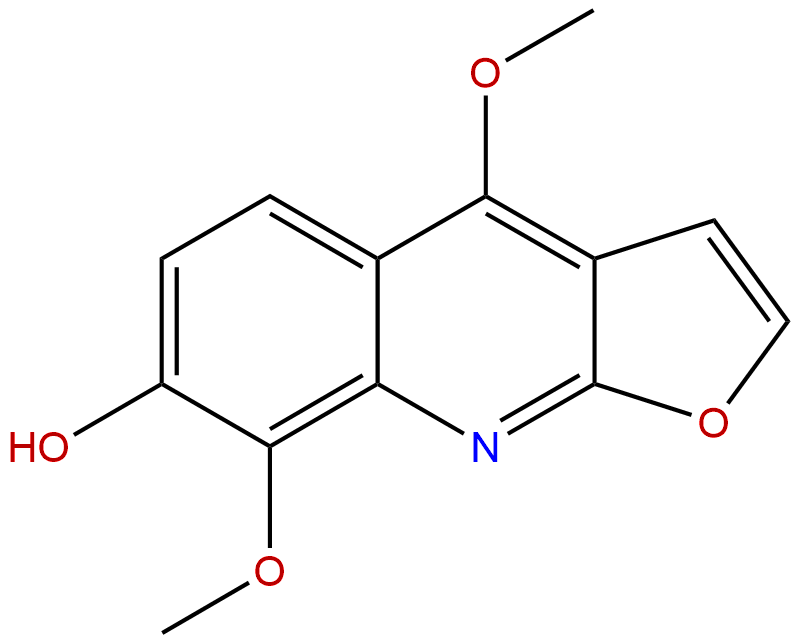


Product name: Haplopine
Synonym name: Demethyl-β-Fagarine; Demethyl-Skimmianine; 7-Hydroxy-8-methoxydictamnine
Catalogue No.: SBP02717
Cas No.: 5876-17-5
Formula: C13H11NO4
Mol Weight: 245.234
Botanical Source:
Physical Description: Powder
Type of Compound: Alkaloids
Purity: 95%~99%
Analysis Method: HPLC-DAD or/and HPLC-ELSD
Identification Method: Mass, NMR
Packing: Brown vial or HDPE plastic bottle
The product could be supplied from milligrams to grams. Inquire for bulk scale.
We provide solution to improve the water-solubility of compounds, thereby facilitating the variety of activity tests and clinic uses.
For Reference Standard and R&D, Not for Human Use Directly.
Storage conditions:Short-term storage at 2~8℃, long-term storage at -20 ~ -80℃
71.9700
1.7800
1.7800
Low
No
No
Unknown
Unknown
No
Unknown
No
Haplopine (CAS number: 5876-17-5) is a natural product with multiple biological activities, first isolated from plants of the genus Haplopine. As a alkaloid compound with photoactive antibacterial activity and DNA binding ability, demethylamine has attracted widespread attention in the field of natural product pharmacology. In recent years, with the in-depth study of its pharmacological effects and molecular mechanisms, berberine has shown potential application value in the treatment of various diseases such as pain relief, anti-inflammatory, antibacterial, anticancer, and photosensitive skin diseases. In addition, its regulatory effect on targets related to autoimmune diseases such as systemic lupus erythematosus also provides new ideas for its clinical translation.
This article provides a systematic review of the chemical structure and physicochemical properties, plant sources and extraction methods, pharmacological activity and mechanism of action, pharmacological evaluation and pharmacokinetic characteristics of demethylamine, and explores its clinical application prospects and future research directions. The aim is to provide a theoretical basis and research reference for the drug development of this natural product.
Noraconitine belongs to the class of furan quinoline alkaloids, with a molecular formula of C15H15NO3 and a molecular weight of 245.2300. Its structure contains a combination of furan ring and pyridine ring, which has certain rigidity and aromaticity. The LogP value of the compound is 1.78, indicating that it has moderate lipid solubility, which is beneficial for membrane penetration. The polar surface area (TPSA) is 71.97 Å ² and the number of hydrogen bond acceptors is 5, indicating its hydrophilicity and hydrogen bond forming ability, which are crucial for its binding with biomolecules such as DNA.
The structural characteristics of demethylamine endow it with unique photoactivation properties, which can produce reactive oxygen species under light conditions and enhance its antibacterial effect. In addition, the aromatic rings and nitrogen atoms in its molecular structure provide potential interaction sites for its binding with DNA. The overall physicochemical properties support its potential as a drug molecule, especially in targeting nucleic acid and protein molecules.
Noramine was initially isolated from plants of the Haplopappus genus, which is widely distributed in North America and some subtropical regions. In traditional Chinese medicine literature, plants of the yam genus are commonly used to treat symptoms such as inflammation, infection, and pain, indicating that their active ingredients have diverse biological effects.
The commonly used methods for extracting berberine include solvent extraction, liquid-liquid distribution, and chromatographic purification. Generally, ethanol or methanol is used as the initial extraction solvent, combined with ultrasound assisted extraction technology to improve extraction efficiency. Subsequently, separation and purification were carried out using methods such as silica gel column chromatography and reverse phase high performance liquid chromatography (RP-HPLC). The purified demethylamine was subjected to structural identification and purity confirmation using techniques such as mass spectrometry (MS) and nuclear magnetic resonance (NMR).
In recent years, with the promotion of green chemistry concepts, new technologies such as supercritical CO2 extraction and microwave-assisted extraction have also been attempted to be applied to the extraction of berberine, aiming to improve yield and purity while reducing environmental pollution.
Noraconitine exhibits significant activity in the fields of analgesia and anti-inflammatory. In vitro and in vivo studies have shown that it can regulate key targets such as TRPV1 (transient receptor potential vanillic acid subtype 1), CNR1 (cannabinoid receptor 1), PTGS2 (cyclooxygenase-2), OPRM1 (μ - opioid receptor), and CalcA (calcitonin gene-related peptide), thereby reducing inflammation response and pain perception. Especially in inflammatory models, demethylamine inhibits the expression and activity of PTGS2, reduces prostaglandin synthesis, and alleviates local inflammation and pain.
The antibacterial activity of demethylamine is particularly outstanding, especially under photoactivation conditions, showing enhanced bactericidal effect. This photosensitive antibacterial effect is mainly achieved by stimulating the production of reactive oxygen species (ROS), disrupting bacterial cell membranes and nucleic acid structures. Its targets involve bacterial DNA dependent RNA polymerase (rpoB), DNA gyrase (gyrA), topoisomerase IV (parC), bacterial cell membrane, and ribosome 50S subunit, demonstrating its multi-target synergistic antibacterial mechanism. This characteristic gives it potential advantages in combating drug-resistant strains.
Noraconitine exhibits inhibitory effects on various tumor cell lines. Its anti-cancer mechanism involves the regulation of key molecules such as DNA dependent protein kinase (PRKDC), tumor suppressor protein p53 (TP53), epidermal growth factor receptor (EGFR), vascular endothelial growth factor receptor (KDR), and histone deacetylase (HDAC1). Noraconitine exerts its anti-tumor activity by promoting DNA damage response, inducing cell cycle arrest and apoptosis, and inhibiting tumor angiogenesis.
In a photosensitive skin disease model, norepinephrine alleviates UV induced inflammation and cell damage by regulating signaling pathways such as nuclear factor kappa B (NFKB1), cyclooxygenase-2 (PTGS2), transcription factor AP-1 (JUN), and cytochrome P450 enzyme (CYP1A1). This indicates its potential application value in the prevention and treatment of photosensitive skin diseases.
Noraconitine has a regulatory effect on systemic lupus erythematosus (SLE) related targets such as Toll like receptor 7 (TLR7), interferon regulatory factor 5 (IRF5), B cell activating factor (TNFSF13B), Fc γ receptor (FCGR2A), and nuclear antigens, suggesting that it may alleviate the pathological process of SLE by regulating immune response and inflammatory pathways.
The multiple biological activities of demethylamine stem from its interactions with various key molecules. Its DNA binding ability enables it to directly interfere with nucleic acid function, affecting gene expression and cell proliferation. Under photoactivation conditions, demethylamine can produce reactive oxygen species, leading to oxidative damage to cell membranes and DNA, enhancing antibacterial and anti-tumor effects.
In terms of pain relief and anti-inflammatory effects, norepinephrine inhibits the production of inflammatory mediators and nerve conduction by regulating targets such as TRPV1, CNR1, and PTGS2, thereby reducing pain and inflammatory responses. Its regulation of OPRM1 may enhance the analgesic effect of the endogenous opioid system.
The antibacterial mechanism involves the inhibition of key bacterial enzymes such as rpoB, gyrA, and parC, blocking bacterial DNA replication and transcription processes, while disrupting cell membrane integrity, leading to bacterial death.
The anti-cancer effect is achieved by activating the DNA damage response pathways (PRKDC, TP53), inhibiting growth factor signaling (EGFR, KDR), and epigenetic regulation (HDAC1), thereby achieving cell cycle arrest and apoptosis induction.
In addition, the effect of norepinephrine on immune regulatory factors (TLR7, IRF5, TNFSF13B, etc.) reveals its potential therapeutic mechanism in autoimmune diseases.
The molecular weight of norepinephrine is 245.23, which conforms to the Lipinski rule for drug molecules. Its LogP value is 1.78, indicating moderate lipid solubility, which is beneficial for oral absorption and cell penetration. The TPSA is 71.97 Å ², indicating its excellent membrane permeability and potential for bioavailability. The number of hydrogen bond receptors is 5, which is within the ideal range in drug design.
The low permeability of the blood-brain barrier suggests that its role in the central nervous system may be limited, but this also reduces the risk of central side effects. Regarding safety indicators such as hepatotoxicity, cardiotoxicity (including hERG inhibition), and mutagenicity (Ames test), the data is currently unclear and further systematic evaluation is needed.
In terms of pharmacokinetics, there is a lack of systematic reports on the absorption, distribution, metabolism, and excretion (ADME) characteristics of norepinephrine. Preliminary in vitro metabolic studies suggest that it may be metabolized through the liver cytochrome P450 enzyme system, and the metabolites and metabolic pathways need further clarification. In the future, in vivo pharmacokinetic studies need to be conducted to clarify its bioavailability, half-life, and tissue distribution, providing a basis for clinical development.
Due to its multi-target and multi mechanism pharmacological properties, norepinephrine has shown broad application prospects in the treatment of various diseases. Its photoactive antibacterial function provides a new strategy for combating drug-resistant bacterial infections, especially suitable for the treatment of photosensitive local infections. The analgesic and anti-inflammatory effects make it potentially useful in the management of chronic inflammation and neuropathic pain.
The anticancer activity and its regulation of tumor related signaling pathways provide the possibility for it to be used as an adjuvant anti-tumor drug or chemotherapy sensitizer. The targeting effects of immune related diseases such as photosensitive skin diseases and systemic lupus erythematosus suggest their development value in the field of immune regulation.
However, the clinical translation of demethylamine still faces several challenges, including insufficient safety evaluation, lack of pharmacokinetic data, limitations in the application of photoactivation conditions, and optimization of large-scale preparation processes. Future research should focus on its toxicological evaluation, formulation development, and photosensitive activity regulation mechanism, combined with modern drug delivery technology to improve its clinical usability.
In addition, the design and synthesis of derivatives based on the structure of demethylamine will help optimize their pharmacological and pharmacokinetic properties, and expand their application scope. Multidisciplinary collaboration and preclinical animal model validation will accelerate its transition from the laboratory to clinical practice.
As a natural product with unique photoactive antibacterial activity and DNA binding ability, demethylamine has demonstrated rich pharmacological activity and broad therapeutic potential. Its mechanism of action in multiple fields such as pain relief, anti-inflammatory, antibacterial, anticancer, and immune regulation has been preliminarily clarified, and its pharmacological parameters show that it has a good foundation for drug development.
In the future, efforts should be made to strengthen its pharmacokinetics, safety, and preclinical research, and promote the pharmacological process of demethylamine and its derivatives. With the deepening of research, demethylamine is expected to become an important member in the development of natural product drugs, providing new strategies and choices for the treatment of related diseases.
