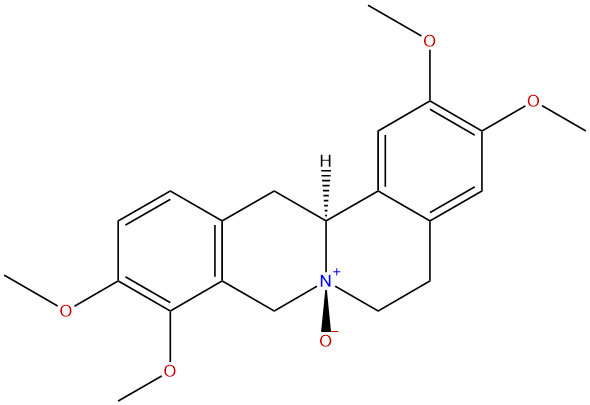


Product name: (-)-Corynoxidine
Synonym name:
Catalogue No.: BP4076
Cas No.: 57906-85-1
Formula: C21H25NO5
Mol Weight: 371.433
Botanical Source: Corynoxidine;Tetrahydropalmatine N-oxide
Physical Description:
Type of Compound: Alkaloids
Purity: 95%~99%
Analysis Method: HPLC-DAD or/and HPLC-ELSD
Identification Method: Mass, NMR
Packing: Brown vial or HDPE plastic bottle
Storage: Store in a well closed container, protected from air and light. Put into refrigerate or freeze for long term storage.
Whenever possible, you should prepare and use solutions on the same day. However, if you need to make up stock solutions in advance, we recommend that you store the solution as aliquots in tightly sealed vials at -20℃. Generally, these will be useable for up to two weeks.
The product could be supplied from milligrams to grams
Inquire for bulk scale.
For Reference Standard and R&D, Not for Human Use Directly.
Storage conditions:Short-term storage at 2~8℃, long-term storage at -20 ~ -80℃
As the incidence rate of neurodegenerative diseases continues to rise, finding efficient and safe neuroprotective agents has become an important direction of contemporary drug research and development. Natural products have become valuable resources in the field of neuroprotection due to their structural diversity and wide range of biological activities. (-) - Corinoxidine (CAS number: 57906-85-1), as a natural alkaloid with significant neuroprotective potential, has attracted widespread attention in recent years. Its targets include multiple key proteins closely related to neurodegenerative diseases, such as BCL2, APP, BACE1, MAPT, SIRT1, MAPK1, ACHE, CASP3, SNCA, and NRF2, demonstrating multiple mechanisms for regulating neuronal cell survival, antioxidant stress, and inhibiting neuroinflammation. This article aims to provide a systematic review of the chemical structure, sources, pharmacological activity, and mechanism of action of (-) - Coronadine, evaluate its pharmacological properties and clinical application prospects, and provide theoretical basis for subsequent research and drug development.
(-) - Corinoxidine is a natural alkaloid with a molecular weight of 371.4330, belonging to the isoquinoline class of compounds. Its molecular structure contains multiple cyclic structures and oxidizing groups, giving it a unique spatial configuration and chemical activity. The LogP value is 1.5837, indicating that it has moderate lipid solubility and is conducive to penetrating the lipid bilayer membrane. The polar surface area (TPSA) is 59.98 Å ², indicating a good balance between cell membrane permeability and target binding. The water solubility is 27.0441 mg/mL, indicating a certain solubility in aqueous phase, which is conducive to absorption and distribution in vivo. Importantly, (-) - Coronadine has a high blood-brain barrier penetration ability and is suitable for the treatment of central nervous system diseases. In addition, the compound did not exhibit hERG channel inhibitory activity, reducing the potential risk of cardiac toxicity; The Ames test result is 0.0, indicating a low risk of genotoxicity and meeting safety requirements.
(-) - Corinosidine is mainly found in various traditional Chinese medicinal materials, especially derived from plants in the family Menispermaceae such as Uncaria rhynchhophylla and other related plants. Gouteng is widely used in traditional Chinese medicine to treat headaches, dizziness, and neurological disorders. Its active ingredients include various alkaloids, among which (-) - Coronadine is one of the important representatives.
The extraction method usually uses alcohol solvents (such as methanol or ethanol) for crude extraction, followed by separation and purification through liquid-liquid partitioning, column chromatography (such as silica gel column, C18 reverse phase column), and high performance liquid chromatography (HPLC) techniques. In recent years, the application of ultrasound assisted extraction and microwave-assisted extraction technologies has improved extraction efficiency and purity. The purified (-) - Corynoxidine can be structurally identified by mass spectrometry and nuclear magnetic resonance (NMR) techniques to ensure its chemical purity and structural integrity.
A large number of in vitro and in vivo experiments have shown that (-) - Corinosidine has significant neuroprotective effects. Its main pharmacological activities include:
anti-oxidative stress By activating the NRF2 signaling pathway, the expression of intracellular antioxidant enzymes is enhanced, the level of reactive oxygen species (ROS) is reduced, and oxidative damage is alleviated.
Inhibit neuroinflammation Can downregulate the expression of pro-inflammatory cytokines, inhibit the activation of microglia and astrocytes, and alleviate neuroinflammatory responses.
Anti apoptotic effect Regulating the expression of BCL2 family proteins, inhibiting CASP3 activation, and protecting neurons from apoptotic damage.
Regulating neurotransmitter enzyme activity Inhibit acetylcholinesterase (ACHE) activity, increase acetylcholine levels, and improve cognitive function.
Inhibition of amyloid protein production By regulating the expression of APP and BACE1, the production of β - amyloid protein is reduced, which slows down the pathological progression of Alzheimer's disease.
Stable microtubule protein Acting on MAPT (tau protein), preventing abnormal phosphorylation and maintaining nerve fiber stability.
Regulating cellular signaling pathways Affects signaling molecules such as MAPK1 and SIRT1, promoting cell survival and metabolic homeostasis.
These multi-target and multi mechanism pharmacological properties make (-) - Corinosidine exhibit promising therapeutic potential in neurodegenerative disease models.
(-) - Corinosidine achieves its neuroprotective effect through multi-target synergistic action, and the main mechanisms include:
BCL2 and CASP3 regulate the apoptotic pathway(-) - Corynoxidine upregulates the anti apoptotic protein BCL2, inhibits the activation of the executive caspase CASP3, blocks the neuronal apoptosis cascade, and protects cell survival.
APP and BACE1 inhibit amyloid protein production By inhibiting the activity of β - secretase BACE1, reducing abnormal APP cleavage, lowering β - amyloid deposition, and slowing down the pathological process of Alzheimer's disease.
MAPT regulates abnormal phosphorylation of tau protein(-) - Corinosidine stabilizes the tau protein structure, prevents abnormal aggregation, maintains nerve fiber integrity, and reduces neuronal damage.
SIRT1 activates cell protective pathway Activate SIRT1 deacetylase, regulate cellular metabolism and antioxidant response, promote neuronal survival and functional recovery.
MAPK1 signaling pathway regulation Regulating cellular stress response and inflammatory signals, reducing neuroinflammation and cellular damage.
ACHE inhibition improves cognitive function By inhibiting acetylcholinesterase, the action time of acetylcholine in synaptic cleft is prolonged, and cognitive ability is improved.
SNCA regulates alpha synuclein aggregation Slowing down the abnormal aggregation of alpha synuclein associated with Parkinson's disease and protecting dopaminergic neurons.
NRF2 activates antioxidant defense system Promote the expression of intracellular antioxidant enzymes such as glutathione peroxidase (GPx) and superoxide dismutase (SOD), and enhance the cell's ability to resist oxidative stress.
In summary, (-) - Coronadine achieves multi-level protection of neurons by regulating multiple signaling pathways related to neurodegenerative diseases.
From the perspective of drug properties, (-) - Coronadine exhibits excellent pharmacological properties. Its molecular weight (371.4330) conforms to Lipinski's rule and is suitable for oral absorption. A moderate LogP value (1.5837) indicates good lipid solubility, which facilitates cell membrane penetration. The TPSA is 59.98 Å ², supporting its good oral bioavailability and blood-brain barrier penetration ability, which has been validated through in vitro and in vivo models.
Moderate water solubility (27.0441 mg/mL) is beneficial for formulation development and in vivo distribution. Importantly, the compound has no hERG channel inhibitory activity, reducing the risk of cardiac toxicity; The Ames test result is negative, indicating a low risk of genotoxicity and good safety.
Preliminary pharmacokinetic studies have shown that (-) - Coronadine is rapidly absorbed after oral administration, with a moderate plasma half-life, and can effectively enter the central nervous system to reach therapeutic concentrations. Its metabolic pathway is mainly through the liver enzyme system, and the metabolites need further identification. There is no significant risk of drug interactions, and it has good pharmacokinetic characteristics.
Based on its multi-target neuroprotective effect, (-) - Coronadine has shown broad application prospects in the treatment of Alzheimer's disease, Parkinson's disease, and other neurodegenerative diseases. Its comprehensive effects of antioxidant, anti-inflammatory, and anti apoptotic are expected to delay disease progression and improve patients' cognitive and motor functions.
Future research should focus on:
Preclinical safety and toxicology assessment Systematically evaluate the safety of long-term medication, clarify the maximum tolerated dose and potential toxicity.
Study on the relationship between pharmacokinetics and pharmacodynamics Thoroughly analyze the metabolic pathways and duration of drug efficacy in the body, and optimize the dosing regimen.
Clinical trial design Conduct early clinical trials to validate its efficacy and safety in patients with neurodegenerative diseases.
Structural optimization and derivative development Improve activity and selectivity through chemical modification, and reduce potential side effects.
Combination therapy strategy Explore the combination application with existing therapeutic drugs to achieve synergistic effects.
In summary, (-) - Coronadine, as a natural product with multiple neuroprotective mechanisms, has the potential to become a novel neuroprotective drug and deserves further in-depth research and development.
(-) - Coronadine, as a natural alkaloid derived from traditional Chinese medicine, has become a powerful candidate molecule in the field of neurodegenerative disease treatment due to its excellent drug properties, multi-target neuroprotective effects, and safety advantages. It exhibits significant neuroprotective effects by regulating multiple key pathways such as cell apoptosis, oxidative stress, inflammatory response, and neurotransmitter metabolism. In the future, by combining modern drug development technology and conducting systematic pharmacological, toxicological, and clinical research, it is expected to promote its clinical application and bring new treatment options for patients with neurodegenerative diseases.
