| Catalog No | Package | Original Price | Price | Inventory | Quantity | Operating |
|---|---|---|---|---|---|---|
| BP5080-5mg | 5mg | $750.00 | Sign in |
|


Storage conditions:Short-term storage at 2~8℃, long-term storage at -20 ~ -80℃
Carmichasine B is a natural diterpenoid alkaloid isolated from the traditional Chinese medicinal herb Aconitum carmichaelii, which has attracted much attention in recent years due to its significant anti-tumor activity. Chuanwu, as a classic traditional Chinese medicine herb, has always been used for pain relief, anti-inflammatory, and treatment of cardiovascular and cerebrovascular diseases. Its active ingredients are mainly various diterpenoid alkaloids. Carmichasine B, as one of the novel diterpenoid alkaloids, exhibits a unique molecular structure and multi-target regulatory ability, providing a new research direction for natural product pharmacology and anti-tumor drug development.
This review systematically summarizes the chemical structure and physicochemical properties, plant sources, and extraction methods of Carmichasine B, with a focus on its pharmacological activity and mechanism of action. Combined with molecular target analysis, its anti-tumor potential is evaluated, and its pharmacological and pharmacokinetic characteristics are evaluated. Finally, the clinical application prospects are discussed, providing theoretical basis and practical guidance for related research.
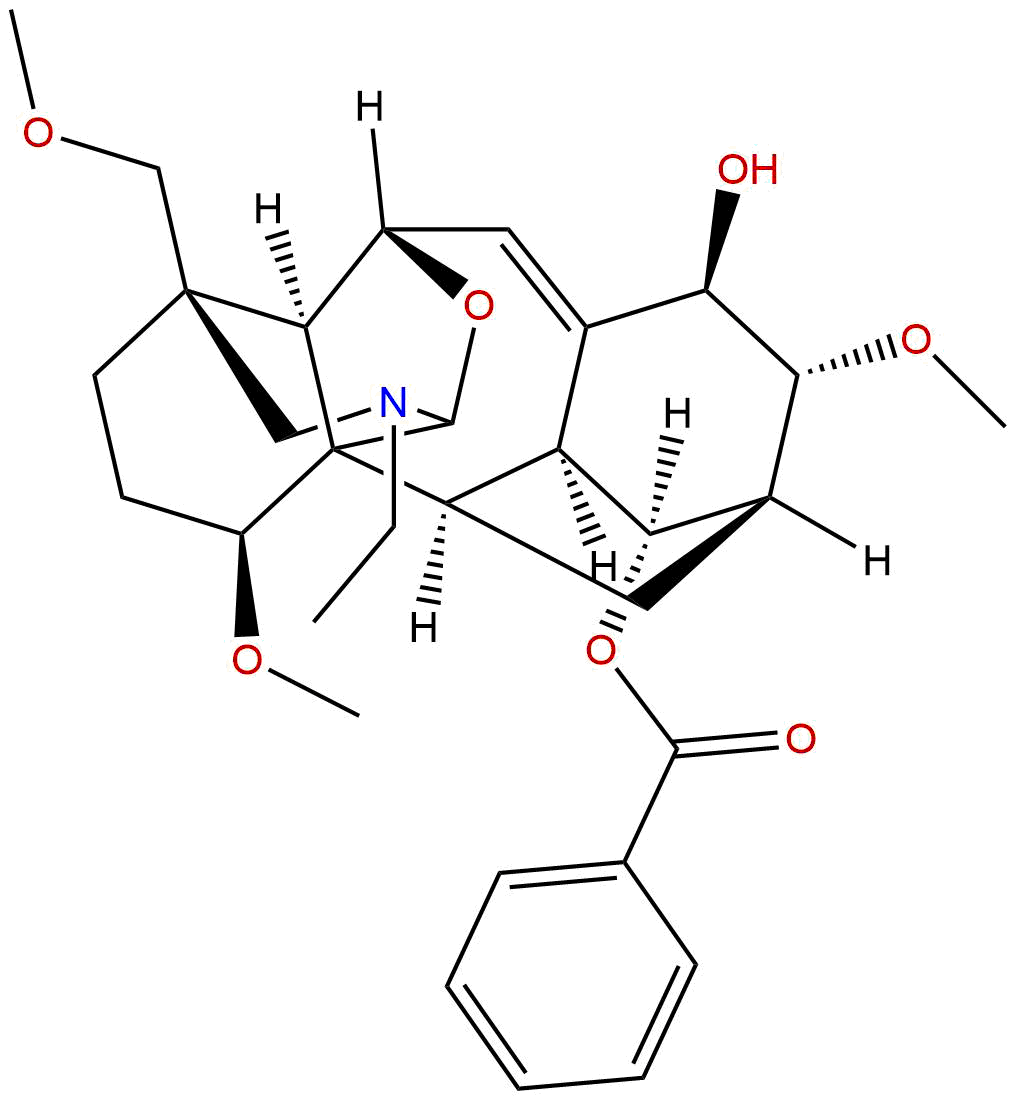
The molecular formula of Carmichasine B is C30H43NO8, with a molecular weight of 539.6690. Its structure belongs to the complex class of diterpenoid alkaloids, with a polycyclic terpene skeleton and nitrogen-containing heterocycles. The structure contains multiple hydroxyl and ester groups, giving it unique chemical properties. The LogP value is 3.0848, indicating moderate lipid solubility that facilitates membrane penetration. The polar surface area (TPSA) is 86.69 Å ², indicating that it has a certain polarity that facilitates binding with biomolecules. Low water solubility (0.0685 mg/mL) suggests limited solubility in aqueous phase, which may affect oral bioavailability.
In addition, Carmichasine B has a high blood-brain barrier penetration ability, which has potential value for the treatment of central nervous system related diseases. However, its inhibitory effect on hERG ion channels suggests a potential risk of cardiac toxicity that needs to be given special attention in drug development. The Ames test score is 0.9, indicating a low risk of genotoxicity.
Carmichasine B mainly comes from Aconitum carmichaelii, a plant in the Ranunculaceae family, which is widely distributed in southwestern China and adjacent areas. The root of Chuanwu is rich in various diterpenoid alkaloids and is an important medicinal part in traditional Chinese medicine.
The extraction of Carmichasine B is usually carried out using organic solvent extraction combined with column chromatography separation technology. The specific process includes:
In recent years, the application of ultrasound assisted extraction and microwave-assisted extraction technologies has improved extraction efficiency and purity, laying the foundation for large-scale preparation.
Carmichasine B shows significant cytotoxicity in many tumor cell lines, especially in lung cancer, breast cancer and liver cancer cells. In vitro experiments have shown that its half maximal inhibitory concentration (IC_50) is mostly at the micromolar level, demonstrating high anti-tumor activity.
In addition, Carmichasine B can induce tumor cell apoptosis, inhibit cell proliferation and migration, and significantly reduce tumor metastasis potential. In animal models, Carmichasine B prolonged the survival of experimental animals by inhibiting tumor growth and reducing the number of metastases, demonstrating good in vivo anti-tumor effects.
In addition to its anti-tumor effects, Carmichasine B also exhibits certain anti-inflammatory and immunomodulatory activities. Its regulation of inflammatory cytokine expression and its impact on immune cell function provide theoretical support for its role in regulating the tumor microenvironment.
The anti-tumor mechanism of Carmichasine B involves multiple signaling pathways and molecular targets, mainly including:
In summary, Carmichasine B exerts its anti-tumor effect through multi-target and multi pathway synergistic effects, reflecting the advantages of natural products as "multi-target drugs".
Carmichasine B has moderate lipid solubility (LogP=3.08), which is beneficial for membrane permeation and in vivo distribution. Its TPSA value is moderate, indicating that the molecule has a certain polarity that facilitates targeted protein binding. Low water solubility may limit its oral absorption and bioavailability, and it needs to be improved through formulation to enhance solubility.
The high penetration ability of the blood-brain barrier suggests its potential in the treatment of central nervous system diseases, but it also increases the risk of central nervous system toxicity. HERG channel inhibition is positive, indicating potential cardiac toxicity that needs to be monitored and optimized in subsequent drug development.
The Ames test results showed a low risk of genotoxicity and a preliminary good safety evaluation.
At present, there is limited systematic pharmacokinetic research on Carmichasine B. Preliminary in vivo experiments have shown that its oral absorption is slow and its plasma half-life is moderate. It is mainly metabolized through the CYP450 family of liver metabolic enzymes, especially the CYP19A1 related pathway. The activity and toxicity of its metabolites still need further research.
Widely distributed in the body, especially with high concentrations in liver, kidney, and brain tissues, which is consistent with its blood-brain barrier penetration characteristics. The main routes of excretion are through bile and urine.
Carmichasine B, as a natural diterpenoid alkaloid with multi-target anti-tumor activity, has the potential to become a candidate molecule for novel anticancer drugs. Its multi-target mechanism of action helps to overcome the resistance problem of traditional single target drugs and enhance therapeutic efficacy.
Future research should focus on:
In addition, considering its blood-brain barrier penetration ability, Carmichasine B may also play a role in the fields of brain tumors and neurological diseases, which is worth further exploration.
Carmichasine B, as a representative diterpenoid alkaloid in Aconitum carmichaelii, has shown promising prospects for drug development due to its unique chemical structure and multi-target anti-tumor activity. Its potential in the field of anti-tumor is not only reflected in its significant cytotoxicity and ability to inhibit tumor metastasis, but also in its synergistic anti-cancer effect achieved by regulating multiple key tumor signaling pathways.
Although there is currently incomplete data on its pharmacokinetics and safety, with the development of modern medicinal chemistry, molecular biology, and pharmacology techniques, Carmichasine B is expected to overcome existing shortcomings through structural optimization and dosage form innovation, becoming an important candidate for the new generation of anti-tumor natural drugs. Future systematic research and clinical validation will lay a solid foundation for its clinical application, promoting innovative development of natural product pharmacology in the field of tumor treatment.
