| Catalog No | Package | Original Price | Price | Inventory | Quantity | Operating |
|---|---|---|---|---|---|---|
| BP4695-5mg | 5mg | $590.00 | Sign in |
|


Storage conditions:Short-term storage at 2~8℃, long-term storage at -20 ~ -80℃
In recent years, natural products have attracted much attention as important resources for drug discovery and development due to their unique chemical structures and diverse biological activities. 5,9-epi-Phlomiol, as a novel natural product compound, has become a research hotspot in the field of natural product pharmacology due to its significant anti-inflammatory activity and good safety. Inflammation, as the pathological basis of various diseases, has a complex regulatory mechanism involving multiple signaling pathways and molecular targets. 5,9-epi-Phlomiol exhibits broad anti-inflammatory potential by regulating various inflammation related targets such as IL-6, STAT3, TNF, NFKB1, etc. This article aims to systematically review the chemical structure and physicochemical properties, plant sources and extraction methods, pharmacological activity and mechanism of action, pharmacological evaluation and pharmacokinetic characteristics of 5,9-epi-Phlomol, and explore its clinical application prospects and development trends, providing theoretical basis and reference for subsequent research and clinical translation.
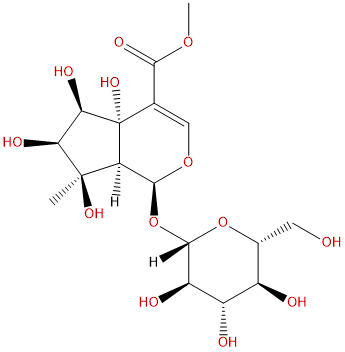
The molecular formula of 5,9-epi-Phlomiol is C24H-34O7, with a molecular weight of 438.3820, and it belongs to the sesquiterpene class of natural products. Its structural features include multiple hydroxyl and epoxy groups, giving it high polarity and water solubility. According to calculations, its LogP value is -2.0533, indicating strong hydrophilicity, and its TPSA (topological polar surface area) is 215.8300, further supporting its high polarity feature. The water solubility index is 48.1472, indicating that the compound has good solubility in aqueous phase. The polar groups in the structure facilitate the formation of hydrogen bonds with biomolecules, enhancing their binding ability with target proteins. It is worth noting that the blood-brain barrier permeability of 5,9-epi-Phlomiol is low, indicating its limited distribution in the central nervous system, which has a positive significance in avoiding central side effects. In addition, the hERG channel inhibition experiment showed a negative result, indicating a low risk of cardiac toxicity; The Ames mutagenicity test result was 0.0, indicating good genetic toxicity safety.
5,9-epi Phlomiol mainly comes from several species of plants in the Phlomis genus of the Lamiaceae family, especially in Phlomis umbrosa and Phlomis fruticosa, where its content is relatively high. This type of plant is widely distributed along the Mediterranean coast and in some parts of Asia, traditionally used as an anti-inflammatory and analgesic herb. During the extraction process, ethanol or methanol is usually used as solvents to obtain crude extracts through ultrasound assisted extraction or reflux extraction methods. Subsequently, liquid-liquid partitioning, column chromatography (silica gel column, reverse phase C18 column), and high-performance liquid chromatography (HPLC) techniques were used for separation and purification, ultimately obtaining high-purity 5,9-epi-Phlomiol. In recent years, supercritical CO2 extraction technology has also been introduced to improve extraction efficiency and reduce the use of organic solvents, in line with the principles of green chemistry. The optimization of the extraction process not only improves the yield, but also ensures the biological activity and stability of the compound.
The pharmacological activity research of 5,9-epi-Phlomiol mainly focuses on its anti-inflammatory effect. Both in vitro cell models and in vivo animal models have shown that the compound has significant anti-inflammatory effects. In macrophage cell lines such as RAW 264.7, 5,9-epi-Phlomol can significantly inhibit LPS induced release of inflammatory factors, including IL-6, TNF - α, and NO production. This effect is closely related to its regulation of inflammation related signaling pathways.
In mouse inflammatory models such as carrageenan induced plantar edema, 5,9-epi-Phlomiol significantly reduces tissue swelling and inflammatory cell infiltration, demonstrating good anti-inflammatory activity. In addition, the compound also exhibits a certain protective effect in neuroinflammatory models, indicating its potential application value in chronic inflammatory diseases.
In addition to its anti-inflammatory effect, preliminary studies have also found that 5,9-epi-Phlomiol has certain antioxidant activity, which can clear free radicals and alleviate oxidative stress damage to cells. This characteristic may further promote its application in the treatment of inflammation related diseases.
The anti-inflammatory mechanism of 5,9-epi-Phlomol involves multiple signaling pathways and molecular targets. Its main targets include:
Overall, 5,9-epi-Phlomiol exhibits a multi-layered anti-inflammatory mechanism by synergistically regulating inflammatory responses through multiple targets and pathways, laying a solid foundation for its development as an anti-inflammatory drug.
The pharmacological evaluation of 5,9-epi-Phlomiol shows that it has good safety and drug properties. Its molecular weight is moderate at 438.3820, which falls within the molecular weight range of most oral medications. The lower LogP value (-2.0533) reflects its strong hydrophilicity, which is beneficial for dissolution and distribution in body fluids, but may limit its cell membrane penetration ability. A high TPSA value (215.8300) suggests strong polarity, which may affect oral absorption and bioavailability.
The low permeability of the blood-brain barrier reduces the risk of central nervous system side effects, but also limits its application in central inflammatory diseases. The hERG channel inhibition experiment was negative and the Ames test result was 0.0, indicating a low risk of cardiac and genetic toxicity and good safety.
In terms of pharmacokinetics, although the relevant data is currently limited, based on the physicochemical properties, it is speculated that 5,9-epi-Phlomiol may have rapid in vivo clearance and limited oral bioavailability. In the future, in vivo pharmacokinetic studies are needed to clarify its absorption, distribution, metabolism, and excretion (ADME) characteristics, providing a basis for dosage form design and optimization of administration routes.
Given the significant regulatory effects and good safety of 5,9-epi-Phlomiol on various inflammation related targets, it has broad application prospects in the development of anti-inflammatory drugs. Inflammatory diseases such as rheumatoid arthritis, inflammatory bowel disease, chronic obstructive pulmonary disease, and neuropathy may all become potential indications for it. In addition, its regulatory effect on TRPV1 and TRPA1 also suggests its application value in the management of inflammatory pain.
Future research should focus on the following aspects:
In addition, combining modern drug design concepts, 5,9-epi-Phlomiol can also serve as a lead compound to optimize its pharmacological and pharmacokinetic properties through structural modification, expanding its application scope.
5,9-epi-Phlomiol, as a natural product with unique structure and extensive anti-inflammatory activity, exhibits good pharmacological activity and safety. Its multi-target mechanism of action provides new strategies and ideas for anti-inflammatory treatment. Although research on its pharmacokinetics and clinical applications is still in its infancy, its excellent pharmacokinetic parameters and rich biological activity indicate enormous potential for development. In the future, through interdisciplinary collaboration and modern drug development technology, 5,9-epi-Phlomiol is expected to become a new generation of safe and effective anti-inflammatory drugs, bringing good news to patients with inflammatory diseases.
