Introduction/Overview
N-Deacetyllapaconitine (CAS number: 11033-64-0) is a natural alkaloid derived from plants of the Aconitum genus, belonging to the aconitine derivatives. This type of compound has received widespread attention in recent years due to its significant pharmacological activity, especially its potential in the field of analgesia. With the increasing clinical demand for chronic pain management, traditional opioid drugs are limited in their application due to drug resistance and addiction risks. New analgesic molecules discovered in natural products have become an important direction for drug development. N-deacetylkaempferol has become a research hotspot due to its unique molecular structure and multi-target properties, exhibiting good analgesic activity and low risk of side effects.
This article will provide a systematic review of the chemical structure and physicochemical properties, plant sources and extraction methods, pharmacological activity and mechanism of action, pharmacological evaluation and pharmacokinetic characteristics of N-deacetylated lapis lazuli, and explore its clinical application prospects and future development directions. The aim is to provide theoretical basis and reference for the in-depth research and drug development of this natural product.
Chemical structure and physicochemical properties
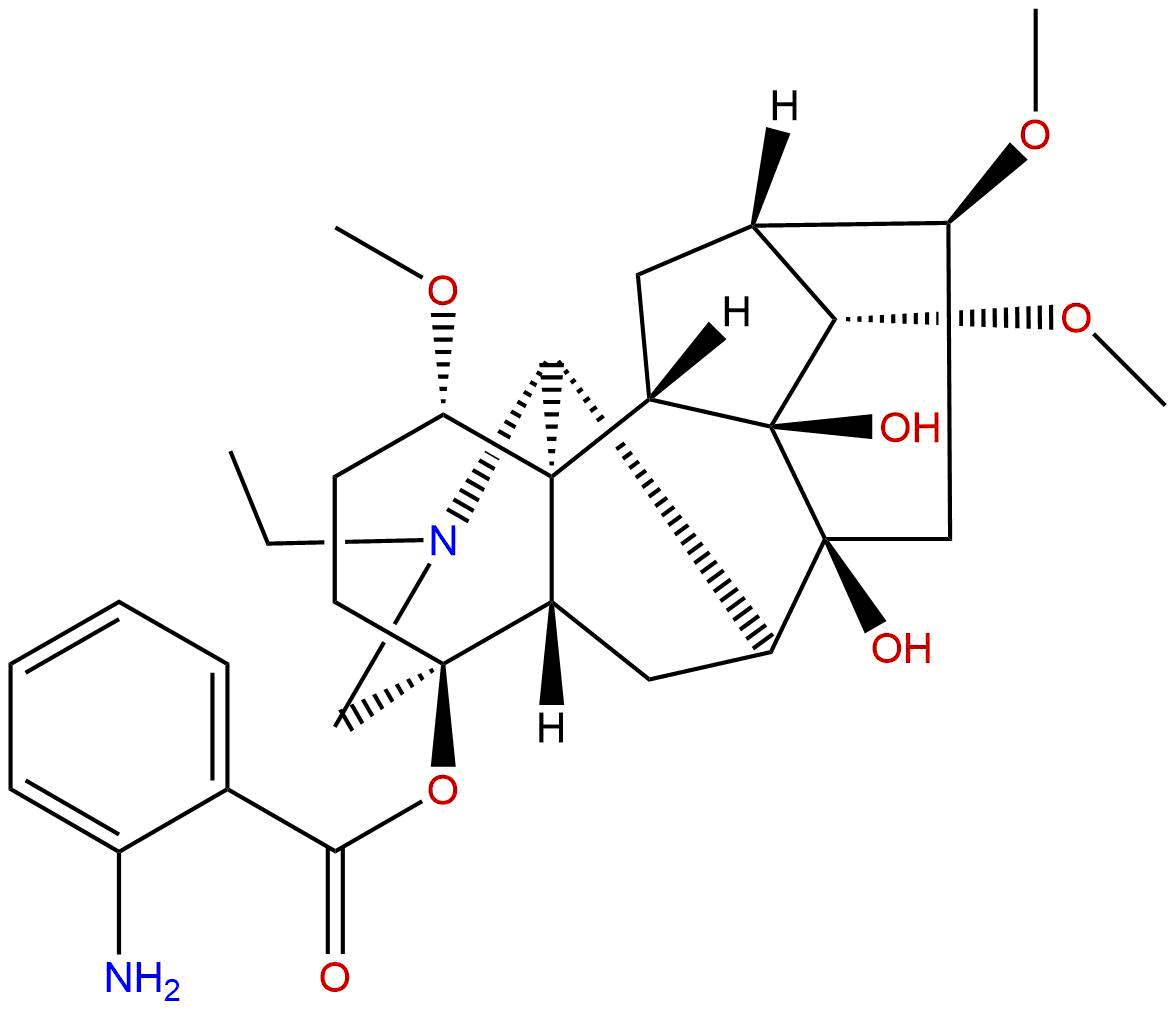
The molecular formula of N-deacetylkaempferol is C30H43NO8, with a molecular weight of 542.6730, belonging to the aconitine alkaloids. Its structure is based on a typical bicyclic dihydroisoquinoline skeleton, removing acetyl groups to form N-deacetylated derivatives. The structure contains multiple hydroxyl and ester groups, giving it a certain degree of polarity and hydrophilicity. Molecules have complex stereoisomers with multiple chiral centers, which have a significant impact on their binding specificity and activity towards biological targets.
In terms of physical and chemical properties, the LogP value of N-deacetylkaempferol is 2.3602, indicating its moderate lipid solubility, which is beneficial for membrane penetration. The polar surface area (TPSA) is 123.7100, indicating that its polarity is moderate and may affect its bioavailability and distribution. Low water solubility (0.0811) suggests limited solubility in aqueous media and may require appropriate formulation strategies to enhance bioavailability. The low permeability of the blood-brain barrier suggests that its direct action in the central nervous system may be limited, but this may also reduce central side effects. The negative result of hERG channel inhibition experiment indicates a low potential risk of cardiac toxicity. The Ames mutagenicity test score is 0.9, indicating a lower risk of genotoxicity.
In summary, the physicochemical properties of N-deacetylkaempferol provide a basis for its pharmacological effects, while also highlighting the challenges it needs to overcome in drug design and formulation development.
Plant sources and extraction methods
N-deacetylkaempferol is mainly found in plants of the Aconitum genus, especially in species such as Aconitum highlandense. Aconitum plants are widely distributed in temperate and subarctic regions of Asia, and have always been used in traditional Chinese medicine to treat diseases such as rheumatism and neuralgia. This type of plant contains a rich variety of aconitine alkaloids, among which N-deacetylkaempferol is one of its important components and has high pharmacological activity.
The extraction method usually uses organic solvent extraction combined with column chromatography separation technology. The specific steps include:
- Ingredient Preparation Select mature roots and rhizomes of Aconitum plants, dry and crush them for later use.
- Solvent extraction Methanol or ethanol is used for reflux extraction, and the extraction time is generally several hours to ensure sufficient dissolution of the active ingredients.
- Crude extract concentration The extract was concentrated under reduced pressure to obtain a crude extract.
- Separation and purification Further purification was carried out using silica gel column chromatography and reverse phase high-performance liquid chromatography (RP-HPLC), combined with thin-layer chromatography (TLC) to monitor the target components.
- Structural Identification Confirm the structure of the compound through nuclear magnetic resonance (NMR), mass spectrometry (MS), and infrared spectroscopy (IR).
In recent years, new technologies such as supercritical fluid extraction (SFE) and microwave-assisted extraction have also been attempted to be applied to the extraction of N-deacetylkaempferol, improving extraction efficiency and purity, reducing the use of organic solvents, and in line with the concept of green chemistry.
Pharmacological activity research
The pharmacological activity research of N-deacetylkaempferol mainly focuses on its analgesic effect. Multiple in vitro and in vivo experiments have shown that this compound has significant analgesic effects, and its mechanism of action is complex, involving multiple pain related targets.
Analgesic activity
In animal models, N-deacetylkaempferol can effectively alleviate inflammatory pain and neuropathic pain. Its analgesic effect is reflected in pain models induced by thermal, mechanical, and chemical stimuli, demonstrating strong analgesic efficacy and longer duration of action.
anti-inflammatory effect
Partial studies have shown that N-deacetylated lappaconitine has an inhibitory effect on the generation of inflammatory mediators, which can reduce the activity of prostaglandin synthase (PTGS1 and PTGS2), alleviate inflammatory reactions, and indirectly alleviate pain.
Neuroprotective effect
There is preliminary evidence to suggest that N-deacetylkaempferol may have potential value in chronic neuropathic pain by regulating the neurotransmitter system, protecting nerve cells from damage, and promoting neurological function recovery.
safety evaluation
The results of in vitro cytotoxicity and genotoxicity testing showed that N-deacetylkaempferol has high safety. The negative inhibition of hERG channel indicates a lower risk of cardiac toxicity, and the Ames test results also support a lower risk of genetic toxicity.
Mechanism of action and molecular targets
The analgesic effect of N-deacetylkaempferol involves multi-target synergistic regulation, with the main targets including:
-
TRPV1 (Transient receptor potential vanillic acid subtype 1)As a key ion channel for pain perception, TRPV1 regulates pain conduction. N-deacetylkaempferol may reduce pain signal transmission by regulating TRPV1 activity.
-
CNR1 (cannabinoid receptor 1)Participate in regulating pain and inflammatory response. This compound may activate or regulate CNR1, exerting analgesic and anti-inflammatory effects.
-
OPRD1 (δ - opioid receptor), OPRM1 (μ - opioid receptor), OPRK1 (κ - opioid receptor)Aconitum alkaloids are often used to mediate analgesia through opioid receptors, and N-deacetylkaempferol may bind to multiple opioid receptors to regulate the endogenous analgesic system.
-
PTGS1 and PTGS2 (cyclooxygenase 1 and 2)Catalytic synthesis of prostaglandins, involved in inflammation and pain processes. The inhibition of PTGS enzyme activity by this compound helps alleviate inflammatory pain.
-
TRPA1 (Transient receptor potential vanillic acid subtype A1)N-deacetylkaempferol may participate in chemical pain perception by regulating TRPA1 channels and inhibiting pain signals.
-
SLC6A4 (Serotonin Transporter)Regulating the reuptake of neurotransmitter serotonin, affecting pain regulation and emotional state.
-
DRD2 (dopamine D2 receptor)Participate in central nervous system pain regulation, which may affect analgesic efficacy and emotion related pain.
Through multi-target action, N-deacetylkaempferol achieves comprehensive regulation of pain signals, inhibiting peripheral inflammatory responses and regulating central nervous system pain perception, demonstrating good analgesic effects and low risk of drug resistance.
Evaluation of drug properties and pharmacokinetics
The evaluation of drug properties is a crucial step in the development of natural product drugs. N-deacetylkaempferol has a molecular weight (542.6730) slightly higher than the recommended upper limit of Lipinski rule (500), but its LogP (2.3602) and TPSA (123.7100) are within a reasonable range, showing moderate lipid solubility and polarity, which is beneficial for drug absorption and distribution.
Low water solubility (0.0811) suggests that there may be limited bioavailability during oral administration, and formulation optimization (such as nanocarriers, solid dispersions, etc.) is needed to improve solubility and absorption rate.
The low permeability of the blood-brain barrier indicates limited direct effects on the central nervous system, which may reduce central side effects but also limit the therapeutic potential for central pain. In the future, its brain distribution can be improved through structural modification or delivery systems.
The negative inhibition of hERG channel and low-risk results of Ames test support its good safety and reduce the risk of cardiac toxicity and genetic toxicity.
In terms of pharmacokinetics, existing research is relatively limited, but it is speculated that its metabolism is mainly carried out through the liver enzyme system, which may involve the CYP450 family. Further systematic research is needed on half-life, oral bioavailability, and pharmacological activity of metabolites.
Clinical application prospects and prospects
N-deacetylkaempferol has great potential for clinical development due to its significant analgesic activity and low toxicity. The future application prospects are mainly reflected in the following aspects:
-
Chronic pain management For neuropathic pain, inflammatory pain, and cancer pain, N-deacetylkaempferol can be used as a new analgesic drug candidate, especially for patients who need long-term medication and are concerned about opioid addiction.
-
Combination therapy strategy When used in combination with existing analgesics, it may have a synergistic effect, reducing the dosage and side effects of monotherapy.
-
Development of new dosage forms To address the drawbacks of poor water solubility and low blood-brain barrier permeability, develop nano formulations, liposomes, or targeted delivery systems to improve bioavailability and targeting.
-
Security advantage HERG negativity and low genotoxicity risk give it an advantage in safety and make it suitable for long-term use.
Future research should focus on in-depth elucidation of its pharmacokinetic characteristics, optimization of dosage forms, systematic toxicological evaluation, and preclinical animal model validation, gradually advancing clinical trials to verify its efficacy and safety.
Conclusion
As a natural derivative of aconitine with a multi-target mechanism of action, N-deacetylkaempferol exhibits significant analgesic activity and good safety characteristics. Its unique chemical structure endows it with a complex pharmacological action network, covering multiple pain related targets, reflecting the advantages of natural product multi-target synergistic regulation.
Although its pharmacokinetics and clinical application research are still in the preliminary stage, based on its pharmacological parameters and preliminary pharmacological data, N-deacetylkaempferol has the potential to become a new generation of analgesic drugs. In the future, through structural optimization, dosage form innovation, and systematic clinical research, it is expected to promote its clinical translation and provide new treatment options for pain management.
In summary, N-deacetylkaempferol, as an important object of natural product pharmacology research, not only enriches the pharmacological knowledge system of aconitine compounds, but also provides valuable scientific basis and development direction for the development of natural product analgesics.