Introduction/Overview
Natural products, as an important source of drug discovery, play an irreplaceable role in the long history of human struggle against diseases. Shikonin and its derivatives, as naphthoquinone pigments derived from Boraginaceae plants, have long been of great concern due to their extensive biological activities such as anti-inflammatory, antibacterial, anti-tumor, and wound healing promotion. In recent years, with the deepening of research on the structure-activity relationship of shikonin compounds, a series of structurally modified derivatives have been isolated, identified or semi synthesized. Among them, isovalerylshikonin (IVS) has gradually become a research hotspot in the field of natural product pharmacology due to its unique chemical structure and significant pharmacological activity, especially its antiviral potential.
Isovaleric purpurin (CAS number: 76549-35-4) is a naturally occurring derivative of purpurin esters, originally derived from Italian thistle(Echium italicum L. Separated from the root epidermis. Its chemical structural feature is that the hydroxyl group on the side chain of the parent nucleus of purpurin is esterified by an isovaleryl group. This structural modification not only changes the lipid solubility of the molecule, but also profoundly affects its interaction mode with biological targets, thereby endowing IVS with unique pharmacological characteristics that distinguish it from other shikonin analogues. Existing research has shown that IVS exhibits broad-spectrum antiviral activity, targeting multiple key stages of the virus lifecycle, including virus entry, genome replication, protein expression, and host immune regulation, demonstrating great potential as a novel antiviral lead compound.
This article aims to provide a comprehensive and systematic review of the current research status of isovaleric purpurin. The article will first elaborate on its chemical structure and physicochemical properties, followed by an introduction to its plant origin and extraction process, with a focus on analyzing its pharmacological activity in antiviral and other fields, and delving into its mechanism of action and molecular targets. On this basis, combined with the drug parameters and pharmacokinetic characteristics, evaluate its potential and challenges as a candidate drug, and finally look forward to its future clinical application prospects. Through this review, it is expected to provide a comprehensive reference framework for researchers engaged in natural product chemistry, pharmacology, and antiviral drug development regarding isovaleric shikonin.
Chemical structure and physicochemical properties
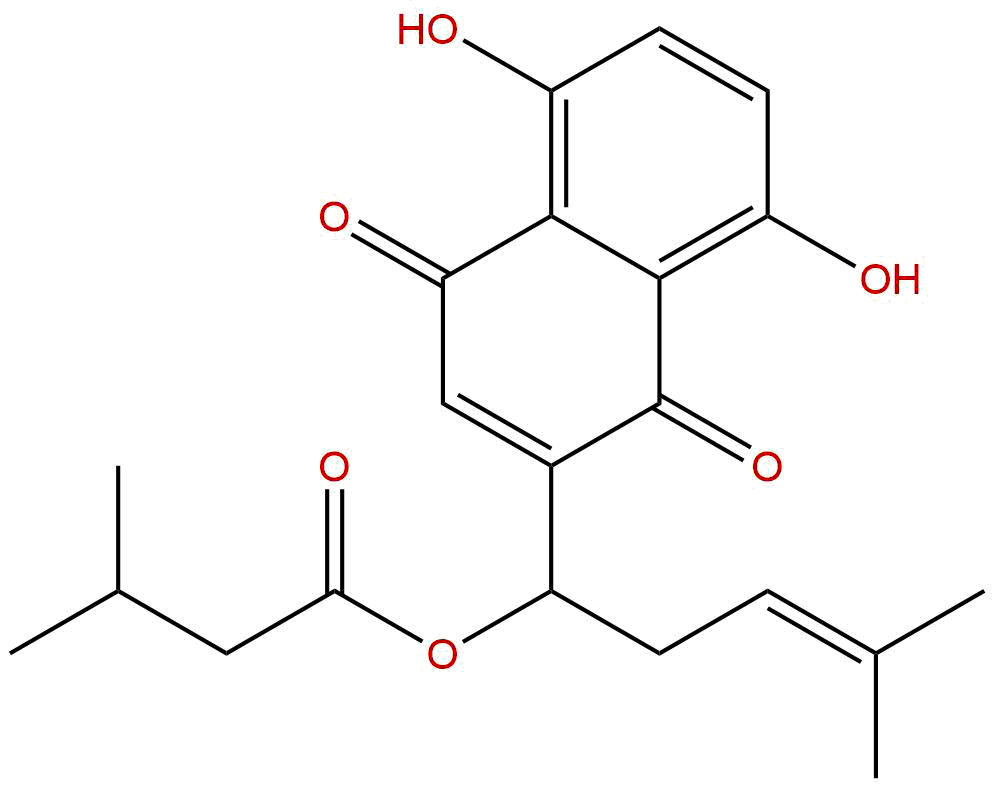
The chemical structure of isovaleric shikonin is the cornerstone of its biological function. From a chemical classification perspective, IVS belongs to the naphthoquinone class of compounds, specifically ester derivatives of shikonin. Shikonin itself is a naphthoquinone pigment with a chiral center. Its structural core is a 5,8-dihydroxy-1,4-naphthoquinone skeleton, and a six carbon side chain containing a chiral hydroxyl group ((R) -1-hydroxy-4-methyl-3-pentenyl) is connected at the C-3 position. The structural feature of isovaleric shikonin is that the hydroxyl group at the end of the side chain of shikonin is connected to isovaleric acid (3-methylbutyric acid) through an ester bond, forming isovaleric ester. Its precise chemical name is: (R) -1- (5,8-dihydroxy-1,4-dioxo-1,4-dihydronaphthalen-2-yl) -4-methyl-3-penten-3-methylbutyrate.
From the perspective of physical and chemical properties, the molecular formula of IVS is C ₂₁ H ₂₄ O ₆, with a molecular weight of 372.4170 g/mol. The lipophilic water partition coefficient (LogP) of the compound is 4.1783, indicating that it has high lipophilicity, mainly attributed to its naphthoquinone core and isovaleric side chain. A higher LogP value is beneficial for its penetration through biofilms, but it may also affect its solubility and distribution in aqueous environments. Its topological polar surface area (TPSA) is 100.9000 Å ², which reflects the total surface area of polar atoms (such as oxygen atoms) in the molecule and is usually related to the molecule's oral absorption and blood-brain barrier penetration ability. The TPSA value of IVS exceeds the common threshold of 60-70 Å ², indicating that its oral absorption may be limited to some extent, and its blood-brain barrier penetration ability is low (also confirmed by the "blood-brain barrier: low" in the drug properties parameters). The water solubility data is 0.0967 mg/mL, further confirming its insolubility in water, which poses a challenge for its formulation development. In terms of safety prediction, the hERG inhibition assessment result is' no ', indicating a low risk of causing QT interval prolongation in the heart; The Ames test result is 0.0, indicating a very low risk of mutagenicity. These preliminary pharmacological evaluations provide a favorable safety basis for the further development of IVS.
Plant sources and extraction methods
Isovaleric purpurin was first discovered and reported in Italian thistle(Echium italicum L. In the root epidermis. Blue thistle genus(Echium)Plants and Purple Grass Genus(Lithospermum)Plants belong to the family Verbenaceae and are one of the important sources of shikonin compounds. Except for E. italicum Subsequent studies have also found that IVS exists in other plants of the family Verbenaceae, such as certain species Arnebia(Soft purple grass genus) and Lithospermum(Boraginaceae) plants, but their content is usually low and varies depending on factors such as plant species, place of origin, and harvest season. In E. italicum In the middle, IVS is mainly enriched in the periderm or epidermal layer of the roots, presenting a purple red color.
The method of extracting IVS usually follows the classic extraction process of natural naphthoquinone pigments. Due to the lipophilicity of IVS, traditional solvent extraction methods often use organic solvents. Common solvents include petroleum ether, chloroform, ethyl acetate, methanol, or ethanol. Considering extraction efficiency and safety, modern research tends to use ethanol or ethanol water mixed solvents for reflux extraction or cold soaking extraction. The extraction process usually involves crushing the dried plant roots, soaking or refluxing them several times with a certain concentration of ethanol (such as 70% -95%) at room temperature or heating conditions, combining the extraction solutions, and concentrating them under reduced pressure to obtain the extract.
The separation and purification of IVS from crude extract requires the combination of multiple chromatographic techniques. Due to the presence of various structurally similar shikonin derivatives in plant extracts, such as acetyl shikonin, β, β - dimethylacryloyl shikonin, etc., separation is difficult. Common separation strategies include:
1. Liquid-liquid extraction Preliminary classification of the extract using solvents of different polarities, such as extracting with petroleum ether or n-hexane to remove lipophilic impurities, and then extracting with ethyl acetate or chloroform to enrich naphthoquinone components.
2. Column chromatography method Silica gel column chromatography is the most commonly used separation method. Preliminary separation of IVS from other shikonin derivatives can be achieved by gradient elution using solvent systems such as n-hexane ethyl acetate or chloroform methanol.
3. High performance liquid chromatography (HPLC)For studies that require high purity, especially preparative HPLC, it is a key step to obtain high-purity IVS. Usually, a reverse phase C18 chromatography column is used, with acetonitrile water or methanol water (often with a small amount of formic acid or acetic acid added) as the mobile phase for isocratic or gradient elution.
4. High Speed Counter Current Chromatography (HSCCC)As a liquid-liquid distribution chromatography technique, HSCCC has also demonstrated advantages in separating shikonin compounds, avoiding irreversible adsorption of samples on solid stationary phases and improving recovery rates.
Attention should be paid to avoiding light during the extraction and separation process, as shikonin compounds are sensitive to light and prone to photodegradation. In addition, the entire process should be carried out at low temperatures as much as possible to reduce oxidative degradation. The final obtained IVS can be structurally confirmed by spectroscopic methods such as nuclear magnetic resonance (NMR) and mass spectrometry (MS).
Pharmacological activity research
The pharmacological activity research of isovaleric purpurin is currently mainly focused on the field of antiviral, while some studies also involve its anti-inflammatory, anti-tumor and other potential activities.
Antiviral activity
The most notable pharmacological activity of IVS is its broad-spectrum antiviral effect. Existing research evidence suggests that IVS exhibits inhibitory activity against various DNA and RNA viruses.
-
Antiherpesvirus activity Multiple studies have confirmed that IVS has a significant inhibitory effect on herpes simplex virus types 1 (HSV-1) and 2 (HSV-2). Its mechanism of action may involve multiple steps, including inhibiting the activity of viral DNA polymerases (UL42, UL54 related), interfering with the expression of immediate early viral proteins (such as ICP27), and affecting the function of viral thymidine kinase (TK). The combined action of these targets enables IVS to effectively block the replication cycle of herpes virus. In addition, IVS can also inhibit the expression of virus envelope glycoprotein gD, which may interfere with the virus's adsorption and invasion processes.
-
Anti human immunodeficiency virus (HIV) activity IVS also exhibits inhibitory activity against HIV-1. Its targets include HIV-1 protease (HIV1-PR) and integrase (INT), which are key enzymes involved in virus maturation and genome integration during the HIV lifecycle. By inhibiting the activity of these enzymes, IVS can block the maturation of viral particles and the integration of host cell genomes. In addition, IVS may also affect virus entry into target cells by downregulating the expression of HIV-1 co receptors CCR5 and CXCR4. This multi-target mode of action makes IVS potentially advantageous in anti HIV therapy, potentially reducing the development of drug resistance.
-
Antiviral activity against other viruses Preliminary studies suggest that IVS may also have inhibitory effects on other members of the herpesvirus family, such as cytomegalovirus (CMV), and its mechanism may be related to the inhibition of viral DNA polymerases (such as UL54). In addition, given its broad-spectrum antiviral properties, the potential activity of IVS against other enveloped viruses such as influenza virus, Zika virus, etc. is also worth further exploration.
Other pharmacological activities
In addition to its antiviral effect, IVS also inherits some common activities of shikonin compounds.
-
anti-inflammatory activity Zicao compounds are classic anti-inflammatory natural products. IVS may exert anti-inflammatory effects by inhibiting inflammatory signaling pathways such as nuclear factor kappa B (NF - κ B) and mitogen activated protein kinase (MAPK), downregulating the production of pro-inflammatory factors such as tumor necrosis factor - α (TNF - α), interleukin-6 (IL-6), and prostaglandin E2 (PGE2). Its target may be related to the inhibition of myeloperoxidase (MPO) activity, which is a key enzyme released by neutrophils in inflammatory responses.
-
Antitumor activity Shikonin and its derivatives have been widely studied for anti-tumor purposes. IVS may be cytotoxic to a variety of cancer cell lines (such as liver cancer, breast cancer, melanoma, etc.). The mechanism may involve inducing cell apoptosis, inhibiting cell proliferation, interfering with the cell cycle, and inhibiting tumor angiogenesis. However, compared to other shikonin derivatives such as acetyl shikonin, there is relatively little research on the anti-tumor activity of IVS, and its specific mechanism and selectivity need to be further elucidated.
Mechanism of action and molecular targets
The pleiotropic pharmacological activity of isovaleric shikonin is rooted in its interactions with multiple molecular targets. Its mechanism of action presents the characteristics of multi-target and multi pathway, especially outstanding in antiviral aspects.
Multi target network for antiviral mechanism:
-
Inhibit viral enzyme activity IVS can directly bind to key enzymes in the virus lifecycle and inhibit their function.
- DNA polymerase For herpes viruses (HSV, CMV), IVS can inhibit virus encoded DNA polymerases (such as UL42 and UL54 of HSV). These enzymes are the core of viral DNA replication, and inhibiting their activity can directly block the replication of the viral genome.
- HIV-1 protease (HIV1-PR)IVS inhibits the cleavage of viral precursor proteins (Gag and Gag Pol) by binding to the active site of HIV-1 protease, thereby preventing the formation of mature and infectious viral particles.
- HIV-1 integrase (INT)IVS can inhibit the chain transfer activity of integrase, preventing the integration of viral DNA into the host cell genome, which is a key step in establishing permanent HIV infection.
-
Interference with viral gene expression and protein synthesis:
- Immediate Early Protein (ICP27)In HSV infection, ICP27 is a key regulatory protein involved in viral gene transcription, mRNA output, and translation. IVS can inhibit the expression or function of ICP27, thereby downregulating the expression of viral genes comprehensively.
- Thymidine kinase (TK)The TK of HSV is a key enzyme in viral nucleotide metabolism and an activation target for many antiviral drugs, such as acyclovir. The inhibitory effect of IVS on TK may interfere with the supply of raw materials for viral DNA synthesis.
-
Block virus entry into host cells:
- Envelope glycoprotein (gD)GD is a protein necessary for the fusion of HSV with the host cell membrane. IVS can inhibit the expression of gD, thereby reducing the infectivity of viral particles.
- Chemokine co receptors (CCR5, CXCR4)HIV-1 needs to bind to CD4 receptors and chemokine co receptors (CCR5 or CXCR4) to enter target cells. IVS can downregulate the expression levels of these co receptors, thereby reducing the efficiency of HIV-1 entry into target cells.
Anti inflammatory and anti-tumor mechanisms:
- Inhibition of MPO activity MPO is a peroxidase released after neutrophil activation, which participates in inflammatory reactions and tissue damage. IVS may exert anti-inflammatory effects by directly inhibiting MPO activity.
- Regulating signal pathways IVS may induce tumor cell apoptosis and suppress inflammatory response by inhibiting the activation of transcription factors such as NF - κ B and STAT3, downregulating the expression of anti apoptotic proteins (such as Bcl-2, Bcl xL) and pro-inflammatory factors, and upregulating pro apoptotic proteins (such as Bax, Bad).
In summary, the mechanism of action of IVS is not a single target "key model", but rather a network effect of "multi-target synergy" formed by simultaneously acting on multiple key nodes of the virus and host cells. This mechanism not only endows IVS with broad-spectrum antiviral activity, but may also reduce the risk of virus drug resistance, as the virus needs to undergo multiple gene mutations simultaneously to completely evade drug inhibition.
Evaluation of drug properties and pharmacokinetics
To push isovaleric shikonin from laboratory research to clinical application, a comprehensive evaluation of its drug like and pharmacokinetic properties is necessary.
Drug Evaluation:
Based on the provided parameters, IVS exhibits some favorable pharmacological characteristics, but also faces challenges.
- Beneficial features:
- Low hERG inhibition risk HERG potassium channel inhibition is the main cause of drug-induced QT interval prolongation and arrhythmia in the heart. The hERG inhibition assessment of IVS is' no ', which is an important safety advantage.
- Low risk of mutagenicity The Ames test result was 0.0, indicating that IVS did not show mutagenicity in the bacterial recovery mutation test, reducing its genetic toxicity risk.
- Challenges and Shortcomings:
- High lipophilicity and low water solubility The LogP is 4.1783 and the water solubility is only 0.0967 mg/mL, indicating that IVS belongs to a typical low solubility, high permeability (BCS class II or IV) compound. This can lead to low oral bioavailability, as the drug must first dissolve in gastrointestinal fluids before it can be absorbed. The development of formulations (such as the use of liposomes, nanoemulsions, cyclodextrin inclusion complexes, etc.) is the key to overcoming this obstacle.
- Low blood-brain barrier penetration ability The TPSA is 100.9 Å ², and the blood-brain barrier penetration assessment is' low '. This is disadvantageous for treating central nervous system diseases such as viral encephalitis, but may be an advantage for peripheral diseases that require reducing central nervous system side effects such as peripheral viral infections and inflammation.
- Metabolic stability As an ester compound, IVS may be rapidly hydrolyzed by esterases in the body, releasing shikonin and isovaleric acid. This prodrug characteristic may affect the duration and intensity of its efficacy. Detailed research is needed on its metabolic stability in plasma, liver, and intestine.
Pharmacokinetic characteristics (prediction and preliminary study):
At present, detailed research data on in vivo PK of IVS is not sufficient, but based on its physicochemical properties and studies of similar compounds, its PK characteristics can be inferred:
- absorb Poor oral absorption and low bioavailability. Intravenous injection may be a more effective route of administration. Transdermal administration may also be an option, as shikonin compounds are traditionally used for topical application.
- distribution Due to its high lipophilicity, IVS is widely distributed in the body and may accumulate in lipid rich tissues such as the liver, lungs, and adipose tissue. The plasma protein binding rate may be high.
- Metabolism The main metabolic pathways may include ester hydrolysis (producing shikonin and isovaleric acid), reduction of naphthoquinone nucleus, hydroxylation, and glucuronic acid/sulfuric acid binding reaction. The liver and intestines are the main metabolic organs.
- excretion Metabolites are mainly excreted through bile and urine. The excretion of prototype drugs in urine may be minimal.
Future pharmacokinetic studies should focus on establishing sensitive biological sample analysis methods (such as LC-MS/MS), determining the blood concentration time curves of IVS and its major metabolites in different animal models (such as mice and rats), calculating key PK parameters (such as Cmax, Tmax, AUC, t1/2, bioavailability F), and evaluating their tissue distribution and excretion pathways. These data are crucial for determining dosing regimens and predicting human PK.
Clinical application prospects and prospects
Isovaleric shikonin, with its unique chemical structure and multi-target antiviral mechanism, has shown broad clinical application prospects, especially in the current context of drug resistance challenges in antiviral drug development, where its value is particularly prominent.
Main application prospects:
-
Antiherpesvirus drugs Given the potent inhibitory activity of IVS on HSV-1/2 and its multi-target mechanism (inhibition of DNA polymerase ICP27、TK、gD), It is expected to be developed into a new drug for treating oral herpes, genital herpes, and herpetic keratitis. Especially for virus strains resistant to nucleoside analogues such as acyclovir, IVS may provide an effective alternative treatment option. The development of its external preparations (such as cream and gel) is highly feasible.
-
Anti HIV drugs IVS simultaneously inhibits HIV-1 protease and integrase, and downregulates co receptor expression. This multi-target mode of action makes it an attractive lead compound for developing novel anti HIV drugs. It can be used as part of a "multi-target" anti HIV drug or in combination with existing antiretroviral drugs (such as reverse transcriptase inhibitors, protease inhibitors) to enhance efficacy and reduce drug resistance. However, its low oral bioavailability is the main obstacle to the development of systemic drugs.
-
Broad spectrum antiviral candidate The antiviral spectrum of IVS may not be limited to herpes virus and HIV. Given that its mechanism of action involves conserved links in the viral life cycle (such as DNA replication and protein processing), IVS may also have potential activity against other DNA viruses (such as CMV, EBV, HBV) and RNA viruses (such as influenza virus, SARS-CoV-2). This is worth conducting a systematic antiviral spectrum screening.
-
Application of anti-inflammatory and immune regulation The anti-inflammatory activity of IVS (inhibition of MPO and NF - κ B pathways) makes it potential for the treatment of inflammatory diseases such as dermatitis, colitis, and arthritis. Its topical preparations can be used to treat skin inflammations such as eczema and psoriasis.
Future research directions and challenges:
-
Research on Structural Optimization and Structure Performance Relationship Using IVS as a lead, the side chain ester groups and naphthoquinone parent nucleus are modified through semi synthetic or biotransformation methods to improve water solubility, metabolic stability, and targeting selectivity, while reducing potential toxicity. Systematically study the effects of different substituents on antiviral and anti-inflammatory activities, and establish a clear structure-activity relationship model.
-
Formulation development Solving the problems of low water solubility and oral bioavailability is the key to IVS drug development. We need to vigorously develop new drug delivery systems, such as lipid nanoparticles, polymer micelles, phospholipid complexes, self microemulsifying drug delivery systems (SMEDS), etc. For topical preparations, study their transdermal absorption characteristics and optimize the matrix formula.
-
In depth pharmacological and toxicological research More comprehensive in vivo pharmacological studies are needed to validate its antiviral and anti-inflammatory efficacy in various animal models. At the same time, conduct preclinical safety evaluations of acute and chronic toxicity, reproductive toxicity, genetic toxicity, etc. of the system to clarify their safety windows.
-
Refined analysis of the mechanism of action Using techniques such as molecular docking, surface plasmon resonance (SPR), and cellular thermal transition analysis (CETSA), confirm the direct binding sites and binding modes of IVS with various target proteins. Elucidate its signal transduction network within cells, particularly how it coordinates antiviral and anti-inflammatory dual functions.
-
Combination therapy strategy Study the synergistic, additive, or antagonistic effects of IVS with existing antiviral drugs such as acyclovir, ganciclovir, zidovudine, etc., and explore the optimal combination therapy to achieve reduced toxicity and increased efficacy.
Conclusion
Isovaleric shikonin, as a structurally unique member of the shikonin family, is endowed with unique biological properties due to its isovaleric side chain. This review systematically summarizes the chemical structure, plant origin, pharmacological activity, mechanism of action, and pharmacological characteristics of IVS. Existing research clearly indicates that IVS is a natural product with broad-spectrum antiviral activity, and its mechanism of action involves synergistic inhibition of multiple targets such as viral DNA polymerase, protease, integrase, regulatory proteins, and host co receptors. This multi-target characteristic is its core advantage over traditional single target antiviral drugs and provides new strategies for addressing viral resistance.
However, the path to clinical translation of IVS is not smooth. The main challenges currently faced are the oral bioavailability issues caused by its high lipophilicity and low water solubility, as well as potential metabolic instability. The future research focus should be on optimizing the structure through medicinal chemical methods and overcoming its pharmacokinetic deficiencies with advanced formulation technologies. At the same time, deeper in vivo pharmacological and toxicological studies, as well as refined analysis of the mechanism of action, will be the key to promoting IVS from the laboratory to clinical applications.
In summary, isovaleric purpurin is a natural antiviral lead compound with great research value and development potential. Despite the numerous challenges ahead, its unique chemical space and pharmacological activity pattern have opened up new possibilities for antiviral drugs, especially for the treatment of drug-resistant viruses. With the cross fusion and deepening of interdisciplinary research, we have reason to believe that isovalerylshikonin and its derivatives have the potential to become new members of the human arsenal against viral diseases in the future.