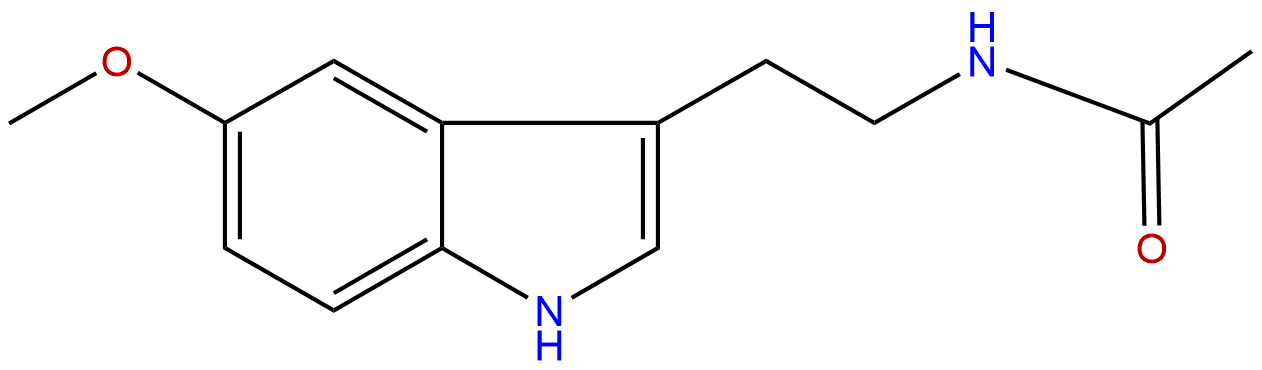


Product name: Melatonin
Synonym name:
Catalogue No.: SBP03308
Cas No.: 73-31-4
Formula: C13H16N2O2
Mol Weight: 232.283
Botanical Source:
Physical Description: Powder
Type of Compound: Alkaloids
Purity: 95%~99%
Analysis Method: HPLC-DAD or/and HPLC-ELSD
Identification Method: Mass, NMR
Packing: Brown vial or HDPE plastic bottle
The product could be supplied from milligrams to grams. Inquire for bulk scale.
We provide solution to improve the water-solubility of compounds, thereby facilitating the variety of activity tests and clinic uses.
For Reference Standard and R&D, Not for Human Use Directly.
Storage conditions:Short-term storage at 2~8℃, long-term storage at -20 ~ -80℃
54.1200
1.8434
1.8435
.2332
2.4409
22.0701
High
74.7782
1.9080
No
No
Yes
No
No
No
0.0
No
No
No
Yes
Melatonin (chemical name: N-acetyl-5-methoxytryptamine, CAS number: 73-31-4) is an endogenous indoleamine hormone widely present in the biological world. Since the first isolation and naming of melatonin from the pineal gland of cattle by dermatologist Aaron Lerner in 1958, research on melatonin has spanned over half a century. Initially, melatonin was named for its ability to lighten the pigmentation of amphibian skin (melanin aggregation), but subsequent research quickly revealed its core role in regulating circadian rhythms and sleep wake cycles. As the main hormone secreted by the pineal gland in the dark environment at night, melatonin is known as the "hormone of darkness" and is a key messenger for organisms to perceive external light cycles and synchronize endogenous biological clocks.
However, the biological function of melatonin goes far beyond regulating sleep. With the deepening of research, its powerful multifunctional effects such as antioxidant, anti-inflammatory, immune regulation, anti-tumor, and neuroprotective have been revealed one by one. Melatonin and its metabolites form a unique cascade antioxidant system that can directly eliminate multiple reactive oxygen species (ROS) and reactive nitrogen species (RNS), while inducing the expression of endogenous antioxidant enzymes. In addition, melatonin regulates multiple downstream signaling pathways by acting on its membrane receptors (MT1 and MT2) and nuclear receptors (ROR α/RZR family), participating in key life processes such as cell proliferation, apoptosis, differentiation, and metabolism. In recent years, the potential application value of melatonin in tumor treatment, metabolic diseases, neurodegenerative diseases, and reproductive health has been increasingly recognized. Especially in the study of hepatocellular carcinoma (HCC), melatonin has been identified as a novel selective activator of transcription factor 6 (ATF-6) inhibitor, which can induce apoptosis of liver cancer cells by downregulating cyclooxygenase-2 (COX-2), providing new ideas for liver cancer treatment. Meanwhile, in the field of reproductive medicine, melatonin can alleviate endoplasmic reticulum stress (ERS) and protect granulosa cell apoptosis induced by palmitic acid, indicating its potential application in improving metabolic related reproductive disorders.
This article will provide a systematic review of the chemical structure, physicochemical properties, source extraction, pharmacological activity, molecular mechanism, pharmacological characteristics, and clinical application prospects of melatonin from the perspectives of natural product pharmacology and medicinal chemistry. The aim is to provide comprehensive references for modern pharmacological research and new drug development of this classic molecule.
The chemical name of melatonin is N - [2- (5-methoxy-1H-indol-3-yl) ethyl] acetamide, with a molecular formula of C ₁ ∝ H ₁₆ N ₂ O ₂ and a molecular weight of 232.28 g/mol. The core of its structure is an indole ring, with a methoxy group (- OCH ∝) attached to the 5th carbon and an N-acetylethylamine group on the 3rd carbon as the side chain. This structural feature gives it both lipophilicity and a certain degree of hydrophilicity, allowing it to freely cross cell membranes and the blood-brain barrier.
From the analysis of physical and chemical properties, the lipid water partition coefficient (LogP) of melatonin is 1.84, indicating that it has moderate lipophilicity and is conducive to diffusion in biofilms. Its topological polar surface area (TPSA) is 54.12 Å ², much lower than the typical threshold for oral drugs (140 Å ²), indicating good membrane permeability. The water solubility data (0.233 mg/mL) shows limited solubility in water, but good solubility in organic solvents such as ethanol and dimethyl sulfoxide (DMSO). Melatonin is neutral under physiological pH conditions, with a pKa value of approximately 9.7 (NH on the indole ring), and mainly exists in a non ionized form in the body.
It is worth noting that melatonin has a high ability to penetrate the blood-brain barrier, which is the structural basis for its sleep regulation and neuroprotective effects in the central nervous system. In addition, the hERG inhibition experiment results were negative, indicating a low risk of cardiac toxicity. The Ames test result is 0.0, indicating that melatonin has no mutagenicity in the standard bacterial recovery mutation test and has a low risk of genetic toxicity. These pharmacological parameters provide favorable conditions for the development of melatonin as a drug lead compound or dietary supplement.
Although melatonin was initially defined as an animal pineal gland hormone, subsequent studies have found its widespread presence in the plant kingdom, including algae, ferns, gymnosperms, and angiosperms. Melatonin in plants not only acts as an antioxidant to protect them from environmental stress, but also participates in regulating physiological processes such as circadian rhythms, seed germination, root development, and fruit ripening. Plant sources rich in melatonin include cherries (especially sour cherries), walnuts, tomatoes, strawberries, grapes, rice, corn, oats, olive oil, red wine, and coffee. Among them, sour cherries and walnuts are considered high-quality natural sources of melatonin, with their content reaching several nanograms to micrograms per gram of fresh weight.
The extraction of melatonin from plants is usually carried out using solvent extraction method. Due to the extremely low content of melatonin in plant tissues (usually in the range of pg/g to ng/g) and its susceptibility to light and temperature, the extraction process needs to be carried out under light avoidance and low temperature conditions. Common extraction solvents include methanol, ethanol, acetonitrile, or their mixed aqueous solutions. To improve extraction efficiency, ultrasound assisted extraction (UAE) or microwave-assisted extraction (MAE) techniques can be used. After centrifugation and filtration, the extraction solution usually needs to be purified by solid-phase extraction (SPE) to remove interfering substances such as pigments, lipids, and phenolic compounds.
Quantitative analysis mainly relies on high-performance liquid chromatography (HPLC) combined with ultraviolet detection (UV) or fluorescence detection (FLD), the latter of which has higher sensitivity. For trace analysis, liquid chromatography tandem mass spectrometry (LC-MS/MS) is currently the gold standard method, providing high selectivity and sensitivity. In addition, enzyme-linked immunosorbent assay (ELISA) is also commonly used for rapid screening. It is worth noting that the content of melatonin in plants is influenced by various factors such as variety, growth environment, harvesting time, and processing methods, which poses challenges for standardized extraction and quality control.
The most classic pharmacological effect of melatonin is to regulate the sleep wake cycle. The secretion of endogenous melatonin exhibits a typical circadian rhythm, reaching its peak at night and remaining at a low level during the day. Exogenous supplementation of melatonin can shorten the latency period to sleep, increase total sleep time, and improve sleep quality, especially suitable for sleep disorders related to circadian rhythm disorders, such as jet lag syndrome, shift work sleep disorders, and sleep phase delay syndrome. Its function is mainly achieved by activating the MT1 and MT2 receptors in the suprachiasmatic nucleus (SCN) of the hypothalamus. The MT1 receptor mainly mediates the inhibitory effect of melatonin on the firing of SCN neurons, while the MT2 receptor participates in the phase adjustment of the circadian rhythm.
Melatonin is an efficient endogenous antioxidant. Unlike traditional antioxidants such as vitamin C and vitamin E, melatonin and its metabolites such as cyclic 3-hydroxymelatonin, N1-acetyl-N2-formyl-5-methoxycarnitine (AFMK) have the ability to scavenge free radicals, forming a so-called "cascade antioxidant" effect. Melatonin can directly scavenge hydroxyl radicals (• OH), superoxide anions (O ₂⁻•), peroxynitrite (ONOO ⁻), and singlet oxygen (¹ O ₂). In addition, melatonin can upregulate the expression of endogenous antioxidant enzymes such as superoxide dismutase (SOD), glutathione peroxidase (GPx), and catalase (CAT) by activating the nuclear factor erythroid 2-related factor 2 (Nrf2) pathway.
In terms of anti-inflammatory effects, melatonin can inhibit the activation of nuclear factor kappa B (NF - κ B), thereby reducing the production of pro-inflammatory cytokines such as tumor necrosis factor alpha (TNF - α), interleukin-1 β (IL-1 β), and interleukin-6 (IL-6). Meanwhile, melatonin can inhibit the expression of COX-2 and inducible nitric oxide synthase (iNOS), and reduce the levels of prostaglandin E2 (PGE2) and nitric oxide (NO). These anti-inflammatory effects have been validated in various inflammatory disease models, including acute lung injury, colitis, pancreatitis, and neuroinflammation.
Melatonin exhibits anti proliferative, pro apoptotic, and anti metastatic activities in various tumor models. Its anti-tumor mechanism involves multiple levels: firstly, melatonin exerts cell inhibitory effects by inhibiting DNA synthesis and cell cycle progression (usually blocking at G1/G0 phase) in tumor cells; Secondly, melatonin can induce apoptosis in tumor cells, and its mechanism includes mitochondrial pathway (upregulation of Bax/Bcl-2 ratio, release of cytochrome c, activation of caspase-3/9) and death receptor pathway (upregulation of Fas/FasL expression).
Of particular note is that melatonin exhibits a unique mechanism of action in hepatocellular carcinoma (HCC). Research has shown that melatonin is a novel selective ATF-6 inhibitor. ATF-6 is one of the sensors for endoplasmic reticulum stress (ERS), which is activated and translocated to the Golgi apparatus during ERS. After cleavage, it enters the nucleus and upregulates the expression of endoplasmic reticulum chaperone proteins and survival promoting genes. Melatonin induces apoptosis in HCC cells by inhibiting the activation of ATF-6 and blocking the expression of its downstream target gene COX-2. This discovery reveals a new mechanism by which melatonin exerts anti-tumor effects by intervening in the ERS signaling pathway, providing a potential target for the treatment of HCC.
The role of melatonin in metabolic diseases is increasingly being recognized. In obesity, type 2 diabetes and non-alcoholic fatty liver disease (NAFLD) models, melatonin can improve insulin sensitivity, reduce blood sugar and lipid levels, and reduce liver steatosis. The mechanism involves activating the AMP activated protein kinase (AMPK) pathway, inhibiting endoplasmic reticulum stress, and improving mitochondrial function.
In the field of reproductive medicine, melatonin has a particularly prominent protective effect on granulosa cells. Granulocytes are important somatic cells in follicles, and their functional status directly affects the quality and development of oocytes. A high-fat environment, such as elevated levels of palmitic acid, can induce endoplasmic reticulum stress in granulosa cells, leading to cell apoptosis and subsequently affecting follicular development and ovulation. Research has found that melatonin can significantly alleviate palmitic acid-induced apoptosis in mouse granulosa cells, and its mechanism is related to inhibiting the expression of endoplasmic reticulum stress markers (such as GRP78, CHOP, ATF-4), restoring endoplasmic reticulum calcium homeostasis, and reducing reactive oxygen species production. This discovery suggests that melatonin has potential application value in improving obesity related infertility.
The biological effects of melatonin are mainly achieved through two pathways: receptor-mediated and non receptor-mediated.
The main membrane receptors of melatonin include MT1 (MTNR1A) and MT2 (MTNR1B), both of which are G protein coupled receptors (GPCRs) belonging to the Rho subfamily. MT1 and MT2 are widely distributed in human tissues, including the brain (especially SCN), retina, cardiovascular system, immune cells, reproductive organs, and tumor tissues.
In addition to membrane receptors, melatonin can also bind to nuclear receptors ROR α (RAR related orphan receptor α) and RZR β, directly regulating gene transcription. ROR α plays an important role in regulating circadian rhythm, lipid metabolism, and immune response.
The antioxidant activity of melatonin is mainly not dependent on receptors, but is achieved through its direct chemical clearance ability. The indole ring in melatonin molecules is electron rich and can effectively supply electrons to free radicals, forming stable indole cation free radicals, which are further metabolized into products such as AFMK. In addition, melatonin can chelate transition metal ions (such as Fe ² ⁺, Cu ² ⁺), inhibit Fenton reaction, and reduce the generation of • OH.
At the signaling pathway level, melatonin downregulates the expression of COX-2, iNOS, and pro-inflammatory cytokines by inhibiting the activation of NF - κ B and ATF-6. Meanwhile, melatonin can activate the Nrf2/ARE pathway and promote the transcription of antioxidant enzyme genes. In terms of energy metabolism, melatonin activates AMPK, inhibits mTOR signaling, promotes autophagy and mitochondrial biosynthesis.
The role of melatonin in sleep regulation involves multiple molecular targets. In addition to MT1 and MT2 receptors, melatonin also regulates circadian rhythms by affecting the expression of circadian clock genes such as CLOCK and PER1. In addition, melatonin interacts with the gamma aminobutyric acid (GABA) system, enhancing the function of GABA_A receptors (including GABRA1, GABRA3, GABRD subunits) and exerting sedative hypnotic effects. Melatonin can also regulate the activity of extracellular signal regulated kinase 1/2 (ERK1/2) and AMPK, participating in the maintenance of sleep homeostasis.
Based on Lipinski's "Rule of Five", melatonin has ideal drug like properties: molecular weight (232.28 Da)<500, LogP (1.84)<5, number of hydrogen bond donors (1 indole NH)<5, and number of hydrogen bond acceptors (3: two O atoms and one N atom)<10. The TPSA is 54.12 Å ², indicating its good oral absorption potential. Although the water solubility (0.233 mg/mL) is low, it is still within an acceptable range. The blood-brain barrier has high penetration ability, which is beneficial for targeting the central nervous system. The risk of hERG inhibition is low, and the Ames test is negative, indicating its good safety.
The oral bioavailability of melatonin is relatively low, about 15%, mainly due to significant first pass effects and rapid liver metabolism. After oral administration, melatonin reaches its peak plasma concentration (Cmax) within 30-60 minutes, with a short half-life (t ₁/₂) of approximately 30-50 minutes. Melatonin is mainly metabolized by the liver cytochrome P450 enzyme system (mainly CYP1A2, followed by CYP2C19 and CYP3A4) in the body, producing 6-hydroxymelatonin, which then binds with sulfuric acid or glucuronic acid and is excreted through urine. In addition, melatonin can also be metabolized into AFMK through non enzymatic pathways.
Due to its short half-life, regular immediate release formulations require multiple daily doses or the use of sustained-release formulations to maintain effective blood drug concentrations. At present, most melatonin products available on the market are either immediate release tablets or sustained-release tablets, with a dosage range of 0.5 mg to 10 mg. It is worth noting that there are significant individual differences in the pharmacokinetics of melatonin, which are influenced by age, liver function, CYP1A2 gene polymorphism, and concomitant medications such as caffeine and oral contraceptives.
Melatonin is safe for short-term use (weeks to months), and common adverse reactions include headache, dizziness, drowsiness, gastrointestinal discomfort, and rash, which are usually mild and reversible. The safety data for long-term use is not sufficient, but existing evidence has not found severe toxicity. The safety of melatonin during pregnancy and lactation is not yet clear, and its use is generally not recommended. In addition, melatonin may interact with anticoagulants (such as warfarin), immunosuppressants (such as cyclosporine), and anticonvulsants, and should be used with caution.
Melatonin has been widely used to treat various sleep disorders. In the United States, melatonin is sold as a dietary supplement, while in regions such as Europe, Australia, and China, melatonin is approved as a prescription or over-the-counter medication for short-term treatment of insomnia. The effect of melatonin is particularly significant for sleep disorders related to circadian rhythm disorders, such as jet lag syndrome and shift work sleep disorders. In addition, the application of melatonin in children with sleep disorders such as autism spectrum disorder related insomnia has also shown positive effects. In the future, personalized melatonin treatment plans (including dosage, formulation, and administration time) for specific subtypes of sleep disorders will be a research focus.
The potential of melatonin in tumor treatment is gradually being explored. Preclinical studies have shown that melatonin can enhance the anti-tumor effect of chemotherapy drugs such as cisplatin, 5-fluorouracil, and doxorubicin, while reducing their toxic reactions such as bone marrow suppression, cardiotoxicity, and neurotoxicity. Small scale clinical trials suggest that melatonin combined chemotherapy can improve the survival rate and quality of life of patients with advanced solid tumors (such as non-small cell lung cancer, breast cancer, liver cancer). The specific role of melatonin as an ATF-6 inhibitor in the treatment of HCC provides a new direction for its development as a targeted drug. However, large-scale, multicenter randomized controlled trials are still urgently needed.
Given its strong antioxidant and anti-inflammatory activities, melatonin has potential protective effects in neurodegenerative diseases such as Alzheimer's disease (AD), Parkinson's disease (PD), and Huntington's disease. Melatonin can reduce the aggregation of β - amyloid protein (A β), inhibit tau protein hyperphosphorylation, protect dopaminergic neurons, and improve mitochondrial function. Clinical studies have shown that melatonin can improve sleep disorders and cognitive function in AD patients, but its delaying effect on disease progression still needs further verification.
The protective effect of melatonin in metabolic syndrome, NAFLD and type 2 diabetes has been widely recognized. It exerts hypoglycemic, lipid-lowering, and anti-inflammatory effects by activating AMPK, inhibiting endoplasmic reticulum stress, and improving mitochondrial function. In the field of reproductive medicine, melatonin, as a natural antioxidant in follicular fluid, can improve oocyte quality and increase the success rate of in vitro fertilization (IVF), especially suitable for polycystic ovary syndrome (PCOS) and elderly women. The protective effect of melatonin on granulosa cells provides a new strategy for treating obesity related infertility.
Although research on melatonin has achieved fruitful results, it still faces many challenges. Firstly, the low bioavailability and short half-life of melatonin limit its clinical application, and it is urgent to develop new delivery systems (such as nanomaterials, liposomes, transdermal patches) to improve its pharmacokinetic properties. Secondly, the pleiotropic mechanism of melatonin results in insufficient target specificity, and the development of highly selective MT1/MT2 receptor agonists or antagonists (such as remdesidine and agomelatine) has become a hot topic in the field of medicinal chemistry. In addition, the biosynthetic pathway and regulatory mechanism of melatonin in plants are not fully understood, and the use of synthetic biology techniques to achieve green and efficient production of melatonin has important application value.
Melatonin, an ancient molecule discovered in the pineal gland, has evolved from a simple sleep hormone to a multifunctional natural product with multiple pharmacological activities after more than 60 years of research. Its unique chemical structure endows it with excellent antioxidant capacity, while its receptor-mediated signaling network plays a key role in sleep regulation, anti-inflammatory, anti-tumor, and metabolic protection. The discovery of melatonin as a novel ATF-6 inhibitor in the treatment of liver cancer, as well as its effect in alleviating endoplasmic reticulum stress and protecting granulosa cells, further expands its pharmacological boundaries. The pharmacological evaluation shows that melatonin has good drug like properties and safety, but its pharmacokinetic defects still need to be overcome through formulation innovation. In the future, with a deeper understanding of the mechanism of action of melatonin and the development of new derivatives, melatonin and its analogues are expected to have greater clinical value in fields such as sleep medicine, tumor treatment, neuroprotection, and reproductive health. The research process of melatonin is a classic example of the discovery, transformation, and application of natural products, which also indicates that this "guardian of the dark night" will shine with new vitality in the era of precision medicine.
Batch can search by a CAS number,one per line
