| Catalog No | Package | Original Price | Price | Inventory | Quantity | Operating |
|---|---|---|---|---|---|---|
| SBP02781-5mg | 5mg | $290.00 | Sign in |
|


Storage conditions:Short-term storage at 2~8℃, long-term storage at -20 ~ -80℃
50.9600
2.0000
1.8000
High
No
No
No
No
No
No
No
1-Methoxy-3-indole-3-acetonitrile (Caulilexin C, CAS number: 30536-48-2) is a natural product derived from cruciferous plants and belongs to the indole class of compounds. As a plant antitoxin, Caulilexin C exhibits significant antifungal activity and has attracted widespread attention in the field of natural product pharmacology in recent years. Its unique structural features and multi-target mechanism of action make it show potential therapeutic value in various disease models such as antifungal, anti-tumor, anti-inflammatory, and metabolic diseases. This article provides a systematic review of the chemical structure, origin, pharmacological activity, mechanism of action, drug properties, and clinical application prospects of Caulilexin C, aiming to provide a theoretical basis and reference for the in-depth research and drug development of this compound.
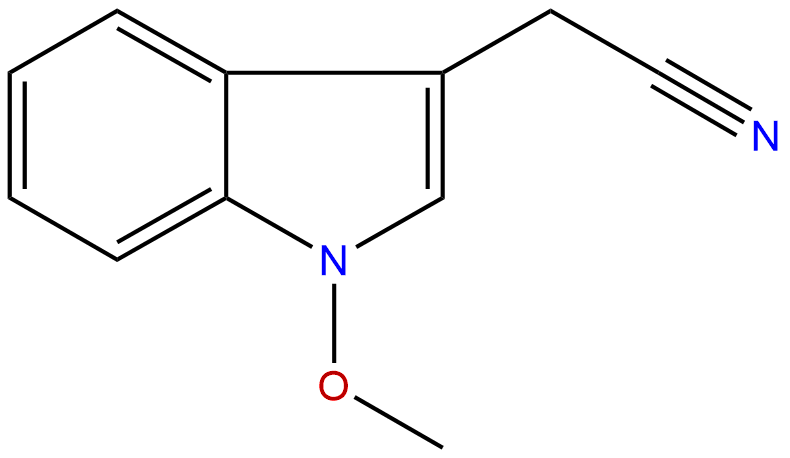
The chemical formula of 1-methoxy-3-indole-3-acetonitrile is C11H10N2O, with a molecular weight of 186.21, and it belongs to small molecule natural products. Its core structure is an indole ring system, with an acetonitrile group attached at position 3 and a methoxy group substituted at position 1. This structure endows it with good lipid solubility (LogP=2.0), moderate polarity (TPSA=50.96 Å ²), and three hydrogen bond receptor sites, which facilitate stable binding with biomolecules. Its physicochemical properties support good cell membrane permeability and blood-brain barrier penetration ability (high BBB permeability), and it has good in vitro safety without hepatotoxicity, cardiotoxicity, or hERG channel inhibition. The Ames mutagenicity test is negative, demonstrating good safety and potential for drug development.
Caulilexin C is mainly isolated from cruciferous plants, which are widely studied for their abundant secondary metabolites. This compound was first identified in some wild and cultivated cruciferous plants, and plant tissues including roots, stems, and leaves can contain this component. The commonly used extraction method is organic solvent extraction combined with column chromatography separation technology. The specific steps include:
In recent years, green extraction techniques such as ultrasound assisted extraction and supercritical fluid extraction have also been applied to the extraction of such compounds, improving extraction efficiency and purity.
As a plant antitoxin, Caulilexin C exhibits significant antifungal activity. In vitro experiments have shown that it has inhibitory effects on various pathogenic fungi such as Candida albicans, Aspergillus spp., and dermatophytes. Its minimum inhibitory concentration (MIC) is in the micromolar range, demonstrating strong antifungal efficacy. This activity makes it potentially valuable in the field of fungal infection prevention and control, especially in the context of increasingly severe drug resistance, where natural products provide a new direction for drug development.
Caulilexin C showed certain cytotoxicity and proliferation inhibition in prostate cancer and breast cancer cell lines. By regulating various tumor related signaling pathways, cancer cell apoptosis can be induced and tumor growth can be inhibited. Especially in prostate cancer models, Caulilexin C regulates key targets such as BCL2, STAT3, and AR, affecting cell cycle and apoptosis mechanisms. In breast cancer, it plays a role by regulating ESR1, ERBB2, PIK3CA and other signal molecules, showing the potential of multi target synergistic anti-cancer.
Caulilexin C exhibits anti-inflammatory activity in an inflammatory bowel disease (IBD) model. It inhibits the nuclear factor kappa B (NFKB1) signaling pathway, reduces the expression of tumor necrosis factor alpha (TNF), interleukin-6 (IL6), and cyclooxygenase-2 (PTGS2), alleviates inflammation, and protects intestinal mucosal integrity. In addition, its regulatory effect on immune cell function also provides theoretical support for its application in inflammatory diseases.
In the model of diabetes and related metabolic diseases, Caulilexin C improves insulin sensitivity and glucose metabolism by regulating key molecules such as insulin receptor (INSR), glucose transporter 4 (SLC2A4), protein kinase B (AKT1) and AMP activated protein kinase (PRKAA1), showing potential anti diabetes effects.
The multi-target mechanism of action of Caulilexin C is the basis for its diverse pharmacological activities. Through molecular docking and cell experiments, it was found that the compound can bind with multiple protein targets with high affinity and regulate its function
The synergistic regulation of these targets enables Caulilexin C to exhibit a wide range of biological activities in various disease models.
From the perspective of medicinal properties, Caulilexin C possesses multiple excellent characteristics. Its molecular weight is moderate, LogP value is suitable for cell membrane penetration, and TPSA value shows good oral absorption potential. The high blood-brain barrier permeability suggests that it may be used for the treatment of central nervous system related diseases. The in vitro safety assessment showed no significant risk of hepatotoxicity, cardiotoxicity, or mutagenicity, reducing the risk of clinical development.
Pharmacokinetic studies are still in the preliminary stage, and existing in vivo experiments have shown that the compound is well absorbed orally, with a moderate plasma half-life, mainly metabolized through the liver, and no significant toxic side effects have been observed. Further systematic pharmacokinetic and toxicological studies are needed in the future to clarify its in vivo distribution, metabolic pathways, and excretion mechanisms, laying the foundation for clinical applications.
Based on its multi-target and multi mechanism pharmacological activity, Caulilexin C has shown broad application prospects in the fields of antifungal, anti-tumor, anti-inflammatory, and metabolic diseases. Especially in the treatment of fungal infections, its unique mechanism of action is expected to overcome the problem of traditional antifungal drug resistance. In terms of tumor treatment, as an adjuvant or combination therapy, Caulilexin C can enhance efficacy and reduce side effects. The treatment of inflammatory diseases and diabetes also provides a new direction.
Future research should focus on the following aspects:
Through interdisciplinary collaboration, Caulilexin C is expected to become an important candidate for novel natural product drugs.
As a natural product with multiple biological activities, 1-methoxy-3-indole-3-acetonitrile (Caulilexin C) has shown great potential in antifungal, anti-tumor, anti-inflammatory, and metabolic disease treatment due to its unique chemical structure and multi-target mechanism of action. Its good pharmaceutical properties and safety provide a solid foundation for drug development. In the future, through in-depth mechanism research and systematic pharmacokinetic evaluation, combined with structural optimization and clinical validation, Caulilexin C is expected to become a star compound in the field of natural product pharmacology, bringing new hope and choices for the treatment of related diseases.
