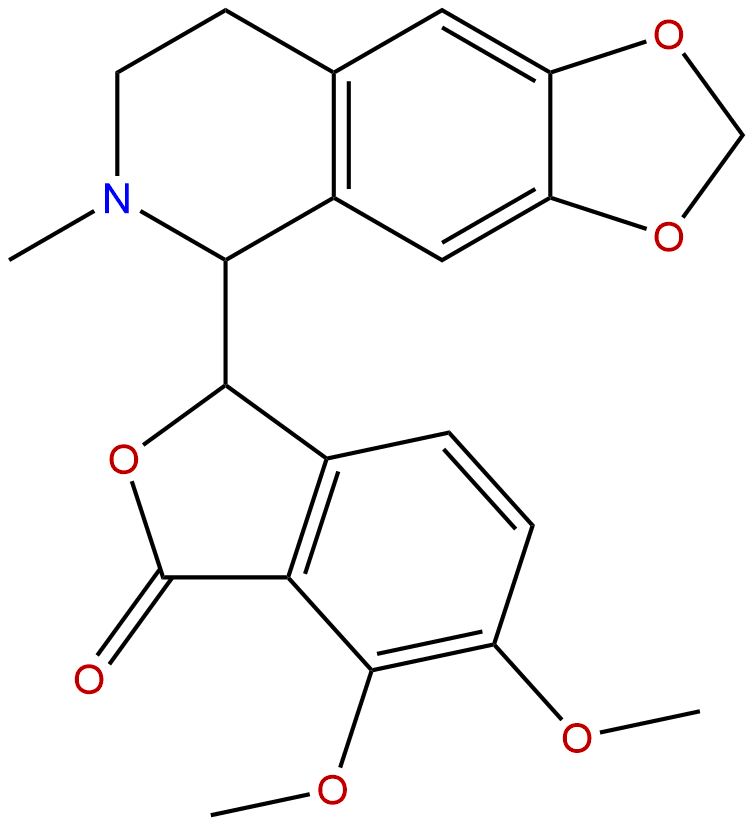


Synonym name: (-)-Beta-Hydrastine
Catalogue No.: BP0744
Cas No.: 118-08-1
Formula: C21H21NO6
Mol Weight: 383.4
Botanical Source: Alkaloid from Hydrastis canadensis and Berberis laurina (Papaveraceae, Berberidaceae)
Purity: 95%~99%
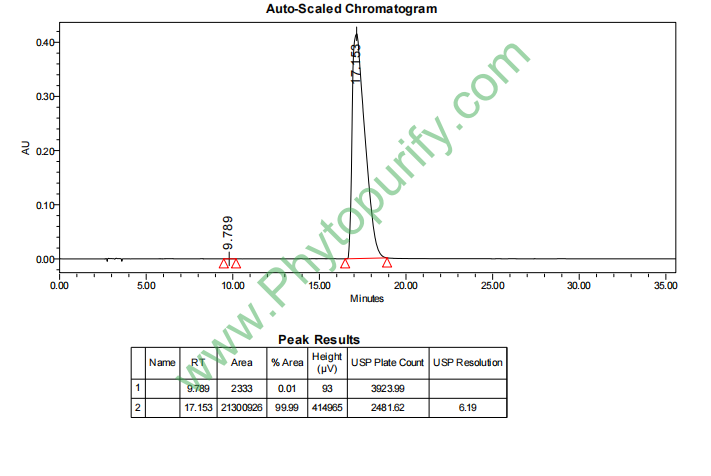
Analysis Method: HPLC-DAD or/and HPLC-ELSD
Identification Method: Mass, NMR
Packing: Brown vial or HDPE plastic bottle
Can be supplied from milligrams to grams.
For Reference Standard and R&D, Not for Human Use Directly.
Inquire for bulk scale.
HPLC of Hydrastine
Storage conditions:Short-term storage at 2~8℃, long-term storage at -20 ~ -80℃
Hydrastine (CAS number: 118-08-1) is a natural plant derived alkaloid compound, first found in Coptis chinensis in North America(Hydrastis canadensis)Separated from the middle. As a natural product with multiple biological activities, North American coptisine has attracted widespread attention in pharmacological research. Its unique molecular structure endows it with multi-target properties, especially demonstrating potential application value in neurological diseases and antibacterial fields. In recent years, with the in-depth study of Parkinson's disease (PD) and related neurodegenerative mechanisms, berberine, as a selective competitive inhibitor of tyrosine hydroxylase (TH), has become an important tool molecule for studying dopaminergic neuron damage. In addition, the inhibitory effect of North American coptisine on Organic Cation Transporter (OCT1) provides a new perspective on its pharmacological activity. This article provides a systematic review of the chemical structure, plant origin, pharmacological activity, mechanism of action, pharmacological evaluation, and clinical application prospects of North American coptisine, aiming to provide theoretical basis and reference for further research and development of this natural product.
The chemical name of North American coptisine is (-) - β - North American coptisine, with a molecular formula of C21H21NO5 and a molecular weight of 383.40. Its chemical structure is characterized by the presence of a polycyclic isoquinoline skeleton, with multiple hydroxyl and methoxy substituents, giving it a certain degree of polarity and water solubility. The LogP value of berberine in North America is 2.6144, indicating that it has moderate lipid solubility and is beneficial for penetrating cell membranes and the blood-brain barrier (BBB). Its topological polar surface area (TPSA) is 66.46 Å ², combined with its high blood-brain barrier permeability, indicating that North American coptisine has great potential for distribution in the central nervous system (CNS). Low water solubility (0.0489 mg/mL) suggests that there may be solubility limitations in vivo, and appropriate formulation techniques are needed to improve bioavailability. It is worth noting that berberine in North America does not exhibit hERG channel inhibitory activity, reducing the risk of cardiac toxicity; The Ames mutagenicity test result is 0.6, indicating a low risk of genetic toxicity and a certain level of safety.
North American coptisine mainly exists in North American coptis(Hydrastis canadensis)The plant belongs to the Ranunculaceae family and is a perennial herbaceous plant traditionally used for treating digestive system diseases and infections. The rhizome of North American Coptis chinensis is the main enrichment site of berberine in North American Coptis chinensis. The extraction method usually uses organic solvents (such as methanol, ethanol, or ethyl acetate) to reflux extract the dried rhizomes, followed by purification through liquid-liquid distribution, column chromatography, and other methods. In recent years, new technologies such as ultrasound assisted extraction (UAE) and microwave-assisted extraction (MAE) have been applied to improve extraction efficiency and purity. In addition, countercurrent chromatography and high-performance liquid chromatography (HPLC) techniques are widely used for the separation and quantitative analysis of coptisine in North America. The optimization of extraction process not only improves the yield, but also lays the foundation for subsequent pharmacological research and formulation development.
North American coptisine, as a selective tyrosine hydroxylase competitive inhibitor, plays a key role in the regulation of dopamine biosynthesis. Tyrosine hydroxylase is the rate limiting enzyme in dopamine synthesis, catalyzing the hydroxylation of tyrosine to dopa hydroxyphenylalanine (L-DOPA). North American coptisine reduces dopamine synthesis by inhibiting enzyme activity (IC50=20.7 μ M, PC12 cells), making it an important tool for studying dopaminergic neuron function and the pathological mechanisms of Parkinson's disease. Its inhibition of the organic cation transporter OCT1 (IC50=6.6 μ M) further affects the uptake and metabolism of neurotransmitters, possibly regulating the homeostasis of the neuronal microenvironment.
Research has shown that berberine in North America may induce neuronal toxicity through mitochondrial dysfunction rather than oxidative stress pathways. When used in combination with L-DOPA, it can exacerbate cell apoptosis, indicating the need to carefully evaluate its potential synergistic toxicity in the treatment of Parkinson's disease. In addition, the effect of North American coptisine on mitochondrial membrane potential and its regulatory mechanism on cellular energy metabolism are becoming a hot topic in neurotoxic research.
North American coptisine exhibits broad-spectrum antibacterial activity, targeting various key proteins of bacteria and fungi, including DNA gyrase A (GYRA), red blood cell membrane protein (GYPB), bacterial cell division protein (FTSZ), fatty acid synthase (FABI), dihydrofolate reductase (DHFR), bacterial adhesion protein (MECA), penicillin binding protein (PENA), fungal cytochrome P450 14 α - demethylase (ERG11/CYP51A1), and fungal efflux pump (CDR1). The diversity of these targets makes North American coptisine potentially valuable in the development of antibacterial drugs, especially in the control of drug-resistant strains.
The main mechanism of action of berberine in North America is focused on the competitive inhibition of tyrosine hydroxylase. By binding to the active site of the enzyme, the process of tyrosine conversion to L-DOPA is blocked, reducing dopamine synthesis and thereby affecting the functional status of dopaminergic neurons. In addition, the inhibitory effect of berberine on OCT1 in North America may affect the intracellular and extracellular transport of neurotransmitters and regulate the chemical environment within neurons. The induction mechanism of mitochondrial dysfunction has not been fully elucidated, but there is evidence to suggest that berberine from North America can interfere with mitochondrial membrane potential and energy metabolism, induce cell apoptosis signaling pathways, and exhibit synergistic toxicity especially when combined with L-DOPA.
In terms of antibacterial mechanism, North American coptisine inhibits key enzymes and proteins in bacteria and fungi through multi-target action, interfering with physiological processes such as DNA replication, cell wall synthesis, fatty acid metabolism, and drug efflux, exhibiting strong antibacterial effects. This multi-target mechanism helps to reduce the occurrence of drug resistance and improve antibacterial efficacy.
The molecular weight of berberine in North America is moderate, and its LogP value and TPSA index show that it has good lipid solubility and suitable polarity, which is consistent with the pharmacokinetic characteristics of central nervous system drugs. Its high blood-brain barrier permeability gives it an advantage in the treatment of neurological diseases. Low water solubility may limit oral bioavailability, and formulation optimization is needed to improve solubility and absorption rate.
In terms of safety, North American coptisine does not inhibit hERG channels, reducing the risk of cardiac toxicity. Ames test results show that its genetic toxicity is low and has a good safety basis. Existing in vitro and in vivo pharmacokinetic studies have shown that berberine is widely distributed in the body, with metabolic pathways mainly involving the liver enzyme system and excretion mainly through the kidneys. Further systematic research is needed on its half-life and bioavailability to guide clinical dose design.
North American coptisine, as a multifunctional natural product, has broad clinical application prospects. In the field of neurological diseases, as a selective inhibitor of tyrosine hydroxylase, it can be used for the pathological mechanism research of Parkinson's disease and related dopaminergic neuron damage, and even has the potential to be developed as an adjuvant therapy drug to regulate dopamine metabolism balance. However, its potential neurotoxicity and synergistic effect with L-DOPA need to be carefully evaluated to avoid adverse reactions.
In the field of antibacterial, the inhibitory effect of North American coptisine on various key targets of bacteria and fungi provides a new approach for combating drug-resistant infections. In the future, through structural optimization and drug design, its antibacterial activity and selectivity can be improved, and new antibacterial drugs can be developed.
In addition, North American coptisine has good pharmacological properties and a solid safety foundation, making it suitable for further preclinical pharmacokinetic and toxicological studies. By combining modern drug delivery technologies such as nanocarriers and sustained-release formulations, it is expected to overcome the problem of insufficient water solubility and enhance clinical application potential.
North American coptisine, as a natural product with unique structure and multiple pharmacological activities, has shown important research value and application potential in the fields of neurological diseases and antibacterial activities. As a selective inhibitor of tyrosine hydroxylase, it provides an effective tool for the study of dopaminergic neuron damage related to Parkinson's disease, and its multi-target antibacterial mechanism provides a theoretical basis for the development of new anti infective drugs. In the future, it is necessary to strengthen systematic research on its mechanism of action, pharmacokinetics, and safety, combined with modern drug development technology, to promote the clinical application of North American coptisine and benefit patients.
