

Storage conditions:Short-term storage at 2~8℃, long-term storage at -20 ~ -80℃
32.7000
2.0500
2.0500
High
No
No
No
No
No
No
Natural products, as an important source of drug discovery, have attracted much attention due to their structural diversity and biological activity. 1-Cinnamoylpyrrolidine is a natural small molecule isolated from Piper caninum, which has attracted widespread research interest in recent years due to its unique pharmacological activity. This compound exhibits DNA strand breaking activity and can induce relaxation of plasmid DNA supercoils in the presence of copper ions. At the same time, it has a significant inhibitory effect on platelet aggregation induced by platelet activating factor (PAF), demonstrating potential multiple pharmacological effects such as antibacterial, anticancer, antithrombotic, and anti-inflammatory. This article provides a systematic review of the chemical structure, sources, pharmacological activity, mechanism of action, and pharmacological evaluation of 1-cinnamoylpyrrolidine, aiming to provide a theoretical basis and research direction for its further drug development and clinical application.
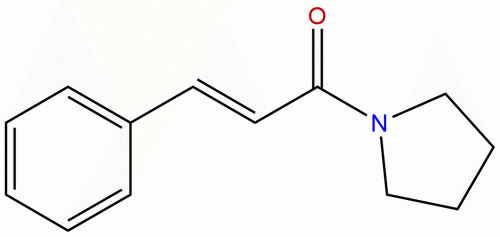
The molecular formula of 1-cinnamoylpyrrolidine is C13H15NO, with a molecular weight of 201.27. Its structure consists of a pyrrolidine ring and a cinnamoyl group connected by a nitrogen atom, exhibiting typical amide bond characteristics. This structure contains both aromatic conjugated systems and pyrrolidine saturated ring structures, endowing it with good molecular stability and moderate polarity.
In terms of physicochemical properties, the LogP value of 1-cinnamoylpyrrolidine is about 2.05, indicating its moderate lipid solubility, which is beneficial for membrane penetration and bioavailability. The polar surface area (TPSA) is 32.7 Å ² and the number of hydrogen bond acceptors is 2, indicating its ability to form hydrogen bonds in intermolecular interactions. This compound has high blood-brain barrier penetration potential and has no hepatotoxicity, cardiotoxicity, hERG channel inhibition, or genotoxicity (Ames test negative), demonstrating good safety and pharmacological basis.
Cinnamyl pyrrolidine is mainly isolated from the crude extract of Piper caninum, a plant in the Piperaceae family. Piper plants are widely distributed in tropical and subtropical regions and have always been used as traditional medicinal herbs with rich bioactive ingredients. The extraction of this compound is usually carried out by using organic solvents such as methanol, ethanol, or ethyl acetate to leach the dried plant powder, followed by separation and purification techniques such as liquid-liquid distribution, column chromatography, and high-performance liquid chromatography (HPLC) to obtain the pure product.
The optimization of extraction process is crucial for improving the yield and purity of 1-cinnamoylpyrrolidine. In recent years, the application of modern extraction techniques such as ultrasound assisted extraction and microwave-assisted extraction is expected to further improve their extraction efficiency and environmental friendliness. In addition, the sustainability of plant sources and the stability of compounds are also important factors to consider during the preparation process.
Cinnamoyl pyrrolidine exhibits certain inhibitory effects on various bacteria and fungi. Its targets include key enzymes such as bacterial DNA gyrase (GYRA), cell wall synthase (FABI), and dihydrofolate reductase (DHFR), indicating that it may achieve antibacterial effects by interfering with bacterial DNA replication and cell wall synthesis. In addition, the effects on fungal related targets such as ERG11 and CYP51A1 suggest their potential for antifungal activity.
As a DNA strand breaker, 1-cinnamoylpyrrolidine can induce supercoil relaxation of plasmid pBR322 DNA in the presence of copper ions, suggesting that it may exert anti-tumor effects by mediating DNA damage. Its targets include DNA topoisomerases I (TOP1) and II (TOP2A), which play critical roles in DNA replication and transcription processes and are important targets for various anticancer drugs. In addition, the compound may affect the signaling pathways of tumor suppressor protein p53 (TP53) and nuclear factor kappa B (NFKB1), regulate cell apoptosis and inflammatory response, and further enhance its anti-cancer potential.
Cinnamyl pyrrolidine can effectively inhibit platelet aggregation induced by platelet activating factor (PAF), with an IC50 of approximately 37.3 μ M. Its main target is platelet activating factor receptor (PTAFR), and it may also affect key factors such as platelet glycoprotein IIb/IIIa complex (ITGA2B/ITGB3) and thrombin (F2), blocking platelet aggregation and thrombus formation processes, with potential antithrombotic therapeutic value.
By inhibiting inflammation related targets such as platelet activating factor receptor (PTAFR), cyclooxygenase-2 (PTGS2), nuclear factor kappa B (NFKB1), and tumor necrosis factor alpha (TNF), 1-cinnamoylpyrrolidine exhibits significant anti-inflammatory effects. It may alleviate the inflammatory response by blocking the inflammatory signaling pathway, reducing the production and release of inflammatory mediators, and is suitable for the treatment of inflammatory diseases.
Although there is currently limited research on 1-cinnamoylpyrrolidine in neurodegenerative diseases, its excellent blood-brain barrier penetration and potential regulatory ability on neuropathological targets such as β - amyloid precursor protein lyase (BACE1) and tau protein (MAPT) suggest that its application prospects in neurodegenerative diseases such as Alzheimer's disease are worth further exploration.
The multi-target mechanism of action of 1-cinnamoylpyrrolidine is the basis of its multiple pharmacological activities. Its DNA strand breaking activity mainly relies on copper ion mediated oxidative stress response, which leads to relaxation and breakage of DNA supercoiled structure, interfering with the proliferation and survival of tumor cells. Inhibition of DNA topoisomerase further blocks DNA replication and transcription processes, inducing cell apoptosis.
In terms of antithrombotic and anti-inflammatory effects, 1-cinnamoylpyrrolidine inhibits PAF mediated signaling by competitively or non competitively binding to platelet activating factor receptors, reducing platelet aggregation and inflammatory mediator release. In addition, the inhibitory effect on cyclooxygenase-2 and nuclear factor kappa B reduces the expression of prostaglandins and pro-inflammatory cytokines, alleviating inflammatory reactions.
Its antibacterial effect involves inhibiting key bacterial enzymes, blocking bacterial DNA replication, cell wall synthesis, and metabolic processes, and inhibiting bacterial growth and reproduction. The effect on fungal targets may be achieved by interfering with the sterol biosynthesis pathway and disrupting the integrity of fungal cell membranes.
The molecular weight of 1-cinnamoylpyrrolidine is moderate (201.27 Da), meeting the requirements of Lipinski's five rules. The LogP value is 2.05, indicating that it has good lipid solubility, which is conducive to oral absorption and cell membrane penetration. The TPSA is 32.7 Å ², far below the blood-brain barrier penetration threshold of 140 Å ². Combined with its high blood-brain barrier permeability, it demonstrates its potential for application in central nervous system diseases.
In terms of safety, the compound has no hepatotoxicity, cardiotoxicity, or hERG channel inhibition, and the Ames test is negative, indicating a low risk of genetic toxicity and a good safety foundation. Preliminary pharmacokinetic studies have shown that it has moderate bioavailability and in vivo stability, but specific absorption, distribution, metabolism, and excretion (ADME) characteristics still require further systematic research.
Based on its multi-target and multi effect pharmacological properties, 1-cinnamoylpyrrolidine has shown broad application prospects in the fields of anti-cancer, antithrombotic, antibacterial, and anti-inflammatory. Especially in tumor treatment, its dual mechanism of action as a DNA strand breaker and topoisomerase inhibitor makes it a promising candidate molecule for novel anticancer drugs.
In addition, its inhibitory effect on platelet activating factor receptors provides new ideas for the prevention and treatment of thrombotic diseases. Anti inflammatory activity provides potential options for the treatment of chronic inflammatory diseases. Given its excellent blood-brain barrier penetration, future research in the field of neurodegenerative diseases is also worth focusing on.
However, preclinical and clinical research on 1-cinnamoylpyrrolidine is still in its infancy. In the future, it is necessary to strengthen systematic research on its pharmacokinetics, toxicology, and pharmacodynamics, optimize its structure to improve activity and selectivity, develop suitable drug delivery formulations, and conduct relevant clinical trials to verify its safety and effectiveness.
1-Cinnamyl pyrrolidine, as a natural product derived from Piper caninum, has demonstrated extensive potential for drug development due to its unique chemical structure and diverse pharmacological activities. Its multi-target mechanism of action in multiple fields such as anti-cancer, antithrombotic, antibacterial, and anti-inflammatory provides a valuable example for the pharmacological research of natural products. In the future, through in-depth mechanism research and preclinical evaluation, it is expected to promote its translation into clinical applications and become a new generation of natural drug candidate molecules with multiple therapeutic functions.
