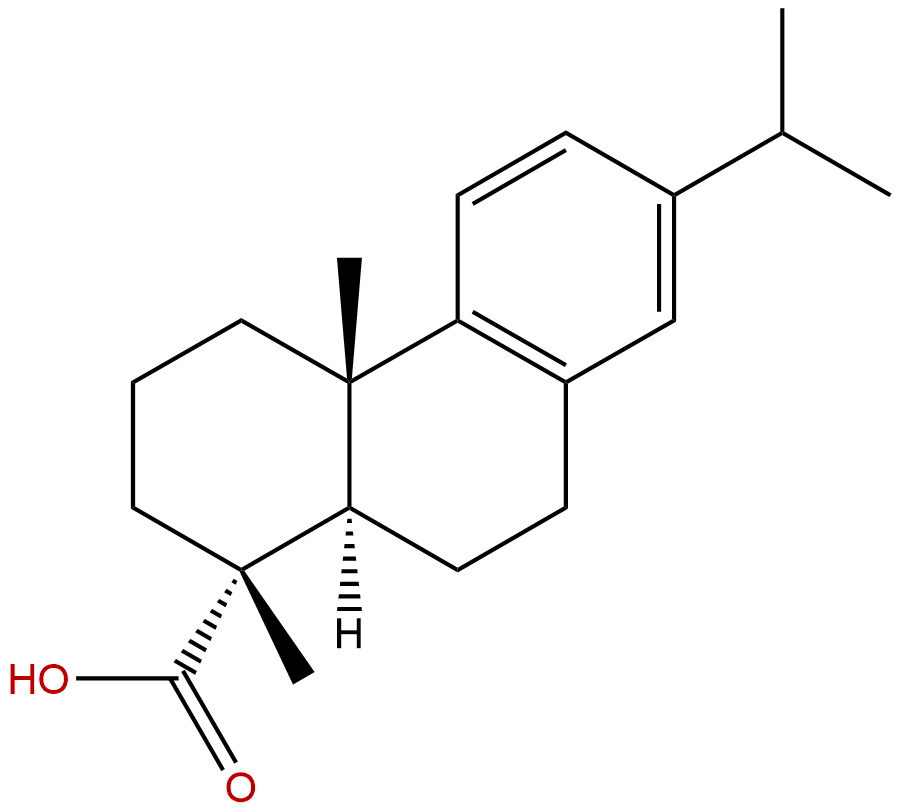


Product name: Dehydroabietic acid
Synonym name:
Catalogue No.: BP3111
Cas No.: 1740-19-8
Formula: C20H28O2
Mol Weight: 300.442
Botanical Source:
Physical Description: Powder
Type of Compound: Diterpenoids
Purity: 95%~99%
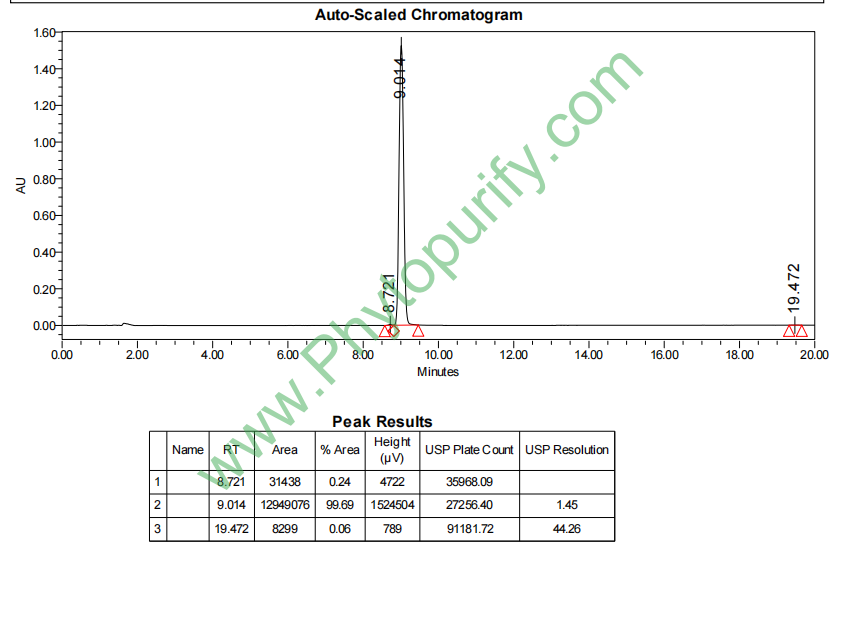
Analysis Method: HPLC-DAD or/and HPLC-ELSD
Identification Method: Mass, NMR
Packing: Brown vial or HDPE plastic bottle
Storage: Store in a well closed container, protected from air and light. Put into refrigerate or freeze for long term storage.
Whenever possible, you should prepare and use solutions on the same day. However, if you need to make up stock solutions in advance, we recommend that you store the solution as aliquots in tightly sealed vials at -20℃. Generally, these will be useable for up to two weeks.
The product could be supplied from milligrams to grams, up to kilograms
Inquire for bulk scale.
Descriptions:
Dehydroabietic acid (DHAA), a major poison to fishes in pulp and paper mill effluents, has toxicological and physiological effects, 20 μg l?1 is close to the “minimum effective concentration” of DHAA to rainbow trout.[1]
Dehydroabietic acid derivatives have been reported to display antisecretory and antipepsin effect in animal models, have gastroprotective activity in the HCl/EtOH-induced gastric lesions in mice as well as for cytotoxicity in human lung fibroblasts (MRC-5) and human epithelial gastric (AGS) cells. [2]
Dehydroabietic acid derivatives have antiulcer activity.[3]
References:
[1] Oikari A, L?nn B E, Castrén M, et al. Water Res, 1983, 17(1):81-9.
[2] Sepúlveda B, Astudillo L, Rodríguez J A, et al. Pharmacol Res, 2005, 52(5):429-37.
[3] Wada H, Kodato S, Kawamori M, et al. Chem Pharm Bull, 1985, 33(4):1472-87.
[4] K. Hroboňová, Dr. J. Lehotay, I. Ska?áni, et al. J Liq Chromatogr R T, 2005, 28(11):1725-35.
HPLC of Dehydroabietic acid
Storage conditions:Short-term storage at 2~8℃, long-term storage at -20 ~ -80℃
37.3000
5.2575
3.3754
.0035
7.3952
31.6559
Low
96.0361
3.4304
No
No
No
No
No
Yes
0.0
No
No
No
No
As an important treasure trove for drug discovery and development, natural products continue to provide modern medicine with lead compounds with novel structures and diverse activities. Among them, diterpenes have attracted much attention due to their complex chemical structures and extensive biological activities. Dehydroabietic acid (DAA, CAS: 1740-19-8), as a typical abietic acid type tricyclic diterpenoid resin acid, is widely present in the resin of Pinaceae plants such as Pinus and Picea. For a long time, rosin and its derivatives have been widely used in traditional medicine and industry, and DAA, as one of its main active ingredients, has gradually revealed its systematic pharmacological research value in recent years. Modern pharmacological research has shown that DAA exhibits multiple biological activities, including antibacterial, antifungal, anti-inflammatory, anticancer, and metabolic regulation, with remarkable potential in its anti-inflammatory and metabolic disease intervention. This article aims to systematically review the chemical properties, plant sources, pharmacological activities, mechanisms of action, medicinal properties, and clinical application prospects of DAA, in order to provide comprehensive scientific references for the deep development and utilization of this natural product.
The chemical name of dehydroabietic acid is (1R, 4aR, 4bR, 10aR) -7-isopropyl-1,4a-dimethyl-1,2,3,4,4a, 4b, 5,6,10,10adecahydrophenanthrene-1-carboxylic acid, with a molecular formula of C20H28O2 and a molecular weight of 300.4420. Its core structure is a highly hydrophobic tricyclic phenanthrene skeleton (A, B, C rings), where the C ring is an aromatic ring, the C-13 position is connected to an isopropyl group, and the C-4 position (one of the dimethyl groups) is connected to a carboxyl group. This rigid aromatic tricyclic structure endows DAA with significant hydrophobicity, and its calculated lipid water partition coefficient (LogP) is as high as 5.2575, indicating its extremely strong lipid solubility. Its topological polar surface area (TPSA) is only 37.3 Å ², further confirming its low molecular polarity. These physicochemical properties directly determine the extremely low water solubility of DAA (about 0.0035 mg/mL), which poses a challenge for its formulation development. In the parameters related to drug properties, the blood-brain barrier permeability of DAA is predicted to be low, which seems contradictory to its high LogP value, possibly due to its large molecular weight and the presence of carboxyl groups, which limit its passive diffusion ability. It is worth noting that the preliminary toxicity prediction shows no significant risk of hERG channel inhibition (low risk of QT interval prolongation), and the Ames test prediction value is 0.0, suggesting that it may not have direct genetic toxicity, providing preliminary positive signals for its safety evaluation.
DAA mainly comes from the resin of pine trees, namely pine resin. Pine resin is a defensive substance secreted by coniferous trees such as pine trees after injury. Its main component is resin acid (about 90%), of which abietic acid and its isomers are the main components. DAA is an important derivative of abietic acid formed by dehydrogenation during storage or processing, and is therefore abundant in natural rosin and rosin processed from it. Common source tree species include Pinus massoniana, Pinus elliottii, Picea spp.
The extraction of DAA from plant materials usually follows the following process: first, collect pine resin or rosin, and use organic solvents (such as ethanol, acetone, ethyl acetate) for leaching or reflux extraction to obtain crude extract. Due to the complex composition of rosin, further purification using chromatographic separation techniques is required. The conventional method includes silica gel column chromatography, with different ratios of petroleum ether ethyl acetate or n-hexane ethyl acetate gradient elution, to separate DAA based on polarity differences. High performance liquid chromatography (HPLC), especially preparative HPLC, is a key step in obtaining high-purity DAA (often requiring>98% purity for pharmacological research), often using a reverse phase C18 column with methanol water or acetonitrile water (often containing small amounts of formic acid or acetic acid) as the mobile phase. In addition, DAA can be selectively prepared by chemical oxidation or catalytic dehydrogenation of extracts rich in rosin acid. The optimization of extraction process aims to improve the yield and purity of DAA, while balancing economy and environmental friendliness.
Numerous in vitro and in vivo studies have confirmed that DAA has broad and significant pharmacological activities.
1. Antibacterial and antifungal activity DAA exhibits inhibitory activity against various Gram positive bacteria (such as Staphylococcus aureus, Bacillus subtilis), some Gram negative bacteria (such as Escherichia coli), and fungi (such as Candida albicans). The mechanism may be related to the disruption of microbial cell membrane integrity, and its hydrophobic structure is prone to insertion into lipid bilayers.
2. anti-inflammatory activity This is one of the most extensively studied activities of DAA. DAA has shown good anti-inflammatory effects in various acute and chronic inflammation models. For example, in mouse paw edema and peritonitis models induced by carrageenan or lipopolysaccharide (LPS), DAA can significantly reduce tissue swelling and decrease inflammatory cell infiltration. Its anti-inflammatory effect is closely related to the inhibition of the production of key pro-inflammatory mediators.
3. anticancer activity Research shows that DAA can inhibit the proliferation and induce apoptosis of many human cancer cell lines, including breast cancer, liver cancer, colon cancer, lung cancer, etc. Its anti-cancer mechanism involves cell cycle arrest, activation of mitochondrial apoptosis pathway, and increased generation of reactive oxygen species (ROS).
4. Metabolic regulatory activity The highlight of recent research is the improvement effect of DAA on metabolic diseases. In the mouse model of obesity, insulin resistance (IR) and liver steatosis induced by high-fat diet (HFD), DAA administration can effectively reduce blood sugar, improve insulin sensitivity, reduce liver lipid accumulation and steatosis, showing the potential to treat type 2 diabetes and non-alcoholic fatty liver disease (NAFLD).
The multiple pharmacological activities of DAA stem from its regulation of multiple signaling pathways within cells, and its mechanism of action is complex and has multi-target characteristics.
1. Core targets and pathways of anti-inflammatory effects In the context of inflammatory diseases such as arthritis, the research on the anti-inflammatory mechanism of DAA is relatively systematic. It mainly exerts its core anti-inflammatory effect by inhibiting the nuclear factor kappa B (NF - κ B) signaling pathway. DAA can inhibit the phosphorylation and degradation of I κ B α, prevent the nuclear translocation of NF - κ B (such as p65 subunit), and thus at the transcriptional level Downregulate the expression of a series of pro-inflammatory factors and mediators, including:
* Tumor necrosis factor alpha (TNF - α)Key initiating factors of inflammatory cascade reactions.
* Interleukin-6 (IL-6, IL-1 β)Important pro-inflammatory cytokines.
* Cyclooxygenase-2 (COX-2, encoded by the PTGS2 gene)The key enzyme that catalyzes prostaglandin synthesis is an important mediator of inflammation and pain.
* Matrix metalloproteinases (MMP-3, MMP-13)Participate in extracellular matrix degradation and play a key role in cartilage destruction in arthritis.
By synergistically inhibiting these key targets, DAA can effectively block the amplification and persistence of inflammation, and alleviate tissue damage.
2. Key targets of metabolic regulation The important mechanism by which DAA improves insulin resistance and hepatic steatosis lies in its Activate peroxisome proliferator activated receptor (PPAR)Research has shown that DAA is a dual agonist of PPAR - α and PPAR - γ, and a partial agonist of PPAR - γ. PPAR - γ is a core nuclear receptor that regulates adipocyte differentiation and glucose and lipid metabolism. Although complete agonists (such as thiazolidinedione drugs) can improve insulin sensitivity, they are accompanied by side effects such as weight gain. DAA, as a partial agonist, may exert insulin sensitizing effects in a safer way. Meanwhile, activation of PPAR - α can promote hepatic fatty acid β - oxidation, reduce lipid synthesis, and alleviate hepatic steatosis. This dual regulatory effect on PPAR - α/γ gives DAA a unique advantage in the treatment of metabolic syndrome.
3. Other potential mechanisms The antibacterial activity of DAA may involve physical disruption of microbial membranes; Its anti-cancer activity is related to regulating the Bcl-2/Bax ratio, activating the caspase cascade reaction, and regulating survival signaling pathways such as PI3K/Akt.
Although DAA has a wide range of pharmacological activities, there are significant challenges and opportunities for drug liking.
challenge:
1. Solubility and permeability The extremely high LogP value and low water solubility are the main obstacles to its oral administration, which may lead to poor absorption and low bioavailability. Its large molecular weight and the presence of carboxyl groups also limit its passive transmembrane transport ability.
2. Pharmacokinetic properties At present, there are insufficient reports on pharmacokinetic studies of DAA systems, such as absorption, distribution, metabolism, excretion, and ADME. Limited animal studies suggest that its oral absorption may be limited and it may undergo extensive metabolism in the body, such as glucuronidation of carboxyl groups and hydroxylation of aromatic rings. Its low blood-brain barrier permeability limits its direct application in central nervous system diseases, but it may also reduce the risk of central side effects.
Opportunities and Optimization Strategies:
1. Preliminary safety signal is good The lack of hERG inhibition and Ames mutagenicity prediction has laid the foundation for its safety development, but comprehensive preclinical toxicology experiments are still needed for verification.
2. Structural modification and prodrug development The most effective strategy for addressing its poor water solubility is to carry out chemical structural modification. For example, making its carboxyl group into salts (such as sodium salt, meglumine salt) can improve its water solubility; Or synthesize ester and amide prodrugs to improve their lipid solubility and absorption characteristics, and then hydrolyze them into active parent DAA in vivo.
3. New drug delivery system Using nanotechnology, such as preparing liposomes, nanoemulsions, polymer micelles, or solid dispersions, encapsulating or embedding DAA can significantly improve its solubility, stability, targeting, and oral bioavailability.
4. Pharmacokinetic study In the future, it is necessary to conduct in-depth ADME research on DAA in animals and humans, clarify its drug time curve, tissue distribution, main metabolites, and excretion pathways, and provide a basis for dosage form design and administration plan formulation.
Based on its solid pharmacological activity foundation and multi-target mechanism of action, DAA has shown broad prospects in translational medicine in multiple therapeutic fields.
1. Inflammatory diseases As:Potential therapeutic drugs for arthritis, especially rheumatoid arthritis and osteoarthritis This is the most direct application direction of DAA. By inhibiting the NF - κ B pathway, it downregulates the expression of TNF - α, IL-6, IL-1 β, COX-2, and MMPs in multiple targets, precisely covering key inflammatory mediators and destructive enzymes in the pathological process of arthritis. It is expected to achieve anti-inflammatory, analgesic, and cartilage protective effects simultaneously, which may be superior to single target drugs.
2. Metabolic diseases As:PPAR - α/γ dual agonist/partial agonist, DAA for treatment Type 2 diabetes, insulin resistance and nonalcoholic fatty liver disease/nonalcoholic steatohepatitis (NAFLD/NASH) New candidate molecules have been provided. The partial activation of PPAR - γ may avoid side effects such as weight gain and edema caused by traditional thiazolidinedione drugs, while the synergistic effect with PPAR - α activation is more conducive to comprehensively improving glucose and lipid metabolism disorders.
3. infectious diseases Its inherent antibacterial and antifungal activity, especially against certain drug-resistant strains, gives it the potential to be developed New antibacterial agents or antibacterial adjuvants Especially in the field of topical preparations (such as skin infections, oral care products).
4. Antitumor adjuvant therapy Its anti-cancer activity provides lead compounds for the development of new anti-tumor drugs, or can be used as sensitizers and adjuvant drugs for chemotherapy.
Future research directions and challenges:
* In depth mechanism research Further clarification is needed on the specific mode and structure-activity relationship of DAA binding to nuclear receptors such as PPAR, as well as the key upstream and downstream nodes in its anti-inflammatory and anticancer signaling network.
* Optimization of drug properties in the system It is necessary to focus on solving its water solubility and bioavailability issues, and achieve breakthroughs through prodrug strategies or nano delivery systems.
* Comprehensive preclinical evaluation On the basis of optimizing compounds or dosage forms, complete standardized pharmacological, pharmacokinetic, and safety evaluations (GLP toxicology studies) to provide data support for clinical trial applications (IND).
* Explore combination therapy Consider combining DAA with existing drugs such as methotrexate, metformin, etc., which may result in a synergistic effect, reducing their respective dosages and side effects.
Dihydroabietic acid, as a naturally occurring diterpenoid compound with abundant sources and unique structures, exhibits clear mechanisms and good effects in anti-inflammatory and metabolic regulation due to its multi-target and multi pathway pharmacological modes of action, making it a highly valuable lead molecule for development. Despite the challenges posed by its inherent physicochemical properties, such as low water solubility, modern medicinal chemistry and pharmaceutical technologies, such as structural modification and nano delivery, provide powerful tools to address these issues. Future research should focus on overcoming its pharmaceutical shortcomings through technological means and conducting systematic preclinical and clinical studies, fully tapping into its therapeutic potential in treating major chronic diseases such as arthritis and metabolic syndrome, promoting the transformation of this ancient natural product into modern innovative drugs, and contributing to human health.
