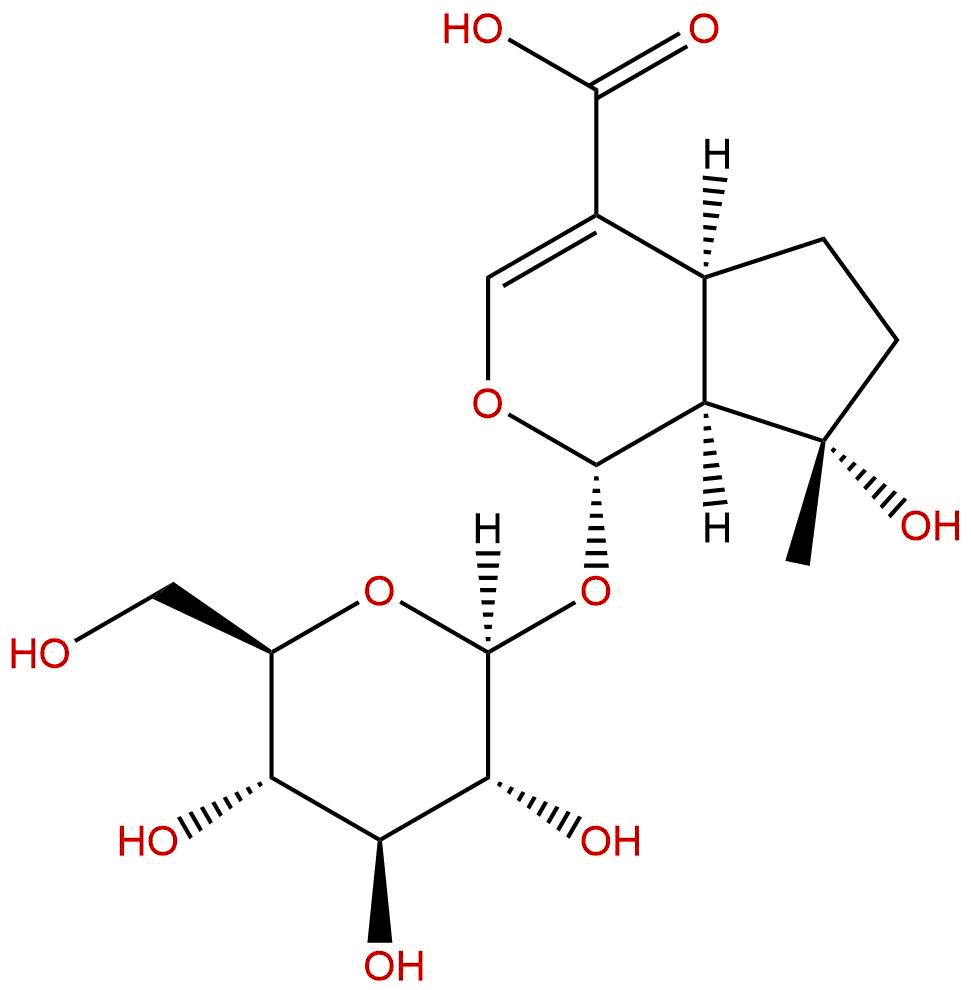


Product name: Mussaenosidic acid
Synonym name:
Catalogue No.: BP4748
Cas No.: 82451-22-7
Formula: C16H24O10
Mol Weight: 376.358
Botanical Source:
Type of Compound: Iridoids
Purity: 95%~99%
Analysis Method: HPLC-DAD or/and HPLC-ELSD
Identification Method: Mass, NMR
Packing: Brown vial or HDPE plastic bottle
Storage: Store in a well closed container, protected from air and light. Put into refrigerate or freeze for long term storage.
Whenever possible, you should prepare and use solutions on the same day. However, if you need to make up stock solutions in advance, we recommend that you store the solution as aliquots in tightly sealed vials at -20℃. Generally, these will be useable for up to two weeks.
The product could be supplied from milligrams to grams
Inquire for bulk scale.
For Reference Standard and R&D, Not for Human Use Directly.
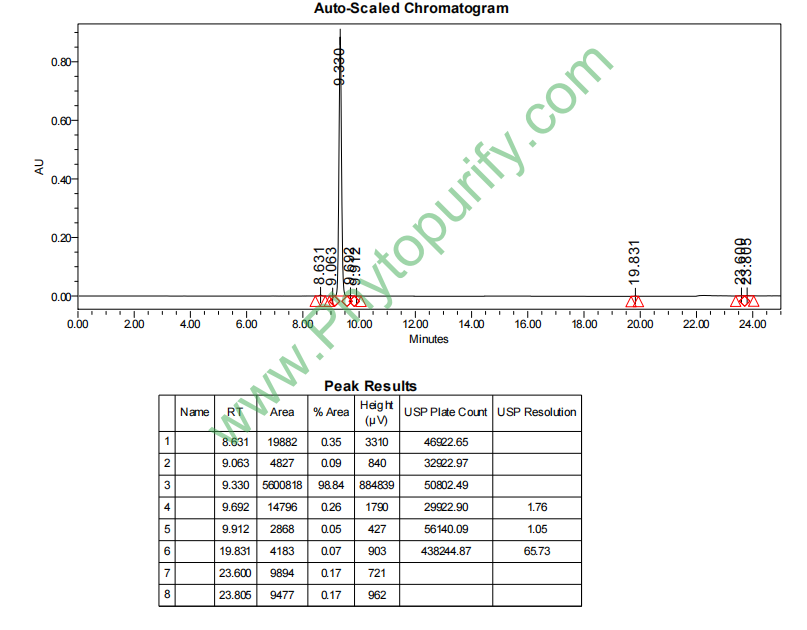
HPLC of Mussaenosidic acid
Storage conditions:Short-term storage at 2~8℃, long-term storage at -20 ~ -80℃
Natural products, as important resources for drug development, have attracted much attention due to their structural diversity and biological activity. Mussaenosidic acid, as an active ingredient isolated from Pedicularis kneri Dalla Torre, has gradually attracted the interest of the pharmacological community in recent years. Although this compound exhibits weak anti glycation activity, its potential in various biological functions such as anti-inflammatory provides a theoretical basis for further research. This article aims to systematically review the chemical structure, physicochemical properties, plant sources, extraction methods, pharmacological activities, and mechanisms of action of jasmonic acid from Polygonatum sibiricum. Combined with drug evaluation, it explores the possibility and development prospects of its future clinical applications.
The chemical structure of yuyejinhua glycoside acid is a natural product with glycosidic bond connections, with a molecular weight of 376.3580. The molecular formula and specific structural characteristics show that it contains multiple polar groups, giving it high polarity and water solubility. Its LogP value is -1.3558, indicating that the compound has strong hydrophilicity and is difficult to diffuse freely through lipid membranes. The topological polar surface area (TPSA) is 166.1400, further confirming its high polarity, which has important implications for its bioavailability and pharmacokinetic behavior. The water solubility is 29.2299, indicating good solubility in aqueous phase, which is beneficial for absorption and distribution in vivo. The low permeability of the blood-brain barrier suggests that its role in the central nervous system may be limited. The hERG channel inhibition experiment result was negative, indicating that the compound has a low risk of cardiac toxicity. The Ames mutagenicity test result is 0.0, indicating that its genetic toxicity risk is relatively low and has a good safety basis.
The main source of yuye jinhua acid is Pedicularis kneri Dalla Torre, which belongs to the Scrophulariaceae family and is widely distributed in specific geographical areas. Traditionally, Daratorelma sagebrush has been used as a folk herb to treat various inflammatory diseases. The roots, stems, and leaves of this plant contain abundant active ingredients, among which jasmonic acid, as one of the key components, has high extraction value.
The extraction method usually uses solvent extraction combined with chromatographic separation technology. Common solvents include mixed solutions of methanol, ethanol, and water to ensure the complete extraction of polar components. The extraction process generally involves drying and crushing plant materials, using ultrasound assisted extraction or reflux extraction, followed by liquid-liquid distribution to remove non-polar impurities, and finally purification using high-performance liquid chromatography (HPLC). The purified Yuyejinhua glycoside acid was confirmed for its structure by mass spectrometry (MS), nuclear magnetic resonance (NMR) and other methods, ensuring the purity of the extract and accurate identification of the active ingredients.
The pharmacological activity research of Yu Ye Jin Hua glycoside acid mainly focuses on anti-inflammatory and anti glycation aspects. Although its anti glycation activity is weak, it shows certain potential in inflammation regulation.
Inflammation is the common pathological basis of various diseases, and key molecular targets regulating inflammatory responses include IL-6, TNF, STAT3, NFKB1, etc. Yuyejinhua glycoside acid has shown a regulatory effect on the above-mentioned inflammatory factors in an in vitro cell model, which can downregulate the expression of pro-inflammatory cytokines and inhibit the activation of inflammatory signaling pathways. For example, quercetin can inhibit the release of IL-6 and TNF - α, block the phosphorylation of STAT3 signaling pathway, weaken the nuclear translocation of NFKB1, and thus reduce the intensity of inflammatory response. In addition, the inhibitory effect of jasmonic acid on inflammation related enzymes such as PTGS1 and PTGS2 (cyclooxygenase 1 and 2) has also been reported, suggesting its potential application value in the mechanism of nonsteroidal anti-inflammatory drugs (NSAIDs).
Glycosylation is a non enzymatic reaction of protein and sugar to produce advanced glycation end products (AGEs), which is closely related to diabetes and its complications. Yuyejinhua glycoside acid exhibits weak anti glycation activity, which may slow down the accumulation of AGEs by scavenging reactive oxygen species or inhibiting the formation of glycation intermediates, and has a certain protective effect.
Some studies have also indicated that jasmonic acid has a regulatory effect on TRPV1 and TRPA1 ion channels, which play important roles in pain and inflammatory responses. By regulating these targets, jasmonic acid may play an auxiliary role in pain relief and neuroinflammation treatment. In addition, the expression regulation of NOS2 (inducible nitric oxide synthase) also provides a new perspective on its anti-inflammatory mechanism.
The biological activity of jasmonic acid is mainly achieved through multi-target and multi pathway synergistic effects. Its anti-inflammatory mechanism involves multiple key molecular targets:
Overall, the synergistic regulation of inflammation related signaling pathways by multiple targets by Yuyejinhua glycoside acid provides a theoretical basis for its anti-inflammatory effects and development as a novel anti-inflammatory drug.
The evaluation of drug properties is an important step in the development of natural product drugs. The physicochemical properties of Yuyejinhua glycoside acid show good water solubility, but its strong hydrophilicity and large polar surface area may limit its oral bioavailability. Low blood-brain barrier permeability suggests limited application in the central nervous system, but it also reduces the risk of central nervous system toxicity.
The hERG channel inhibition experiment was negative, indicating a low risk of cardiac toxicity and good safety. The Ames test showed no mutagenicity, further supporting its safety. Although there is currently a lack of systematic pharmacokinetic (PK) data, based on its structural characteristics, it is speculated that its metabolism in vivo may mainly be carried out through the liver enzyme system, with renal excretion being the main pathway.
Future research needs to focus on its absorption, distribution, metabolism, and excretion (ADME) characteristics, optimize administration routes and dosage forms, improve bioavailability, and evaluate its pharmacological (PD) performance in vivo.
As a natural product, yuye jinhua glycoside acid has multi-target anti-inflammatory activity and good safety, and has certain clinical development potential. Its anti-inflammatory effect is applicable to various chronic inflammatory diseases, such as rheumatoid arthritis, inflammatory bowel disease, and certain neuroinflammatory states. In addition, the regulation of TRPV1 and TRPA1 channels provides the possibility for their application in pain management.
However, current research is mostly focused on in vitro and animal models, lacking systematic preclinical and clinical research data. In the future, in-depth pharmacological and toxicological research is needed to clarify its mechanism of action and treatment window, optimize formulation design, and conduct clinical trials to verify its efficacy and safety.
In addition, although its anti glycosylation activity is weak, combined with the synergistic effect of other natural products, it is expected to develop compound preparations for the adjuvant treatment of diabetes and its complications.
As an important active ingredient in Artemisia scoparia, yuye jinhua acid exhibits multi-target anti-inflammatory activity and good safety characteristics. Its unique chemical structure and physicochemical properties provide the basis for its pharmacological effects. Although its anti glycation activity is weak, it has potential application value in inflammation regulation and pain management. In the future, it is necessary to strengthen its pharmacokinetic research and preclinical evaluation, and promote its translation into clinical applications. Overall, as a candidate molecule for natural product drug development, yuye jinhua glycoside acid has broad development prospects and application potential.
