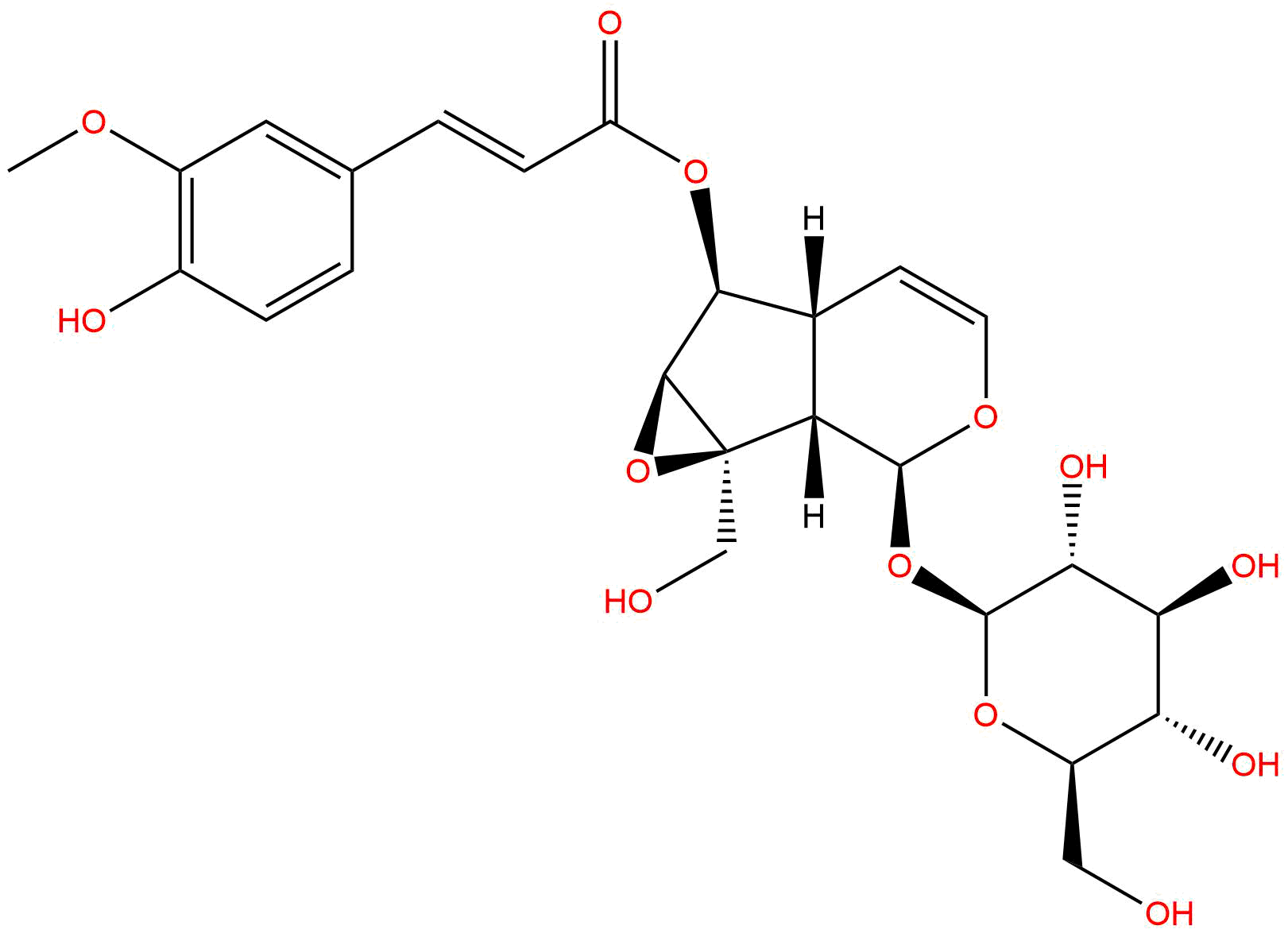


Product name: 6-Feruloylcatalpol
Synonym name:
Catalogue No.: SBP01656
Cas No.: 770721-33-0
Formula: C25H30O13
Mol Weight: 538.502
Botanical Source:
Physical Description: Powder
Type of Compound: Iridoids
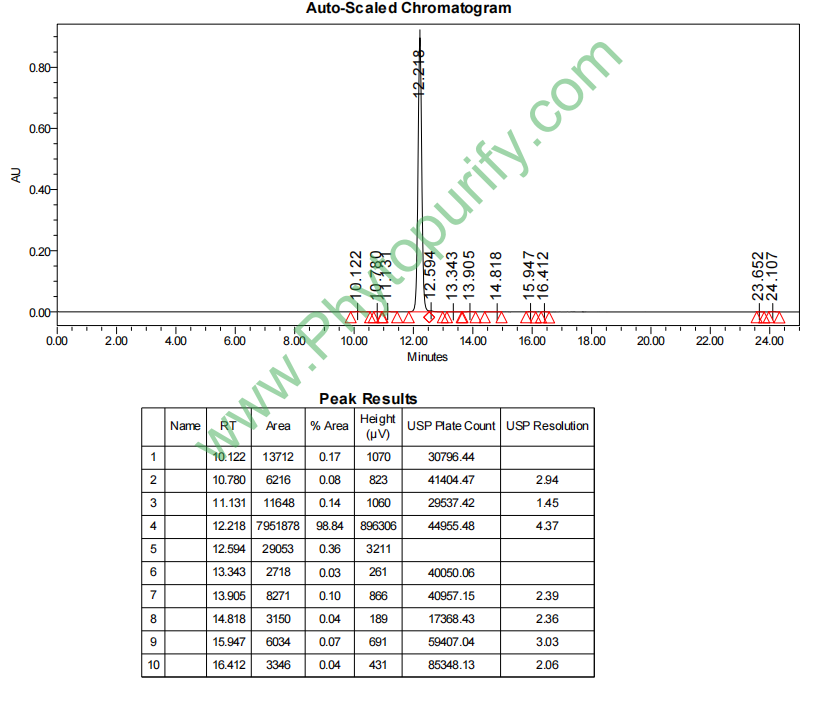
Purity: 95%~99%
Analysis Method: HPLC-DAD or/and HPLC-ELSD
Identification Method: Mass, NMR
Packing: Brown vial or HDPE plastic bottle
The product could be supplied from milligrams to grams. Inquire for bulk scale.
We provide solution to improve the water-solubility of compounds, thereby facilitating the variety of activity tests and clinic uses.
For Reference Standard and R&D, Not for Human Use Directly.
HPLC of 6-Feruloylcatalpol
Storage conditions:Short-term storage at 2~8℃, long-term storage at -20 ~ -80℃
6-Feruloylcatapol (CAS number: 770721-33-0) is a naturally occurring hydroxycinnamic acid derivative, belonging to ester natural products. Due to its unique chemical structure and diverse biological activities, it has received widespread attention in the field of natural product pharmacology in recent years. As a metabolite, 6-feruloyl catalpol exists in various plants, especially in traditional Chinese medicinal materials, showing significant pharmacological potential. Its role in the field of immune regulation is particularly prominent, involving multiple key signaling pathways and molecular targets such as TLR4, STAT3, NFKB1, etc., demonstrating the potential to regulate immune response, anti-inflammatory, and immune tolerance.
This article aims to provide a systematic review of the chemical structure and physicochemical properties, plant sources and extraction methods, pharmacological activity and mechanism of action, pharmacological evaluation, and clinical application prospects of 6-feruloyl catalpol, aiming to provide comprehensive and in-depth reference materials for researchers in related fields and promote the further development and application of this natural product.
6-Ferulic acid catalpol is a complex formed by ester bonding between ferulic acid and catalpol, with a molecular formula of C27H34O12 and a molecular weight of 538.5020. Its structural characteristics include a hydroxycinnamic acid group (ferulic acid) connected to a polyhydroxy cyclic glycoside (catalpol), endowing it with abundant hydroxyl and phenolic hydroxyl functional groups, resulting in strong polarity.
In terms of physicochemical properties, the LogP value of 6-feruloyl catalpol is -0.1022, indicating its strong hydrophilicity and good water solubility (3.8664), which is beneficial for its dissolution and distribution in vivo. Its topological polar surface area (TPSA) is 197.13 Å ², and higher TPSA is usually related to molecular polarity and hydrogen bonding ability, suggesting that it may have certain limitations in cell membrane permeability. The low penetration ability of the blood-brain barrier indicates its limited distribution in the central nervous system. The hERG channel inhibition experiment showed a negative result, indicating a low risk of cardiac toxicity. The Ames mutagenicity test result is 0.0, indicating a low risk of genetic toxicity.
In summary, 6-feruloyl catalpol has good water solubility and safety characteristics, but its high polarity and low lipid solubility may limit its oral bioavailability and cell membrane penetration ability, providing direction for subsequent pharmacokinetic optimization.
6-Feruloyl catalpol is mainly found in various traditional Chinese medicine plants, especially those containing abundant catalpol derivatives and cinnamic acid compounds. For example, it has been reported in plants of the Scrophulariaceae family, catalpa alcohol plants, and certain medicinal plants with immune regulatory functions. Although its content is not high, it can be effectively extracted and purified through modern separation techniques.
Common extraction methods include:
Solvent extraction method
Using methanol, ethanol, or their aqueous solutions as extraction solvents, 6-feruloyl catalpol can be efficiently dissolved through reflux or ultrasound assisted extraction. Extraction conditions such as temperature, time, and solvent polarity have a significant impact on yield.
Liquid liquid distribution and column chromatography separation
After liquid-liquid distribution to remove lipophilic impurities, the extraction solution was separated and purified using a silica gel column, C18 reverse phase column, or high-performance liquid chromatography (HPLC) to obtain high-purity 6-feruloyl catalpol.
Modern extraction techniques
New technologies such as supercritical CO2 extraction and microwave-assisted extraction have shown advantages in improving extraction efficiency, reducing solvent usage, and protecting active ingredients, gradually becoming research hotspots for the extraction of 6-feruloyl catalpol.
In addition, the harvesting time, location, and growth environment of plants have a significant impact on the content of 6-feruloyl catalpol. Optimizing planting and harvesting conditions is the key to ensuring the quality of raw materials.
The pharmacological activity research of 6-feruloyl catalpol mainly focuses on immune regulation and anti-inflammatory effects. It exhibits potential therapeutic capabilities for autoimmune diseases, inflammatory diseases, and immune dysfunction by regulating immune responses through multiple targets and pathways.
6-Ferulic acid catalpol can regulate various immune cell functions, including T cells, B cells, and macrophages. In vitro experiments have shown that it can regulate cytokine expression, promote the expression of immune tolerance related factors such as FOXP3, inhibit the activity of pro-inflammatory factors such as NFKB1, and balance Th1/Th2 cell responses.
By inhibiting the TLR4 signaling pathway, 6-feruloyl catalpol reduces the release of pro-inflammatory cytokines such as IL2 and IFNG, alleviating the inflammatory response. In animal models, this compound exhibits the effect of reducing inflammatory tissue damage and lowering inflammatory indicators.
Some studies suggest that 6-feruloyl catalpol may have antioxidant, anti-tumor, and neuroprotective effects, but the relevant mechanisms still need further clarification.
The mechanism of action of 6-feruloyl catalpol involves multiple immune signaling pathways and key molecular targets, reflecting its multi-target regulatory characteristics.
TLR4, as an important receptor of innate immunity, mediates the initiation of inflammatory response. 6-Ferulic acid catalpol inhibits the activation of TLR4, blocks downstream MyD88 dependent signaling, reduces nuclear translocation of NFKB1, and lowers the expression of pro-inflammatory cytokines such as IL2 and IFNG, thereby alleviating the inflammatory response.
6-Ferulic acid catalpol regulates the activity of STAT3 and STAT4, affects cytokine signaling, and regulates the differentiation and function of immune cells. The inhibition of STAT3 helps to suppress inflammation and immune suppression in the tumor microenvironment, while the regulation of STAT4 affects the function of Th1 cells.
This compound promotes the expression of immunosuppressive factors such as CTLA4, IL10, and FOXP3, enhances regulatory T cell (Treg) function, maintains immune homeostasis, and prevents excessive immune response.
6-Feruloyl Azitol can regulate the expression of TGFB1, participate in immune tolerance and tissue repair processes, and promote tissue recovery after inflammation.
In summary, 6-feruloyl catalpol exhibits excellent immunomodulatory potential by modulating the balance of the immune system through multi-target synergistic effects.
Based on Lipinski's rule and other drug similarity indicators, 6-feruloyl catalpol has a high molecular weight (538.5 Da) and polarity (TPSA 197.13 Å ²), with a LogP close to zero, indicating good water solubility but poor lipid solubility, which may affect oral absorption and cell membrane penetration. It does not inhibit hERG channels, is genotoxic negative, and has high safety.
At present, there is limited research on the in vivo pharmacokinetics of 6-feruloyl catalpol. Based on its physicochemical properties, it is speculated that its oral bioavailability may be limited and its blood-brain barrier penetration ability may be low, suggesting that it mainly acts on the peripheral immune system.
The metabolic pathway may involve hydroxylation of liver enzymes, glucuronic acid binding, and other phase I and phase II metabolic reactions. The excretion pathway may be mainly through the kidneys.
In the future, systematic in vivo pharmacokinetic studies are needed, including absorption, distribution, metabolism, and excretion (ADME) characteristics, to guide formulation design and optimize dosing regimens.
As a natural product with significant immunomodulatory activity, 6-feruloyl catalpol has shown broad clinical application potential. Its application in autoimmune diseases, chronic inflammatory diseases, and immune dysfunction is particularly noteworthy.
By regulating Treg cells and inhibiting pro-inflammatory factors, 6-feruloyl catalpol may effectively alleviate the pathological processes of autoimmune diseases such as rheumatoid arthritis and multiple sclerosis.
Its anti-inflammatory effect by inhibiting the TLR4/NFKB1 pathway suggests its therapeutic potential in diseases such as inflammatory bowel disease and chronic obstructive pulmonary disease.
Promoting the expression of immune tolerance related factors may help control immune rejection in organ transplantation.
Although 6-feruloyl catalpol has good biological activity and safety, its high polarity and molecular weight limit its oral bioavailability. In the future, its pharmacokinetic performance can be improved through drug chemical modification, nanocarrier delivery systems, and other means.
In addition, the preclinical safety evaluation and clinical trial design of the system will be key to promoting its clinical application.
As a natural product with a unique structure and multi-target immunomodulatory activity, 6-feruloyl catalpol has shown broad pharmacological research and clinical application prospects. It exhibits anti-inflammatory and immunomodulatory potential by regulating key molecules such as TLR4, STAT3, NFKB1, and modulating immune responses. Despite the challenges in terms of drug efficacy, its safety is good, providing valuable natural molecular templates for the development of novel immunomodulatory drugs.
In the future, by combining modern drug design techniques and systematic pharmacokinetic studies, it is expected to promote the clinical translation of 6-feruloyl-quercetin and benefit patients with immune related diseases. Researchers should strengthen their in-depth analysis of its mechanism of action, optimize extraction and purification processes, conduct systematic preclinical and clinical studies, and fully explore its medicinal value.
