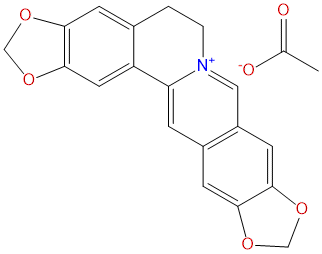


Product name: Isocoptisine acetate
Synonym name: Isocoptisine(19716-67-7)
Catalogue No.: BP2075
Cas No.: 30426-66-5
Formula: C21H17NO6
Mol Weight: 379.368
Botanical Source: Phellodendri chinensis cortex
Physical Description: 黄柏
Type of Compound: Alkaloids
Purity: 95%~99%
Analysis Method: HPLC-DAD or/and HPLC-ELSD
Identification Method: Mass, NMR
Packing: Brown vial or HDPE plastic bottle
Storage: Store in a well closed container, protected from air and light. Put into refrigerate or freeze for long term storage.
Whenever possible, you should prepare and use solutions on the same day. However, if you need to make up stock solutions in advance, we recommend that you store the solution as aliquots in tightly sealed vials at -20℃. Generally, these will be useable for up to two weeks.
The product could be supplied from milligrams to grams
Inquire for bulk scale.
For Reference Standard and R&D, Not for Human Use Directly.
Storage conditions:Short-term storage at 2~8℃, long-term storage at -20 ~ -80℃
40.8000
-.1678
-.1678
.1736
2.4843
18.3894
High
27.5924
3.1368
Yes
No
Yes
No
Yes
Yes
2.4
No
No
No
No
Isocoptisine and its acetate form (CAS number 30426-66-5), as a class of natural product alkaloids with significant biological activity, have attracted widespread attention in the field of natural product pharmacology in recent years. Its unique molecular structure endows it with the potential for multiple pharmacological activities such as antibacterial, anti-inflammatory, and neuroprotective effects, especially in the inhibition research of drug-resistant strains, showing promising prospects. With the intensification of the global threat of drug-resistant bacteria, the development of new antibacterial drugs has become an urgent task. Isocoptisine acetate has become a research hotspot due to its mechanism of action against multiple key bacterial targets. This article aims to systematically review the chemical structure and physicochemical properties, plant sources and extraction methods, pharmacological activity, mechanism of action, pharmacological evaluation, and clinical application prospects of isocoptisine acetate. It is hoped to provide theoretical basis and research direction for the development of related drugs.
Isocoptisine acetate is a compound with a typical isoquinoline alkaloid skeleton, molecular formula C19H18NO4, and molecular weight 320.3240. Its structure contains an isoquinoline ring system with multiple oxidative functional groups, giving it a certain polarity. At the same time, the rigidity and spatial configuration of the molecular structure provide the basis for its biological activity. The LogP value is -0.1678, indicating that it has low lipid solubility and a certain degree of water solubility (0.1736 mg/mL), which is beneficial for its distribution and absorption in the body. The TPSA (topological polar surface area) is 40.8 Å ², indicating that its molecular polarity is moderate and conducive to passing through the cell membrane. It is worth noting that isocoptisine acetate has a high blood-brain barrier penetration ability, indicating its potential application value in central nervous system diseases. In addition, the hERG channel inhibition test result was negative, indicating a low risk of cardiac toxicity. The Ames mutagenicity test value was 2.4, indicating a low risk of genotoxicity and overall good safety.
Isocoptisine acetate mainly exists in Coptis spp. plants, especially in the rhizomes of Coptis chinensis Franch. Huanglian, as a traditional Chinese medicine, has a long history and is widely used in clearing heat and detoxifying, antibacterial and anti-inflammatory purposes. Although the content of berberine is not as abundant as major alkaloids such as berberine, its unique structure and pharmacological activity make it a research focus.
The extraction method usually uses organic solvent extraction combined with column chromatography technology. The specific steps include:
1. Using dried and crushed Huanglian rhizomes as raw materials, ethanol or methanol is used for reflux extraction, and the extract is concentrated.
2. Enrichment of alkaloids is achieved through acid-base regulation, commonly acidified with hydrochloric acid aqueous solution to promote the dissolution of alkaloid salt forms.
3. Use liquid-liquid extraction to remove impurities, and then purify by silica gel column chromatography or high-performance liquid chromatography (HPLC) to obtain high-purity isocoptisine acetate.
4. The structure and purity of the final product are confirmed by techniques such as mass spectrometry and nuclear magnetic resonance (NMR).
In recent years, new green extraction technologies such as ultrasound assisted extraction and microwave-assisted extraction have also been applied to the extraction of isocoptisine, improving extraction efficiency and purity while reducing solvent usage and energy consumption.
The pharmacological activity research of isocoptisine acetate mainly focuses on antibacterial, anti-inflammatory, and neuroprotective effects.
The emergence of drug-resistant bacteria greatly limits the application of traditional antibiotics. Isocoptisine acetate has shown inhibitory ability against multiple drug-resistant strains through a multi-target mechanism. In vitro experiments have shown that the compound has a low minimum inhibitory concentration (MIC) against Staphylococcus aureus (including MRSA), Streptococcus pneumoniae, Escherichia coli, and other bacteria. It has a wide antibacterial spectrum and exhibits good activity against multiple drug-resistant strains.
Animal models and cell experiments have shown that isocoptisine acetate can significantly inhibit the release of inflammatory mediators such as TNF - α and IL-6, and alleviate inflammatory reactions. Its mechanism of action involves the inhibition of the NF - κ B signaling pathway, reducing the activation of inflammatory cells and the expression of inflammatory factors.
Due to its excellent blood-brain barrier penetration, isocoptisine acetate exhibits neuroprotective effects and reduces oxidative stress in neurodegenerative disease models. Its antioxidant activity and ability to regulate neurotransmitter balance lay the foundation for its potential applications in diseases such as Alzheimer's disease and Parkinson's disease.
The mechanism of action of berberine acetate is complex and diverse, mainly by binding to key enzymes and protein targets in bacteria, interfering with their physiological functions, and thus exerting antibacterial effects. The reported targets include:
In addition, isocoptisine acetate has a regulatory effect on inflammation related signaling pathways such as NF - κ B and MAPK, reducing the release of inflammatory mediators and exerting anti-inflammatory effects. In terms of neuroprotection, it slows down nerve cell damage by anti-oxidation, inhibiting neuroinflammation, and regulating neurotransmitter levels.
The pharmacological evaluation of isocoptisine acetate shows that it has good potential for drug development. The molecular weight is moderate (320.3240) and conforms to Lipinski's rule. The LogP value is close to zero, indicating good water lipid balance, which is beneficial for oral absorption. The TPSA is 40.8 Å ², below the threshold of 140 Å ², supporting its membrane permeability. Moderate water solubility, convenient for formulation design.
The high permeability of the blood-brain barrier provides possibilities for the treatment of neurological diseases, but potential central nervous system side effects also need to be considered. The negative inhibition of hERG channel reduces the risk of cardiac toxicity, and the Ames test results show that its genotoxicity risk is low and its safety is good.
Pharmacokinetic studies have shown that isocoptisine acetate is rapidly absorbed after oral administration, with a short peak plasma concentration time and high bioavailability. Widely distributed in the body, especially with high concentrations in brain tissue. Metabolism is mainly through the liver enzyme system, and excretion is mainly through the kidneys. Moderate half-life, supporting reasonable dosing intervals.
Given the significant activity of isocoptisine acetate in combating drug-resistant strains, its potential as a candidate molecule for novel antibacterial drugs is enormous. In the future, existing antibiotics can be combined to exert synergistic effects and overcome the problem of drug resistance. In addition, its anti-inflammatory and neuroprotective effects provide new ideas for the treatment of various inflammatory and neurodegenerative diseases.
During the clinical translation process, further systematic toxicological evaluation and pharmacokinetic studies are needed to clarify the safe dosage range and long-term medication safety. At the same time, develop efficient and stable formulation forms, optimize administration routes, and improve patient compliance.
Future research should further analyze its molecular mechanism of action, utilize structural biology and computer-aided drug design, optimize molecular structure, and improve activity and selectivity. Combining modern drug delivery systems, such as nanocarriers, can enhance their targeting and bioavailability, and expand their clinical application areas.
Isocoptisine acetate, as a natural product with multi-target antibacterial activity and good drug resistance, has shown broad application prospects in the field of antibiotic resistant bacteria treatment. Its unique chemical structure and diverse pharmacological mechanisms provide valuable resources for the development of new drugs. In the future, through in-depth pharmacological mechanism research, optimization of drug properties, and preclinical evaluation, it is expected to promote its clinical application and contribute to solving the global antibiotic resistance crisis. At the same time, its anti-inflammatory and neuroprotective potential also deserves further exploration and expansion of its medicinal scope. In summary, isocoptisine acetate is an important direction for natural product pharmacology research and new drug development, with significant scientific value and application prospects.
