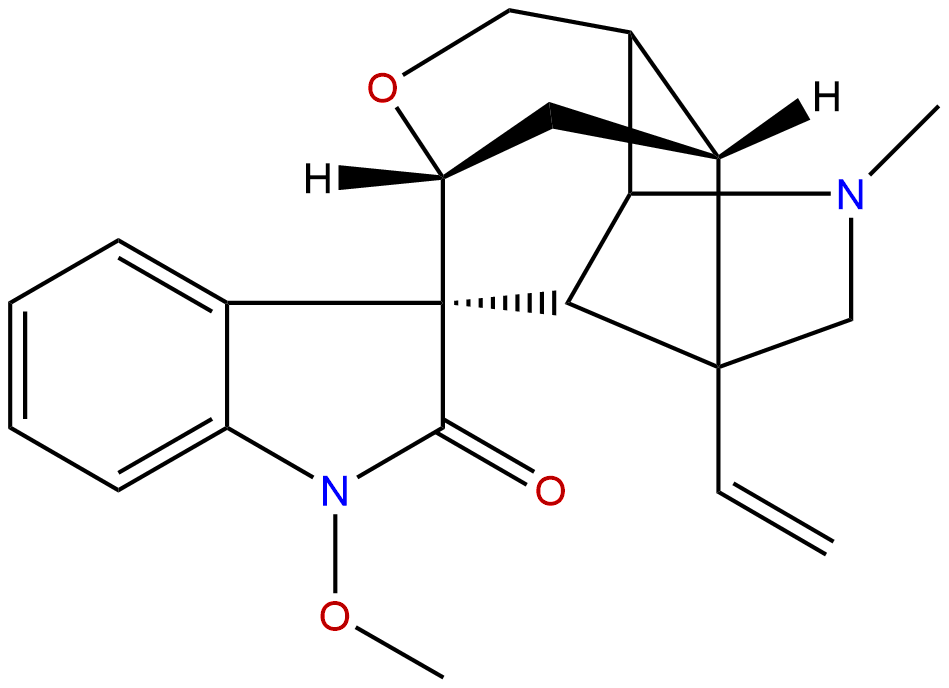


Product name: Gelsevirine
Synonym name:
Catalogue No.: SBP00064
Cas No.: 38990-03-3
Formula: C21H24N2O3
Mol Weight: 352.434
Botanical Source:
Physical Description: Powder
Type of Compound: Alkaloids
Purity: 95%~99%
Analysis Method: HPLC-DAD or/and HPLC-ELSD
Identification Method: Mass, NMR
Packing: Brown vial or HDPE plastic bottle
The product could be supplied from milligrams to grams. Inquire for bulk scale.
We provide solution to improve the water-solubility of compounds, thereby facilitating the variety of activity tests and clinic uses.
For Reference Standard and R&D, Not for Human Use Directly.
Storage conditions:Short-term storage at 2~8℃, long-term storage at -20 ~ -80℃
42.0100
2.1823
1.7431
.4720
4.8913
18.1214
High
66.7959
6.7133
No
Yes
Yes
Yes
Yes
No
1.2
Yes
No
Yes
Yes
Gelsevirine (CAS number: 38990-03-3) is one of the main alkaloids isolated from Gelsemium elegans, a plant in the genus Gelsemium. As a traditional Chinese medicinal herb, Gelsemium has always been highly regarded for its significant biological activity, especially its potential pharmacological effects in anti anxiety, analgesic, and anti-tumor aspects. Gelsemium green alkaloid, as an important active ingredient in this plant, has attracted widespread research interest in the field of natural product pharmacology in recent years. Its unique chemical structure and multi-target mechanism of action make it a novel candidate drug for studying anxiety disorders and related neurological and psychiatric disorders. In addition, Gelsemium green alkaloid exhibits certain anti proliferative activity against various tumor cells, providing a theoretical basis for its anti-tumor potential.
The purpose of this review is to systematically summarize the chemical structure, plant sources, extraction methods, pharmacological activities, and mechanisms of action of Gelsemium glaucum alkaloids, and to explore their prospects and challenges in clinical applications through drug evaluation and pharmacokinetic characteristics. This will provide scientific references for subsequent research and new drug development.
The molecular formula of Gelsemium green alkaloid is C20H22N2O3, with a molecular weight of 352.4340. Its structure belongs to indole alkaloids, with a typical multi ring skeleton and nitrogen-containing heterocyclic structure. The molecule of Gelsemium elegans contains an indole ring system and multiple oxidative functional groups, which endow it with strong biological activity. Its LogP value is 2.1823, indicating that the compound has moderate lipid solubility and is beneficial for penetrating lipid membranes, especially the blood-brain barrier (BBB). Its blood-brain barrier permeability has been evaluated as high, supporting its pharmacological effects in the central nervous system.
The polar surface area (TPSA) of Gelsemium green alkaloid is 42.0100, which belongs to the category of moderately polar compounds. Its water solubility is 0.4720, indicating its limited solubility in the aqueous phase, but sufficient to support in vivo absorption. It is worth noting that Gelsemium green alkaloid exhibits hERG channel inhibitory activity, indicating that its cardiac electrophysiological safety needs to be carefully evaluated. In addition, the Ames test result is 1.2, indicating that there may be a certain risk of genotoxicity and further in-depth research is needed.
Gelsemium elegans, an evergreen shrub distributed in southern China and Southeast Asia, is the main source of Gelsemium alkaloids. Gelsemium is used in traditional medicine to treat various diseases, but its toxicity is strong and should be used with caution. Gelsemium green alkaloid, as one of the main alkaloids in this plant, is abundant in content.
The common methods for extracting Gelsemium green alkaloid include solvent extraction, liquid-liquid distribution, and column chromatography separation. Methanol or ethanol is usually used as the initial extraction solvent to obtain a total alkaloid mixture. Subsequently, impurities were removed through acid-base adjustment and liquid-liquid extraction, followed by further purification using silica gel column chromatography or high-performance liquid chromatography (HPLC) to obtain high-purity Gelsemium green alkaloid. In recent years, the application of ultrasound assisted extraction and microwave-assisted extraction technologies has improved extraction efficiency and purity, providing technical support for large-scale production.
The most well-known pharmacological activity of Gelsemium green alkaloid is its significant anti anxiety effect. Multiple in vitro and in vivo experiments have shown that Gelsemium green alkaloid can effectively alleviate anxiety behavior in animal models, exhibiting good sedative and anti anxiety activity. Its dosage range is wide, and its side effects are lower than traditional anti anxiety drugs, showing a good efficacy and safety window.
Gelsemium green alkaloids have inhibitory effects on the proliferation of various tumor cells. Research has shown that the IC50 values of Gelsemium green alkaloid for human colon cancer cell line SW480 and gastric cancer cell line MGC80-3 are 1.41 mM and 1.22 mM, respectively, indicating that it can significantly inhibit the growth of tumor cells at high concentrations. The anti proliferative effect may be related to its induction of cell apoptosis, inhibition of cell cycle, and inhibition of tumor related signaling pathways, and the specific mechanism needs further clarification.
Although the analgesic effect of Gelsemium green alkaloid has not been systematically studied, it has potential interactions with various analgesic related targets such as TRPV1, CNR1, OPRD1, etc., suggesting that it may have some analgesic activity. In addition, the regulatory effect of Gelsemium green alkaloid on the central nervous system also provides possibilities for its application in neuroprotection and the treatment of mental illnesses.
The anti anxiety mechanism of Gelsemium green alkaloid is mainly related to its excitatory effect on glycine receptors (GlyRs) in the brain. Glycine receptors, as important inhibitory neurotransmitter receptors in the central nervous system, regulate neural excitability and emotional states. Gelsemium green alkaloids enhance inhibitory nerve conduction and alleviate anxiety symptoms by activating glycine receptors.
In addition, turmeric alkaloids may exert their effects by regulating various neurotransmitter systems, including dopamine receptors (DRD2), opioid receptors (OPRM1, OPRK1, OPRD1), and serotonin transporter protein (SLC6A4). These targets play key roles in emotion regulation, pain transmission, and cognitive function, and the multi-target effects of Gelsemium erinaceus contribute to the realization of its comprehensive pharmacological effects.
In terms of anti-tumor effects, Gelsemium green alkaloids may induce cell apoptosis and cell cycle arrest by inhibiting signaling pathways related to tumor cell proliferation, such as PI3K/Akt, MAPK, etc. In addition, its regulation of inflammation related enzymes PTGS1 (COX-1), PTGS2 (COX-2), and TRP channels (TRPV1, TRPA1) may be involved in its anti-inflammatory and analgesic effects.
The physicochemical properties of Gelsemium green alkaloid show that it has good lipid solubility and blood-brain barrier permeability, making it suitable for the treatment of central nervous system diseases. Its LogP value and TPSA are both within the ideal range, supporting its oral absorption and brain distribution.
However, Gelsemium green alkaloid exhibits hERG channel inhibitory activity, indicating a potential risk of cardiac toxicity, and cardiac safety assessment should be a key focus in drug development. In addition, the Ames test results indicate that it may have certain genotoxicity, and further long-term toxicology and mutagenicity studies are needed.
At present, there is limited pharmacokinetic data on Gelsemium glaucum alkaloids. Preliminary studies have shown that its bioavailability is moderate and it is widely distributed in the body, especially enriched in brain tissue. The metabolic pathway may involve the CYP450 enzyme system in the liver, and the activity and safety of metabolites still need to be further studied. Excretion is mainly carried out through the renal and biliary pathways.
Gelsemium green alkaloid, as a natural product with significant anti anxiety activity and potential anti-tumor effects, has shown promising clinical application prospects. Its efficient central nervous system penetration ability and multi-target regulatory effects make it a novel therapeutic candidate for anxiety disorders, depression, and related neurological and psychiatric disorders.
Future research should focus on optimizing the safety of Gelsemium glaucum alkaloids, particularly in controlling the risks of cardiotoxicity and genotoxicity. Meanwhile, in-depth analysis of its mechanism of action and pharmacokinetic characteristics will help guide the rational dosage design and formulation of dosing regimens. By combining modern medicinal chemistry methods and improving its pharmacological and pharmacokinetic properties through structural modification, the potential for drug development is enhanced.
In addition, the application of Gelsemium green alkaloid in the field of tumor treatment also has potential. Although its anti proliferative activity needs further validation in in vivo models, it provides important clues for the development of novel anti-tumor drugs. In the future, emerging technologies such as nanocarriers can be combined to improve their bioavailability and targeting, and broaden their clinical indications.
Gelsemium green alkaloid, as an important alkaloid in the Gelsemium plant, has shown broad research and application prospects in the fields of anti anxiety, analgesia, and anti-tumor due to its unique chemical structure and multi-target pharmacological activity. Although its safety and pharmacokinetic characteristics still need further improvement, Gelsemium green alkaloid undoubtedly provides valuable resources and ideas for the development of natural product drugs. In the future, through interdisciplinary collaborative research, it is expected to achieve the transformation of Gelsemium glaucum alkaloids from laboratory to clinical use, promoting the development and innovation of natural product pharmacology.
