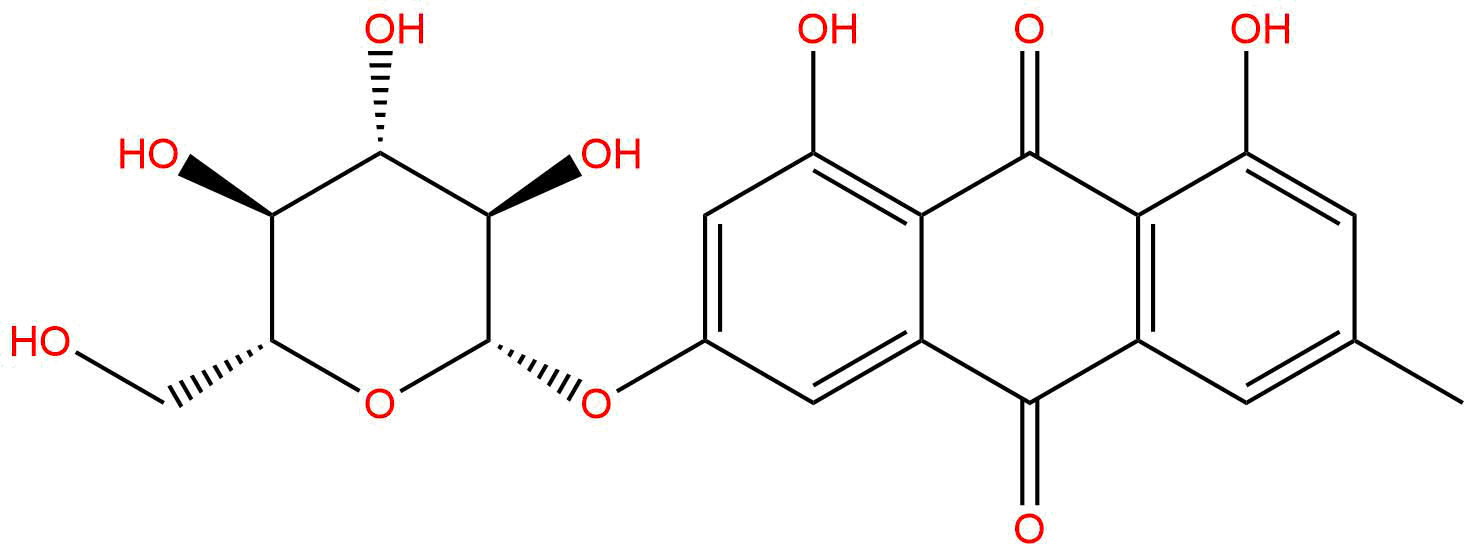


Product name: Emodin-6-O-glucoside
Synonym name: Emodin glucoside; Glucoemodin
Catalogue No.: BP4688
Cas No.: 34298-85-6
Formula: C21H20O10
Mol Weight: 432.381
Botanical Source:
Type of Compound: Quinones
Purity: 95%~99%
Analysis Method: HPLC-DAD or/and HPLC-ELSD
Identification Method: Mass, NMR
Packing: Brown vial or HDPE plastic bottle
Storage: Store in a well closed container, protected from air and light. Put into refrigerate or freeze for long term storage.
Whenever possible, you should prepare and use solutions on the same day. However, if you need to make up stock solutions in advance, we recommend that you store the solution as aliquots in tightly sealed vials at -20℃. Generally, these will be useable for up to two weeks.
The product could be supplied from milligrams to grams
Inquire for bulk scale.
For Reference Standard and R&D, Not for Human Use Directly.
Storage conditions:Short-term storage at 2~8℃, long-term storage at -20 ~ -80℃
Emodin-6-O-glucoside (CAS number: 34298-85-6) is an important natural product and a glycoside derivative of anthraquinone compounds. As one of the active ingredients in traditional Chinese medicine such as Rheum spp., this compound has received widespread attention in the field of pharmacology research in recent years due to its unique biological activity and good safety. Especially in terms of its laxative effect, emodin 6-O-glucoside exhibits significant pharmacological effects, involving the regulation of multiple ion channels and transporters, demonstrating its potential value as a natural laxative.
This article aims to systematically review the chemical structure and physicochemical properties, plant sources and extraction methods, pharmacological activity and mechanism of action, pharmacological evaluation and pharmacokinetic characteristics of emodin 6-O-glucoside, and explore its clinical application prospects. It is expected to provide theoretical basis and reference for subsequent related research and new drug development.
Emodin-6-O-glucoside is an anthraquinone compound with a molecular formula of C21H20O10 and a molecular weight of 432.3810. Its structure is formed by the O-glycosidic bond between emodin molecules and glucose molecules through the 6-position hydroxyl group. This structure endows it with high polarity, with a LogP value of 0.6915, indicating moderate lipophilicity that facilitates in vivo distribution but is not easily excessively lipophilic, consistent with good drug compatibility.
Its topological polar surface area (TPSA) is 173.98 Å ², indicating that the molecule has strong polarity and hydrogen bond donor/acceptor ability, which is usually associated with good water solubility. The water solubility value is 1.2527, supporting its good solubility in aqueous phase. In addition, the blood-brain barrier permeability of emodin 6-O-glucoside is low, indicating a lower risk of side effects in the central nervous system. The negative result of hERG channel inhibition experiment indicates a low risk of cardiac toxicity. The Ames mutagenicity test score is 1.2, indicating a low risk of genotoxicity and good safety potential.
Emodin-6-O-glucoside is mainly found in the rhizomes of Rheum spp., especially from Rheum palmatum L. and Rheum officinale Baill. commonly used in traditional Chinese medicine. As a traditional Chinese medicine, rhubarb is widely used for its laxative, heat clearing, and detoxifying effects, and the extraction and separation techniques of related active ingredients are also relatively mature.
Extraction methods often use water extraction alcohol precipitation or alcohol extraction separation techniques. The specific process usually includes:
In recent years, ultrasound assisted extraction and microwave-assisted extraction techniques have also been applied to improve extraction efficiency and purity, further promoting the research and development of emodin 6-O-glucoside.
The pharmacological activity of emodin 6-O-glucoside mainly focuses on its laxative effect, and it also exhibits certain anti-inflammatory, antioxidant, and antibacterial activities. However, the laxative effect is its most significant and extensively studied biological function.
As a glycoside derivative of anthraquinone compounds, emodin 6-O-glucoside promotes the excretion of intestinal contents by regulating the transport of intestinal water and electrolytes, exhibiting a significant laxative effect. Both in vitro and in vivo experiments have shown that it can significantly increase intestinal peristalsis, promote water secretion, and shorten the passage time of feces.
Some studies have shown that emodin 6-O-glucoside can inhibit the release of inflammatory mediators, alleviate the inflammatory response of intestinal mucosa, and may exert anti-inflammatory effects by regulating the NF - κ B signaling pathway. At the same time, the phenolic hydroxyl groups in its structure endow it with certain free radical scavenging ability, exhibiting antioxidant activity and helping to alleviate tissue damage related to oxidative stress.
There are studies reporting that it has inhibitory effects on certain pathogens, suggesting that it may play an auxiliary role in regulating intestinal microbiota, but the relevant mechanisms still need further clarification.
The mechanism of laxative action of emodin 6-O-glucoside involves the regulation of multiple intestinal ion channels and transporters, with the main targets including:
By regulating the above targets, emodin 6-O-glucoside can coordinate the transport of intestinal electrolytes and water, enhance intestinal peristalsis, and ultimately achieve a laxative effect. In addition, its regulation of inflammatory signaling pathways indirectly promotes the recovery and maintenance of intestinal function.
The pharmacological parameters of emodin 6-O-glucoside show that it has good potential for drug development. The molecular weight of 432.3810 meets the basic requirements of Lipinski's rule, and the LogP value of 0.6915 suggests that it has moderate lipid solubility, which is beneficial for in vivo distribution. Although a high TPSA value (173.98) may limit oral bioavailability, its good water solubility (1.2527) is helpful for formulation development.
The low permeability of the blood-brain barrier reduces the risk of central nervous system side effects. The hERG channel has no inhibitory effect, reducing the potential risk of cardiac toxicity. The Ames test results indicate that its genotoxicity risk is low and its safety is good.
In terms of pharmacokinetics, existing research is relatively limited. Preliminary in vivo experiments have shown that its oral absorption is slow, possibly due to the glycoside structure being interpreted by water in the intestine to amplify flavin and exert activity. Metabolism is mainly carried out through the liver enzyme system, and the safety of metabolites needs further evaluation. The main excretion pathways are the kidneys and bile, with a moderate half-life and suitable for daily administration.
Emodin-6-O-glucoside, as a natural laxative, has significant pharmacological activity and good safety, and has broad clinical application prospects. It demonstrates potential advantages in the treatment of constipation, intestinal dysfunction, and related inflammatory bowel diseases, especially suitable for patients with high long-term usage needs and strict safety requirements.
Future research should focus on the following aspects:
Emodin-6-O-glucoside, as a natural anthraquinone glycoside, has shown important pharmacological value in the treatment of diarrhea and intestinal diseases due to its unique chemical structure and multi-target regulatory mechanism. Its good safety and pharmacological parameters provide a solid foundation for the development of new drugs. In the future, through systematic pharmacological mechanism research, pharmacokinetic analysis, and clinical validation, it is expected to be developed into a safe and effective natural laxative, benefiting a wide range of patients. The in-depth exploration of pharmacology of natural products will further promote the application and innovation of emodin 6-O-glucoside and its similar compounds in modern medicine.
