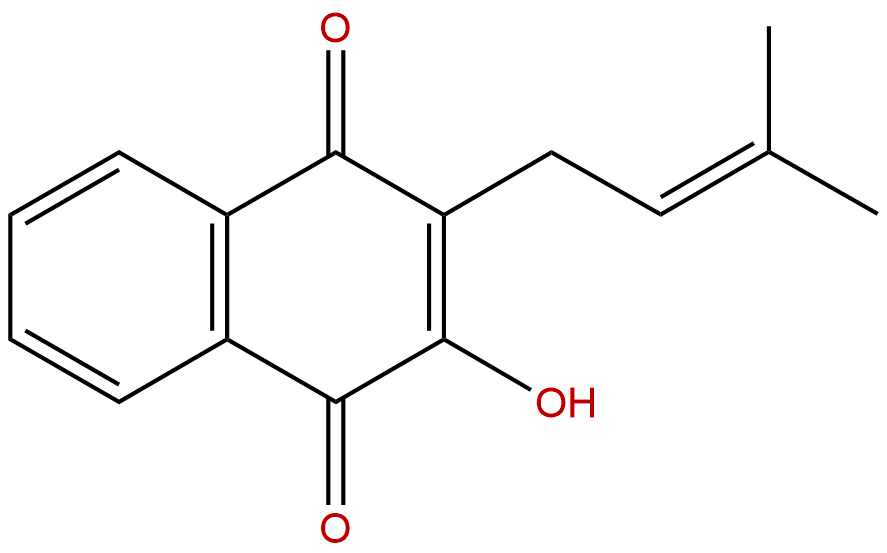


Synonym name: Greenhartin; Taiguic acid; Tecomin; Groenhartin; Lapachoic acid
Catalogue No.: BP0841
Cas No.: 84-79-7
Formula: C15H14O3
Mol Weight: 242.274
Botanical Source: Widespread occurrence in the plant world, particularly in heartwood, bark and roots, e.g. the Bignoniaceae and various Tabebuia, Tecomella and Tectona spp.
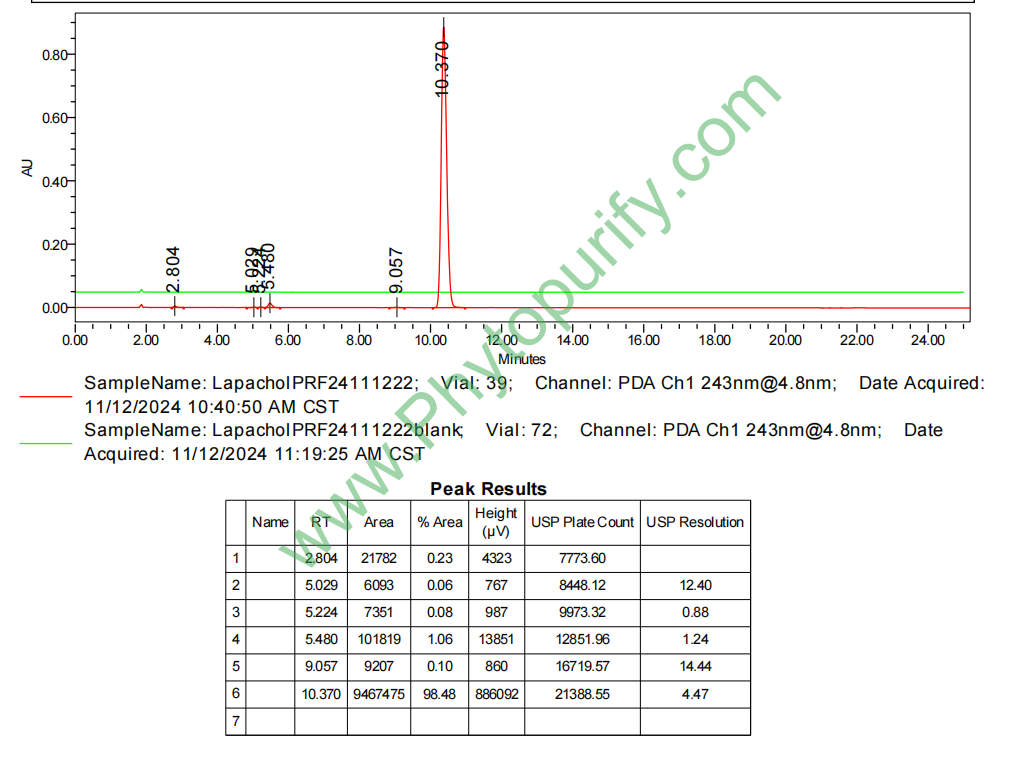
Purity: 95%~99%
Analysis Method: HPLC-DAD or/and HPLC-ELSD
Identification Method: Mass, NMR
Packing: Brown vial or HDPE plastic bottle
Can be supplied from milligrams to grams.
For Reference Standard and R&D, Not for Human Use Directly.
Inquire for bulk scale.
HPLC of Lapachol
Storage conditions:Short-term storage at 2~8℃, long-term storage at -20 ~ -80℃
Lapachol, also known as 2-hydroxy-3- (3-methylbut-2-en-1-yl) -1,4-naphthoquinone, is a naturally occurring hydroxy-1,4-naphthoquinone compound. Since its first isolation from the bark of the South American endemic plant Tabebuia avellanedae in 1882, crocetin has become an important subject of natural product pharmacology research due to its significant biological activity. Its unique chemical structure endows it with diverse pharmacological activities, covering multiple aspects such as antibacterial, anti-tumor, anti-inflammatory, and regulation of plant metabolism, especially showing great potential in the field of tumor treatment.
In recent years, with the development of molecular biology and medicinal chemistry, the mechanism of action of berberine and its interactions with various disease-related molecular targets have gradually been revealed, especially in the application research of digestive system tumors such as colon cancer, significant progress has been made. This article aims to provide a systematic review of the chemical structure, sources, pharmacological activity, mechanism of action, pharmacological evaluation, and clinical application prospects of yellow bell flower quinone, providing a theoretical basis and reference for subsequent related research and new drug development.
The molecular formula of yellow bell flower quinone is C15H14O3, with a molecular weight of 242.2740. Its core structure is a 1,4-naphthoquinone skeleton, which is replaced by hydroxyl and 3-methylbut-2-en-1-yl groups at positions 2 and 3, respectively, forming a conjugated system with strong electron donor and acceptor properties. This structure endows it with excellent chemical reactivity, particularly outstanding in redox reactions.
In terms of physical and chemical properties, the LogP value of crocetin is 2.9130, indicating its moderate lipid solubility, which is beneficial for membrane penetration and bioavailability. Its topological polar surface area (TPSA) is 54.37 Å ², indicating that the molecule has a certain polarity that facilitates binding with biomolecules such as proteins. The low water solubility (0.0623 mg/mL) limits its solubility in the aqueous phase, which may affect its in vivo distribution and administration method. The low permeability of the blood-brain barrier indicates its limited ability to penetrate the central nervous system. The hERG channel inhibition experiment showed a negative result, indicating a low risk of cardiac toxicity. The Ames test score is 0.9, indicating a low risk of genotoxicity and good safety.
Yellow bell flower quinone mainly exists in the bark of plants in the genus Tabebuia spp., especially in species such as Tabebuia avellanedae and Tabebuia impetiginosa. These plants are widely distributed in tropical and subtropical regions of South America, traditionally used by local residents to treat diseases such as infections, inflammation, and tumors.
The traditional method for extracting yellow bell flower quinone usually involves organic solvent extraction, such as ethanol, methanol, or ethyl acetate, combined with hot reflux or ultrasound assisted extraction techniques to improve extraction efficiency. The extraction solution undergoes separation and purification steps such as concentration, separation, and column chromatography to ultimately obtain high-purity yellow bell flower quinone. In recent years, green and efficient technologies such as supercritical fluid extraction and microwave-assisted extraction have also been applied to the extraction of flavonoids, significantly improving yield and purity while reducing environmental pollution.
Huangzhong flower quinone exhibits broad-spectrum antibacterial activity, especially significant inhibitory effects on Gram positive bacteria such as Staphylococcus aureus and certain Gram negative bacteria. Its antibacterial mechanism mainly involves cell membrane disruption and interference with the cellular respiratory chain. In vitro experiments have shown that berberine can inhibit bacterial growth and reproduction, and also exhibit certain activity against drug-resistant strains, indicating its potential application value in the context of antibiotic resistance.
The anti-tumor activity of Huangzhonghuaquinone is one of its most concerned pharmacological properties. A number of in vitro and in vivo studies have shown that clomaquinone has cytotoxic effects on many tumor cell lines, especially in colon cancer, breast cancer and lung cancer cells. Its anti-tumor effect is manifested by inducing cell apoptosis, blocking cell cycle, inhibiting tumor cell migration and invasion, etc.
In colon cancer models, berberine inhibits tumor cell proliferation and survival through multi-target regulation, significantly delaying tumor growth. Huangzhonghuaquinone can also enhance the efficacy of chemotherapy drugs, showing potential synergistic effects.
Huangzhonghuaquinone has good anti-inflammatory effects and can inhibit the expression of inflammatory mediators such as tumor necrosis factor alpha (TNF - α), interleukin-6 (IL-6), and cyclooxygenase-2 (COX-2), thereby reducing inflammatory reactions. Its anti-inflammatory mechanism involves inhibition of the NF - κ B signaling pathway and regulation of oxidative stress, suggesting its potential application in inflammation related diseases.
Huangzhonghuaquinone, as a plant metabolite, also exhibits regulatory effects on plant growth and stress resistance. Its redox properties endow it with certain activity in free radical scavenging and antioxidant activities, which may have a positive impact on cell protection and tissue repair.
The multi-target mechanism of action of Huangzhonghuaquinone is the basis for its diverse pharmacological activities. Regarding colon cancer, berberine mainly exerts anti-tumor effects by regulating the following key molecular targets:
AMPK(PRKAA1)As a regulator of cellular energy metabolism, AMPK activation promotes metabolic stress in tumor cells, induces autophagy and apoptosis. Huangzhonghuaquinone can activate the AMPK signaling pathway and inhibit the growth of tumor cells.
BCL2 Downregulation of anti apoptotic protein BCL2 helps promote tumor cell apoptosis. Huangzhonghuaquinone disrupts the intracellular anti apoptotic balance by inhibiting BCL2 expression.
STAT3 As a transcription factor, STAT3 is involved in the proliferation and immune escape of tumor cells. Huangzhonghuaquinone inhibits the phosphorylation and activity of STAT3, blocking the expression of downstream oncogenes.
ABCB1 Inhibition of multidrug resistance protein ABCB1 helps reverse chemotherapy resistance in tumor cells. Huangzhonghuaquinone can reduce the expression of ABCB1 and enhance the intracellular accumulation of chemotherapy drugs.
ALOX5 Huangzhonghuaquinone participates in the regulation of inflammation and tumor microenvironment, and reduces pro tumor inflammatory response by inhibiting ALOX5 activity.
LCK As a tyrosine kinase, LCK regulates immune cell function and tumor signaling. The regulation of LCK by yellow bell flower quinone helps to regulate the tumor immune microenvironment.
TOP1 Topoisomerase I is a key enzyme in DNA replication and transcription, and berberine inhibits tumor cell proliferation by suppressing TOP1 activity.
RELA (NF - κ B p65 subunit)The NF - κ B signaling pathway plays a central role in inflammation and tumors. Huangzhonghuaquinone inhibits the activation of RELA and weakens the pro tumor inflammatory signal.
MAPK1 The MAPK signaling pathway involved in cell proliferation and differentiation is an important regulatory node for tumor growth. Huangzhonghuaquinone regulates MAPK1 activity and inhibits tumor development.
TNF Downregulation of pro-inflammatory cytokine TNF can help alleviate tumor associated inflammation. Huangzhonghuaquinone reduces TNF expression and improves the tumor microenvironment.
In summary, Huangzhonghuaquinone regulates tumor cell proliferation, apoptosis, migration, and immune escape through multi-target and multi pathway synergistic effects, demonstrating a complex and effective anti-tumor mechanism.
The pharmacological evaluation of Huangzhonghuaquinone shows that it has certain potential for drug development. Its molecular weight of 242.2740 conforms to Lipinski's rule, and its LogP value of 2.9130 suggests moderate lipid solubility, which is beneficial for oral absorption. The TPSA value of 54.37 Å ² supports its good membrane permeability. Low water solubility is a major challenge in its drug development, and it is necessary to improve solubility and bioavailability through drug formulation techniques such as nanocarriers, liposomes, or salt formation.
The low permeability of the blood-brain barrier limits its application in central nervous system diseases, but it helps to reduce central nervous system toxic side effects. The negative inhibition of hERG channel indicates a low risk of cardiac toxicity and good safety. The Ames test results show that its genotoxicity risk is relatively low, further supporting its safety.
In terms of pharmacokinetics, the oral absorption of berberine is relatively fast, but its bioavailability is limited due to poor water solubility and first pass effects. The distribution in the body is mainly concentrated in the liver and kidneys, and the metabolic pathway is mainly through the liver cytochrome P450 enzyme system for oxidative metabolism. Excretion is mainly through bile and urine. Future research needs to further clarify the activity and toxicity of its metabolites, and optimize the dosing regimen to enhance therapeutic efficacy.
Huangzhong flower quinone, as a multifunctional natural product, has shown broad clinical application prospects in antibacterial, anti-tumor, and anti-inflammatory fields. Especially in the treatment of colon cancer, berberine has potential adjuvant therapeutic value by regulating tumor cell proliferation and apoptosis through multiple targets. In addition, its inhibitory effect on multidrug resistance proteins provides a new approach to overcome chemotherapy resistance.
However, the clinical translation of crocetin still faces several challenges. Firstly, its poor water solubility and low bioavailability limit its efficacy, which needs to be addressed through formulation improvement and optimization of administration routes. Secondly, although in vitro and animal experiments have shown good results, there is a lack of systematic clinical trial data to support its safety and efficacy. Finally, further research is needed on the pharmacokinetic characteristics and toxicity of metabolites of Huangzhonghuaquinone.
In the future, combining modern drug design technologies such as molecular modification, nanocarrier delivery, and combination therapy strategies is expected to enhance the efficacy and safety of berberine. At the same time, conducting multicenter, randomized controlled clinical trials will lay a solid foundation for its clinical application. In addition, in-depth analysis of its molecular mechanism of action will help discover new drug targets and treatment strategies.
Huangzhong flower quinone, as a natural hydroxy-1,4-naphthoquinone compound with rich biological activity, has shown broad application potential in antibacterial, anti-tumor, and anti-inflammatory fields due to its unique chemical structure and multi-target mechanism of action. Especially in the treatment of malignant tumors such as colon cancer, berberine exerts significant anti-tumor effects by regulating key targets such as AMPK, BCL2, STAT3, etc.
Although it has shown certain advantages in drug properties, its poor water solubility and in vivo pharmacokinetic characteristics still need to be optimized. Future research should focus on the innovation of formulation technology, in-depth analysis of mechanisms, and clinical trial verification to promote the transition of berberine from laboratory to clinical application. In summary, as an important candidate for natural product drug development, Huangzhonghuaquinone has the potential to become a new type of anti-tumor drug and deserves continuous attention and in-depth exploration.
