| Catalog No | Package | Original Price | Price | Inventory | Quantity | Operating |
|---|---|---|---|---|---|---|
| BP1210-20mg | 20mg | $30.00 | Sign in |
|


Synonym name:
Catalogue No.: BP1210
Cas No.: 81-88-9
Formula: C28H31ClN2O3
Mol Weight: 479.017
Botanical Source:
Purity: 95%~99%
Analysis Method: HPLC-DAD or/and HPLC-ELSD
Identification Method: Mass, NMR
Packing: Brown vial or HDPE plastic bottle
Can be supplied from milligrams to grams.
For Reference Standard and R&D, Not for Human Use Directly.
Inquire for bulk scale.
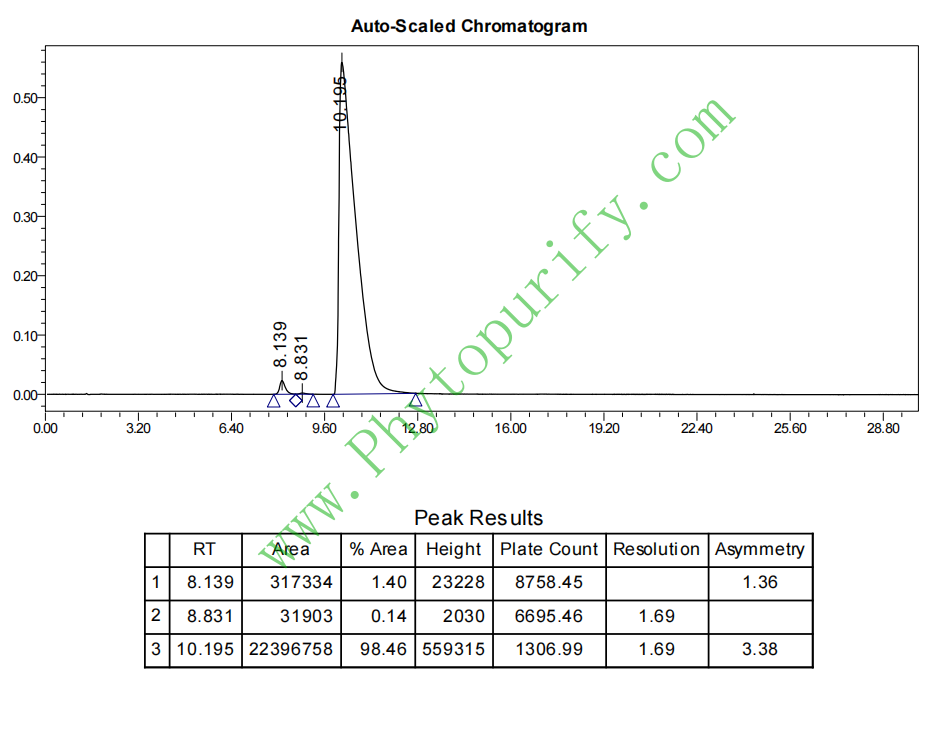
HPLC of Rhodamine B
Storage conditions:Short-term storage at 2~8℃, long-term storage at -20 ~ -80℃
56.6900
2.8373
.9073
.0080
.7022
2.9368
Low
87.1458
2.9255
Yes
No
No
No
No
Yes
0.9
No
No
Yes
No
Rhodamine B (CAS number: 81-88-9), as a classic fluorescent dye, has been widely used in textile, papermaking, cosmetics, biomedical labeling and other fields due to its bright color and excellent fluorescence properties since its synthesis in the late 19th century. For a long time, its role in the field of pharmacology has mainly been limited to a non-specific cell staining agent or tracing tool. However, with the deepening of interdisciplinary research, especially in response to the increasingly severe problem of bacterial resistance, researchers have begun to re-examine the biological activity of these known compounds. In recent years, a series of in vitro studies have unexpectedly revealed that Rhodamine B not only has broad-spectrum antibacterial potential, but its effects may involve multiple key bacterial targets, providing new scientific evidence for its transformation from a "staining tool" to a "potential antibacterial lead compound". This article aims to systematically review the chemical basis, traditional sources, emerging pharmacological activities (especially focusing on antibacterial effects), potential mechanisms of action, and molecular targets of Rhodamine B. It also provides a preliminary evaluation of its pharmacological properties and finally looks forward to its application prospects and challenges in the field of anti infective therapy.
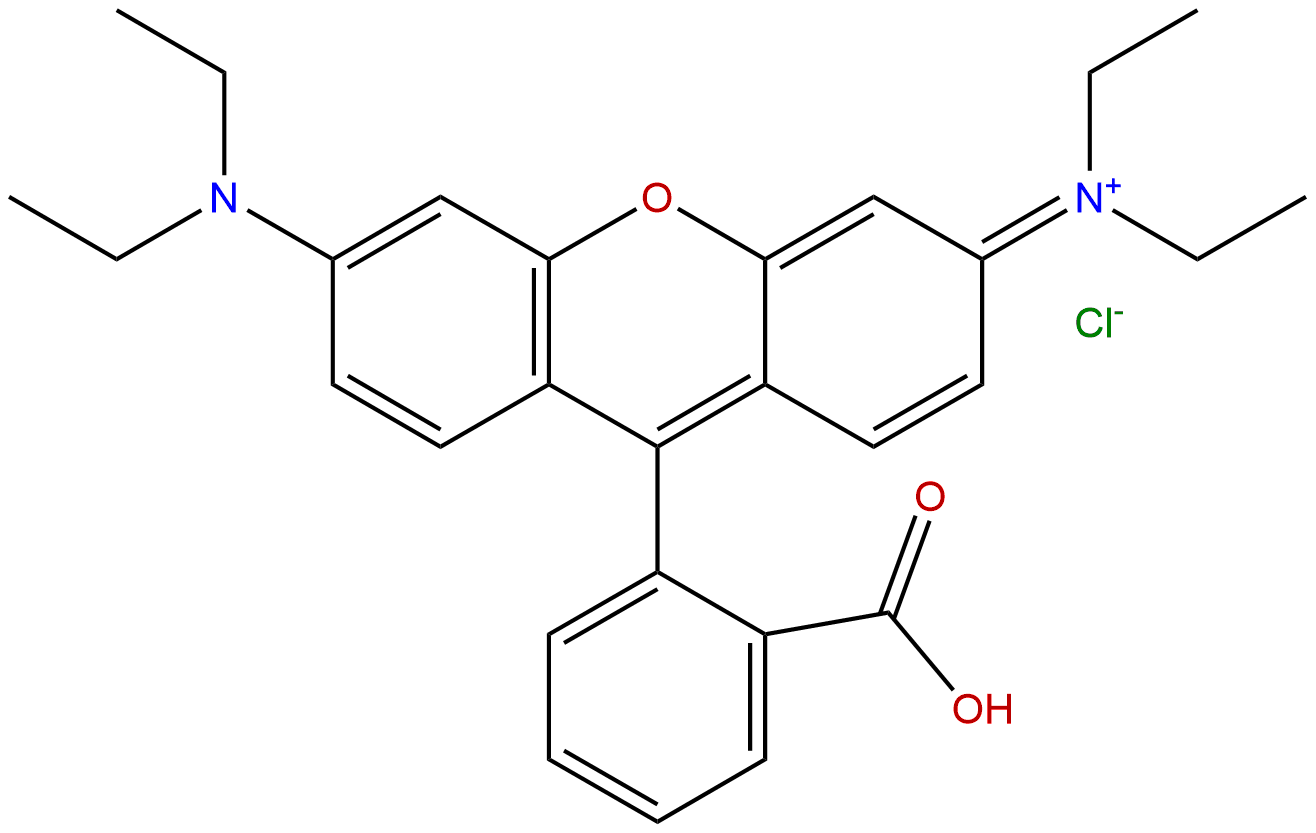
The chemical name of Rhodamine B is N - [9- (2-carboxyphenyl) -6- (diethylamino) -3H xanthen-3-ylidene] - N-ethylamine chloride, which is an organic chloride salt. Its molecular formula is C ₂₈ H ∝₁ ClN ₂ O ∝, and its molecular weight is 443.5670. Structurally, it belongs to the xanthene dye family, with a core structure of an oxanthracene (xanthene) ring. This ring system has high planarity and conjugation, which is the basis for its strong fluorescence. The ring is connected with diethylamino (as a strong electron donor) and carboxyphenyl (as an electron acceptor or coordination site), and this push-pull electronic structure greatly optimizes its photophysical properties.
In terms of physical and chemical properties, Rhodamine B usually appears as green crystals or reddish purple powder, which is easily soluble in polar solvents such as water, ethanol, methanol, etc. Its aqueous solution is bright blue red and emits strong orange red fluorescence (maximum excitation wavelength is about 550 nm, maximum emission wavelength is about 575 nm). The calculated chemical parameters show that its lipid water partition coefficient (LogP) is 2.8373, indicating that it has a certain degree of lipophilicity. The topological polar surface area (TPSA) is 56.69 Å ², which is relatively small. Its water solubility value is 0.0080 (which may refer to molar solubility or related parameters), indicating that its solubility in water is limited, but under acidic or alkaline conditions, the ionization state of its carboxyl and amino groups will significantly change its solubility characteristics. These properties collectively determine its distribution, permeation, and ability to interact with biomolecules in biological systems.
It should be clearly pointed out that Rhodamine B is not a natural product in the traditional sense. It is a compound prepared by a fully chemical synthesis method, and there is no known direct biosynthetic source from plants or microorganisms in nature. Its synthesis usually starts from meta hydroxydiethylaniline and phthalic anhydride, and is obtained through condensation, cyclization, acidification and other steps. Therefore, this section should more accurately elaborate on the methods of obtaining and purifying it as a "research object".
In laboratory research, high-purity rhodamine B can be obtained as a standard from commercial channels. If it involves detecting or extracting Rhodamine B from complex matrices such as textiles stained with it, environmental samples, or illegally added foods and drugs, specific extraction and purification techniques are required. Common methods include:
1. Solvent extraction method Extract using the difference in solubility of Rhodamine B in different solvents. For example, ultrasound assisted extraction from solid samples using methanol, ethanol, or water organic solvent mixed systems.
2. Solid phase extraction method For liquid samples such as beverages and urine, reverse phase solid-phase extraction columns such as C18 can be used for enrichment and purification to remove matrix interference.
3. Chromatographic separation method For further purification or analysis, high-performance liquid chromatography is often used, combined with UV visible or fluorescence detectors for qualitative and quantitative analysis.
Although it is not a natural source, including it in the discussion of natural product pharmacology reflects the reverse thinking of modern drug discovery to rediscover biological activity from the "known chemical space", which has important methodological significance.
For a long time, the pharmacological activity research of Rhodamine B has not been mainstream. Its known biological effects are mostly related to its characteristics as a dye or probe, such as non-specific staining in mitochondrial membrane potential detection. However, in recent years, research has gradually focused on its potential antibacterial activity, which constitutes a core new progress in its pharmacological activity research.
Antibacterial activity Multiple in vitro studies have shown that Rhodamine B exhibits varying degrees of inhibitory activity against various Gram positive bacteria (such as Staphylococcus aureus, Bacillus subtilis) and Gram negative bacteria (such as Escherichia coli, Pseudomonas aeruginosa). The minimum inhibitory concentration value varies depending on the strain, usually ranging from micromoles to millimoles. It is worth noting that some studies suggest that it may also have inhibitory effects on certain drug-resistant strains, such as methicillin-resistant Staphylococcus aureus (MRSA), which brings hope for its ability to address resistance issues. In addition, there have been reports of inhibitory effects on some fungi, such as Candida albicans, but their activity is usually weaker than that on bacteria.
Function characteristics:
1. broad-spectrum Has inhibitory potential against various bacteria.
2. concentration-dependent Its antibacterial effect increases with concentration and can exhibit bactericidal activity at high concentrations.
3. Possible interaction with the membrane Its amphiphilic structure suggests that it may interfere with the integrity of bacterial cell membranes, leading to leakage of contents.
4. The impact on biofilm Preliminary studies have shown that sub inhibitory concentrations of Rhodamine B may interfere with the formation of bacterial biofilms, which is of great significance for the treatment of chronic infections.
It should be emphasized that the vast majority of activity data currently come from in vitro experiments, and their in vivo effectiveness and safety have not yet been confirmed. In addition, its strong staining characteristics may interfere with the interpretation of certain experimental results, and caution should be exercised in designing controls.
The antibacterial mechanism of Rhodamine B has not been fully elucidated, but based on its chemical structural characteristics and existing bioinformatics and preliminary experimental studies, it is speculated that it may exert its effects through a multi-target mode of action, which is similar to the characteristics of many natural antibacterial products. Related research points to the following potential targets:
Nucleic acid synthesis related targets:
Cell division targets:
Cell membrane and cell wall synthesis targets:
Sterol synthesis targets (targeting fungi):
Multi target synergistic effect Rhodamine B may not act strongly on a single target, but rather affect key nodes in multiple bacterial life processes at moderate intensity simultaneously. This multi-target characteristic may bring two advantages: first, it reduces the risk of rapid drug resistance caused by single target mutations; The second is to produce a synergistic antibacterial effect. However, this may also increase its potential toxicity risk to host cells.
Based on the provided parameters and existing knowledge, a preliminary evaluation of the potential pharmacological properties of Rhodamine B as a potential drug is conducted
Summary From the preliminary physicochemical parameters, Rhodamine B has some drug like properties, but there are significant risks in terms of water solubility, potential chronic toxicity, and safety. As a drug, its development must be based on comprehensive and rigorous preclinical safety evaluation.
The path of Rhodamine B from fluorescent dye to potential antibacterial drug is full of both opportunities and challenges.
Potential application prospects:
1. New antibacterial lead compounds Its multi-target mechanism of action provides new ideas for designing novel antibacterial drugs, especially for combating multidrug-resistant bacterial infections. It can be used as the core structure for systematic medicinal chemical modification, optimizing its antibacterial activity, selectivity, and pharmacokinetic properties, while striving to reduce toxicity.
2. Combination therapy sensitizer Studying its synergistic effect with existing antibiotics may be used to restore the sensitivity of drug-resistant bacteria to traditional drugs and extend the lifespan of existing antibiotics.
3. Topical antibacterial agents for local use Given its potential systemic toxicity concerns, developing antibacterial agents (such as ointments, dressings, mouthwashes) for local infections of the skin, mucous membranes, wounds, etc. may be a more realistic and lower risk conversion pathway. Its fluorescence characteristics can even be used for visual monitoring of infected areas and treatment effectiveness.
4. Anti biofilm agent Exploring its ability to inhibit or destroy bacterial biofilms, which can be used as an adjuvant therapy for medical device coatings or chronic infections (such as pulmonary infections in cystic fibrosis patients).
Main challenges faced and future research directions:
1. Safety is the primary obstacle Systematic and in-depth toxicology research must be conducted to clarify the risks of carcinogenicity, genotoxicity, reproductive toxicity, etc., which is a prerequisite for any clinical translation.
2. The mechanism of action needs to be further elucidated It is necessary to confirm its direct interaction, binding mode, and inhibition constant with the speculated target through biophysical, structural biology, and chemical biology methods, and distinguish between the main target and the secondary effect.
3. Optimize the structure to improve properties Through rational drug design, improve its water solubility, antibacterial potency, and selectivity index (toxicity window to bacteria and mammalian cells), reduce non-specific staining and potential toxicity.
4. Conduct in vivo pharmacological evaluation Validate its in vivo antibacterial effect and therapeutic window in appropriate animal models of infection.
5. Explore new forms of application Combining nanotechnology to prepare targeted delivery systems may improve efficacy, reduce systemic exposure, and toxicity.
Rhodamine B, a shining name in the history of dye chemistry, is quietly entering a new stage of pharmacological research. Existing evidence suggests that it is not just a passive staining molecule, but more likely a chemical entity with multi-target antibacterial potential. Despite its vivid colors and unknown long-term toxicity casting a heavy shadow on its path to drug development, the research paradigm it represents - rediscovering biological activity from the known and structurally rich "chemical toolbox" - undoubtedly has important enlightening value. The focus of future research should be on using modern medicinal chemistry and pharmacology methods to deeply analyze its mechanism of action, rationally modify its structure to highlight its strengths and avoid weaknesses, and strictly evaluate its safety boundary. Regardless of whether Rhodamine B can ultimately be successfully transformed into an antibacterial drug, the process of exploring it will undoubtedly enhance our understanding of the interactions between xanthene compounds and biological systems, and may open up new pathways for discovering novel anti infective lead compounds. In the protracted battle between humans and drug-resistant bacteria, every new chemical skeleton and mechanism exploration deserves careful and active attention.
