Introduction/Overview
Natural products, as an important source of drug discovery, play an indispensable role in the long struggle between humans and diseases. From ancient plant therapies to the development of modern targeted drugs, small molecule compounds in nature continue to provide valuable lead compounds for the pharmaceutical field with their unique chemical structures and diverse biological activities. Among numerous natural products, anthraquinone compounds have attracted much attention due to their broad pharmacological activities, among which Alizarin 1-methyl ether, derived from the traditional medicinal plant madder, is one of them(Rubia cordifolia L. Natural anthraquinone derivatives have gradually become a hot topic in pharmacological research in recent years.
Alizarin-1-methylether, also known as 1-methoxy-2-hydroxyanthraquinone, is one of the abundant red pigment components in the roots of Ganoderma lucidum. In history, as a derivative of Alizarin, it has been widely used as a natural dye in textiles and paintings along with Alizarin. Its bright red hue has left a profound mark on the history of human civilization. However, the value of Alizarin-1-methylether goes far beyond its aesthetic applications. Modern pharmacological research reveals that this ancient natural dye contains a complex network of biological activities, exhibiting multi-target and multi pathway action characteristics. Research has shown that Alizarin-1-methylether can activate the adenosine monophosphate activated protein kinase (AMPK) and vascular endothelial growth factor receptor 2/endothelial nitric oxide synthase (VEGFR2/eNOS) signaling pathways, regulate phosphatidylinositol 3-kinase/protein kinase B (PI3K/Akt) signaling, inhibit the nuclear factor kappa B (NF - κ B) pathway, and enhance the activity of cytochrome P450 family 1 subfamily A member 1 (CYP1A1) enzymes. These molecular level regulatory effects endow Alizarin-1-methyl ether with great potential in the treatment of hypertension, vascular endothelial dysfunction and a variety of cancers (including pancreatic cancer, breast cancer, osteosarcoma and liver cancer).
This article aims to provide a systematic professional review of Alizarin-1-methylether, starting from its chemical structure and physicochemical properties, tracing its plant origin and extraction process, deeply analyzing its various pharmacological activities and mechanisms of action, and evaluating its pharmacokinetic characteristics based on its pharmacological parameters. Finally, it looks forward to its prospects and challenges in clinical applications, in order to provide comprehensive references for the in-depth research and development of this natural product.
Chemical structure and physicochemical properties
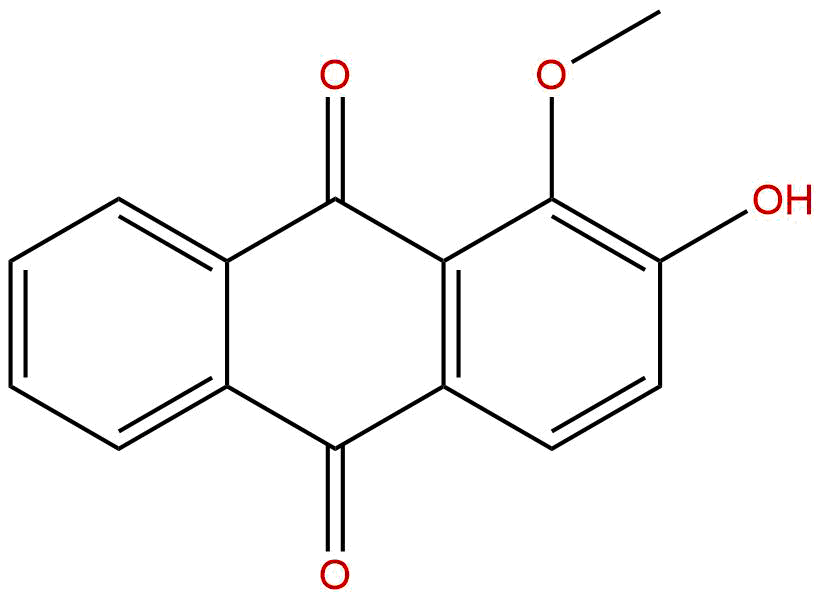
Alizarin 1-methyl ether belongs to the class of hydroxy anthraquinone compounds, and its core structure consists of an anthraquinone nucleus composed of three benzene rings fused together. There are methoxy (- OCH ∝) and hydroxyl (- OH) substituents attached to the 1st and 2nd positions of the anthraquinone nucleus, respectively. Its system is named 1-methoxy-2-hydroxyanthraquinone, with a molecular formula of C ₁₅ H ₁₀ O ₄. Compared with the parent compound alizarin (1,2-dihydroxyanthraquinone), the 1-hydroxy group of alizarin-1-methyl ether is methylated, which significantly affects its physicochemical properties and biological activity.
In terms of physicochemical properties, the molecular weight of Alizarin-1-methyl ether is 254.2410 g/mol. Its lipid water partition coefficient (LogP) is 2.6448, indicating that the compound has moderate lipophilicity, which is beneficial for crossing biofilms, but may also affect its solubility and distribution in aqueous environments. Its topological polar surface area (TPSA) is 63.6000 Å ², which is at a moderate level, indicating that it may have some cell membrane permeability, but may also be affected by efflux transporters. The water solubility of this compound is extremely low, only 0.0052 mg/mL. This characteristic is the basis for its fixation as a natural dye on textiles. However, in drug development, low water solubility often becomes a bottleneck that restricts its bioavailability and formulation development. It is worth noting that Alizarin-1-methylether has a high blood-brain barrier (BBB) penetration potential, which provides a possibility for its application in the treatment of central nervous system diseases, but may also bring potential neurotoxic risks. In addition, the risk assessment of hERG inhibition is' no ', indicating a low risk of inducing QT interval prolongation and arrhythmia in the heart, which is a favorable safety signal. The Ames test result is 2.1, indicating that there may be a certain genetic toxicity risk, which needs to be given special attention and validation in subsequent development.
Plant sources and extraction methods
The main natural source of Alizarin-1-methyl ether is the madder plant in the madder family(Rubia cordifolia L. The root of. Rubia is a perennial climbing herbaceous plant widely distributed in temperate and tropical regions of Asia, Europe, and Africa. It has a long history of medicinal use and dyeing in countries such as China, India, and Japan. Qiancao root is rich in various anthraquinone pigments, including Alizarin, Alizarin-1-methylether, Purpurin, etc. These components together constitute the pharmacological activity basis of Qiancao root. The content of Alizarin-1-methylether varies in the roots of Chinese parasol trees from different regions and harvesting seasons, usually coexisting with Alizarin, and its content is influenced by plant growth environment and genetic factors.
The traditional extraction method of Alizarin-1-methylether is mainly based on solvent extraction. Due to the good solubility of the compound in organic solvents and extremely low solubility in water, polar organic solvents such as ethanol, methanol, or acetone are often used for soaking or reflux extraction of dried and crushed reed roots. After filtration and concentration, the extract can be preliminarily purified by acid-base precipitation or column chromatography. For example, the separation of anthraquinone compounds from other impurities can be achieved by utilizing their characteristics of salt dissolution under alkaline conditions and precipitation under acidic conditions. In recent years, in order to improve extraction efficiency and purity, some modern extraction techniques have also been applied to the preparation of Alizarin-1-methylether, such as ultrasound assisted extraction, microwave-assisted extraction, and supercritical fluid extraction. These technologies can achieve higher extraction rates in a shorter period of time while reducing the use of organic solvents by disrupting cell walls, accelerating solvent permeation, and mass transfer processes.
Further purification usually relies on chromatographic techniques. Silica gel column chromatography is the most commonly used method for separating Alizarin-1-methyl ether. It uses mixed solvents such as petroleum ether ethyl acetate or chloroform methanol for gradient elution, which can effectively separate Alizarin-1-methyl ether from other anthraquinone components such as Alizarin and purple Alizarin. High performance liquid chromatography (HPLC) can be used to prepare high-purity standards. With the development of separation science, new technologies such as high-speed counter current chromatography (HSCCC) have also been successfully applied to the separation of anthraquinone components in Ganoderma lucidum roots, demonstrating advantages such as high separation efficiency and low sample loss.
Pharmacological activity research
The pharmacological activity research of Alizarin-1-methylether has expanded from traditional anti-inflammatory and antibacterial methods to multiple cutting-edge fields such as cardiovascular protection and anti-tumor effects, demonstrating its enormous potential as a multi-target natural product.
1. Cardiovascular protective effect
Alizarin-1-methylether has shown significant protective effects in the cardiovascular system, particularly in hypertension and endothelial dysfunction. Vascular endothelium is an important barrier of vascular wall, and its dysfunction is the common pathological basis of many cardiovascular diseases such as hypertension and atherosclerosis. Research has shown that Alizarin-1-methylether can promote the phosphorylation of endothelial nitric oxide synthase (eNOS) by activating the VEGFR2/eNOS signaling pathway, thereby increasing the production of nitric oxide (NO). NO is a key signaling molecule that maintains vasodilation, inhibits platelet aggregation, and white blood cell adhesion. In addition, Alizarin-1-methylether can also activate the AMPK pathway, which acts as a cellular energy receptor. Its activation helps improve endothelial cell metabolic stress, inhibit oxidative stress and inflammatory reactions, thereby protecting vascular endothelial function. In animal models, Alizarin-1-methylether has been proven to effectively lower blood pressure, improve vasodilation function, alleviate oxidative damage and inflammatory infiltration of the vascular wall, providing a new candidate molecule for the treatment of hypertension and its complications.
2. Antitumor activity
Alizarin-1-methylether exhibits broad-spectrum cytotoxic effects on various malignant tumor cell lines, and its anti-tumor mechanism involves multiple levels.
- pancreatic cancer Alizarin-1-methyl ether can inhibit the proliferation of pancreatic cancer cells and induce their apoptosis. The mechanism may be related to the inhibition of the PI3K/Akt signaling pathway. The PI3K/Akt pathway is a core pathway that regulates cell survival, proliferation, and metabolism, and is often in an abnormally activated state in various cancers. Alizarin-1-methylether promotes tumor cell apoptosis by downregulating the phosphorylation level of Akt and blocking the downstream pro survival signal transmission.
- breast cancer Alizarin-1-methyl ether also showed anti proliferation and pro apoptosis activities in breast cancer cells. In addition to affecting the PI3K/Akt pathway, it can also inhibit the activation of the NF - κ B pathway. NF - κ B is a key transcription factor involved in regulating the expression of genes related to inflammation, immunity, and cell survival. Alizarin-1-methylether inhibits the phosphorylation and degradation of I κ B α, preventing NF - κ B from entering the nucleus and downregulating the expression of its target genes (such as Bcl-2, cyclin D1, etc.), thereby suppressing the growth and metastasis of tumor cells.
- Osteosarcoma and liver cancer Alizarin-1-methylether also showed similar inhibitory effects on osteosarcoma and liver cancer cells. Research has confirmed that it can induce cell apoptosis through the mitochondrial pathway and endoplasmic reticulum stress pathway, while also inhibiting the migration and invasion ability of tumor cells. It is worth noting that Alizarin-1-methylether can also enhance the activity of CYP1A1 enzyme. CYP1A1 is an important drug metabolizing enzyme, and in some cancers, upregulation of its expression may help convert precursor drugs into active forms or promote detoxification of carcinogens, thereby exerting chemopreventive effects. However, induction of CYP1A1 may also affect the metabolism of other drugs and requires careful evaluation.
3. Antibacterial activity
Although there is relatively little research on the antibacterial activity of Alizarin-1-methylether compared to its anti-tumor and cardiovascular protective effects, existing studies have shown that it has certain antibacterial potential. Its antibacterial effect may be achieved by acting on multiple bacterial targets, including DNA gyrase A subunit (GYRA), DNA gyrase B subunit (GYPB), cell division protein FtsZ (FTSZ), acyl acyl carrier protein reductase (FABI), dihydrofolate reductase (DHFR), penicillin binding protein 2a (MECA), penicillin binding protein (PENA), sterol 14 α - demethylase (ERG11/CYP51A1), and resistance related protein (CDR1). This multi-target mode of action may make it less susceptible to drug resistance, but it also increases the challenge of selective toxicity. Its potential effects on fungal targets ERG11 and CYP51A1 suggest that it may have antifungal activity, which is worth further exploration.
Mechanism of action and molecular targets
The pharmacological activity of Alizarin-1-methylether does not originate from the action of a single target, but rather from a networked regulatory mode achieved by regulating multiple key signaling pathways and molecular targets. Its core mechanism of action can be summarized as follows:
1. Activation of AMPK signaling pathway
AMPK is the core regulator of cellular energy metabolism. Alizarin-1-methylether can directly or indirectly activate AMPK, leading to phosphorylation of a series of downstream target proteins. In the cardiovascular system, AMPK activation can promote eNOS phosphorylation, increase NO production, and improve endothelial function; Meanwhile, AMPK can also inhibit the mTOR pathway, reduce protein synthesis and cell proliferation, which are equally important in anti-tumor mechanisms. In addition, AMPK activation can enhance mitochondrial biosynthesis and autophagy, clear damaged organelles, and maintain cellular homeostasis.
2. Activation of VEGFR2/eNOS signaling pathway
Vascular endothelial growth factor receptor 2 (VEGFR2) is the main VEGF receptor on vascular endothelial cells. Alizarin-1-methylether can promote the phosphorylation of VEGFR2, thereby activating downstream PI3K/Akt and eNOS pathways. The activation of eNOS is a key step in the generation of NO. As a vasodilator, NO plays a central role in regulating blood pressure, inhibiting platelet aggregation, and promoting vascular smooth muscle cell proliferation. Therefore, the activation of the VEGFR2/eNOS pathway is an important molecular basis for the cardiovascular protective effect of Alizarin-1-methylether.
3. Regulation of PI3K/Akt signaling pathway
The PI3K/Akt pathway is a key signaling hub for cell survival, proliferation, and metabolism. The regulatory effect of Alizarin-1-methylether on this pathway exhibits a certain cell type dependence. In tumor cells, it mainly manifests as inhibiting the phosphorylation of Akt, thereby blocking its pro survival signal and inducing cell apoptosis. In endothelial cells, it may promote eNOS activation and cell survival by activating Akt. This differential regulatory effect enables Alizarin-1-methylether to exert different biological effects in different cellular environments.
4. Inhibition of NF - κ B signaling pathway
NF - κ B is a core transcription factor for inflammation and immune response. Alizarin-1-methylether can inhibit the activity of I κ B kinase (IKK), prevent the degradation of I κ B α, and thus leave NF - κ B inactive in the cytoplasm, unable to enter the nucleus to initiate transcription of target genes. By inhibiting the NF - κ B pathway, Alizarin-1-methylether can downregulate the expression of various pro-inflammatory cytokines (such as TNF - α, IL-6), chemokines, and adhesion molecules, thereby exerting anti-inflammatory and anti-tumor effects.
5. Enhancement of CYP1A1 enzyme activity
Alizarin-1-methylether can induce the expression and activity of CYP1A1. CYP1A1 is a target gene of aromatic hydrocarbon receptor (AhR), involved in the metabolism of various exogenous substances, including polycyclic aromatic hydrocarbons. Enhancing CYP1A1 activity may help accelerate the detoxification process of certain carcinogens, thereby exerting a chemopreventive effect. However, induction of CYP1A1 may also lead to activation of certain pre carcinogens or affect the pharmacokinetics of other drugs, and its net effect needs to be evaluated in specific contexts.
Evaluation of drug properties and pharmacokinetics
Based on the provided pharmacological parameters, a preliminary evaluation of the drug development potential of Alizarin-1-methylether can be conducted. Its molecular weight (254.24 Da) meets the requirement of Lipinski's Rule of Five for molecular weight less than 500. The LogP value (2.6448) also falls within the ideal range (-0.4 to 5.6), indicating good lipid solubility and facilitating transmembrane absorption. The TPSA value (63.60 Å ²) is less than 140 Å ², indicating good oral absorption potential. However, its extremely low water solubility (0.0052 mg/mL) is the main obstacle to drug formation, which may lead to low oral bioavailability and difficulty in achieving effective blood drug concentrations. The high blood-brain barrier penetration suggests that it may have central nervous system activity, but potential neurotoxicity should also be monitored. The low risk of hERG inhibition is a favorable safety signal, but the Ames test results (2.1) suggest that it may have genetic toxicity, which is a risk point that requires high attention in drug development and must be validated through more comprehensive genetic toxicity tests (such as in vivo micronucleus tests).
There is currently relatively limited publicly available research data on the pharmacokinetic characteristics of Alizarin-1-methylether. Based on its physicochemical properties, it is speculated that after oral administration, its absorption may be limited by low water solubility, but good lipid solubility helps it to passively diffuse through intestinal epithelial cells. After absorption, due to its high lipid solubility, it may be widely distributed in tissues, including brain tissue. In terms of metabolism, as an inducer of CYP1A1, Alizarin-1-methylether may induce its own metabolism or undergo phase I metabolic reactions such as hydroxylation and demethylation through enzyme systems such as CYP1A1, CYP2C9, CYP3A4, and then combine with glucuronic acid or sulfuric acid for phase II metabolism. Its metabolites may have different biological activities. The main excretion pathways may be bile and urine. In the future, systematic pharmacokinetic studies are needed, including oral bioavailability, tissue distribution, metabolite identification, and excretion pathway analysis in animal models, to comprehensively evaluate their in vivo behavior.
Clinical application prospects and prospects
Alizarin-1-methylether, as a multi-target natural product derived from traditional herbs, has shown remarkable preclinical application prospects in multiple disease fields.
1. Cardiovascular disease treatment
In view of its remarkable effects in activating AMPK and VEGFR2/eNOS pathways, improving vascular endothelial function and reducing blood pressure, Alizarin-1-methyl ether is expected to be developed into a new drug for treating vascular endothelial dysfunction related diseases such as hypertension and atherosclerosis. Especially for hypertensive patients with metabolic syndrome, the simultaneous activation of AMPK may bring additional metabolic improvement benefits. However, its low water solubility and potential genetic toxicity are key issues that must be addressed before entering clinical practice.
2. Anti tumor therapy
Alizarin-1-methyl ether has inhibitory effects on pancreatic cancer, breast cancer, osteosarcoma, liver cancer and other solid tumors, making it a potential anti-tumor candidate compound. Its mechanism of action by inhibiting the PI3K/Akt and NF - κ B pathways overlaps with the targets of many existing anticancer drugs, such as PI3K inhibitors and NF - κ B inhibitors. However, as a natural product, it may have better tolerance. In the future, it may be used as a monotherapy or in combination with chemotherapy drugs and targeted drugs to improve efficacy and reduce toxic side effects. In particular, its ability to enhance CYP1A1 activity may be used to design prodrug strategies that convert inactive prodrugs into active forms through CYP1A1 at the tumor site, achieving targeted therapy.
3. Antibacterial and anti-inflammatory applications
Although its antibacterial activity is relatively weak, its multi-target antibacterial mechanism makes it potentially valuable in combating drug-resistant bacteria. At the same time, its anti-inflammatory effect by inhibiting the NF - κ B pathway makes it possible for the treatment of chronic inflammatory diseases such as rheumatoid arthritis and inflammatory bowel disease.
Outlook and Challenges
Despite its promising prospects, the clinical translation of Alizarin-1-methylether still faces many challenges. The primary challenge is its extremely low water solubility and potential genetic toxicity. The strategies to solve the problem of water solubility include: preparing salts, using nanocarriers (such as liposomes, polymer nanoparticles), synthesizing water-soluble prodrugs, etc. For genetic toxicity risks, a more in-depth and comprehensive in vitro and in vivo genetic toxicity assessment is needed, and its safety window needs to be clarified in conjunction with toxicology research. In addition, its induction effect on CYP1A1 may cause drug drug interactions, which need to be carefully evaluated when used in combination therapy. Future research should focus on: 1) improving its pharmacokinetic properties through structural modification or formulation techniques; 2) Using omics techniques such as transcriptomics and proteomics to further elucidate its multi-target action network; 3) Validate its efficacy and safety in animal models closer to clinical settings, such as transgenic mice and human tumor xenograft models; 4) Explore its synergistic effect with existing drugs and provide a basis for combination therapy.
Conclusion
Alizarin-1-methylether, an ancient natural dye derived from madder, is demonstrating its extraordinary value as a multi-target natural active molecule in modern pharmacological research spectra. From cardiovascular protection to anti-tumor, from antibacterial to anti-inflammatory, its broad pharmacological activity is rooted in the precise regulation of key signaling pathways such as AMPK, VEGFR2/eNOS, PI3K/Akt, NF - κ B. Its chemical structure is simple, but its mechanism of action is complex, reflecting the unique advantages of natural products such as "multi-target and low toxicity". However, the path from laboratory discovery to clinical application is not an easy one. Low water solubility, potential genetic toxicity, and complex drug interaction risks are the main bottlenecks that constrain its drug development. In the future, through drug chemical modification, the application of new formulation technologies, and systematic pharmacological and toxicological evaluations, it is expected to overcome these obstacles and transform this ancient natural molecule into modern drugs for treating human diseases. The in-depth study of Alizarin-1-methylether is not only a modern interpretation of traditional herbal wisdom, but also opens up a promising new path for innovative drug development.