| Catalog No | Package | Original Price | Price | Inventory | Quantity | Operating |
|---|---|---|---|---|---|---|
| BP4694-5mg | 5mg | $590.00 | Sign in |
|


Storage conditions:Short-term storage at 2~8℃, long-term storage at -20 ~ -80℃
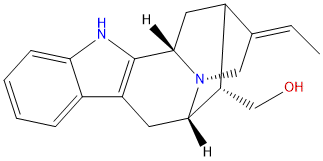
Koumidine (CAS number: 1358-75-4) is a natural alkaloid isolated from Tripterygium elegans. Gelsemium plants have always played an important role in traditional Chinese medicine, especially known for their anti-inflammatory, analgesic, and immunomodulatory effects. As one of the active ingredients in plants of the genus Gelsemium, Gelsemium has received widespread attention in pharmacology and medicinal chemistry in recent years due to its significant analgesic activity and multi-target mechanism of action. This article aims to systematically review the chemical structure and physicochemical properties, plant sources and extraction methods, pharmacological activity and mechanism of action, pharmacological evaluation, pharmacokinetic characteristics, and clinical application prospects of Gelsemium elegans, providing a theoretical basis and research direction for subsequent related research and new drug development.
The molecular formula of Gelsemium elegans is C18H24N2O, with a molecular weight of 294.3980. Its structure belongs to the alkaloid class, with a typical nitrogen heterocyclic skeleton, containing multiple aromatic rings and hydrophobic side chains. The LogP value is 2.4134, indicating that it has moderate lipid solubility, which is beneficial for membrane penetration. The polar surface area (TPSA) is 39.26 Å ², indicating moderate polarity and favorable binding with biomolecules. Low water solubility (0.1202 mg/mL) suggests limited solubility in aqueous phase, but sufficient to meet certain bioavailability requirements. Gelsemium has a high blood-brain barrier penetration ability, indicating that it can act on targets in the central nervous system. It is worth noting that the compound exhibits hERG channel inhibitory activity, indicating that its cardiac safety needs to be carefully evaluated. The Ames test result is 0, indicating that Gelsemium elegans has no significant genotoxicity.
The main source of Gelsemium elegans is Tripterygium elegans, which belongs to the Celastraceae family and is widely distributed in southern China and some parts of Southeast Asia. Gelsemium is used in traditional Chinese medicine as a medicinal herb for anti-inflammatory, analgesic, and immune regulation. The extraction of Gelsemium elegans is usually carried out using organic solvent extraction combined with column chromatography separation technology. The specific methods include:
In recent years, the application of ultrasound assisted extraction and supercritical fluid extraction technology has further improved the extraction efficiency and purity of Gelsemium elegans, providing technical support for its large-scale preparation.
The pharmacological activity of Gelsemium elegans mainly focuses on its analgesic effect. Numerous in vitro and in vivo experiments have shown that Gelsemium can significantly alleviate pain behaviors in various pain models, including inflammatory pain, neuropathic pain, and chronic pain. Its analgesic effect is comparable to traditional opioid drugs, but the side effects are relatively small.
In addition, Gelsemium also exhibits certain anti-inflammatory activity, which can inhibit the release of inflammatory mediators and alleviate tissue inflammatory reactions. Some studies have also found that it has certain antidepressant and anti anxiety effects, which may be related to its regulation of multiple targets in the central nervous system.
Specific pharmacological activities include:
The analgesic mechanism of Gelsemium elegans is complex, involving the regulation of multiple ion channels, receptors, and enzymes. Its main targets include:
Through multi-target synergistic effects, Gelsemium not only alleviates pain, but also regulates emotions and inflammatory responses, demonstrating its comprehensive advantages as a potential analgesic.
The pharmacological evaluation of Gelsemium elegans shows that it has good potential for drug development. Its molecular weight (294.4) and LogP value (2.41) comply with Lipinski's rule, indicating good oral bioavailability. TPSA (39.26 Å ²) is moderate and beneficial for membrane penetration and blood-brain barrier crossing, supporting the central nervous system function.
Low water solubility (0.12 mg/mL) may limit its dissolution rate, but it can be improved through formulation optimization. The high blood-brain barrier permeability makes it suitable for treating central pain. Inhibition of hERG channels suggests potential risks of cardiac toxicity and requires focused monitoring and optimization in subsequent drug development.
The negative result of Ames test indicates that Gelsemium elegans has no significant mutagenicity and is relatively safe. Preliminary pharmacokinetic studies have shown that Gelsemium elegans is rapidly absorbed after oral administration, with a moderate plasma half-life and widespread distribution, especially at high concentrations in brain tissue.
As a multi-target analgesic natural product, Gelsemium elegans has broad clinical application prospects. Its significant analgesic effect and low risk of side effects make it a promising new type of analgesic drug, especially suitable for the treatment of chronic pain, neuropathic pain, and inflammatory pain.
Future research should focus on:
In addition, the structural modification and derivative development of Gelsemium elegans will also provide abundant chemical space for the research and development of new drugs.
As an important alkaloid in the Gelsemium plant, Gelsemium elegans exhibits excellent analgesic activity and multi-target mechanism of action, with good medicinal properties and high safety potential. Its application prospects in the field of pain management are broad, and in the future, through systematic pharmacological, toxicological, and clinical research, it is expected to be developed into a new generation of efficient and safe analgesic drugs. The research on Gelsemium elegans not only enriches the theoretical system of natural product pharmacology, but also provides valuable examples and inspirations for the development of new natural product drugs.
