Introduction/Overview
Natural products have always been an important source of innovative drug discovery, and their unique chemical structures and diverse biological activities provide valuable molecular templates for tackling complex diseases. Among numerous natural compounds with potential, Achilleamide (CAS number: 42997-42-2) has gradually entered the field of researchers. As an alkaloid compound isolated from traditional medicinal plants, acalimide has attracted much attention due to its multi-target and multi pathway inhibitory activity in the field of anti-tumor. Its pharmacological effects are not limited to direct cytotoxicity, but also involve the regulation of multiple key links such as tumor cell apoptosis, invasion and metastasis, angiogenesis, and hormone metabolism, demonstrating great potential as a novel multi-target anti-tumor candidate drug. This article aims to systematically review the chemical properties, plant sources, pharmacological activities, mechanisms of action, pharmacological properties, and clinical application prospects of acalimide, in order to provide comprehensive academic references for the in-depth research and development of this compound.
Chemical structure and physicochemical properties
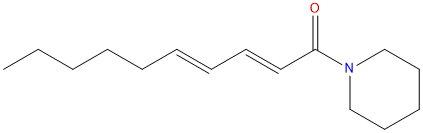
Acrylamide is a relatively simple phenylethylamine alkaloid derivative. Its basic skeleton consists of an aromatic ring system and an amide side chain, which gives it a certain degree of lipophilicity and the ability to form intermolecular hydrogen bonds. Its molecular formula is C ₁₄ H ₂₁ NO ₂, and its molecular weight is 235.3710 g/mol.
From the analysis of physical and chemical properties, the lipid water partition coefficient (LogP) of acalimide is 4.4370, indicating that the compound has high lipophilicity, which is beneficial for its penetration of cell membranes, but may also affect its water solubility. Its topological polar surface area (TPSA) is 20.310 Å ², which is a relatively low value, further confirming its low molecular polarity. The calculated water solubility value is 0.0379 mg/mL, which belongs to the category of insoluble compounds. This is a key issue that needs to be considered and addressed in the development of their formulations. It is worth noting that based on its physical and chemical parameters, acalimide has a high blood-brain barrier permeability, which provides unique advantages for its potential application in central nervous system tumors or related diseases. In addition, preliminary pharmacological risk assessment showed that the hERG inhibition risk was negative, and the Ames test result was 0.0 (indicating no mutagenicity). These early safety data laid a relatively good foundation for its subsequent development.
Plant sources and extraction methods
Achillea is mainly isolated from plants of the Achillea genus in the Asteraceae family, which is also the origin of its name. Yarrow plants are widely distributed worldwide, and many species have a long history of application in folk medicine, often used to treat inflammation, infections, and digestive system diseases. As one of the characteristic secondary metabolites of this genus of plants, the content of acarylamide varies depending on the plant species, origin, harvest season, and location.
At the laboratory scale, the extraction of acalimide is usually carried out using organic solvent extraction method. The common process is to crush dry plant materials (such as aboveground parts), first degreasing them with petroleum ether or n-hexane to remove strong lipophilic impurities such as chlorophyll and wax. Subsequently, medium polarity solvents such as chloroform, ethyl acetate, or methanol are used for repeated leaching or reflux extraction. After vacuum concentration, the crude extract obtained was preliminarily separated by silica gel column chromatography, using different ratios of petroleum ether ethyl acetate or chloroform methanol gradient elution. The fraction containing acarylamide is further purified by preparative thin layer chromatography, reverse phase column chromatography, or high performance liquid chromatography (HPLC) to obtain high-purity monomer compounds. Structural identification is accomplished through the comprehensive use of modern spectroscopic techniques such as nuclear magnetic resonance (NMR, including ¹ H-NMR and ¹ ³ C-NMR), mass spectrometry (MS), and infrared spectroscopy (IR). In order to meet the needs of pharmacological research and future development, developing efficient, environmentally friendly, and scalable extraction and separation processes, such as supercritical fluid extraction or high-speed countercurrent chromatography technology, will be the future research direction.
Pharmacological activity research
The most notable pharmacological activity of acalimide is its extensive anti-tumor effects. A large number of in vitro studies have shown that Akalimide has significant proliferation inhibitory activity on a variety of human tumor cell lines, including breast cancer, liver cancer, lung cancer, colon cancer and leukemia cells, and its IC ₀ values are mostly at the micromolar level, showing a broad spectrum of anti-cancer potential.
Its anti-tumor effect is mainly reflected in the following aspects:
1. Inhibition of cell proliferation and induction of apoptosis Acalimide can block the tumor cell cycle in the G0/G1 or S phase, preventing it from entering mitosis. More importantly, it can significantly induce programmed cell death (apoptosis) in tumor cells, manifested as cell shrinkage, chromatin condensation, phosphatidylserine eversion, and activation of the Caspase protease family.
2. Inhibit invasion and metastasis Tumor metastasis is the main cause of treatment failure and patient death. Research has found that acalimide can effectively inhibit the migration and invasion ability of tumor cells, which is closely related to its downregulation of the expression of certain key protein hydrolases.
3. Angiogenesis inhibition The growth and metastasis of tumors depend on the formation of new blood vessels (angiogenesis). Acalimide can cut off the nutritional supply to tumors by inhibiting the proliferation, migration, and lumen formation of endothelial cells.
4. Regulating hormone metabolism: For hormone dependent tumors (such as breast cancer), Akelimide also shows its influence on hormone metabolic pathways.
In addition to its anti-tumor activity, some studies also suggest that acalimide may have certain anti-inflammatory and neuroprotective effects, but research in these areas is still in its infancy and needs further exploration.
Mechanism of action and molecular targets
The anti-tumor effect of acalimide is not achieved through a single target, but presents the characteristics of multi-target and networked regulation, which enables it to intervene in multiple key links of tumor occurrence and development simultaneously, and may help overcome the problem of resistance to single target drugs. The molecular targets whose effects have been discovered or predicted so far mainly include:
-
Apoptosis regulatory targets (BCL2, MCL1)BCL2 and MCL1 are important anti apoptotic proteins that are overexpressed in various tumors and help tumor cells evade apoptosis. Research has shown that acalimide can downregulate the expression levels of BCL2 and MCL1, while possibly upregulating the expression of pro apoptotic proteins such as BAX, thereby breaking the balance of apoptosis and initiating mitochondrial pathway cell apoptosis.
-
Signal transduction targets (STAT3, MAPK1)STAT3 is a key oncogenic transcription factor in the tumor microenvironment, and sustained activation of STAT3 promotes cell proliferation, survival, and immune escape. Acalimide can inhibit the phosphorylation activation of STAT3 and block the transcription of downstream oncogenes. MAPK1 (ERK2) is a core component of the MAPK/ERK signaling pathway, which regulates cell growth and differentiation. The inhibition of acalimide may contribute to its cell cycle arrest effect.
-
Extracellular matrix degradation target (MMP2)Matrix metalloproteinase-2 (MMP2) can degrade type IV collagen in the extracellular matrix and is a key enzyme for tumor cell invasion and angiogenesis. Acalimide can significantly inhibit the expression and activity of MMP2, which directly explains its anti invasion and anti metastasis activity.
-
DNA metabolic targets (TOP1, TOP2A)Topoisomerase I (TOP1) and II α (TOP2A) are key enzymes that regulate DNA topology and are targets of many chemotherapy drugs, such as irinotecan and etoposide. Acalimide may cause irreparable damage during DNA replication and transcription by interfering with the function of these enzymes, leading to cell death.
-
Hypoxia and angiogenesis target (HIF1A)Hypoxia inducible factor-1 alpha (HIF1A) is stably expressed in hypoxic areas of tumors, activating a series of genes that promote angiogenesis, metabolic reprogramming, and invasion and metastasis. Acalimide may disrupt the hypoxic adaptation of tumors by inhibiting the stability or transcriptional activity of HIF1A.
-
Hormone related targets (ESR1, CYP19A1)Estrogen receptor alpha (ESR1) and aromatase (CYP19A1) are important targets for the treatment of estrogen dependent breast cancer. Acalimide may act as a regulator of estrogen receptors or a weak inhibitor of aromatase, interfering with the estrogen signaling pathway and thereby inhibiting hormone dependent tumor cell growth.
In summary, acalimide forms a complex anti-tumor pharmacological network by synergistically acting on multiple targets mentioned above, ultimately leading to inhibition of tumor cell proliferation, initiation of apoptosis, decreased invasion and metastasis ability, and obstruction of angiogenesis.
Evaluation of drug properties and pharmacokinetics
Although acalimide has shown excellent anti-tumor activity in vitro, its successful development as a drug highly depends on systematic drug efficacy evaluation and pharmacokinetic studies.
According to its physicochemical parameters, the advantage of acalimide lies in its high membrane permeability and blood-brain barrier permeability, which is beneficial for its tissue distribution, especially for brain tumors. It has no risk of hERG inhibition and negative Ames mutagenicity, preliminarily ruling out the hidden dangers of serious cardiac toxicity and genetic toxicity, and has a good safety starting point. However, its main challenge lies in Extremely low water solubility(0.0379 mg/mL), This can lead to problems such as poor oral absorption, low bioavailability, and difficulties in developing injectable drug formulations. High LogP values may also bring risks of large internal distribution volume and slow elimination.
At present, there are insufficient reports on the pharmacokinetic studies of the acalimide system. Based on the properties of similar compounds, it is speculated that their absorption after oral administration may be incomplete and irregular due to solubility limitations. After entering the bloodstream, due to its lipophilicity, it may be widely distributed in various tissues and organs, including brain tissue. In the body, acalimide is likely to be metabolized through the liver cytochrome P450 enzyme system (such as CYP3A4), producing hydroxylated or dealkylated products. Its original form and metabolites are mainly excreted through bile and kidneys.
In order to improve its medicinal properties, future research priorities should include:
1. Formulation strategy Develop new delivery systems such as nanocrystals, liposomes, micelles, solid dispersions, or cyclodextrin inclusion complexes to significantly improve their solubility and dissolution rate, and enhance oral bioavailability.
2. Prodrug design By introducing hydrophilic groups or linker molecules that can be specifically cleaved by enzymes in the body through chemical modification, water-soluble prodrugs are prepared, and active active active ingredients are released in vivo.
3. Research on ADME of the System Comprehensive absorption, distribution, metabolism, and excretion studies need to be conducted in both rodent and non rodent animals to clarify their pharmacokinetic characteristics, absolute bioavailability, major metabolic pathways, and potential drug drug interactions.
4. toxicological evaluation Conduct standardized preclinical safety evaluations for acute toxicity, repeated administration toxicity, reproductive toxicity, etc., and comprehensively evaluate their treatment window.
Clinical application prospects and prospects
As a multi-target natural anti-tumor candidate compound, acalimide has broad clinical application prospects, but also faces many challenges.
Potential application directions:
1. Single or combination therapy for solid tumors Given its multi-target nature, acalimide has the potential to be used as a single drug for the treatment of tumors that develop resistance to existing targeted drugs. A more realistic strategy is to use it in combination with existing chemotherapy drugs (such as topoisomerase inhibitors), targeted drugs, or immune checkpoint inhibitors, to enhance efficacy and reduce individual doses and toxic side effects through synergistic effects of different mechanisms.
2. Treatment of central nervous system tumors The high blood-brain barrier permeability predicted by it is its unique advantage, making it of special value in the treatment of malignant brain tumors such as glioblastoma, which can compensate for the difficulty of many large molecule targeted drugs and chemotherapy drugs entering the brain.
3. Adjuvant anti metastatic therapy Due to its clear inhibition of MMP2 and HIF1A activity, acalimide may be developed for adjuvant therapy after tumor surgery, aimed at clearing micro metastases, preventing tumor recurrence and distant metastasis.
Challenges and Prospects Faced:
1. Optimization of drug properties As mentioned earlier, poor water solubility is the primary bottleneck restricting its development. Future research in chemistry and pharmacy must focus on addressing this issue.
2. Deep explanation of mechanism At present, its target of action is mostly based on computational prediction and preliminary verification, and it is necessary to use chemical biology methods (such as affinity fishing, molecular probes) to clarify its direct target of action and draw more accurate signal network diagrams.
3. Confirmation of in vivo pharmacological effects More and more clinically relevant animal models (such as human tumor xenograft models and transgenic mouse models) need to be established to comprehensively evaluate their in vivo anti-tumor efficacy and dose-response relationship.
4. Structural optimization and development of analogues Using it as the parent nucleus, systematic structure-activity relationship studies and structural modifications are expected to obtain derivatives or analogues with stronger activity, lower toxicity, and better drug properties.
5. Explore new indications Based on its potential anti-inflammatory and neuroprotective activities, its research in neurodegenerative diseases (such as Alzheimer's disease) or autoimmune diseases can be expanded.
Conclusion
Acalimide is a natural alkaloid with significant multi-target anti-tumor activity discovered from traditional medicinal plants. It exhibits comprehensive efficacy in inhibiting tumor cell proliferation, inducing apoptosis, resisting invasion and metastasis, and resisting angiogenesis by regulating multiple key targets such as MCL1, BCL2, STAT3, MMP2, TOP1/2A, and HIF1A. Although its excellent in vitro activity and good early safety characteristics are encouraging, its low solubility and unclear pharmacokinetic properties are the core obstacles that must be overcome on its path to drug conversion. With the continuous advancement of modern pharmaceutical chemistry, pharmacy, and pharmacology technologies, acalimide is expected to be successfully optimized through dosage form innovation, prodrug design, and systematic preclinical research, providing a new candidate drug or lead compound with Chinese original characteristics for tumor treatment, especially for the treatment of multidrug resistance and brain tumors. Continued in-depth research on it will not only contribute to the development of new drugs, but also further enrich our understanding of the multi-target mode of action of natural products.