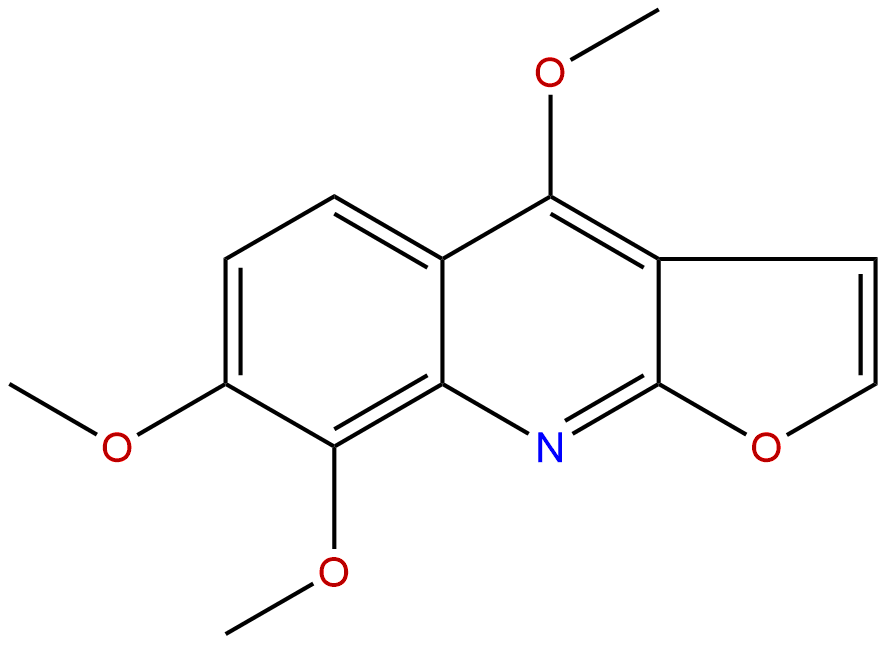


Product Name: Skimmianine
Synonym name: Beta-Fagarine; Chloroxylonine; Pentaphylline; 7,8-Dimethoxydictamnine;
Catalogue No.: BP1315
Cas No.: 83-95-4
Formula: C14H13NO4
Mol Weight: 259.261
Botanical Source: Alkaloid from Skimmia japonica, Haplophyllum tuberculum, Zanthoxylum ovalifolium, Zanthoxylum coco, Fagara coco, Fagara zanthoxyloides, Acronychia pedunculata, Acronychia laurifolia, Stauranthus perforatus and many other spp., mostly in the Rutaceae
Purity: 95%~99%
Analysis Method: HPLC-DAD or/and HPLC-ELSD
Identification Method: Mass, NMR
Packing: Brown vial or HDPE plastic bottle
Can be supplied from milligrams to grams.
For Reference Standard and R&D, Not for Human Use Directly.
Inquire for bulk scale.
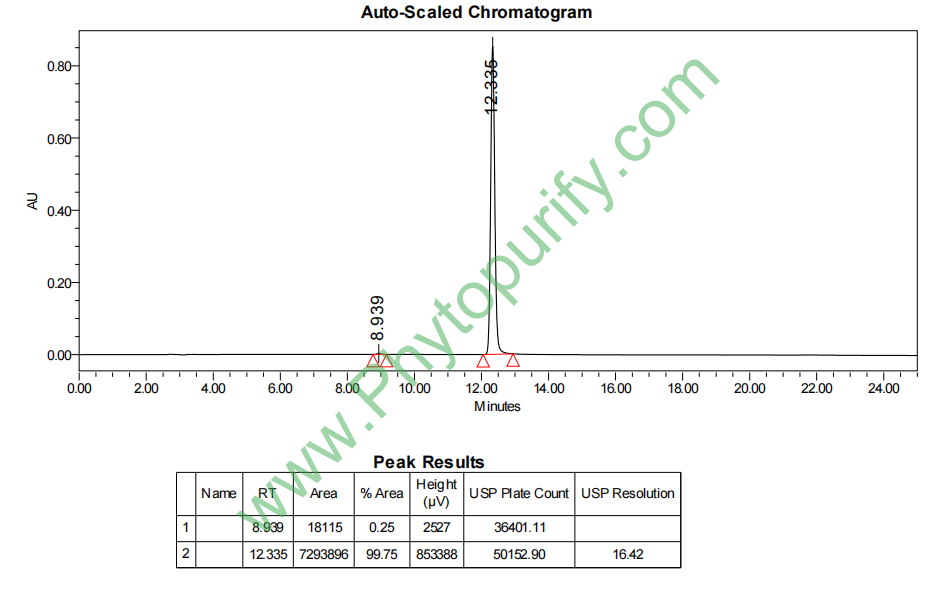
HPLC of Skimmianine
Storage conditions:Short-term storage at 2~8℃, long-term storage at -20 ~ -80℃
53.7200
2.2937
2.2937
.0361
3.1228
40.8424
High
84.0068
2.5232
Yes
No
Yes
No
Yes
Yes
1.5
Yes
No
Yes
Yes
Natural products have long been an important source of innovative drug discovery, among which alkaloid compounds have attracted much attention due to their structural diversity and significant biological activity. Skimmianine (CAS number: 83-95-4), as a typical furan quinoline alkaloid, is mainly distributed in Rutaceae plants and is one of the characteristic chemical components of this family. Since its isolation and identification, yam alkaloids have become a hot topic in natural product pharmacology research due to their extensive pharmacological activities. Early research revealed its traditional medicinal values such as pain relief, spasmolysis, and sedation, while modern pharmacological research has further deepened and found that it exhibits multiple biological activities in anti-inflammatory, neuroprotective, antioxidant, and potential anti-tumor aspects. Of particular note is that matrine can cross the blood-brain barrier, providing a prerequisite for its action on central nervous system related diseases such as neuroinflammation and neurodegenerative diseases. This article aims to systematically review the chemical structure, plant origin, pharmacological activity, mechanism of action, and pharmacological characteristics of yam alkaloids, and to prospect their clinical application prospects, in order to provide comprehensive scientific references for the in-depth research and potential drug development of this compound.
The chemical name of yam alkaloids is 4,7,8-trimethoxyfuran [2,3-b] quinoline, with a molecular formula of C14H13NO4 and a molecular weight of 259.2610. Its core structure is composed of a fused quinoline ring and a furan ring, belonging to the family of furan quinoline alkaloids. There are three methoxy groups (- OCH3) attached to the 4th, 7th, and 8th positions of the quinoline ring, and these substituents have important effects on its physicochemical properties and biological activity.
From the analysis of physical and chemical properties, the lipid water partition coefficient (LogP) of yam alkaloids is 2.2937, indicating that they have a certain lipophilicity, which is consistent with their ability to penetrate biological membranes (including the blood-brain barrier) well. Its topological polar surface area (TPSA) is 53.7200 Å ², which is relatively small and further supports its good membrane permeability. However, its water solubility is relatively low, around 0.0361 mg/mL, which may pose challenges in formulation development. In the preliminary safety screening, the Ames test value of Yinyu alkaloid was 1.5, indicating that it may have a slight mutagenic risk and needs to be given special attention in subsequent development. In addition, existing data shows that it does not inhibit hERG potassium channels, indicating a low risk of causing cardiac toxicity (such as long QT syndrome), which is a favorable pharmacological feature.
Yinyu alkaloids are mainly found in various plants of the Rutaceae family and are one of the characteristic alkaloids of this family. Common plants rich in humus alkaloids include Skimmia, Evodia, Ruta, Dictamnus, and Zanthoxylum. These plants have a history of application in traditional medicine in many regions around the world, especially in Asia and Europe, and are commonly used to treat pain, inflammation, spasms, and neurological disorders.
Organic solvent extraction is commonly used to extract matrine from plant materials. The common process includes crushing dried plant tissues (such as roots, stems, and leaves) and using polar organic solvents such as methanol, ethanol, or chloroform for cold soaking or hot reflux extraction. After filtration and concentration, the crude extract can be preliminarily purified using acid-base treatment: the total alkaloids are dissolved in a dilute acidic aqueous solution, alkalized, and then back extracted with organic solvents (such as chloroform and ethyl acetate) to obtain the total alkaloid fraction. Further separation and purification often rely on column chromatography techniques, often using silica gel, alumina, or reverse phase silica gel (such as C18) as the stationary phase, and gradient elution with solvent systems such as petroleum ether ethyl acetate and chloroform methanol in different ratios. High performance liquid chromatography (HPLC), especially preparative HPLC, is a key technology for obtaining high-purity linaloone monomers. Modern extraction techniques such as ultrasound assisted extraction and microwave-assisted extraction have also been applied, which can improve extraction efficiency and shorten time.
A large number of pharmacological studies both in vitro and in vivo have confirmed that yam alkaloids have various biological activities, and their spectrum of action is relatively broad.
Central nervous system activity Yinyu alkaloid exhibits significant sedative and analgesic effects. Animal experiments have shown that it can prolong pentobarbital induced sleep time and reduce acetic acid induced writhing reactions in mice. Its analgesic mechanism is partially independent of the opioid system and may be related to anti-inflammatory effects and affecting other neurotransmitters. Of particular importance is that matrine has inhibitory activity against acetylcholinesterase (AChE) (IC50=8.6 μ g/mL), indicating its potential to improve cholinergic neurotransmission and be associated with the treatment of cognitive disorders such as Alzheimer's disease.
Anti inflammatory and immune regulatory activity Anti inflammatory effect is one of the most prominent pharmacological properties of yam alkaloids. In various acute and chronic inflammation models, such as carrageenan induced rat foot swelling and lipopolysaccharide induced macrophage inflammation model, icariin can effectively inhibit the inflammatory response. It can significantly reduce the levels of pro-inflammatory cytokines such as tumor necrosis factor - α (TNF - α), interleukin-6 (IL-6), and interleukin-1 β (IL-1 β), while inhibiting the expression of inducible nitric oxide synthase (iNOS) and cyclooxygenase-2 (COX-2) and the production of their products (NO, PGE2).
Neuroprotective effect Based on its anti-inflammatory activity and ability to penetrate the blood-brain barrier, sophocarpine has shown potential in neuroprotection. Research has shown that in models such as cerebral ischemia-reperfusion injury and lipopolysaccharide induced neuropathy, matrine can alleviate neuronal damage and improve neurological deficits. Its function is closely related to inhibiting excessive activation of microglia, reducing oxidative stress and inflammatory cascade reactions.
Spasmodic and anti allergic effects Yinyu alkaloid can counteract smooth muscle spasms caused by various agonists, traditionally used to alleviate gastrointestinal and bronchial spasms. Its antispasmodic mechanism involves calcium channel blockade and anticholinergic effects. In addition, it can inhibit the release of histamine by mast cells and interfere with protein kinase C signaling and intracellular calcium mobilization, indicating its anti allergic potential.
Cytotoxicity and Genotoxicity It is worth noting that icariine shows cytotoxicity to many tumor cell lines (such as liver cancer, breast cancer and lung cancer cells), which provides clues for its anti-tumor research. However, some studies also suggest that matrine may have genetic toxicity (Ames test positive), and its potential carcinogenic risk needs to be evaluated through more comprehensive genetic toxicity testing in future drug development.
Cardiovascular protective effect In the myocardial ischemia-reperfusion injury model, icariin can reduce myocardial infarction area, inhibit myocardial cell apoptosis, and exhibit cardioprotective effects through its antioxidant and anti-inflammatory properties.
The multiple pharmacological activities of yam alkaloids stem from their regulation of multiple signaling pathways within cells, and their mechanism of action has been extensively studied at the molecular target level.
Core anti-inflammatory mechanism: targeting NF - κ B and PI3K/Akt pathway:
Regulation of specific targets:
anti-oxidative stress Yinyu alkaloid can enhance the activity of endogenous antioxidant enzymes such as superoxide dismutase and glutathione peroxidase, while reducing the levels of lipid peroxidation products such as malondialdehyde, thereby alleviating oxidative stress damage, which is particularly important in cardiovascular and neurological protection.
The impact on cellular signaling By inhibiting protein kinase C signaling and regulating intracellular calcium homeostasis, matrine affects various physiological and pathological processes such as degranulation of mast cells and smooth muscle contraction.
Although the pharmacological activity of yam alkaloids is extensive, their pharmacological properties as candidate drugs still require systematic evaluation.
pharmacokinetics Current research is relatively limited. The good lipid solubility (LogP~2.29) and small TPSA of Yinyu alkaloid indicate that its oral absorption may be better, and it can effectively penetrate the blood-brain barrier, which is its advantage in acting on the central nervous system. However, its low water solubility may limit its dissolution rate in gastrointestinal fluids, thereby affecting oral bioavailability. The key pharmacokinetic parameters such as metabolic pathways, major metabolites, half-life, tissue distribution, and excretion pathways in the body still need to be further studied through standardized animal experiments (such as rats and dogs).
safety evaluation In the evaluation of drug properties, safety is of paramount importance. A positive Ames test (value of 1.5) is a clear warning signal indicating that matrine may have mutagenicity. In drug development, a more comprehensive combination of genetic toxicity tests (such as micronucleus tests, chromosome aberration tests) must be conducted to clarify their risks. Research on acute toxicity, subacute toxicity, long-term toxicity testing, and reproductive toxicity is also essential. Although its lack of hERG inhibition suggests a low risk of cardiac toxicity, a comprehensive pharmacological evaluation of cardiovascular safety is still needed.
Formulation development challenges Low water solubility is the main bottleneck in the development of yam alkaloids. Advanced drug delivery technologies such as nanocrystals, liposomes, cyclodextrin inclusion complexes, or solid dispersions may be required to enhance their solubility and oral bioavailability. Regarding its potential genetic toxicity, it is also necessary to consider how to reduce the risk through structural modification or prodrug design during the formulation process.
The multi-target action characteristics of yam alkaloids provide possibilities for their application in various disease fields, but there are still challenges and opportunities for their clinical application.
Potential therapeutic areas:
challenges faced:
Future research directions:
As a furan quinoline alkaloid derived from traditional medicinal plants, yam alkaloids have become an attractive candidate molecule in the field of natural product drug development due to their unique chemical structure and extensive and significant pharmacological activities, especially their excellent anti-inflammatory, neuroprotective effects, and ability to penetrate the blood-brain barrier. By regulating core signaling pathways such as NF - κ B and PI3K/Akt, it intervenes in inflammation and oxidative stress processes with multiple targets, demonstrating the potential for treating complex diseases such as neurodegenerative diseases and chronic inflammation. However, the potential genetic toxicity risks and the need to improve pharmacokinetic characteristics are key scientific issues that must be seriously addressed and resolved on its path towards clinical application. Future research should focus on improving its safety through structural optimization, elucidating its precise molecular mechanism of action using modern technology, and conducting systematic preclinical development studies. Only by overcoming these challenges can this ancient natural molecule be revitalized and have the potential to contribute new therapeutic drugs to human health.
