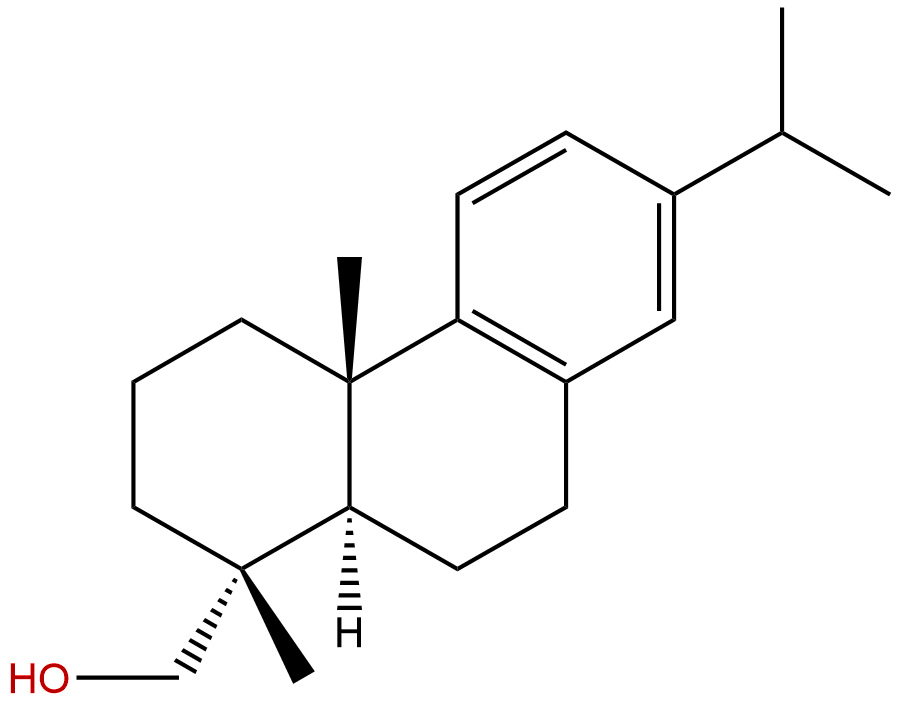


Storage conditions:Short-term storage at 2~8℃, long-term storage at -20 ~ -80℃
Dehydroabietinol (CAS number: 3772-55-2) is a typical diterpenoid compound of the rosin class, widely present in the resin of pine trees. As an important diterpenoid member in natural products, dehydroabietic alcohol has attracted widespread attention in the field of pharmacology research in recent years due to its unique structure and diverse biological activities. Especially in terms of immune regulation and antimicrobial activity, dehydroabietic alcohol has shown significant potential and has become an emerging candidate molecule for studying immune-mediated diseases and anti infective therapies.
This review aims to systematically summarize the chemical structure and physicochemical properties, plant sources and extraction methods, pharmacological activity and mechanism of action, pharmacological evaluation and pharmacokinetic characteristics of dehydroabietic alcohol, and explore its potential value and future development direction in clinical applications, providing comprehensive reference materials for researchers in related fields.
Dehydroabiethanol belongs to the class of diterpenes of the rosin alkane, with a molecular formula of C20H30O and a molecular weight of 286.4590. Its structure is based on a tricyclic rosin alkane skeleton, containing a hydroxyl functional group that endows it with certain polarity and reactivity. The chemical structure characteristics of dehydroabietic alcohol make it exhibit strong lipophilicity in intermolecular interactions.
In terms of physicochemical properties, the LogP value of dehydroabietic alcohol is 5.6412, indicating strong hydrophobicity, which is beneficial for its penetration of cell membranes, but also limits its water solubility (only 0.0008), which may have a certain impact on its bioavailability. The topological polar surface area (TPSA) of dehydroabietic alcohol is 20.2300, and lower TPSA is usually associated with better cell membrane permeability. In addition, dehydroabietic acid has a high blood-brain barrier penetration ability, which makes it potentially valuable for research on central nervous system related diseases. In terms of safety, dehydroabietic alcohol did not exhibit hERG channel inhibition, and the Ames mutagenicity test result was 0, indicating a low risk of cardiac toxicity and genotoxicity.
Dehydrosol is mainly present in the resin and leaves of pine plants, especially in the pine resin of coniferous trees such as Picea spp., Abies spp., and Pinus spp., where the content is relatively high. Rosin, as a traditional natural resin, has a long history and is widely used in industrial and pharmaceutical fields. Its composition is complex, and dehydroabietic alcohol is one of the important active ingredients.
The common methods for extracting dehydroabietic alcohol include solvent extraction, liquid-liquid distribution, and chromatographic purification. Traditional extraction solvents often use organic solvents such as ethanol, methanol, or ethyl acetate to improve extraction efficiency through reflux or ultrasound assisted extraction. The extract was further purified using techniques such as silica gel column chromatography and reverse phase high-performance liquid chromatography (RP-HPLC) to obtain high-purity dehydroabietic alcohol. In recent years, supercritical CO2 extraction technology has been gradually applied to the extraction of dehydroabietic alcohol due to its green environmental protection and high selectivity, significantly improving the extraction purity and yield.
The pharmacological activity research of dehydroabietic alcohol mainly focuses on its immunomodulatory and antimicrobial effects. It exhibits inhibitory activity against the immune related kinase SYK (Spleen Tyrosine Kinase) with an IC50 value of 46.4 μ M. SYK, as a key kinase in immune cell signal transduction, participates in signal transduction mediated by B cell receptor (BCR) and Fc receptor, regulating inflammatory response and immune cell activation. Dehydrosol exhibits potential immunomodulatory functions by inhibiting SYK kinase activity, making it suitable for research on immune-mediated diseases such as autoimmune and inflammatory diseases.
In addition, dehydroabietic alcohol has shown a wide range of effects in terms of antimicrobial activity. Its targets involve multiple key molecules, including:
The diversity of these targets suggests that dehydroabietic alcohol may exert its antimicrobial activity through multi-target synergistic effects, covering various pathogens such as bacteria and fungi, demonstrating broad anti infective potential.
The mechanism of action of dehydroabietic alcohol is mainly based on its regulation of immune signaling pathways and key microbial enzymes. As an inhibitor of SYK kinase, dehydroabietic acid blocks the tyrosine kinase activity of SYK, interferes with signal transduction in B cells and other immune cells, inhibits the release of inflammatory mediators and overactivation of immune cells, thereby reducing immune-mediated tissue damage.
In terms of antimicrobial activity, dehydroabietic alcohol exerts its effects through a multi-target mechanism:
Immune regulatory targets By regulating the TLR4-MyD88 signaling pathway, dehydroabietic acid can modulate innate immune responses and enhance host recognition and clearance of pathogens.
Bacterial and fungal targets Dehydrosol inhibits the activity of key enzymes such as DHFR, ERG11, CYP51, FKS1, blocking the metabolism and membrane synthesis of pathogens, and inhibiting their growth and reproduction.
DNA replication and cell wall synthesis targets By acting on GYRB and PBP2, dehydroabietic alcohol affects bacterial DNA replication and cell wall synthesis, further enhancing its antibacterial effect.
Antimicrobial peptide regulation The regulation of DEFB1 by dehydroabietic alcohol may promote the expression of host antimicrobial peptides and enhance natural immune defense.
These multi-target synergistic mechanisms provide a theoretical basis for the application of dehydroabietic alcohol in complex infectious environments, and also provide important clues for its development as a novel anti infective drug.
The pharmacological parameters of dehydroabietic alcohol indicate that it has certain potential for drug development. Its high LogP value (5.6412) indicates that the molecule is highly hydrophobic, facilitating membrane penetration, but may lead to poor water solubility (0.0008), posing a challenge to oral bioavailability. Low TPSA (20.2300) and high blood-brain barrier penetration ability suggest that dehydroabietic acid has potential advantages in the treatment of central nervous system diseases.
In terms of safety, dehydroabietol did not exhibit hERG channel inhibition, reducing the risk of cardiac toxicity; The Ames test is negative, indicating no significant mutagenicity, which provides a good safety basis for its clinical application.
At present, there is limited research on the pharmacokinetics of dehydroabietic alcohol. Existing data suggests that its in vivo metabolism may involve liver enzyme systems, and high hydrophobicity may lead to strong tissue accumulation. Further research on in vivo absorption, distribution, metabolism, and excretion (ADME) is needed in the future to clarify its pharmacokinetic characteristics and dosage form optimization strategies.
The activity of dehydroabietic alcohol in immune regulation and antimicrobial fields provides broad prospects for its clinical application. As a SYK kinase inhibitor, dehydroabietol is expected to be applied in the treatment of autoimmune diseases (such as rheumatoid arthritis, systemic lupus erythematosus) and inflammatory diseases, by regulating immune signaling pathways to alleviate pathological inflammation.
Its broad-spectrum antimicrobial activity covers various pathogens such as bacteria and fungi, especially its potential inhibitory effect on drug-resistant strains, making it an emerging candidate drug for anti infective treatment. In addition, the excellent blood-brain barrier penetration ability of dehydroabietic acid provides the possibility for the treatment of central nervous system infections and related diseases.
However, the bioavailability issues caused by the low water solubility and hydrophobicity of dehydroabietic alcohol, as well as the lack of systematic preclinical and clinical research, remain the main obstacles in its development process. Future research should focus on:
Through interdisciplinary collaboration, dehydroabietic alcohol is expected to become an important player in the development of natural product drugs.
Dihydroabietic alcohol, as a type of rosin based diterpenoid, has shown extensive potential in the fields of immune regulation and antimicrobial activity due to its unique chemical structure and multi-target pharmacological activity. Its inhibitory effect on SYK kinase provides a new approach for the treatment of immune-mediated diseases, while its multi-target antimicrobial mechanism provides valuable lead compounds for the development of anti infective drugs.
Although there are still many challenges in the development and clinical application of dehydroabietic acid, with the continuous deepening of extraction and purification technology, drug delivery systems, and pharmacological mechanism research, dehydroabietic acid is expected to play an important role in the future development of natural product drugs. Future research should focus on systematic pharmacokinetic studies and preclinical validation, promoting their clinical translation and ultimately benefiting patients.
