Introduction/Overview
Natural products have long been an important source of innovative drug discovery, among which isoquinoline alkaloids have attracted much attention due to their structural diversity and wide range of biological activities. Ruikulin (+) - Riticoline, also known as bovine heart fruit alkaloid, is a tetrahydroisoquinoline alkaloid with (S) - configuration, CAS number 485-19-8. As a key precursor in the biosynthesis pathways of various complex alkaloids such as morphine and berberine, it also exhibits unique pharmacological activities. In recent years, with the deepening understanding of the pathological mechanisms of cardiovascular diseases such as heart failure and the rise of multi-target treatment strategies, Ruikuling has re entered the research field due to its regulatory effects on multiple potential disease-related targets such as AMPK, EHMT2, MAOA, etc. Its pharmacological parameters, such as good blood-brain barrier permeability and low potential genetic toxicity risk, further enhance its development value as a lead compound. This article aims to systematically review the chemical properties, plant sources, pharmacological activities, mechanisms of action, medicinal properties, and clinical application prospects of Ruikuling, in order to provide comprehensive scientific references for the in-depth research and potential drug development of this natural product.
Chemical structure and physicochemical properties
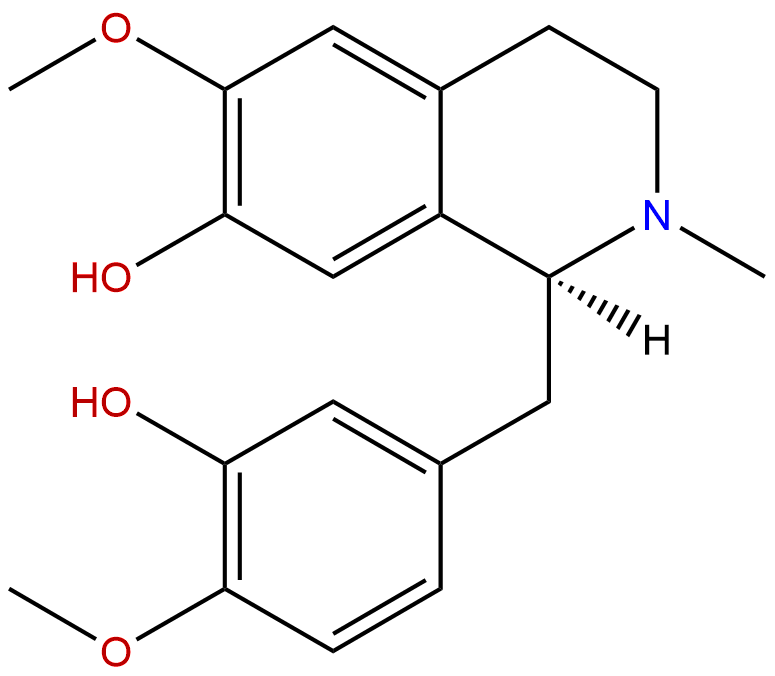
The chemical name of (+) - Riticoline is (S) -1,2,3,4-tetrahydro-1- [(3-hydroxy-4-methoxyphenyl) methyl] -6-methoxy-7-hydroxy-2-methylisoquinoline, with a molecular formula of C19H23NO4 and a molecular weight of 329.3960. Its core structure is a tetrahydroisoquinoline skeleton, with methoxy and hydroxyl groups connected at positions 6 and 7, respectively, and hydroxyl and methoxy groups connected at positions 3 'and 4' of the benzyl substituent at position 1. This (S) - configuration is the key to its biological activity, making it significantly different from the (R) - enantiomer in terms of biological activity.
From the analysis of physical and chemical properties, the lipid water partition coefficient (LogP) of Ruikuling is 2.5236, indicating that it has moderate lipophilicity and is conducive to transmembrane transport. Its topological polar surface area (TPSA) is 62.1600 Å ², which is relatively moderate, suggesting that it may have good membrane permeability. The water solubility data (0.4478 mg/mL) shows that it belongs to the category of slightly soluble to poorly soluble, which may require consideration of solubilization strategies in formulation development. Of particular note is that its blood-brain barrier (BBB) permeability is predicted to be "high", suggesting that the compound can effectively enter the central nervous system, which is of great significance for potential therapeutic applications targeting central targets such as MAOA and APP. In addition, preliminary pharmacological risk assessment shows that it has no inhibitory activity on hERG potassium channels (hERG inhibition: no), reducing the risk of inducing QT interval prolongation in the heart; The Ames test result is 0.0, indicating no mutagenicity in this testing system, providing preliminary positive signals for its safety.
Plant sources and extraction methods
Ruikuling is widely present in various plants such as Papaveraceae, Annonaceae, Magnoliaceae, and Menispermaceae. It's a poppy(Papaver somniferum)The key intermediate in the biosynthesis pathway of morphine is also found in the cowheart lychee(Annona reticulata Its name "Niuxinguojian" comes from this), Magnolia officinalis(Magnolia officinalis)And various species of the genus Tripterygium(Stephania)Separated and identified in plants.
The extraction method usually follows the conventional process of natural product chemistry. Firstly, plant materials such as roots, stem bark, or fruits are dried and crushed, and then subjected to cold soaking or heating reflux extraction using polar solvents such as methanol or ethanol. After vacuum concentration, the crude extract was subjected to liquid-liquid distribution using solvents such as petroleum ether and ethyl acetate to preliminarily remove oil and impurities of different polarities. Ruikuling is mainly enriched in the ethyl acetate fraction. Further purification is often carried out using column chromatography technology, often using silica gel as the stationary phase and gradient elution systems such as chloroform methanol or dichloromethane methanol for separation. Due to its optical activity, obtaining high enantiomeric purity of (S) - Ruikuling may require the use of chiral stationary phase high-performance liquid chromatography (HPLC) for final purification. Modern biotechnology also provides alternative solutions, such as using metabolically engineered microorganisms (such as yeast) for fermentation production, providing a potential pathway for large-scale acquisition of the compound.
Pharmacological activity research
The pharmacological activity research of Ruikuling has revealed its multifaceted biological effects, especially showing potential in the fields of cardiovascular system, nervous system, and cancer.
- Cardiovascular protective effect This is currently the most popular active direction of Ruikuling. Research has shown that Ruikuling exhibits cardioprotective effects in various experimental heart failure models. The mechanism may involve improving myocardial energy metabolism, inhibiting myocardial fibrosis, and cell apoptosis. Its potential activation effect on AMPK (PRKAA1) is particularly crucial, as AMPK is a core regulatory factor of cellular energy metabolism. Its activation can promote glucose uptake and fatty acid oxidation, provide energy support for the failing heart, and inhibit pathological myocardial hypertrophy.
- Neuropsychiatric system activity Ruikuling has an inhibitory effect on monoamine oxidase A (MAOA). MAOA is a key enzyme that degrades monoamine neurotransmitters such as serotonin and norepinephrine, and its inhibitors are commonly used to treat depression. Therefore, Ruikuling may have antidepressant potential. In addition, its high blood-brain barrier permeability supports its pivotal role. Its potential regulatory effect on beta amyloid precursor (APP) also suggests that it is worth exploring in Alzheimer's disease related research.
- Anti inflammatory and antioxidant activity The phenolic hydroxyl group in the structure of Ruikuling endows it with antioxidant capacity and can scavenge free radicals. The study also found that it has a regulatory effect on certain inflammatory mediators, such as lipoxygenase products produced through the ALOX15 pathway, which complements its potential cardiovascular and neuroprotective effects.
- Antitumor and Multidrug Resistance Regulation Ruikuling exhibits regulatory effects on ABC transporter family members such as ABCB1 (P-glycoprotein) and ABCG2 (BCRP). These proteins are one of the main mechanisms of multidrug resistance (MDR) in tumors. Ruikuling may serve as an MDR reversing agent, enhancing the accumulation of chemotherapy drugs in drug-resistant tumor cells. In addition, its potential inhibition of histone methyltransferase EHMT2 (G9a) may affect the epigenetic regulation of tumors and inhibit tumor growth.
- Other activities: It has also been reported that Ruikuling has a slight estrogen receptor beta (ESR2) regulatory activity and acts as an inhibitor of protein tyrosine phosphatase 1B (PTPN1), which is a potential therapeutic target for diabetes and obesity.
Mechanism of action and molecular targets
The pharmacological effects of Ruikuling exhibit multi-target characteristics, which are consistent with its complex chemical structure and extensive biological effects. Based on existing research, its mechanism of action mainly revolves around the following key targets:
- AMPK(PRKAA1)AMP activated protein kinases are the "main switches" of cellular energy homeostasis. Ruikuling may activate AMPK directly or indirectly. Activated AMPK promotes fatty acid oxidation, glucose transport, and inhibits protein and lipid synthesis, thereby improving the energy deficiency of myocardial cells in heart failure and inhibiting pathological myocardial remodeling. This is the core mechanism hypothesis of its anti heart failure effect.
- EHMT2(G9a)Histone lysine methyltransferase G9a mainly catalyzes the dimethylation of lysine at position 9 of histone H3 (H3K9me2), which is an epigenetic marker associated with gene transcription inhibition. Inhibiting G9a can reactivate certain silenced tumor suppressor genes or beneficial genes. The potential inhibitory effect of Ruikuling on G9a may provide an epigenetic explanation for its anti-tumor and cardioprotective effects (by affecting fibrosis related gene expression).
- MAOA Monoamine oxidase A is a mitochondrial outer membrane enzyme. As a MAOA inhibitor, Ruikuling can reduce the degradation of central and peripheral monoamine neurotransmitters (such as serotonin and norepinephrine), thereby increasing the concentration of synaptic neurotransmitters. This may be the direct mechanism of its antidepressant and potential neuroprotective effects.
- ABC transporters (ABCB1, ABCG2)Ruikuling may act as a substrate or competitive inhibitor for these efflux pumps, competing with chemotherapy drug binding sites to prevent the latter from being pumped out of cells and reversing tumor multidrug resistance.
- Other targets Its inhibition of ALOX15 (lipoxygenase) may reduce the production of pro-inflammatory leukotrienes; Inhibition of PTPN1 can enhance the insulin signaling pathway; The regulation of APP may affect the pathway of amyloid protein production. These targets together form the network basis for the pleiotropic pharmacological effects of Ruikuling.
It should be pointed out that the direct interaction strength and specificity between Ruikuling and these targets still need to be further verified and elucidated through biophysical methods such as crystal co structure analysis and isothermal titration calorimetry (ITC).
Evaluation of drug properties and pharmacokinetics
Based on the provided parameters and existing research, a preliminary evaluation of the pharmacological properties of Ruikuling is conducted
- Absorption and distribution Moderate LogP (2.52) and TPSA (62.16) predict that it may have good intestinal absorption after oral administration. Its high blood-brain barrier permeability is its significant advantage, laying the foundation for the development of central nervous system drugs. The molecular weight of 329.4 conforms to the rules of drug likeness.
- Metabolism and excretion As an isoquinoline alkaloid, Ruikuling is likely to undergo extensive phase I and phase II metabolism. Phase I metabolism may involve the oxidation or O-demethylation of aromatic rings by cytochrome P450 enzyme systems (such as CYP2D6, CYP3A4); The combination reaction of II mainly involves glucuronidation and sulfation. Its inhibition of MAOA may also affect the metabolism of itself and other monoamine substances. At present, there is a lack of detailed pharmacokinetic data in vivo (such as half-life, oral bioavailability, tissue distribution, etc.), which is a gap that must be filled in future preclinical studies.
- Preliminary Safety Assessment The absence of hERG inhibition and negative Ames mutagenicity are important early safety signals. However, comprehensive safety evaluation still requires in vitro liver cell toxicity testing, microsomal stability testing, and long-term animal toxicology studies. Its multi-target nature is a double-edged sword, as it brings therapeutic advantages but may also increase the risk of off target effects and unpredictable toxic side effects.
- pharmaceutical properties Low water solubility (0.45 mg/mL) may affect the development of its formulations, especially injectable forms. It may be necessary to improve its dissolution and bioavailability through strategies such as salt formation (such as forming hydrochloride salts), preparation of nanocrystals, use of cyclodextrin inclusion or liposome drug loading.
Overall, Ruikuling possesses multiple advantageous physicochemical properties and preliminary safety indicators to become a lead compound, but its pharmacokinetic characteristics and detailed toxicological profile are key factors determining its successful conversion into a drug.
Clinical application prospects and prospects
The clinical application prospects of Ruikuling mainly rely on its multi-target pharmacological properties, especially in the field of complex disease treatment, which may have unique value.
- heart failure This is the most promising direction. Traditional heart failure treatment drugs (such as beta blockers and ACEI/ARBs) mainly target neuroendocrine overactivation, while Ruikuling directly targets the core pathological link of myocardial cell energy metabolism disorders by activating AMPK, providing a new treatment strategy. It may serve as a supplement or adjuvant to existing standard treatments, particularly suitable for heart failure patients with severe energy metabolism impairment. Its potential anti fibrotic (through targets such as EHMT2) and antioxidant effects are also in line with the multi mechanism treatment concept of heart failure.
- Central nervous system diseases Its MAOA inhibitory activity and high BBB permeability make it potential for development as a novel antidepressant. Meanwhile, the regulatory effect of APP provides imaginative space for its application in the prevention or treatment of Alzheimer's disease, although this requires extensive research verification.
- neoadjuvant therapy As a regulator of ABCB1/ABCG2, Ruikuling or its derivatives may be used to reverse tumor multidrug resistance and improve chemotherapy efficacy when combined with conventional chemotherapy drugs. Its epigenetic regulatory activity (EHMT2 inhibition) also provides clues for the development of novel anti-tumor drugs.
- Outlook and Challenges:
- structural optimization Using Ruikuling as the lead compound for structural modification, the aim is to enhance its selectivity and efficacy towards specific targets such as AMPK, improve its water solubility and pharmacokinetic properties, while reducing potential off target toxicity.
- Deepening mechanism There is an urgent need to utilize technologies such as gene knockout and chemical proteomics to accurately validate their direct interaction with candidate targets and upstream and downstream signaling pathways in cell and animal models.
- Research on the synergistic effect of multiple targets The focus is on exploring how it can generate synergistic therapeutic effects among multiple targets in complex disease models such as heart failure, which is its core advantage over highly selective single target drugs.
- Preclinical development Completing pharmacological, pharmacokinetic, and toxicological studies that meet IND application requirements is a necessary step in advancing the system towards clinical trials.
Conclusion
As a natural source of tetrahydroisoquinoline alkaloid, (+) - Riticoline is far more than just an intermediate in the biosynthesis of various alkaloids. Its unique (S) - configuration, excellent drug like parameters (especially high blood-brain barrier permeability), and regulatory ability against multiple disease-related targets such as AMPK, EHMT2, MAOA, ABC transporter, make it an attractive multi-target lead compound. Especially in the field of heart failure treatment, its mechanism of action against the core defect of myocardial energy metabolism provides an important supplementary perspective for the current treatment plan mainly based on neuroendocrine inhibition. Although it has shown potential in the reversal of neuropsychiatric disorders and tumor drug resistance, translating it into clinically available drugs still faces many challenges, including confirming the mechanism of action, optimizing selectivity, improving pharmacokinetic properties, and comprehensive safety evaluation. Future research should focus on using modern medicinal chemistry and biological techniques to deeply elucidate its multi-target action network, and based on this, carry out reasonable structural optimization, ultimately promoting the revitalization of this ancient natural molecule and providing new candidate drugs for the treatment of complex diseases such as heart failure.