| Catalog No | Package | Original Price | Price | Inventory | Quantity | Operating |
|---|---|---|---|---|---|---|
| BP5076-5mg | 5mg | $750.00 | Sign in |
|


Storage conditions:Short-term storage at 2~8℃, long-term storage at -20 ~ -80℃
Natural products, as an important source of drug discovery, occupy an irreplaceable position in modern pharmacological research. Aconitum carmichaelii, as a traditional Chinese medicinal herb, has attracted much attention due to its rich diterpenoid alkaloids. Aconicarchine B is a novel C20 diterpenoid alkaloid isolated from Aconitum carmichaelii, which has become a research hotspot in recent years due to its significant antiarrhythmic activity. Arrhythmia, as a common and life-threatening cardiovascular disease in clinical practice, urgently requires safer and more effective drugs for its treatment. Aconicarchine B exhibits good pharmacological activity and superior safety by regulating multiple cardiac ion channel related targets, demonstrating broad clinical application potential.
This article will provide a systematic review of the chemical structure and physicochemical properties, plant sources and extraction methods, pharmacological activity and mechanism of action, pharmacological evaluation and pharmacokinetic characteristics of Aconicarcimine B. Combined with current research progress, it will explore its clinical application prospects and development directions in the field of antiarrhythmic drugs.
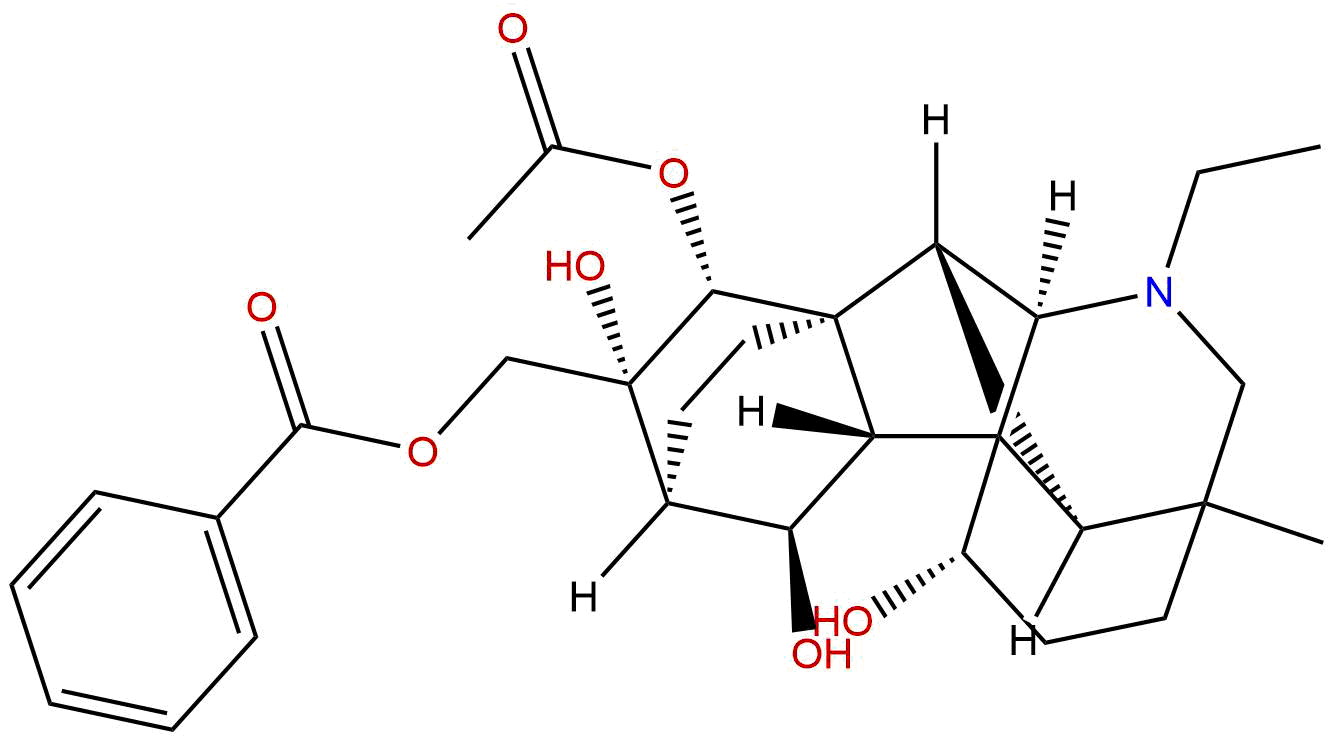
Aconicarchine B belongs to the C20 diterpenoid alkaloid class, with a complex molecular formula and a typical polycyclic terpene skeleton structure. Its molecular weight is 539.6690, and its molecular structure contains multiple chiral centers and nitrogen-containing groups, endowing it with unique chemical and biological activity characteristics. The LogP value of the molecule is 2.6727, indicating that it has moderate lipid solubility, which is beneficial for membrane penetration and bioavailability. The TPSA (topological polar surface area) is 116.5300, indicating moderate polarity, which may affect its binding affinity and in vivo distribution with the target.
Low water solubility (0.0784) suggests limited solubility in aqueous phase and may require improvement in bioavailability through formulation techniques. The low permeability of the blood-brain barrier reduces the risk of central nervous system side effects. Importantly, Aconicorachamine B does not exhibit hERG channel inhibitory activity, which is crucial for the safety assessment of antiarrhythmic drugs and avoids potential drug-induced arrhythmia risks. The Ames test result is negative, indicating that it does not have significant genotoxicity, further supporting its safety.
Aconicarchine B is mainly isolated from Aconitum carmichaelii. Chuanwu, a plant of the Aconitum genus in the Ranunculaceae family, is an important medicinal herb used in traditional Chinese medicine for dispelling wind, dispelling cold, and relieving pain. The roots of Chuanwu are rich in various diterpenoid alkaloids, with complex structures and abundant biological activities.
During the extraction process, organic solvents such as methanol and ethanol are usually used to leach the dried powder of Chuanwu, followed by multi-step separation and purification techniques such as liquid-liquid distribution and column chromatography to obtain the target compound. High performance liquid chromatography (HPLC) and mass spectrometry (MS) techniques are widely used for purity detection and structural identification. In recent years, emerging technologies such as ultrasound assisted extraction and microwave-assisted extraction have also been introduced to improve extraction efficiency and yield.
In addition, considering the toxicity of other alkaloids in Aconitum carmichaelii, strict control of the purification steps is required in the extraction process to ensure the purity and safety of Aconitum B, laying the foundation for subsequent pharmacological research and clinical applications.
Aconicarchine B, as a novel C20 diterpenoid alkaloid, exhibits the most significant pharmacological activity of antiarrhythmic effects. Multiple in vitro and in vivo experiments have shown that Aconcarachine B can effectively regulate cardiac electrophysiological function, stabilize myocardial cell membrane potential, and reduce the frequency of abnormal heart rhythm.
In the ex vivo heart model, Aconicarcimine B showed the ability to inhibit premature ventricular contractions and atrial fibrillation, and had a relatively mild effect on heart rate, avoiding the negative cardiac effects commonly seen with traditional antiarrhythmic drugs. Cellular electrophysiological studies further reveal its regulatory effects on various cardiac ion channels, including potassium channels, sodium channels, and calcium channels.
In addition, in animal experiments, Aconicotinamine B demonstrated cardioprotective effects by improving myocardial ischemia-reperfusion injury and reducing myocardial cell apoptosis. Its antioxidant and anti-inflammatory activities have also been reported, suggesting that it may exert cardiovascular protection through multi-target and multi pathway synergistic effects.
The antiarrhythmic mechanism of Aconicarchine B mainly relies on the regulation of key cardiac ion channels. Its targets include:
Through the synergistic effect of multiple targets, Aconicarcimine B can effectively regulate the electrical activity of myocardial cells, inhibit abnormal excitation and conduction, and exert anti arrhythmic effects. This multi-target mechanism not only enhances the broad-spectrum efficacy of drugs, but also reduces the risk of drug resistance and side effects from single target drugs.
The pharmacological evaluation of Aconicarchine B shows that it has good potential for drug development. The molecular weight is 539.6690, slightly higher than the ideal range of traditional small molecule drugs, but its moderate LogP value (2.6727) and TPSA (116.5300) ensure good cell membrane penetration and targeted binding ability.
Low water solubility (0.0784) suggests the need to improve bioavailability through formulation optimization techniques such as nanocarriers, liposomes, or solid dispersions. The blood-brain barrier has low permeability, which helps reduce central nervous system side effects and is suitable for targeted therapy of the cardiovascular system.
In terms of safety, Aconicarchine B does not inhibit hERG channels, reducing the risk of drug-induced arrhythmia. A negative Ames test indicates no significant genotoxicity and meets drug safety requirements.
Pharmacokinetic studies are still in the preliminary stage, and the characteristics of in vivo absorption, distribution, metabolism, and excretion (ADME) need further clarification. Preliminary data suggests that Aconicotinamine B has a moderate half-life in animals, and its metabolic pathway may involve the liver cytochrome P450 enzyme system. The activity and toxicity of its metabolites require further investigation.
Arrhythmia, as a serious cardiovascular disease that threatens life, has limited efficacy and significant side effects with existing treatment drugs. Aconicarchine B, with its unique chemical structure, multi-target mechanism of action, and good safety, has demonstrated the potential to become a new generation of antiarrhythmic drugs.
The future clinical application prospects include:
However, the clinical translation of Aconicarchine B still faces many challenges, such as optimizing large-scale preparation processes, conducting systematic pharmacokinetic and toxicological evaluations, validating preclinical animal models, and designing clinical trials. Future research needs to strengthen the molecular level analysis of its mechanism of action, improve safety and efficacy data, and promote its clinical application.
Aconicarchine B, as a C20 diterpenoid alkaloid isolated from Aconitum carmichaelii, has become an important research object in the field of natural product pharmacology due to its unique chemical structure and multi-target antiarrhythmic activity. Its good pharmacological parameters and safety characteristics provide a solid foundation for the development of new drugs for the treatment of arrhythmia. Although research on its pharmacokinetics and clinical applications is still in its early stages, with the advancement of modern drug development technology, Aconicarcimine B is expected to play an important role in the treatment of cardiovascular diseases in the future.
Continuous and in-depth basic research and clinical translation work will help reveal its comprehensive pharmacological mechanism, optimize drug design, promote its clinical application, and ultimately benefit the majority of arrhythmia patients.
