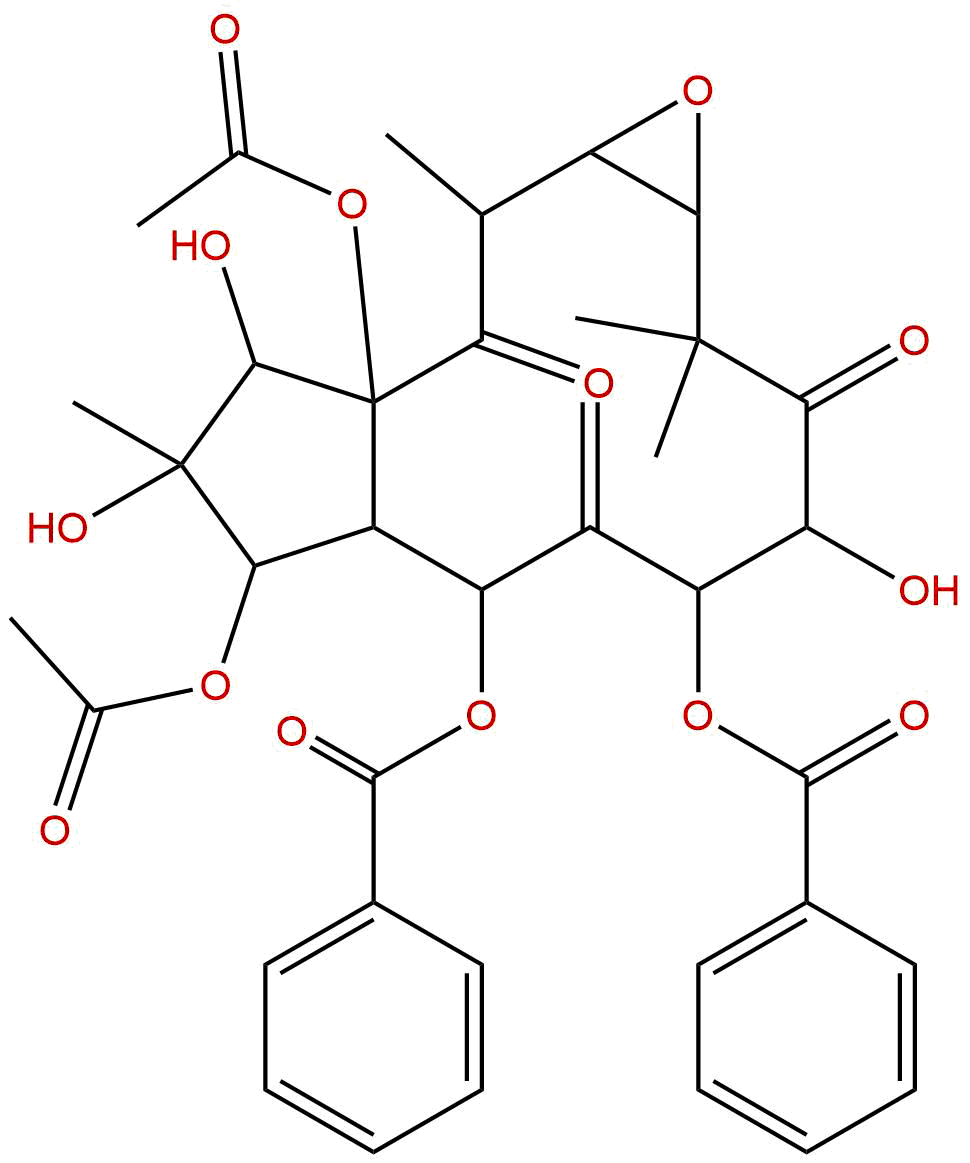


Storage conditions:Short-term storage at 2~8℃, long-term storage at -20 ~ -80℃
212.5600
2.3954
2.3954
.0146
1.1410
1.6062
Low
83.3270
5.8894
No
No
No
No
No
Yes
0.0
Yes
No
Yes
Yes
Natural products, as an important source of drug discovery, play an irreplaceable role in the long history of human fight against diseases. Exploring lead compounds with unique chemical structures and significant biological activities from traditional Chinese medicine is one of the hot topics in modern medicinal chemistry and pharmacology research. Euphorbiaceae plant Gansui(Euphorbia kansui T. N. Liou ex T. P. Wang, as a traditional water repellent medicine, can be traced back to the "Shennong Bencao Jing" for its medicinal history. Modern pharmacological research has shown that the chemical composition of Gansui is complex, mainly containing diterpenes, triterpenes, and tannins, among which the diterpenoid esters of Jatrophane and Lathyrane are particularly noteworthy. These compounds not only endow Gansui with unique biological activity, but also become important objects of natural product chemistry and pharmacology research due to their significant anti-tumor, antiviral, and anti-inflammatory effects.
Kansuinin B (CAS number: 57685-46-8) is a representative giant diterpenoid compound isolated from Kansuinin. Since its first isolation and identification, Gansui terpenoid ester B has attracted widespread attention from scholars at home and abroad due to its unique chemical skeleton and potential pharmacological activity, especially anti-tumor activity. As an organic oxygen compound, it is functionally described as being related to tetracarboxylic acids, suggesting that its molecular structure may contain multiple carboxylic acid functional groups or derivatives, thereby endowing it with unique physicochemical properties and biological activity. This article aims to provide a systematic and in-depth review of the chemical structure, physicochemical properties, plant sources, extraction methods, pharmacological activity, mechanism of action, pharmacological evaluation, and clinical application prospects of Gansui terpenoid ester B, in order to provide reference for further research and development of this natural product.
Gansui terpene ester B belongs to the class of giant diterpenoid esters. The basic skeleton of giant diterpenes is a tricyclic system composed of a fused five membered ring, a seven membered ring, and a three membered ring, with a core structure of a 5/7/3 ring system. The chemical structure of Gansui terpene ester B is highly oxidized on this skeleton and is connected with multiple acyl, ester, and hydroxyl substituents. Specifically, its molecules typically contain multiple ester groups such as acetoxy, benzoyloxy, or nicotinoyloxy, as well as free hydroxyl groups. The types, numbers, and spatial configurations of these substituents collectively determine the chemical properties and biological activity of Gansui terpene ester B. Its chemical structural formula can be accurately identified and resolved through high-resolution mass spectrometry (HR-MS) and nuclear magnetic resonance spectroscopy (NMR, including 1H-NMR, 13C-NMR, COSY, HSQC, HMBC, etc.) techniques.
From the perspective of physical and chemical properties, the molecular weight (MW) of Gansui terpene ester B is 722.7400 Da, which belongs to a medium to large natural product molecule. Its lipophilic water partition coefficient (LogP) is 2.3954, indicating that the compound has a certain degree of lipophilicity, which is consistent with its multi esterification structural characteristics. Higher lipid solubility is beneficial for its penetration of cell membranes and interaction with intracellular targets, but it may also affect its solubility and bioavailability in aqueous environments. Its topological polar surface area (TPSA) is as high as 212.5600 Å ², much higher than the recommended threshold for oral medications (approximately 140 Å ²). A high TPSA value usually means that the molecule has more polar groups (such as hydroxyl, ester, carboxyl, etc.), which is beneficial for enhancing hydrogen bonding interactions with the target protein, but also significantly reduces its transmembrane passive diffusion ability, especially its ability to cross the blood-brain barrier (BBB). In fact, the evaluation of pharmacological parameters shows that the blood-brain barrier penetration ability of Gansui terpenoid ester B is "low", which is consistent with high TPSA values. In addition, the water solubility of the compound is only 0.0146 mg/mL, making it a poorly soluble compound, which may be one of the main reasons for its low oral bioavailability. In terms of early safety assessment, the predicted result of hERG inhibition is' no ', indicating a low risk of causing QT interval prolongation and apical torsion ventricular tachycardia; The Ames test result is 0.0, indicating a low potential risk of mutagenicity. These preliminary pharmacological parameters provide important reference information for subsequent drug development.
The only known plant source of Gansui terpenoid ester B is Gansui(Euphorbia kansui T. N. Liou ex T. P. Wang)。 Gan Sui is a perennial herbaceous plant of the Euphorbiaceae family, mainly distributed in Gansu, Shanxi, Shaanxi, Henan, Hebei and other regions of China. Its dried root is a medicinal part of the traditional Chinese medicine Gan Sui, which has the effects of promoting diuresis, reducing swelling, and dispersing lumps. Modern research has confirmed that the chemical composition of Gansui is diverse, with diterpene esters being its main active ingredient group, and Gansui terpene ester B being one of them.
The extraction and separation of Gansui terpenoid ester B from Gansui usually follow the classic process of natural product chemistry, which mainly includes the following steps:
Raw material pretreatment and extraction Grind the dried Gansui tubers and extract them using organic solvents. Due to the lipophilic characteristics of Gansui terpene ester B, solvents with moderate polarity, such as methanol, ethanol, or ethyl acetate, are often selected. Cold soaking, percolation, or reflux extraction are commonly used methods. In order to improve extraction efficiency and selectivity, solvents of different polarities are sometimes used for staged extraction, such as degreasing with petroleum ether or n-hexane first, and then extracting the target components with ethyl acetate or methanol.
Preliminary separation of crude extract Concentrate the extract to obtain the total extract. The total extract usually has complex components and requires preliminary separation and enrichment. Common methods include liquid-liquid extraction (such as sequential extraction with petroleum ether, ethyl acetate, and n-butanol) and silica gel column chromatography for crude separation. By adjusting the polarity gradient of the eluent (such as petroleum ether ethyl acetate, chloroform methanol, etc.), Gansui terpene ester B can be enriched in specific fractions.
Purification and refinement For the fraction rich in Gansui terpene ester B, further purification using more refined chromatographic techniques is required. Common methods include:
Throughout the entire extraction and separation process, the structural identification of compounds typically relies on spectroscopic methods. By comparing with the spectral data reported in literature, especially NMR and MS data, it can be finally confirmed that the isolated compound is Gansui terpene ester B. Due to the similar structure, low content, and instability (easy hydrolysis or oxidation) of diterpene esters in Gansui, strict control conditions are required during the extraction and separation process, such as avoiding light, low temperature, and strong acid and alkali environments.
The pharmacological activity research of Gansui terpenoid ester B mainly focuses on the field of anti-tumor, while also involving other biological activities.
Numerous in vitro and in vivo studies have shown that Gansui terpenoid ester B exhibits significant proliferation inhibition and cytotoxicity against various types of tumor cell lines.
In addition to anti-tumor activity, Gansui terpenoid ester B has also been reported to have other pharmacological effects, but its research depth is far less than anti-tumor activity.
* anti-inflammatory activity Some studies suggest that Gansui terpenoid ester B may have certain anti-inflammatory effects, but its specific mechanism is still unclear.
* Antiviral activity Preliminary reports have shown that certain diterpenoid esters of Gansui have anti HIV or anti influenza virus activity, but the research evidence for Gansui terpenoid ester B in this area is not sufficient.
The anti-tumor mechanism of Gansui terpenoid ester B is complex, involving multiple signaling pathways and molecular targets. Based on existing research, its core mechanism can be summarized as follows:
This is one of the core mechanisms of the anti-tumor effect of Gansui terpenoid ester B. It regulates the expression balance of Bcl-2 family proteins directly or indirectly.
* Targeting MCL1 and BCL2 MCL1 and BCL2 are two important anti apoptotic proteins in the Bcl-2 family, highly expressed in various tumors and closely related to tumor occurrence, development, and drug resistance. Research has shown that Gansui terpenoid ester B can significantly downregulate the protein levels of MCL1 and BCL2. This downregulation may be achieved through transcriptional inhibition or accelerated protein degradation. The downregulation of MCL1 and BCL2 allows pro apoptotic proteins such as Bax and Bak to be released from the complex, thereby initiating mitochondrial outer membrane permeabilization (MOMP), leading to cytochrome c release and Caspase cascade activation. Therefore, MCL1 and BCL2 are key targets for the anti-tumor activity of Gansui terpenoid ester B.
Signal transducer and activator of transcription factor 3 (STAT3) is a key transcription factor that is continuously activated in various tumors, promoting cell proliferation, survival, angiogenesis, and immune escape.
* Targeting STAT3 Gansui terpenoid ester B was found to inhibit the phosphorylation of STAT3 (Tyr705 site), thereby blocking its activation. Activated STAT3 forms a dimer and translocates to the nucleus, activating downstream target genes (such as...) MCL1、BCL2、CCND1、VEGF、MMP2 The transcription of (etc.). Therefore, inhibiting the STAT3 signaling pathway can simultaneously downregulate the expression of multiple genes associated with tumor malignancy phenotype, resulting in a "multi-target" effect. The inhibitory effect of Gansui terpenoid ester B on STAT3 is an important upstream mechanism for its anti proliferative, pro apoptotic, anti metastatic, and anti angiogenic activities.
DNA topoisomerase is a key enzyme in DNA replication, transcription, and repair processes, and is also an important target for various clinical anti-tumor drugs such as camptothecin and anthracycline.
* Targeting TOP1 and TOP2A Research has shown that Gansui terpenoid ester B can inhibit the activity of topoisomerase I (TOP1) and topoisomerase II α (TOP2A). By stabilizing the enzyme DNA cleavable complex, the reconnection of DNA strands is prevented, leading to the accumulation of DNA damage and ultimately causing cell cycle arrest and apoptosis. This mechanism of action is similar to classical topoisomerase inhibitors, providing another important explanation for the anti-tumor activity of Gansui terpene ester B.
In summary, Gansui terpenoid ester B forms a complex anti-tumor molecular network by directly regulating apoptotic proteins (MCL1, BCL2), inhibiting key transcription factors (STAT3), interfering with DNA replication (TOP1, TOP2A), and inhibiting tumor microenvironment adaptation (HIF-1 α, MMP-2) at multiple levels. This multi-target mode of action is the potential advantage of its strong anti-tumor activity and low susceptibility to drug resistance.
The evaluation of drug properties and pharmacokinetic studies are crucial steps in advancing natural products from laboratory research to clinical applications. Based on existing data and computational predictions, a preliminary evaluation of the pharmacological properties of Gansui terpenoid ester B.
At present, there are very limited experimental studies on the in vivo pharmacokinetics (ADME) of Gansui terpenoid ester B. Based on its physicochemical properties, its pharmacokinetic behavior can be reasonably inferred:
* Absorption Oral absorption may be poor, mainly due to its low water solubility and high TPSA. Its absorption may depend on intestinal transporters or be absorbed through the lymphatic system. Injection administration (such as intravenous or intraperitoneal injection) may be a more effective route of administration.
* Distribution Due to its lipophilicity, it may be widely distributed in tissues after intravenous administration, especially in organs with abundant blood flow. But high TPSA makes it difficult for it to pass through the blood-brain barrier, resulting in low exposure to the central nervous system.
* Metabolism As a multi ester compound, Gansui terpene ester B is easily hydrolyzed by esterases in the body, producing corresponding acid and alcohol metabolites. These metabolites may have different biological activities or toxicity. In addition, the hydroxyl groups in its molecules may also undergo II phase metabolic reactions such as glucuronidation or sulfation. The liver and plasma are the main metabolic sites.
* Excretion Metabolites may be mainly excreted through bile and urine. The renal excretion of the prototype drug may be lower due to its high molecular weight and lipophilicity.
Pharmaceutical strategy Given the challenges posed by the pharmacological properties of Gansui terpenoid ester B, future drug development may need to consider the following strategies:
1. Structural modification Improve its physicochemical properties and metabolic stability through prodrug design (such as introducing phosphate groups, amino acid esters, etc. to enhance water solubility) or skeleton modification (such as simplifying structure, removing unnecessary polar groups).
2. Development of new dosage forms Using nanotechnology (such as liposomes, polymer nanoparticles, micelles, etc.) to encapsulate Gansui terpenoid ester B, in order to improve its water solubility, bioavailability, and achieve targeted delivery.
3. Non oral administration route Explore routes such as transdermal administration, pulmonary inhalation, or local injection to avoid oral absorption barriers and directly target the lesion site (such as skin cancer, lung cancer, local tumors).
Gansui terpenoid ester B, as a natural anti-tumor lead compound with unique structure and novel mechanism of action, has shown promising clinical application prospects, but also faces many challenges.
Gansui terpene ester B, as a giant diterpenoid compound derived from traditional Chinese medicine Gansui, occupies a place in the field of natural product pharmacology due to its unique chemical structure and multi-target anti-tumor mechanism. It exhibits broad-spectrum and efficient anti-tumor activity by regulating a series of key proteins and signaling pathways closely related to tumor occurrence, development, metastasis, and drug resistance, such as MCL1, BCL2, STAT3, TOP1/2A, HIF-1 α, MMP-2, etc. However, as a candidate drug, it also faces typical pharmaceutical challenges such as poor water solubility, metabolic instability, and low oral bioavailability.
Looking ahead to the future, the research on Gansui terpenoid ester B is in a critical period of transition from "discovery" to "development". By utilizing interdisciplinary research methods such as modern medicinal chemistry, pharmacy, pharmacology, and toxicology, especially combining advanced drug delivery technologies and in-depth structure-activity relationship studies, it is expected to overcome the barriers to drug development and translate its potential into clinical value. The continuous in-depth study of Gansui terpenoid ester B not only helps to reveal the pharmacological substance basis of traditional Chinese medicine Gansui, but also provides valuable lead molecules for the development of new anti-tumor drugs with independent intellectual property rights. Despite the numerous challenges ahead, its unique chemical space and biological activity make it a "treasure trove" worth exploring in depth, and its application in precision tumor treatment in the future is worth looking forward to.
Batch can search by a CAS number,one per line
