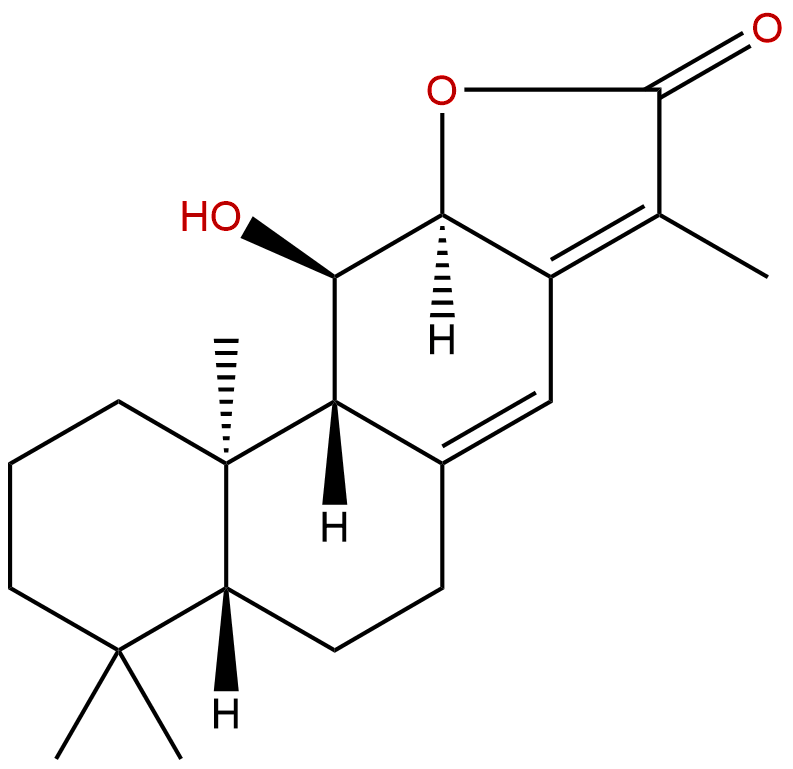


Product name: ent-11α-Hydroxyabieta-8(14),13(15)-dien-16,12α-olide
Synonym name:
Catalogue No.: SBP04132
Cas No.: 130466-20-5
Formula: C20H28O3
Mol Weight: 316.441
Botanical Source:
Physical Description:
Type of Compound: Diterpenoids
Purity: 95%~99%
Analysis Method: HPLC-DAD or/and HPLC-ELSD
Identification Method: Mass, NMR
Packing: Brown vial or HDPE plastic bottle
The product could be supplied from milligrams to grams. Inquire for bulk scale.
We provide solution to improve the water-solubility of compounds, thereby facilitating the variety of activity tests and clinic uses.
For Reference Standard and R&D, Not for Human Use Directly.
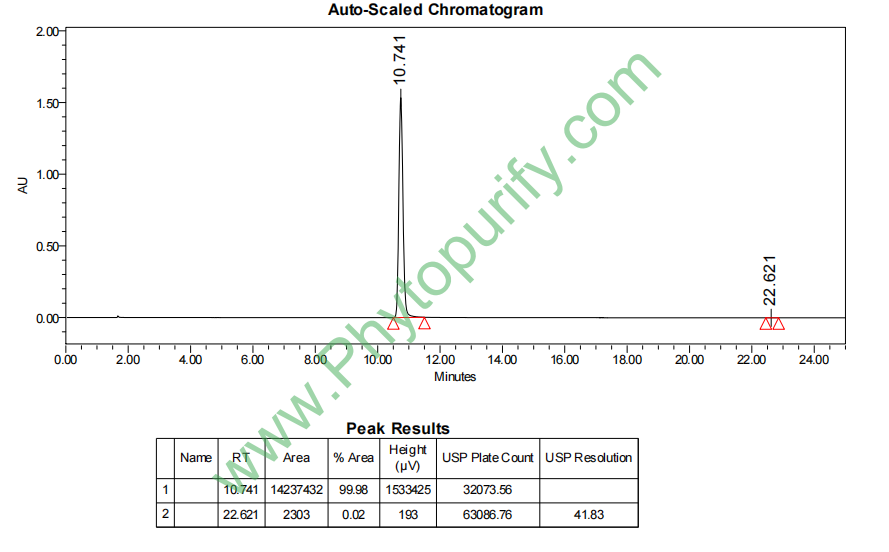
HPLC of ent-11α-Hydroxyabieta-8(14),13(15)-dien-16,12α-olide
Storage conditions:Short-term storage at 2~8℃, long-term storage at -20 ~ -80℃
46.5300
4.1875
4.1872
.0327
3.7840
15.0440
High
80.9745
4.6291
No
No
No
No
No
No
0.0
No
No
No
No
Natural products have long been an important treasure trove for innovative drug discovery, with their structural diversity and extensive biological activity providing unique molecular frameworks for treating various diseases. As an important class of secondary metabolites in natural products, diterpenes have attracted much attention due to their complex chemical structures and significant pharmacological activities. Among them, rosin type diterpenes and their lactone derivatives have shown great potential in anti-inflammatory, anti-tumor, antibacterial and other fields.
This article focuses on a rosin alkyl diterpenoid lactone with a unique chemical structure and significant anti-inflammatory activity——ENT-11 α - Hydroxyabietin-8 (14), 13 (15) - dien-16,12 α - lactone(ent-11α-Hydroxyabieta-8(14),13(15)-dien-16,12α-olide, hereinafter referred to as Compound 11 α - OH). Since its discovery, this compound has become a hot topic in pharmacological research due to its potent activity in various inflammatory models. Its CAS number is 130466-20-5. Existing research has preliminarily revealed that it exerts anti-inflammatory effects through multiple pathways and targets by acting on multiple key inflammatory targets and signaling pathways, providing highly attractive lead compounds for the development of new anti-inflammatory drugs. This review aims to systematically summarize the chemical properties, plant sources, pharmacological activities, mechanisms of action, and medicinal properties of this compound, and to provide prospects for its clinical application.
Compound 11 α - OH The molecular formula is C20H28O3 and the molecular weight is 316.4410. Its structure belongs to the ent abietane type diterpenes, which is an important stereochemical configuration series in natural products. The core structural features are as follows:
1. Basic skeleton It is a classic tricyclic diterpenoid rosin skeleton, but the C-4 position is an alpha methyl (i.e. enantiomeric configuration), which is opposite to the common rosin acid and other configurations.
2. Unsaturated sites There are two double bonds at positions C-8 (14) and C-13 (15), forming a conjugated diene system, which may have important effects on its electron distribution and biological activity.
3. oxygen-containing functional group The C-11 position is connected to an alpha configured hydroxyl group (11 α - OH), which is an important polar group and potential active site.
4. Lactone ring The carboxyl group at C-16 and the α - hydroxyl group at C-12 form a five membered γ - lactone ring (16,12 α - lactone). The presence of lactone rings is a key structural feature, typically associated with enhanced biological activity and specific molecular interactions.
Physicochemical properties In terms of calculation and experimental data, the following characteristics have been revealed:
* fat-soluble The calculated LogP value is 4.1875, indicating that the compound has high lipophilicity, which is beneficial for its penetration into cell membranes, but may also affect its water solubility and formulation development.
* Polar Surface Area The topologically polar surface area (TPSA) is 46.53 Å ², which is relatively small, further confirming its lipophilic characteristics.
* Water solubility The predicted water solubility value is relatively low (about 0.0327 mg/mL), indicating that it is a poorly soluble compound. This suggests that solubilization strategies such as cyclodextrin inclusion, nanocrystals, liposomes, etc. may be needed in future formulation research.
* Blood-brain barrier penetrability Prediction shows that it has high blood-brain barrier (BBB) penetration potential. This characteristic gives it a unique advantage in treating central nervous system related inflammatory diseases such as neuropathic pain, cerebral ischemia, and neurodegenerative diseases, but it may also pose potential risks of central side effects that need to be carefully evaluated during development.
* Early safety warning According to the prediction, this compound has no significant risk of hERG potassium channel inhibition (hERG inhibition: No), indicating a low risk of cardiac toxicity. Meanwhile, the Ames test predicted a value of 0.0, indicating that it may not have direct genetic toxicity, providing preliminary positive signals for its safety evaluation.
Compound 11 α - OH Mainly from the Lamiaceae family, Salvia genus(Salvia)Separated from plants. Salvia plants are rich in structurally diverse diterpenes of the rosin alkane type, which are important resources for discovering such active ingredients. For example, it is found in traditional medicinal plants such as Salvia przewalskii、Orange Sage (Salvia aerea) Found in the roots or entire grass of the species.
Extraction and Separation Usually following the classic process of natural product chemistry:
1. Extract Dry and crushed plant materials are first subjected to cold soaking or heated reflux extraction with medium polarity organic solvents (such as methanol, ethanol, or acetone) to fully extract secondary metabolites including target diterpenes.
2. Rough classification The extract obtained by concentrating the extract is often subjected to preliminary separation using liquid-liquid extraction method. For example, suspend the extract in water and extract it sequentially with petroleum ether and ethyl acetate.Compound 11 α - OH Due to its equal polarity, it is usually enriched in the ethyl acetate extraction site.
3. purification The ethyl acetate fraction is further separated and purified through a series of chromatographic techniques. Normal phase silica gel column chromatography is commonly used, with different ratios of petroleum ether ethyl acetate or petroleum ether acetone gradient elution. Subsequently, high-purity monomer compounds were obtained by final purification using reverse phase high performance liquid chromatography (RP-HPLC, commonly C18 column, with methanol water or acetonitrile water as mobile phase). Structural identification involves the comprehensive use of spectroscopic methods such as nuclear magnetic resonance (NMR, including 1H, 13C, 2D-NMR such as HSQC, HMBC, COSY), mass spectrometry (MS), infrared spectroscopy (IR), and specific rotation, especially 2D-NMR, which is crucial for determining its complex relative and absolute configurations (enantiomer rosin).
Numerous in vitro and in vivo pharmacological studies have confirmed that,Compound 11 α - OH The core pharmacological activity is anti-inflammatory And demonstrate therapeutic potential in relevant disease models.
Compound 11 α - OH The anti-inflammatory effect is not achieved through a single target, but rather presented Multi target, multi pathway The characteristics mainly involve the regulation of key inflammatory signal transduction nodes:
In conclusion,Compound 11 α - OH A synergistic anti-inflammatory and analgesic network is formed by simultaneously acting on transcription levels (NF - κ B, STAT3), protease complex levels (NLRP3 inflammasome), and membrane receptor/ion channel levels (TRPV1/TRPA1).
Based on computational predictions and preliminary experimental data Compound 11 α - OH Preliminary evaluation of the medicinal properties:
Advantage:
Challenges and research questions:
Compound 11 α - OH As a natural lead compound with unique value, its clinical application development can focus on the following directions:
Future research focus Should include:
* In depth pharmacokinetic and toxicological research This is the cornerstone for promoting its transformation into preclinical research.
* Research on Structural Optimization and Structure Activity Relationship (SAR)Using it as the parent nucleus, semi synthetic modifications (such as modifying the lactone ring, introducing polar groups to improve water solubility, modifying C-11 hydroxyl groups, etc.) aim to enhance activity, selectivity, and drug properties, and discover better candidate drugs.
* Deepening the mechanism of action Using chemical biology methods such as affinity fishing and molecular probes to identify their direct targets and create more accurate interaction network diagrams.
* Development of a new delivery system To address the issue of poor water solubility, advanced delivery technologies such as nanocrystals, liposomes, and polymer micelles are being studied to improve oral absorption or achieve targeted delivery.
ENT-11 α - Hydroxyabietin-8 (14), 13 (15) - dien-16,12 α - lactone is a novel structure, significant anti-inflammatory activity, and multi-target mechanism of action of rosin type diterpenoid lactone. It exhibits good therapeutic potential in various inflammation and pain models by synergistically inhibiting NF - κ B, STAT3, NLRP3 inflammasomes, and regulating TRPV1/A1 ion channels. Despite facing challenges in solubility and systemic pharmacokinetics, its excellent early safety warning and unique blood-brain barrier penetration ability endow it with broad development prospects. In the future, through interdisciplinary in-depth research, including drug chemical modification, formulation innovation, and in-depth preclinical evaluation, this compound is expected to be developed into a novel drug for the treatment of neuropathic pain, chronic arthritis, and central nervous system inflammatory diseases, adding an important member to the discovery of innovative drugs derived from natural products.
